meccanoman
Thinker

- Joined
- Feb 19, 2017
- Messages
- 232
I don't understand well the objection. Please, can you expand the explanation?
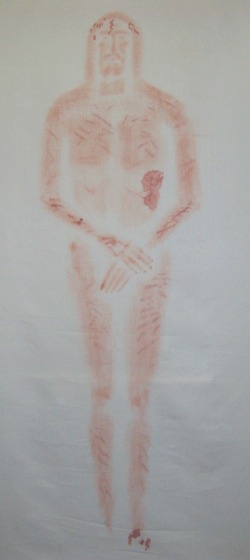
There's a crucial difference between my imprinting technology and that of Garlaschelli's frottage. Mine is non-judgemental, non-artistic, requiring no mental decisions as to what to imprint once the linen has been draped over the flour-coated subject. However, there's just one caveat - the linen must not be allowed to make contact with the vertical sides of the subject. One simply presses down VERTICALLY with the palms of one's hands onto the highest, flattest relief. It's a pressing action, note, without any rotation of palms, as seems to be the case(?) in frottage. That way one gets a final imprint onto linen that is simply a mirror image of the distribution of flour that settled, snow-like, onto the higher flatter relief. The vertical pressing prevents 'harvesting' of flour that may have settled onto inaccessible lower relief, excluding, that is, very shallow surface hollows, where pressure cannot be readily applied, nor of any small amounts of flour that may have settled onto the sloping or vertical sides (the latter being 'out of bounds' to one's pressed-down palms.
Now you are the one who has inserted frottage into this thread, DavidMo, which I have to say I consider somewhat unhelpful and largely irrelevant to the Shroud for the reason stated - it's a procedure that DOES involve constant mental and dare one say artistic judgement as to where to apply powder ON TOP of the linen. It is a procedure that requires making second-by-second arbitrary judgements as to how far to proceed from the flat relief in the direction of lower vertical relief.
I suspect there's a temptation to go too far towards the vertical sides in the mistaken belief that if one does not, the imprint will be too narrow. But that overlooks a subtle factor. What I've referred to as higher flatter relief, e.g. the chest, the limbs etc are of course slightly convex surfaces. There will indeed be some so-called "lateral distortion", if that term is taken to mean the image on the opened-out imprint is slightly wider than that of the perceived cross-sectional width of subject (from external viewpoint). But far from being a drawback, it can in actual fact be an ADVANTAGE. Lateral WIDENING as I prefer to call it can compensate at least partially for a LIMITED AREA imprint looking too narrow, compared say with the real subject, or a photograph or painting of the same.
Note I've avoided too much detail as regards the precise manner the hands are deployed in frottage, not having used the technique myself and having no intention of doing so. What I'm saying is: compare my imprints with those of Luigi's you displayed, and note the obvious difference. His makes contact with, and imprints, not just the higher planar relief but the sloping transition zone round towards vertical sides too. Mine doesn't. But I'm here to promote a new model, which does not require a simultaneous critique of all previous models. (In fact I've discarded 9 previous ones of my own without referring to them at all, so feel no obligation to refer to others' models either.)
I'm only obliged, scientifically speaking, David to flag up the perceived advantages of my latest model at this stage. So if it's all the same to you, I'll leave you to make any further comments you wish regarding Garlaschelli's frottage and take my leave from that topic. The same applies to the earlier references on this thread to McCrone's notions re the body image being particulate.
Last edited: