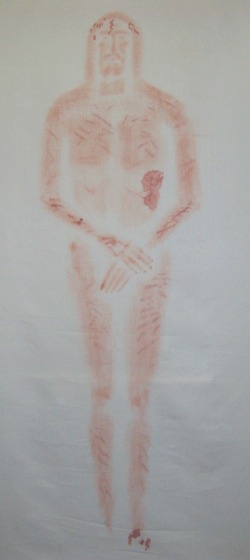
The Turin Shroud: The Image of Edessa created in c. 300-400 AD?

I don't understand well the objection. Please, can you expand the explanation?

There's a crucial difference between my imprinting technology and that of Garlaschelli's frottage. Mine is non-judgemental, non-artistic, requiring no mental decisions as to what to imprint once the linen has been draped over the flour-coated subject. However, there's just one caveat - the linen must not be allowed to make contact with the vertical sides of the subject. One simply presses down VERTICALLY with the palms of one's hands onto the highest, flattest relief. It's a pressing action, note, without any rotation of palms, as seems to be the case(?) in frottage. That way one gets a final imprint onto linen that is simply a mirror image of the distribution of flour that settled, snow-like, onto the higher flatter relief. The vertical pressing prevents 'harvesting' of flour that may have settled onto inaccessible lower relief, excluding, that is, very shallow surface hollows, where pressure cannot be readily applied, nor of any small amounts of flour that may have settled onto the sloping or vertical sides (the latter being 'out of bounds' to one's pressed-down palms.

Now you are the one who has inserted frottage into this thread, DavidMo, which I have to say I consider somewhat unhelpful and largely irrelevant to the Shroud for the reason stated - it's a procedure that DOES involve constant mental and dare one say artistic judgement as to where to apply powder ON TOP of the linen. It is a procedure that requires making second-by-second arbitrary judgements as to how far to proceed from the flat relief in the direction of lower vertical relief.

I suspect there's a temptation to go too far towards the vertical sides in the mistaken belief that if one does not, the imprint will be too narrow. But that overlooks a subtle factor. What I've referred to as higher flatter relief, e.g. the chest, the limbs etc are of course slightly convex surfaces. There will indeed be some so-called "lateral distortion", if that term is taken to mean the image on the opened-out imprint is slightly wider than that of the perceived cross-sectional width of subject (from external viewpoint). But far from being a drawback, it can in actual fact be an ADVANTAGE. Lateral WIDENING as I prefer to call it can compensate at least partially for a LIMITED AREA imprint looking too narrow, compared say with the real subject, or a photograph or painting of the same.

Note I've avoided too much detail as regards the precise manner the hands are deployed in frottage, not having used the technique myself and having no intention of doing so. What I'm saying is: compare my imprints with those of Luigi's you displayed, and note the obvious difference. His makes contact with, and imprints, not just the higher planar relief but the sloping transition zone round towards vertical sides too. Mine doesn't. But I'm here to promote a new model, which does not require a simultaneous critique of all previous models. (In fact I've discarded 9 previous ones of my own without referring to them at all, so feel no obligation to refer to others' models either.)

I'm only obliged, scientifically speaking, David to flag up the perceived advantages of my latest model at this stage. So if it's all the same to you, I'll leave you to make any further comments you wish regarding Garlaschelli's frottage and take my leave from that topic. The same applies to the earlier references on this thread to McCrone's notions re the body image being particulate.
 
Last edited:
@meccanoman The problem with your experiment is that you used a subject which is far more angular than a human, and there is a problem of scale. Try again your experiment at a proper scale, and you will quickly find out that on the thorax and head, it is nigh impossible to avoid the start of the side of the subject (especially the jaws). The last time I did the same experiment, even letting slowly down the linen on the face, the jaw were enormously wide compared to the shroud. You simply can#t get something like the shroud with a simple impression of a linien posed on the face.
 
@meccanoman The problem with your experiment is that you used a subject which is far more angular than a human, and there is a problem of scale. Try again your experiment at a proper scale, and you will quickly find out that on the thorax and head, it is nigh impossible to avoid the start of the side of the subject (especially the jaws). The last time I did the same experiment, even letting slowly down the linen on the face, the jaw were enormously wide compared to the shroud. You simply can#t get something like the shroud with a simple impression of a linien posed on the face.

Firstly, I'm puzzled by your comment regarding scale, Aepervius. I've been working my way up the size scale, the latest 'Power Ranger MegaForce' being approximately half the height and width of a smallish adult, and have never seen anything radically different as regards ease or fidelity of imprinting. They all behave essentially the same. But you're right - a real person should be tested at some stage, though it probably won't be under my roof. Maybe Prof. Luigi Garlaschelli could recruit some more student volunteers to check out my model alongside his! I'd be willing to offer a small reward to the participants as a group, both modellers and modelled, e.g. a crate of Prosecco!

Your observation re angularity is puzzling. Angularity as stated earlier is the enemy of contact imprinting. But there are only two regions of the RECUMBENT human body that could be described as highly angular - the head (nose and chin especially) and the feet. But I've already conceded, as did Garlaschelli, that a shallow bas relief would need to substitute for a real face, BUT still using the rest of the real person as template for contact imprinting. So let's be hearing no more please about face and jaws.

That leaves the feet, but they have not been overlooked here (see earlier mention of imprinting the soles, not tops of feet - it being a simple matter to imprint soles from a separate face-down volunteer, draping linen around his heels to imprint off the underside of his feet).

But you also say it's impossible to avoid imprinting off the side of the thorax as well. NO! Not in my model, where one has virtually complete control over what gets imprinted and what does not. How? There's possible control at the first stage - swabbing the subject with vegetable oil to act as weak adhesive for the white flour. If you don't want a particular area to be imprinted, then don't swab with oil (or having swapped, wipe off the oil from all the places you want to be image- free, bearing in mind that I knock surplus flour off the subject before imprinting, with scarcely any flour attaching to oil-free surfaces). Another more specialized tactic is to mask areas (linen offcuts?) before performing the next step - i.e. sprinkling with flour from a height through a fine sieve. (I mention it here because I suspect the modelled site for the blood from the Roman soldier's lance into the side of the chest was masked off first to create a 'blank canvas' image-free zone that was then incompletely painted to simulate a mixture of blood and water, the latter Gospel-detail suggested, albeit with exercise of a little imagination, from whitish areas lacking both blood and body image!).

Finally one can simply confine one's manual pressing to the parts one wants imprinted. Don't go near the sides! One can make life easier for oneself by taking a simple precaution: drape the wet linen over the subject, such that the surplus material at the sides slopes down gently towards and finally onto the floor or bench such that it simply CANNOT make contact with the sides!).

Where there's a will there's a way...
 
Last edited:
Incidentally, there's an interesting point that arises from using a bas relief for the face AFTER imprinting just the torso and limbs from a real person, without the face initially, so as to leave a temporary blank area 'up top'. How does one then deploy to best advantage one's bas relief for completing the entire image, face an'all?

So far I've argued that imprinting of the body was performed by draping wet linen OVER the 2 flour-coated subjects aligned head to head, one face-up, the other face-down.

That way, one can not only see what one's doing but use manual pressure directly on the linen to achieve optimal contact with the body contours.

But there's a problem if adding the head later. One can hardly lay the coated bas relief on the floor and drape with the imprinted linen with imprinted side down. One would need X ray eyes to know whether one had the bas relief in EXACTLY the correct position so as to make the head seem continuous with the body.

So what does one do? The answer is simple, but fraught with hazard. One turns the imprinted linen over so as to put the headless body image on the side facing up, where it can be seen. One then coats the bas relief with flour/oil, as if human skin, and uses it like a cattle brand or rubber stamp, ie pushed vertically downwards, applying it carefully to precisely the correct location to ensure a natural-looking continuity with the torso. (Yes, one would need a soft underlay to get optimal imprinting in this new configuration).

But there's a problem. While one can see the body image, one cannot then see the imprint left by the bas relief until the latter has been lifted away! What's happening, out of sight, at the contact zone between bas relief and linen? The alignment might be correct, but about the buckling effect of pressing a bas relief into linen over a yielding underlay?

Might not that "press-down" configuration at the 2nd stage have left a tell-tale signature, an UNWELCOME ONE?

Yes, I believe it did. Can anyone here guess what it is? Take another look at the image of the Man on the Shroud. Are there one or more imperfections in the imaging of the face that might suggest there was press-down imprinting, at least of the head and face. Correction, a less angular substitute - more medieval modeller-friendly to contact-imprinting or so they probably imagined until the final imprinting step...

Happy hunting.
 
Last edited:
There's a crucial difference between my imprinting technology and that of Garlaschelli's frottage. Mine is non-judgemental, non-artistic, requiring no mental decisions as to what to imprint once the linen has been draped over the flour-coated subject.(...)

Now you are the one who has inserted frottage into this thread, DavidMo, which I have to say I consider somewhat unhelpful and largely irrelevant to the Shroud for the reason stated - it's a procedure that DOES involve constant mental and dare one say artistic judgement as to where to apply powder ON TOP of the linen. It is a procedure that requires making second-by-second arbitrary judgements as to how far to proceed from the flat relief in the direction of lower vertical relief.
(...)
Note I've avoided too much detail as regards the precise manner the hands are deployed in frottage, not having used the technique myself and having no intention of doing so. What I'm saying is: compare my imprints with those of Luigi's you displayed, and note the obvious difference. His makes contact with, and imprints, not just the higher planar relief but the sloping transition zone round towards vertical sides too. Mine doesn't. (...)
I continue a little confused with your arguments.

Effectively, Garlaschelli’s method needs a person with some skill (an artist or a craftsman). But this is just a difference with your method not an arbitrary handicap -why "arbitrary"-? The arbitrariness is even an advantage in this occasion because the shroud image has some arbitrary features -this is to say, the appearance of the body is not natural-. I have spoken of this in a previous comment.
Garlaschelli avoids the lateral deformations (“slopes”) by working only the frontal-protruding surfaces on the body, and extending the pigment after till the natural proportions of a human body. “L’immagine è stata poi rifinita a mano libera dopo avere steso il telo su una superficie piana. Abbiamo infatti constatato che non è possibile applicare il colore col tampone in modo uniforme quando sotto il telo si trova ancora il corpo”. This way he avoids the imprinting of the "slopes that worries you. The final outcome is this: http://sindone.weebly.com/uploads/1/2/2/0/1220953/2940640.jpg . I think that the reproduction is similar to the original, in the photography at least.

I see a problem with your replica. You are using small objects that are different to this represented in the Shroud. The fabric is not falling in the same way than in a human body. This would be a minor objection, but elegance remains . Elegance is basically the simplicity of suppositions that makes more acceptable one hypothesis in equality of predictive power with others. I think that Garlaschelli’s hypothesis is more elegant because is founded on technics that were well known in the Middle Ages and doesn’t need a forced invention of strange materials (flour?).
 
Last edited:
I continue a little confused with your arguments.

Effectively, Garlaschelli’s method needs a person with some skill (an artist or a craftsman). But this is just a difference with your method not an arbitrary handicap -why "arbitrary"-? The arbitrariness is even an advantage in this occasion because the shroud image has some arbitrary features -this is to say, the appearance of the body is not natural-. I have spoken of this in a previous comment.
Garlaschelli avoids the lateral deformations (“slopes”) by working only the frontal-protruding surfaces on the body, and extending the pigment after till the natural proportions of a human body. “L’immagine è stata poi rifinita a mano libera dopo avere steso il telo su una superficie piana. Abbiamo infatti constatato che non è possibile applicare il colore col tampone in modo uniforme quando sotto il telo si trova ancora il corpo”. This way he avoids the imprinting of the "slopes that worries you. The final outcome is this: http://sindone.weebly.com/uploads/1/2/2/0/1220953/2940640.jpg . I think that the reproduction is similar to the original, in the photography at least.

I see a problem with your replica. You are using small objects that are different to this represented in the Shroud. The fabric is not falling in the same way than in a human body. This would be a minor objection, but elegance remains . Elegance is basically the simplicity of suppositions that makes more acceptable one hypothesis in equality of predictive power with others. I think that Garlaschelli’s hypothesis is more elegant because is founded on technics that were well known in the Middle Ages and doesn’t need a forced invention of strange materials (flour?).

Sorry, DavidMo. I really don'r see where you are going with this. Given the initial impact of the Shroud on a first- time viewer is to be seen as a whole body imprint, then what is so difficult about it being produced by simple imprinting? My methodology requires brief contact between subject and linen under applied pressure (which could be body weight alone in a pro-authenticity context, or a quick manual application of pressure in a 14th century context). The imprinting medium is specified, readily available in medieval times, indeed in every single household, and the chemistry of its action is readily appeciated (Maillard browning reactions) even if the later stages of melanoidin production is not. Contrast that with Garlaschelli's where he has to impute the presence of acid impurities in his mineral oxide powders, which then assumes a chemical pathway to colour formation (acid dehydration et etc) which I personally have been unable to model and frankly consider to be a non-starter.

But there's a more fundamental difficulty I have with your line of questioning, DavidMo. Why are you and others attempting to discredit my NOVEL model that is still struggling for exposure by arguing for someone else's that has already been in the literature for some years and been the subject of severe critiques. You must surely be aware of the hatchet job that Thibault Heimburger MD did on Garlaschelli's model. He did the same to my Model 2 (direct contact scorching off a heated metal bas relief) back in 2012, but approx a year ago and less stated that my flour-imprinting model was in his opinion the best non-authenticity one that he had seen so far, superior to Garlaschelli's
 
Because this is what occurs when the cloth is extended:

[qimg]http://sindone.weebly.com/uploads/1/2/2/0/1220953/1152617.jpg?216[/qimg]

[qimg]http://sindone.weebly.com/uploads/1/2/2/0/1220953/6917977.jpg[/qimg]

[qimg]http://sindone.weebly.com/uploads/1/2/2/0/1220953/8859260.jpg[/qimg]

…amongst other things that are incompatible with the image of the shroud.
I would accept a contact-hypothesis as a basis of a subsequent manual handling -frotis, for example-. Not as a natural transfer.

DavidMo. I have been back to Garlaschelli's 2010 paper entitled "Life-size Reproduction of the Shroud of Turin and its Image".

Yes, it contains the two imprints you have selected above. But your choice was unfortunate. Those pictures are NOT ones obtained by any procedure involving frottage or indeed any deployment of solid powder (least of all mine!). They were from a preliminary experiment which Garlaschelli did using a "red viscous liquid (red ochre suspended in bath foam gel)". As such they are not only IRRELEVANT but totally MISLEADING if readers here assume they are typical of the results obtained by powder imprinting, whether by Garlaschelli or my own distinctly different modus operandi.

Reminder: my technique of imprinting with powder (white flour) involves sprinkling it snow-like from above through a fine sieve so that it settles preferentially onto the subject's oil-smeared horizontal or sloping planes only, but NOT the vertical zones at the sides of the limbs, torso etc. It may not qualify as an "elegant" procedure in your aesthetic sense, David, but it does give a remarkably close match between the model imprint viewed alongside that of the Shroud, with a convincing yellow-brown colour after the oven heating step, and a convincingly faint ghost-like aura after washing - which is good enough thus far for this box-ticking investigator...

I was always taught to seek out the merits in any new scientific hypothesis ("model") before making invidious comparisons with existing ones.

PS: my 'sprinkle vertically from on high' flouring of the subject guarantees a fuzzy edge to the image, the lack of which was a sticking point with Thibault Heimburger in some of my earlier models. One now has a more realistic alternative to those radiation models that require one to entertain notions of air-attenuated radiation being emitted from a dead body, AND in a collimated beam that is highly directed, able to generate images without need for optical lenses, mirrors etc. I prefer my image-making "snow" coming in to their mystery incandescence streaming out in an oh-so-orderly a manner!
 
Last edited:
One occasionally hears expressed the sentiment that some explanation or other is "too elegant not to be true."

That's the moment to recall Thomas Huxley:

"The great tragedy of science - the slaying of a beautiful hypothesis by an ugly fact".

Conversely, there are other explanations perceived by some aesthetes to be too inelegant to be true. Annoyingly for them, they can hang around in the literature for far too long, sustained and empowered by an ever-growing body of those ugly facts.
 
Last edited:
Oh dear. This thread appears to be fizzling out (prematurely?). Anyone care to provide an analysis of where things started to go wrong?

Is hands-on scientific modelling maybe not a suitable topic for this site? Or is it the particular model I've proposed for explaining the 'enigmatic' properties of the Shroud that is at fault? Scientifically - or through lacking that certain je ne sais pas quoi, like "elegance"?

Should I maybe have dispensed with the white flour, and used something more exotic - like Luigi Garlaschelli's acidulated cobalt aluminate?
 
Last edited:
There's a crucial difference between my imprinting technology and that of Garlaschelli's frottage. Mine is non-judgemental, non-artistic, requiring no mental decisions as to what to imprint once the linen has been draped over the flour-coated subject. However, there's just one caveat - the linen must not be allowed to make contact with the vertical sides of the subject. One simply presses down VERTICALLY with the palms of one's hands onto the highest, flattest relief. It's a pressing action, note, without any rotation of palms, as seems to be the case(?) in frottage. That way one gets a final imprint onto linen that is simply a mirror image of the distribution of flour that settled, snow-like, onto the higher flatter relief. The vertical pressing prevents 'harvesting' of flour that may have settled onto inaccessible lower relief, excluding, that is, very shallow surface hollows, where pressure cannot be readily applied, nor of any small amounts of flour that may have settled onto the sloping or vertical sides (the latter being 'out of bounds' to one's pressed-down palms.

Now you are the one who has inserted frottage into this thread, DavidMo, which I have to say I consider somewhat unhelpful and largely irrelevant to the Shroud for the reason stated - it's a procedure that DOES involve constant mental and dare one say artistic judgement as to where to apply powder ON TOP of the linen. It is a procedure that requires making second-by-second arbitrary judgements as to how far to proceed from the flat relief in the direction of lower vertical relief.

I suspect there's a temptation to go too far towards the vertical sides in the mistaken belief that if one does not, the imprint will be too narrow. But that overlooks a subtle factor. What I've referred to as higher flatter relief, e.g. the chest, the limbs etc are of course slightly convex surfaces. There will indeed be some so-called "lateral distortion", if that term is taken to mean the image on the opened-out imprint is slightly wider than that of the perceived cross-sectional width of subject (from external viewpoint). But far from being a drawback, it can in actual fact be an ADVANTAGE. Lateral WIDENING as I prefer to call it can compensate at least partially for a LIMITED AREA imprint looking too narrow, compared say with the real subject, or a photograph or painting of the same.

Note I've avoided too much detail as regards the precise manner the hands are deployed in frottage, not having used the technique myself and having no intention of doing so. What I'm saying is: compare my imprints with those of Luigi's you displayed, and note the obvious difference. His makes contact with, and imprints, not just the higher planar relief but the sloping transition zone round towards vertical sides too. Mine doesn't. But I'm here to promote a new model, which does not require a simultaneous critique of all previous models. (In fact I've discarded 9 previous ones of my own without referring to them at all, so feel no obligation to refer to others' models either.)

I'm only obliged, scientifically speaking, David to flag up the perceived advantages of my latest model at this stage. So if it's all the same to you, I'll leave you to make any further comments you wish regarding Garlaschelli's frottage and take my leave from that topic. The same applies to the earlier references on this thread to McCrone's notions re the body image being particulate.
Term noted by coloration by me above. This is why and is far the more used definition of the word: http://www.urbandictionary.com/define.php?term=frottage Can be found in most other dictionaries of size and value!!!
 
Term noted by coloration by me above. This is why and is far the more used definition of the word: http://www.urbandictionary.com/define.php?term=frottage Can be found in most other dictionaries of size and value!!!

Granted - but it has a specialized meaning in art for any impression made by surface rubbing. Garlaschelli did not use it in his landmark 2010 paper, but a google search suggests it was Joe Nickell in his 98 modelling studies who first introduced the term into 'sindonology' having pioneered the rubbing technique.

I prefer a pressing to a rubbing technique, but don't know if there's a specialized artistic term, or whether such a term also has a mirth-provoking risque double meaning.;)
 
Last edited:
Still thinking of that oh-so-downmarket idea of mine that plain ol' white flour was the imprinting agent, I got to wondering (and googling) the other day on what may have got the medieval makers of the Shroud onto its sterling qualities.

Here's a suggestion I left on another site called "Odds n Sods - a Miscellany", Feb 17:

The key word is Leviticus:


Hello again Paul (Andruss).

I hope you won’t mind if I now use your site – and possibly your social media contacts too – for a kite-flying exercise, the kite in question being a mere 3 hours old!


It began with me googling (bible flour). I got to wondering this morning if there might be some clues as to why medieval ‘forgers’ of the Turin Shroud might choose to use white breadmaking flour as an imprinting medium.

Suppose I said there was a chapter in the Bible that mentions not only my white flour, that additionally mentions cooking oil (also an important ingredient in my imprinting medium) AND fire AND white linen as well? That would be asking too much, right, to have 4 vital components in my medieval manufacturing scenario not only in the Bible, but in a particular chapter thereof?

Well, guess what? There is. See Leviticus, third book after Genesis and Exodus in the Old Testament, Chapter 16 6! (Oops).

It’s about the procedures/rituals that have to be followed by those who have confessed their sins to a priest, and who are required under Jewish law to make a sacrifice.

Chp 6 is targeted at poorer folk who can’t afford animal sacrifices, who are told to bring along cheaper food, “finest flour” especially – some to be used as a burnt offering, the rest to be baked into unleavened (i.e. non-yeasted) bread for the presiding priest and hopefully his family especially!

Here are two key verses (New International Version):

15. The priest is to take a handful of the finest flour and some olive oil,
together with all the incense on the grain offering, and burn the memorial portion on the altar as an aroma pleasing to the LORD.

Wow! That’s three of the ingredients – flour, oil and fire. What about the 4th? Linen?

Guess what? It comes 5 verses earlier in the same chapter :

As before, the New International Version:

10. The priest shall then put on his linen clothes, with linen undergarments next to his body, and shall remove the ashes of the burnt offering that the fire has consumed on the altar and place them beside the altar.

(Yes, the white linen has special ritual significance, given what we read in the following verse):

11.Then he is to take off these clothes and put on others, and carry the ashes outside the camp to a place that is ceremonially clean.

This comment is already too long, Paul, so I shall end here, except to propose an entirely new explanation for the Turin Shroud. Might it have been intended initially to symbolize the crucifixion of Jesus as an Old Testament style sacrifice of Son by Father, intended as an expiation of someone else’s , i.e. mankind’s sins.
That explains why the technology was customized, a one-off. It was a gesture on the part of those powerful, privileged folk who commissioned it (the Lirey-based de Charny family certainly, based on the Lirey Pilgrim’s badge, but conceivably under instructions from the highest in the land, King John the Good as well, no less. Those two battle-hardened knights were linked via their self-created chivalrous Order of the Star, said to have been de Charny’s idea, modelled on England’s Order of the Garter).

You read it here first!

Listen ye here now, you authenticity-promoting imaging via nuclear or electromagnetic radiation obsessed tunnel vision shroudologists. You may get away with ignoring my site, basically because I’m uninclined at this stage to involve the MSM (or even so-called ‘peer-reviewed’ journals, read chum-reviewed in many instances). Will you dare ignore Paul’s and others’ internet sites too?


End of quote (The final para has been scored through, being targeted at a faction that scarcely exists any longer on this site - think J word - and thus scarcely relevant in the present context). Indeed, it seems I've been too preoccupied in trying to penetrate the carapace of the true-believers and failing to spot a problem closer to home - true non-believers fixated with paint pigments and similar, not just for free-hand painting but for imprinting procedures that assume or rely on acid contaminants - natural or added - to produce the brown image.

I think I know where and with whom that seductive (but poorly documented) idea came from originally, namely that the Shroud image is a product of CHEMICAL etching - acids especially - with heat (THERMAL energy) being ignored or paid lip service only. (Hugh Farey and others please note.) Those acid-based mechanisms invariably assume that the cellulose of linen is the only target worth considering. Wrong, wrong, WRONG!!!!! Cellulose is one of the most chemically-resistant polymers in nature, protected as it is by its own inter- and intra- chain hydrogen bonding. Thus the need to consider substances that may have been added after production of the linen - as did Raymond Rogers. The key role of technological additions of starch/saponins into his so-called naturalistic model was given a much easier ride than the one this investigator is getting for his technological addition - white flour. As the lady said: "It's a funny old world". (But she did go on to win back the Falklands!).

I shall be back when I've tracked down the source of what I believe to have been the erroneous idea that derailed non-authenticity chemistry...

I seem to recall there's a source that is not behind a paywall, unlike so much of the endlessly-cited "received wisdom" , read straitjacket, of sindonology.
 
DavidMo. I have been back to Garlaschelli's 2010 paper entitled "Life-size Reproduction of the Shroud of Turin and its Image".

Yes, it contains the two imprints you have selected above. But your choice was unfortunate. Those pictures are NOT ones obtained by any procedure involving frottage or indeed any deployment of solid powder (least of all mine!).

I am sorry, but you are in a mistake. The last image I have copied here is the first attempt with a tampon and paint powder. See: "É possibile riprodure la sindone?"

2940640.jpg


In a second phase, Garlaschelli had to use some liquid paint in order to simulate the impurities and acids formed by the action of the decomposition of the materials in the process of ageing.

I have requested the English article via ResearchGate. Maybe there are some differences between the two versions.
 
I am sorry, but you are in a mistake. The last image I have copied here is the first attempt with a tampon and paint powder. See: "É possibile riprodure la sindone?"

[qimg]http://sindone.weebly.com/uploads/1/2/2/0/1220953/2940640.jpg[/qimg]

In a second phase, Garlaschelli had to use some liquid paint in order to simulate the impurities and acids formed by the action of the decomposition of the materials in the process of ageing.

I have requested the English article via ResearchGate. Maybe there are some differences between the two versions.

Your comment 122 shows photos of Luigi Garlaschelli engaged in the PRELIMINARY experiments he refers to in his 2010 paper, the latter published in the Journal of Imaging Science and Technology. (Prof G kindly sent me a gratis copy back in 2012 when I first began my 5 year programme of hands-on research - one that independently began exploring down the same paths as his).

Your comment does NOT use the image you have just shown, the one that you use on the banner of your website. It's NOT even the one I objected to earlier for the reasons you state - being the result of his finally developed technology using powdered solid imprinting medium (with or without the addition of measured amounts of acid solutions).

In repeat: those two images obtained using crude daubing with viscous PAINT should not have appeared here on this site, as if representative of powder-imprinting technology. They give a hugely negative impression of what is achievable. (I have to say I'm none too impressed either by the dismissive nature of your comments regarding my flour-imprinting technology, especially your use of "elegance" as a criterion. I am not Watson or Crick about to spring the double helix on the world, merely a retired scientist attempting to reproduce medieval technology with scarcely any chemical data worth speaking of as regards the body image. Contrary to STURP I do not consider it to be "conjugated carbonyls" - a flight of fancy on the part of Adler and Heller if ever there was, on a par with those "extraordinary amounts of bilirubin").

Might I suggest, DavidMo, that you give serious consideration to a unique feature of my model, namely that my powdered imprinting medium was not dabbed manually and directly onto the non-contact side of the linen, as per Nickell, Garlaschelli and now Hugh Farey, but sprinkled from a height as a fine dust onto the 3D subject first, so as to settle selectively on the predominantly flatter contact-side relief that one wishes to image, as distinct from vertical relief which would give a grotesque result when the linen was laid flat. My technology gives a far more subtle result, with fuzzy edges due to the guaranteed fade-off non-abrupt transition from image to non-image zone. Credit where credit is due? Or merely fair play? Did you get to see Thibault Heimburger's first impressions (and largely favourable comment finally) on my own site? Link available on request (which I could post to your site to avoid further charges that I'm only interested in commenting here as a ploy for driving traffic to my site).

Why the knocking copy DavidMo so soon, when most folk here (unlike yourself) will not be aware of the (relatively) new-kid-on-the-block technology that I have patiently developed over 5 years, exploring and rejecting 9 models before arriving at flour-imprinrting technology?
 
PS I think I see why those ghastly imprints in DavidMo's Comment 122 were selected. He was wanting us to view the application of imprinting medium directly to the body as grossly inferior to that of application to the linen, the latter having first been placed over the body.

But it's not a like-for-like comparison if a liquid imprinting medium is used for the first, or either (a) a dry solid powder or (b) a moist acid paste for the second. (Garlaschelli felt obliged to test both (a) and (b) which is where his frottage technique starts to get somewhat ambiguous and confusing).

I have described a method that essentially uses dry powder at the imprinting stage onto the body. Yes, there's a smear of oil on the body first, which helps the flour to stick - and incidentally accelerates colour development in the oven too - and the linen has to be wet. But it's still essentially a dry powder model, especially as it's sprinkled onto the oil-smeared subject from on high,with gravity and other factors determining where it does and does not attach, as distinct from the operator needing to apply "artistic judgement".

So it's less about whether the imprinting medium is on top or underneath the linen. It's about a lot of other more subtle factors, like non-manual application of the flour, like the participation of oil, like use of wet linen, like introduction of late thermal step that fixes and develops colour at the precise location where the particulate imprinting material has settled under gravity.

No, it's maybe not "elegant" in your eyes, DavidMo, but some might think the prime goal in reproducing the subtle Shroud image is to surmise, or at any rate guess, the medieval technology that can credibly account for the subtlety, even if final proof/disproof of the hypothesis is some way off or even unattainable.

The hypothesis, right or wrong, can still be used to make predictions, like the one I made recently (might the flecks one sees on high-mag photographs of the Shroud body image be wheat gluten?). My model also accounts for the prominent "chin-crease" if it's assumed a bas relief for the face only was applied contact-side down - see earlier challenge- allowing linen to get creased-up out of sight of the operator, and discovered too late to be corrected.).

How many predictions can you make, DavidMo, from your preferred frottage model?

That is the true test of a scientific model - its ability to account for the existing facts AND generate predictions that prompt new experimental investigation - not the pursuit of that subjective quality that has quietly infiltrated this thread, almost via the backdoor, namely "elegance".
 
Last edited:
[...]

That is the true test of a scientific model - its ability to account for the existing facts AND generate predictions that prompt new experimental investigation - not the pursuit of that subjective quality that has quietly infiltrated this thread, almost via the backdoor, namely "elegance".

So is falsifiability. That where I am right now with your model 10. Is it falsifiable?
 
So is falsifiability. That where I am right now with your model 10. Is it falsifiable?

I was afraid someone would ask that, John Jones! I'm sure I don't need to remind you that Popper's insistence on falsifiability is not shared by everyone, it being arguably over-perfectionist (is the Theory of Evolution falsifiable when one considers the alternatives, like Creationism or even the watered-down Intelligent Design?).

It's been a while since I've engaged in the somewhat masochistic exercise of thinking up ways of falsifying one's own model, but I shall now switch off the laptop and proceed to do so for the next few hours. Expect a response, probably lame, by the end of the day.
 
I find the sprinkling flour idea quite compelling. The problem of collimated radiation (or collimated vapour exudation) from 'body' to 'cloth' has bothered all sorts of people, and reduced most of them to the "it must have been a miracle" explanation, but the sprinkling of flour, delightfully reversing the vertical essential, elegantly accounts for it.

Meanwhile, I have been looking for a body, particularly a flattish one that might mean the artist didn't have to have a separate head, and am currently exploring the wooden effigies that used to be used for the "quem quaeritis" rite. Have a look at the Easter Sepulchre at Wienhausen Abbey (http://www.medievalhistories.com/the-wienhausen-sepulchre-and-the-risen-christ/). It's not quite a smoking gun, but I think something like it could have been used to produce the kind of imprint meccanoman has in mind.
 
I was afraid someone would ask that, John Jones! I'm sure I don't need to remind you that Popper's insistence on falsifiability is not shared by everyone, it being arguably over-perfectionist (is the Theory of Evolution falsifiable when one considers the alternatives, like Creationism or even the watered-down Intelligent Design?).

It's been a while since I've engaged in the somewhat masochistic exercise of thinking up ways of falsifying one's own model, but I shall now switch off the laptop and proceed to do so for the next few hours. Expect a response, probably lame, by the end of the day.

I am aware that not everyone whole-heartedly endorses falsifiability, but I don't know anyone who summarily rejects it. It's a useful concept, IMO.

And evolution is falsifiable. Karl Popper changed his mind on that subject later in life and agreed that evolution was falsifiable and scientific.
 
Your comment 122 shows photos of Luigi Garlaschelli engaged in the PRELIMINARY experiments he refers to in his 2010 paper, the latter published in the Journal of Imaging Science and Technology.
If the articles in English and in Italian are not different you are mistaken with the pictures and Garlaschelli's replicas. He speaks of four different attempts:
(1) “Il corpo, il volto e i capelli sono stati spalmati uniformemente con un colore viscoso. Su corpo è stato poi steso un telo bianco. In un primo tentativo il telo è stato solo appoggiato delicatemente, e lasciato adagiare sul corpo unicamente grazie al proprio peso. Si è ottenuta un’impronta che mostra solo una piccola parte dei rilievi maggiori del corpo”.
This is the picture: http://sindone.weebly.com/uploads/1/2/2/0/1220953/1152617.jpg?216
(2) “Dopo una nuova applicazione di colorante, il telo è stato premuto sul corpo con delicatezza, utilizzando una specie di largo “tampone”. L’impronta è più “piena”, ma sempre deformata”.
Here: http://sindone.weebly.com/uploads/1/2/2/0/1220953/6917977.jpg
(3) “Il telo è stato disteso sopra un volontario, e con un tampone sporcato di ocra rossiccia sono state sfregate solo le parti più in rilievo. L’immagine è stata poi rifinita a mano libera dopo avere steso il telo su una superficie piana.”
Picture: http://sindone.weebly.com/uploads/1/2/2/0/1220953/2940640.jpg
(4) “Successivamente, abbiamo aggiunto l’equivalente delle impurezze che sarebbero sate presenti nell’ocra usata dall’artista medievale. Dopo svariati tentativi con diversi sali e acidi, è stato utilizzato dell’acido solforico all’1,2-1,3 % circa in acqua, il quale è stato mescolato con un pigmento inerte in polvere, ottenendo una specia di pappetta semifluida.”
Picture: http://sindone.weebly.com/uploads/1/2/2/0/1220953/5543350.jpg#122

Garlaschelli himself explains why he used a semi-fluid mixture in (4).

My comment #122 was referred only to the first and second replicas.I was only trying to show the deformations by contact-

I am in a hurry and I cannot translate the paragraphs now. I will do it if you want. (I don’t warrant the outcome. My Italian is as bad as my English).
 

Back
Top Bottom