• Quick note - the problem with Youtube videos not embedding on the forum appears to have been fixed, thanks to ZiprHead. If you do still see problems let me know.

The Turin Shroud: The Image of Edessa created in c. 300-400 AD?

It seems you've relied on secondary sources for your information about McCrone's analysis. If you'd have read his peer-reviewed, published paper you'd know his polarized light microscopy results were confirmed by microchemical tests, SEM/EDX elemental analysis and x-ray diffraction. See http://www.mcri.org/v/64/The-Shroud-of-Turin

Unfortunately the link to the paper on that page is broken; PM me if you'd like me to email you a copy.

ETA: The particles he analyzed were absent from the non-image (control) tape samples; the particles he analyzed were the chromophores.

You have made no attempt to address my point - namely that decolorization of the Shroud image fibres by diimide makes it virtually incontestable that the chromophore is carbon-based, with -C=C- double bonds in conjugation with -C-C single bonds. That's just one observation that should kick McCrone's and other's particulate inorganic paint pigments into the long grass.

However, I'm not here to review the entire Shroud literature going back to 78 and earlier. I'm here to flag up the existence of new model-building studies - my particular interest, dare I say forte - that most folk here were maybe unaware of until a day or two ago. I leave it to you and others to defend the work and memory of the late Walter McCrone. For my part, I'm especially keen to know why DavidMo and Hugh Farey have rejected contact-imprinting which I regard as a near-certainty - unless, that is, a credible alternative can be proposed. Inorganic paint pigments are NOT a credible alternative but rather a stale controversy that refuses to go away.

Nor do I consider Hugh's vinegar/iron oxide a credible alternative, unless he can be more precise as to the nature of the chromophore - which has to be bleachable by diimide. In fact, ordinary domestic bleach works on my roasted flour imprints, which would not be the case if they were based on inorganic artists' pigments like red ochre etc.
 
For my part, I'm especially keen to know why DavidMo and Hugh Farey have rejected contact-imprinting which I regard as a near-certainty - unless, that is, a credible alternative can be proposed.

Because this is what occurs when the cloth is extended:

1152617.jpg


6917977.jpg


8859260.jpg


…amongst other things that are incompatible with the image of the shroud.
I would accept a contact-hypothesis as a basis of a subsequent manual handling -frotis, for example-. Not as a natural transfer.
 
Last edited:
Because this is what occurs when the cloth is extended:

[qimg]http://sindone.weebly.com/uploads/1/2/2/0/1220953/1152617.jpg?216[/qimg]

[qimg]http://sindone.weebly.com/uploads/1/2/2/0/1220953/6917977.jpg[/qimg]

[qimg]http://sindone.weebly.com/uploads/1/2/2/0/1220953/8859260.jpg[/qimg]

…amongst other things that are incompatible with the image of the shroud.
I would accept a contact-hypothesis as a basis of a subsequent manual handling -frotis, for example-. Not as a natural transfer.

Sorry David, but you have to appreciate that Luigi Garlaschelli's powder frottage is performed in such a way as to virtually guarantee gross lateral distortion - as seen in the imprints. Why? Because he first covers his subject with linen, with much of it curling round the 'forbidden zone' i.e. sides of the subject. He then applies his powder imprinting medium on top of the linen, starting no doubt with the highest, flattest contours, but gradually working towards the sides, with no barrier of any kind to avoid pressing powder onto VERTICAL rather than horizontal relief!

Now compare with my methodology, where I first smear with oil, either on the largely plane surfaces only, or even round the vertical sides as well, and then sprinkle flour from above. The flour settles and attaches preferentially onto those FLATTER plane surfaces. Even if some does happen to settle on the vertical sides, it wont be much, for reasons of geometry, gravity and adhesion, and if considered excessive could be wiped away if desired. But if one drapes a sufficiently wide sheet of wet linen over the subject, it tends not to make contact with the sides anyway if sloping away at a diagonal to table or floor level.

Contact-imprinting ain't rocket science. It's simply a case of avoiding, by one means or another, contact with those vertical sides!

I may add a postscript to this comment, once I've cropped and uploaded the latest pix. They are the ones from my half life size plastic mannequin! You'll see a negligible degree of lateral distortion from the torso and limbs.

The face (as repeatedly stated here) is a different matter, needing, as Luigi says, a bas relief.
 
That looks conclusive to me. Games set and match.

There's rather too much of the 'game/set/match ' mentality on display here if you don't mind me saying. Science does not operate on that principle. Science is about the progressive refinement of hypotheses in the light of NEW EXPERIMENTAL DATA some of it coming from model systems that can be tweaked.

I've scarcely begun myself to list the multitude of reasons for regarding the Shroud image as one produced by contact imprinting. I prefer first to hear the reasons some here have for thinking otherwise.

Contact-imprinting that fails to avoid the SIDES - noting they are ABSENT on the Shroud - is simply irrelevant and misleading technology. That's not to say LuigiG could not refine his technology to get a better match to the Shroud, at least where undistorted human morphology is concerned by purposely confining his powder to DESIRED regions. But he'd then need to match the chromophore chemistry as well. I wish him luck!
 
You have made no attempt to address my point - namely that decolorization of the Shroud image fibres by diimide makes it virtually incontestable that the chromophore is carbon-based, with -C=C- double bonds in conjugation with -C-C single bonds. That's just one observation that should kick McCrone's and other's particulate inorganic paint pigments into the long grass.


Can you give a give a citation for this diimide test? Have you actually read McCrone's paper? I've performed qualitative tests but I would always give preference to results based on physics (quantum mechanics), like SEM/EDX, over qualitative color tests. But I realize taking McCrone's results seriously would detract from your experimentation. Question: do you think medieval flour contained substantial amounts of mercury?

However, I'm not here to review the entire Shroud literature going back to 78 and earlier. I'm here to flag up the existence of new model-building studies - my particular interest, dare I say forte - that most folk here were maybe unaware of until a day or two ago. I leave it to you and others to defend the work and memory of the late Walter McCrone. For my part, I'm especially keen to know why DavidMo and Hugh Farey have rejected contact-imprinting which I regard as a near-certainty - unless, that is, a credible alternative can be proposed. Inorganic paint pigments are NOT a credible alternative but rather a stale controversy that refuses to go away.

Nor do I consider Hugh's vinegar/iron oxide a credible alternative, unless he can be more precise as to the nature of the chromophore - which has to be bleachable by diimide. In fact, ordinary domestic bleach works on my roasted flour imprints, which would not be the case if they were based on inorganic artists' pigments like red ochre etc.


I don't feel any need to defend McCrone's work; as reviewed and published work I think it stands on its own. I mention it for any interested in direct analysis of the individual particles forming the image.
 
There's rather too much of the 'game/set/match ' mentality on display here if you don't mind me saying. Science does not operate on that principle. Science is about the progressive refinement of hypotheses in the light of NEW EXPERIMENTAL DATA some of it coming from model systems that can be tweaked.

I've scarcely begun myself to list the multitude of reasons for regarding the Shroud image as one produced by contact imprinting. I prefer first to hear the reasons some here have for thinking otherwise.

Contact-imprinting that fails to avoid the SIDES - noting they are ABSENT on the Shroud - is simply irrelevant and misleading technology. That's not to say LuigiG could not refine his technology to get a better match to the Shroud, at least where undistorted human morphology is concerned by purposely confining his powder to DESIRED regions. But he'd then need to match the chromophore chemistry as well. I wish him luck!
You are but a step away from pastry. Have you considered making apple pie?
 
Sorry David, but you have to appreciate that Luigi Garlaschelli's powder frottage is performed in such a way as to virtually guarantee gross lateral distortion - as seen in the imprints.

I had written: "I would accept a contact-hypothesis as a basis of a subsequent manual handling -frotis, for example-. Not as a natural transfer".
The technic of frottage or "frotis" is not a "natural" transfer such as we could expect in a cloth placed on a corpse and moved away later. I think that Maillard reaction is a chemical reaction of dead meat. Is it not? Raymond Rogers turned to Maillard reaction as a natural process that would justify the authenticity of the Shroud without a miracle. Overtaking Calvin with Calvinism, we could say. But I can not think of what a medieval craftsman might be doing with a corpse. I find it a bit "baroque".

I have always found your experiments interesting, but are not you afraid they will be too complex? Remember that elegance is also a scientific requisite.
 
Last edited:
Oops: for some reason, my pictures have not displayed, despite using the same uploading procedure as before - copying image address from newly-uploaded images to my own website. So for now, one has to click on the URLs while I endeavour to sort the problem.

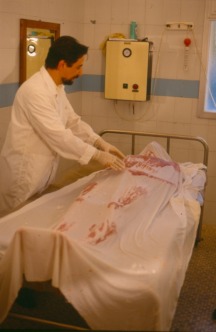
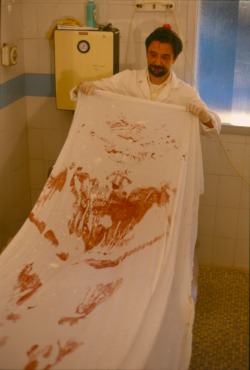
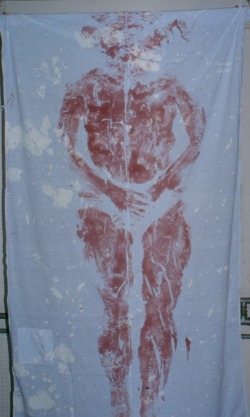
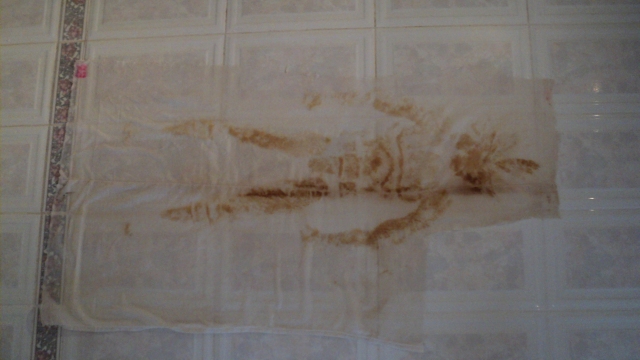
Here are 4 pix showing how my flour-imprinting procedure performs with that plastic toy referred to earlier, approx half human scale.

https://shroudofturinwithoutalltheh...6/01/dsc03225-from-stepladder.jpg?w=229&h=300


This shows the new large toy, alongside a metre rule (far left) and the 2 much smaller toys used in previous work. One can see the first stage imprint. The imprint of the torso and limbs did not have the grotesque distortion one saw earlier in that powder-frottage system reported by David M. (There is a subtle kind of distortion that is not immediately obvious, which I might return to at a future date: suffice it to say that the image on the Shroud may be slightly wider than that of the subject from which it was imprinted WHICH MIGHT NOT HAVE BEEN A BAD THING!

However, the head did show obvious width enlargement/ lateral distortion, deliberately so, because I always make a point of reporting my results warts an'all.

https://shroudofturinwithoutallthehype.files.wordpress.com/2016/01/dsc03241.jpg?w=169&h=300


After taking that photograph yesterday, I then soaked the imprint in warm water, and waited for it to plump up to make a bas relief. (There's a possible link there to the Lirey pilgrim's badge from the mid-1350s which shows a strangely bulbous and some might think unflattering representation of the man on the shroud in both frontal and dorsal views, but I'll spare you my unbridled speculations for now).

The wet imprint was then stuck to the wall tiles on my shower cabinet for photography.

https://shroudofturinwithoutallthehype.files.wordpress.com/2016/01/dsc03075.jpg?w=300&h=169

So what about the problem head, where linen tends to drape round the sides giving hideous distortion? Can that be prevented, or at any rate, anticipated and avoided?

Yes, obviously, and there are various measures one can take. Here's just one where, in a separate experiment, I taped off the frontal area I wished to imprint, using sticky tape, before sprinkling with flour.

https://shroudofturinwithoutallthehype.files.wordpress.com/2016/01/dsc03087.jpg?w=640&h=583

Here's the image of that circumscribed face as it appeared late in the oven-roasting stage. Note the reasonable image quality without obvious distortion, and showing, incidentally, the ability of the technology to capture fine detail (compare with template in the previous picture).

But taping is not a solution where a real human face is concerned. Why not? It's that awkward feature we call the nose. It's too prominent, angular, generating creases as Hugh Farey said earlier. That's where one has to concede defeat as far as whole-body imprinting is concerned, and concede, as did Garlaschelli, that a separate bas relief was almost certainly required for the head, while not needing to ditch the entire imprinting technology!!!

Why would medieval fabricators bother with imprinting technology when they could simply call in an artist and get him to do something in a sepia shade? The answer should be obvious. A life-size image of a naked man on an up-and-over sheet of expensive linen, intended with its bloodstains to represent the crucified Jesus, was obviously intended to be appreciated immediately by the first-time viewer as a real BODY IMPRINT, not just any old run-of-the-mill devotional painting, and there are any number of additional subtle cues to the observant that scream "IMPRINT", not painting. But it helps to know what part of the crucifixion/entombment narrative the fabricators were doing their utmost to simulate to the best of the ability. No, not the body resting on a slab in the tomb, with linen making contact with the sides of the body. Nope it was earlier than that. It was transport of the body with Joseph of Arimathea's linen (delivered to the CROSS, not tomb) deployed as a make-shift stretcher. Supported by bearers at the four corners, with the body bowed down under its own weight, there would arguably have been little contact between linen and sides of the body, such that sweat and blood would have created imprints on frontal and dorsal surfaces only. In passing, the arching of the linen would have preferentially imprinted the SOLES, not tops of the feet which is precisely what one sees on the Shroud. (The pro-authenticists have a different explanation for that - rigor mortis - with all sorts of question marks over time-scales which I leave them to deliberate upon to their heart's content).

PS: will the comments accept (via way of Edit) the image address that worked in an earlier comment of mine, the one that introduced the new half-scale toy. I shall use the image-insert icon from the toolbar as I did earlier today. If a URL appears instead of the Image then "Huston, we still have an ongoing problem..."


dsc03133.jpg


Success! So what was different with those first 4 links. I think I know. I used WordPress's toolbar to reduce the size of my images on my site before pasting the link here. Maybe this site does not like images that have been monkeyed with...

I'll try again with just one of the four with 'as is' size from my own image files and see if that works. Let's start with whole-body imprint, stuck to my bathroom wall...

dsc032411.jpg


Success. Moral: don't bother in future with reducing image size.

Let's now draw a line under this comment, unless requested to do so, i.e. no more editing, lesson learnt.

 
Last edited:
I had written: "I would accept a contact-hypothesis as a basis of a subsequent manual handling -frotis, for example-. Not as a natural transfer".
The technic of frottage or "frotis" is not a "natural" transfer such as we could expect in a cloth placed on a corpse and moved away later. I think that Maillard reaction is a chemical reaction of dead meat. Is it not? Raymond Rogers turned to Maillard reaction as a natural process that would justify the authenticity of the Shroud without a miracle. Overtaking Calvin with Calvinism, we could say. But I can not think of what a medieval craftsman might be doing with a corpse. I find it a bit "baroque".

I have always found your experiments interesting, but are not you afraid they will be too complex? Remember that elegance is also a scientific requisite.


Can we forget about frottage now please, DavidMo, since it's clearly an unsuitable technology if allowed to imprint sides as well as top planes.

No, you need to do some reading on Maillard reactions. They have scarcely anything to do with meat unless it's been roasted in an oven. It was Rogers who invoked Maillard reactions in his naturalistic model, but had to propose that the body was undergoing rapid putrefaction, generating volatile amines, and that it was those amines that kick-started a Maillard reaction at normal environmental temperatures, and much unfounded speculation as to the source of the other needed ingredient - reducing sugars).

My model uses the conventional Maillard browning reactions you can read about in wiki and elsewhere - those that take place in a hot oven where wheat flour etc provides both the reducing sugars - already present- and amino-groups (from lysine side chains on proteins etc). The end product, which also gets a brief mention in wiki, are those incredibly complex melanoidins which I believe to be the Shroud body image chromophores - not "conjugated carbonyls" as speculated by Heller, Adler and others.

Why the reference to a corpse in the context of medieval modelling of the Deposition from the Cross (Joseph of Arimathea's linen)? Where have I mentioned a corpse. All my comments refer to the use of one, nay TWO live volunteers for the oil/flour imprinting procedure.

Elegance? I make no claim to elegance. It was the Shroud image itself that could be described as "elegant" even if the blood and scourge marks are too-good-to-be-true. Neither the technology deployed in the 14th century to make that image, nor my final Model 10 to imagine how it was achieved, need to be elegant. Simple, yes, bearing in mind the limitations in medieval times of (food) chemicals and equipment (largish oven), but elegant? No!

Incidentally, the oven does not need to be industrial size, since one can get away with slinging the linen over a series of taut strings to make a W, or even a WW etc., concertina-style. Contact between flour and string makes virtually no difference to the final outcome.
 
Last edited:
How I miss Jabba.

A few months before Jabba appeared on this site, I had an email from him. It was to say that he was planning to set up a grand internet debate between the pro-authenticity and opposite factions. He would represent the first, and asked whether in view of my stance on Dan Porter's (now closed for new business) shroudstory site, I'd be willing to head up the opposition.

I visited his site, and then, as graciously as possible, decided to decline the invitation.

Looking at Jabba's subsequent punchbag persona later on this site, running it seemed for YEARS (!) on end, provoking much mirth, jollity and merciless ribbing, to say nothing of THOUSANDS of comments, I have to say I'm hugely relieved to have stayed clear of that so-called debate.

Cue end of my tuppenceworth for what it's worth. Nuff said.
 
Don't go there. We've had enough "the presence of blood proves authenticiy" nonsense, and The Encyclopedia of Logical Fallacies.

I'm find this Maillard reaction stuff interesting and not implausible.


Thanks for the (awakening?) interest.

Is it any wonder that STURP's Heller and Adler in the late 70s/early 80s had a blind spot for Maillard reactions and melanoidins - with Ray Rogers a late convert, albeit in his somewhat contrived naturalistic (pro-authenticity) model?


Here's the abstract of a paper from just 6 years ago that reaffirms just how little is known about that class of high molecular weight yellow-brown end-products of Maillard reactions between proteins and reducing sugars.

Melanoidins produced by the Maillard reaction: Structure and biological activity

Article in Food Chemistry 128(3):573-584 · October 2011
He-Ya Wang, , He Qian, Wei-Rong Yao


Abstract

Melanoidins are compounds generated in the late stages of the Maillard reaction from reducing sugars and proteins or amino acids during food processing and preservation. Recently the effects of melanoidins on human health and the chemical characterisation of the beneficial components have gained a lot of attention. Food melanoidins have been reported to be anionic, coloured compounds and some of their key chromophores have been elucidated. The antioxidant activity and other biological effects of melanoidins from real foods and model systems have been widely studied. Despite this, very few different melanoidin structures have actually been described, and specific health effects have yet to be linked to chemically distinct melanoidins. The variety of different Maillard reaction products formed during the reaction, in conjunction with the difficulty in purifying and identifying them, makes a thorough analysis of melanoidins challenging. This review provides a comprehensive look at what is known to date about melanoidin structure, the formation mechanism for these compounds, and the biological properties related to the beneficial health effects of melanoidins.

I was asked here a couple of days ago if there was a specific test for "melanoidins" and replied, basically, "none that I know of". The above abstract suggests that further searching of the literature would be a waste of time.

The alternative, as stated, is not to waste time and energy on identifying the the final, end-stage Maillard products, but the imprinting medium from which it was generated via exposure to a high temperature (hot medieval oven). In other words: traces of globules of sticky, water-insoluble wheat gluten, easily attaching to or trapped within a linen weave, could realistically be the main target of a thorough chemical search (STURP Mk2?).
 
Last edited:
Here's the abstract of a paper from just 6 years ago that reaffirms just how little is known about that class of high molecular weight yellow-brown end-products of Maillard reactions between proteins and reducing sugars.

I'm a little familiar with the Maillard reaction because of some research at work in food chemistry. It's extremely complex, and there is an entire sub-discipline of chemistry devoted to it. At low temps you can get polymeric compounds that clog our equipment. At higher temps you can get carcinogens like acrylamide.
 
I'm a little familiar with the Maillard reaction because of some research at work in food chemistry. It's extremely complex, and there is an entire sub-discipline of chemistry devoted to it. At low temps you can get polymeric compounds that clog our equipment. At higher temps you can get carcinogens like acrylamide.

We need a new, easily recalled technical term for melanoidins, one that sums up the present state of knowledge of their detailed chemical makeup.

I would suggest Brown Gunge...
 

Back
Top Bottom