
Kinetic energy at atmospheric reentry from lunar mission

wogoga

Critical Thinker
Joined
Apr 16, 2007
Messages
334
Escape velocity from Earth is 11.2 km/s. A spacecraft leaving the gravitational field of the moon and falling on the Earth accelerates to a speed of 11 km/s before reaching the atmosphere at an altitude of around 120 km (see: Atmospheric entry). The kinetic energy corresponding to 11 km/s is around 60 Mega-Joule for every kilogram of spacecraft and crew. For comparison: energy content of jet fuel, gasoline and diesel is only around 45 MJ per kg (source).

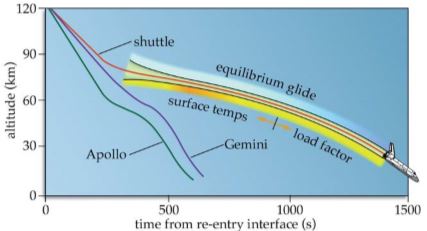
Figure 4.1.7-25 of Returning from Space: Re-entry shows "Re-entry Profiles for the Shuttle Versus Gemini and Apollo":
apollo_reentry.JPG


"Notice Gemini and Apollo re-entered much more steeply than the Space Shuttle."

According to this figure, Apollo needed around 250 sec to descent from altitude 120 km to 60 km. This results in an average speed of v = 60 km / 250 s = 240 m/s. To a speed of 240 m/s correspond only 28 kilo-Joule per kg, which is a negligible quantity in comparison to the 60 Mega-Joule corresponding to the entry speed of 11 km/s. Thus in the order of 99.9% of the kinetic energy must have disappeared before falling to an altitude of 120 km. Yet friction due to atmospheric pressure above 120 km altitude is too weak to relevantly reduce speed.

Wikipedia on meteors:

"Meteors become visible between about 75 to 120 km above the Earth. They usually disintegrate at altitudes of 50 to 95 km."

The return capsule of Stardust (bringing down to Earth dust samples in 2006) reached its maximum deceleration of 34 g (!) at an altitude of only 55 km:

"On January 15, 2006, at 05:57:00 UTC, the Sample Return Capsule successfully separated from Stardust and re-entered the Earth's atmosphere at 09:57:00 UTC, at a velocity of 12.9 km/s, the fastest reentry speed into Earth's atmosphere ever achieved by a man-made object. The capsule followed a drastic reentry profile, going from a velocity of Mach 36 to subsonic speed within 110 seconds. Peak deceleration was 34 g, encountered 40 seconds into the reentry at an altitude of 55 km over Spring Creek, Nevada."

So the question becomes even more acute: How could Apollo reduce its speed from 11 km/s to less than 1 km/s before or when entering the atmosphere (at an altitude of around 120 km)?

Cheers, Wolfgang
www.pandualism.com
 
Escape velocity from Earth is 11.2 km/s. A spacecraft leaving the gravitational field of the moon and falling on the Earth accelerates to a speed of 11 km/s before reaching the atmosphere at an altitude of around 120 km (see: Atmospheric entry). The kinetic energy corresponding to 11 km/s is around 60 Mega-Joule for every kilogram of spacecraft and crew. For comparison: energy content of jet fuel, gasoline and diesel is only around 45 MJ per kg (source).

Figure 4.1.7-25 of Returning from Space: Re-entry shows "Re-entry Profiles for the Shuttle Versus Gemini and Apollo":

[qimg]http://www.pandualism.com/upload/apollo_reentry.JPG[/qimg]

"Notice Gemini and Apollo re-entered much more steeply than the Space Shuttle."

According to this figure, Apollo needed around 250 sec to descent from altitude 120 km to 60 km. This results in an average speed of v = 60 km / 250 s = 240 m/s. To a speed of 240 m/s correspond only 28 kilo-Joule per kg, which is a negligible quantity in comparison to the 60 Mega-Joule corresponding to the entry speed of 11 km/s. Thus in the order of 99.9% of the kinetic energy must have disappeared before falling to an altitude of 120 km. Yet friction due to atmospheric pressure above 120 km altitude is too weak to relevantly reduce speed.

Wikipedia on meteors:

"Meteors become visible between about 75 to 120 km above the Earth. They usually disintegrate at altitudes of 50 to 95 km."

The return capsule of Stardust (bringing down to Earth dust samples in 2006) reached its maximum deceleration of 34 g (!) at an altitude of only 55 km:

"On January 15, 2006, at 05:57:00 UTC, the Sample Return Capsule successfully separated from Stardust and re-entered the Earth's atmosphere at 09:57:00 UTC, at a velocity of 12.9 km/s, the fastest reentry speed into Earth's atmosphere ever achieved by a man-made object. The capsule followed a drastic reentry profile, going from a velocity of Mach 36 to subsonic speed within 110 seconds. Peak deceleration was 34 g, encountered 40 seconds into the reentry at an altitude of 55 km over Spring Creek, Nevada."

So the question becomes even more acute: How could Apollo reduce its speed from 11 km/s to less than 1 km/s before or when entering the atmosphere (at an altitude of around 120 km)?

Cheers, Wolfgang
www.pandualism.com

Your math is not wrong.

Your math is irretrievably broken.

Your conceptualisation of the problem is similarly irretrievably broken.

Your underlying assumptions are broken too.
 
Your math is not wrong.

Your math is irretrievably broken.

Your conceptualisation of the problem is similarly irretrievably broken.

Your underlying assumptions are broken too.
This.I suspect he's dabbling in Apollo denialism.
I believe this may be of use.
bart6.gif
 
... snipped for brevity ...

So the question becomes even more acute: How could Apollo reduce its speed from 11 km/s to less than 1 km/s before or when entering the atmosphere (at an altitude of around 120 km)?

Cheers, Wolfgang
www.pandualism.com

They cheated.

That is how they were able to slow down, by cheating.

:bunpan
 
I'm sure Jay Utah can answer the question in the OP much more comprehensively than I ever could, but just to be a little bit constructive I would point out that velocity is a vector, not a scalar, and the graph of altitude vs. time can only be used to calculate the vertical component of that vector. It doesn't tell you anything at all about the horizontal component. Your numbers for the speed (i.e. the magnitude of the velocity vector) are therefore completely wrong; you'd need to know the angle of descent at every point on the re-entry profile to correct them. Since your starting numbers are wrong, the rest of your calculations aren't really any use.

Dave
 
Reentry is all about angle. You can think about it as for every altitude there is 'safe' speed at which you can travel at for unlimited time, without overheating. Obviously this speed is lower at lower altitudes. The trick with reentry is to never be above safe speed at any given moment. You can think about it also as steps. You enter the very outskirts of atmosphere, and will stay at that altitude as until you are slow enough to descent another few hundred meters, again slow down enough, and again descent.
Such approach would require lots of maneuvering, and it's not how it's done, it's just an example.
In reality, for each spacecraft, there is 'reentry angle'. If the spacecraft reentries at this angle, it will safely decelerate before diving too deep into denser air. Thing is .. the angle is different for every spacecraft, and it depends on how much will the spacecraft decelerate due to the air friction.
The Space shuttle was constructed to fly, and it uses the same configuration while going up. It's designed to have very low drag. Therefore it will slow down only very slowly .. so it needs very shallow reentry angle. Btw. Space shuttle also does high G horizontal turns to bleed speed faster, which is not part of your diagram.
Old style single use reentry modules were designed differently. The are built to have high drag coefficient (and high drag induced stability). Thus they will use much steeper reentry angle. They will simply slow down fast enough.
Space shuttle descent is controlled, so it can stay above ballistic course. It can do the shallow reentry in controllable fashion.
But old style reentry modules are not controlled at descent stage. So if they relied on shallow reentry angle, there would be danger, that they slow down too much at high altitude, which will then change the reentry angle to deeper one, just to overheat at lower altitude.
It's another reason why steep reentry angle is used. While there is huge difference between 5 and 15 degrees reentry angle, there is much less different between 60 and 70.
That's why old style reentry module has different reentry angle. It will also be exposed to lot higher deceleration forces.
 
Last edited:
Escape velocity from Earth is 11.2 km/s. A spacecraft leaving the gravitational field of the moon and falling on the Earth accelerates to a speed of 11 km/s before reaching the atmosphere at an altitude of around 120 km (see: Atmospheric entry). The kinetic energy corresponding to 11 km/s is around 60 Mega-Joule for every kilogram of spacecraft and crew. For comparison: energy content of jet fuel, gasoline and diesel is only around 45 MJ per kg (source).

Figure 4.1.7-25 of Returning from Space: Re-entry shows "Re-entry Profiles for the Shuttle Versus Gemini and Apollo":

[qimg]http://www.pandualism.com/upload/apollo_reentry.JPG[/qimg]

"Notice Gemini and Apollo re-entered much more steeply than the Space Shuttle."

According to this figure, Apollo needed around 250 sec to descent from altitude 120 km to 60 km. This results in an average speed of v = 60 km / 250 s = 240 m/s. To a speed of 240 m/s correspond only 28 kilo-Joule per kg, which is a negligible quantity in comparison to the 60 Mega-Joule corresponding to the entry speed of 11 km/s. Thus in the order of 99.9% of the kinetic energy must have disappeared before falling to an altitude of 120 km. Yet friction due to atmospheric pressure above 120 km altitude is too weak to relevantly reduce speed.

Wikipedia on meteors:

"Meteors become visible between about 75 to 120 km above the Earth. They usually disintegrate at altitudes of 50 to 95 km."

The return capsule of Stardust (bringing down to Earth dust samples in 2006) reached its maximum deceleration of 34 g (!) at an altitude of only 55 km:

"On January 15, 2006, at 05:57:00 UTC, the Sample Return Capsule successfully separated from Stardust and re-entered the Earth's atmosphere at 09:57:00 UTC, at a velocity of 12.9 km/s, the fastest reentry speed into Earth's atmosphere ever achieved by a man-made object. The capsule followed a drastic reentry profile, going from a velocity of Mach 36 to subsonic speed within 110 seconds. Peak deceleration was 34 g, encountered 40 seconds into the reentry at an altitude of 55 km over Spring Creek, Nevada."

So the question becomes even more acute: How could Apollo reduce its speed from 11 km/s to less than 1 km/s before or when entering the atmosphere (at an altitude of around 120 km)?

Cheers, Wolfgang
www.pandualism.com

I will not bother to ask you to re-examine your own math, but just ask you to focus on the starting points you yourself provided:

The unmanned Sample Return capsule entered the atmosphere at 12.9 km/s and braked to parachute speeds within 110 seconds using one of the most drastic re-entry profiles ever employed. This caused it to encounter a peak deceleration of 34 gs.

Manned Apollo used a different re-entry profile but arrived at 11 km/s and required (over) 250 seconds to eventually slow down enough for parachute deployment. Due to the longer time (and you cut off events below 60 km altitude ) and the precise shape of the re-entry Apollo experienced 6 to over 7 gs decceleration (Mercury up to 11g!).

The shuttles took even longer to break and maxed out around 3 g.

Doesn't seem hard to understand why this works this way.

If you look at the actual spacecraft in museums you will see that the re-entry heat nonetheless took quite on toll on them- either ablative shielding or thermal tiles. They certainly heated up enormously during re-entry and a lot of engineering went into preventing transfer of this heat into the cabins.

By the way- most of the meteors that burn up on reentry are very small- the size of dust or sand. No thermal mass, no place for the heat to go, and they are gone. Many enter with a combined speed (adding Earth's movement) of 71 km/s. Versus multi-ton engineered spacecraft at 12 km/s. Even slightly larger meteors survive, hit the surface with no engineered solution, and are called meteorites. I have a small one at home. Larger ones survive and can create a lot of damage.

Why do you still use velocity when you mean speed?
 
Last edited:
The unmanned Sample Return capsule entered the atmosphere at 12.9 km/s and braked to parachute speeds within 110 seconds using one of the most drastic re-entry profiles ever employed. This caused it to encounter a peak deceleration of 34 gs.

Holy McJesus, that's a braking maneuver.

How hot did it get?
 
Oh, yeah, nobody gets launched and returned at the forces the early guys withstood. Apollo guys were around 11g peak and shuttles were around 3g IIRC. Soyuz reentries are apparently pretty rough - nominally 4g peaks but pretty variable from mission to mission apparently.
 
Figure 4.1.7-25 of Returning from Space: Re-entry shows "Re-entry Profiles for the Shuttle Versus Gemini and Apollo":

apollo_reentry.JPG


"Notice Gemini and Apollo re-entered much more steeply than the Space Shuttle."

According to this figure, Apollo needed around 250 sec to descent from altitude 120 km to 60 km. This results in an average speed of v = 60 km / 250 s = 240 m/s.


I would point out that velocity is a vector, not a scalar, and the graph of altitude vs. time can only be used to calculate the vertical component of that vector. It doesn't tell you anything at all about the horizontal component. Your numbers for the speed (i.e. the magnitude of the velocity vector) are therefore completely wrong; you'd need to know the angle of descent at every point on the re-entry profile to correct them.


Ok. My embarrassing calculation is based on two errors: First, "More steeply" doesn't mean steep. Second, the shallower the angle, the higher is resulting average speed because a longer path is needed to lower altitude. Mistakenly I assumed the opposite when writing the post. Nevertheless, the quoted figure cannot be correct. Quote from At what angle did Apollo 13 need to reenter?:

"All of the Apollo lunar returns were within about a tenth of a degree of -6.5° (halfway between -5.3° and -7.7°), except for Apollo 13, which was within a quarter of a degree."

As sin 6.5° ≈ 0.11, around 8.8 km are needed to lower altitude by one kilometer. This means, average speed during descent from 120 km to 60 km is not 240 m/s as I erroneously calculated, but 8.8 ∙ 240 m/s = 2.1 km/s (assuming unchanged angle). As the Apollo curve is more or less a straight line in the 120 - 60 km range, the figure implies that Apollo missions moved at 2.1 km/s when reaching altitude 120 km with 6.5°.

To a speed of 2.1 km/s corresponds only 2.2 Mega-Joule per kg, which is a rather negligible quantity in comparison to the 60 MJ corresponding to the entry speed of 11 km/s. Thus around 96% of the kinetic energy would have disappeared before falling to an altitude of 120 km. For an astronaut of 80 kg these "missing" 96% would result in 4.7 Tera-Joule, enough to heat up ten tons (10000 kg) of steel by 1000° Kelvin.

Cheers, Wolfgang
 
Ok. My embarrassing calculation is based on two errors: First, "More steeply" doesn't mean steep. Second, the shallower the angle, the higher is resulting average speed because a longer path is needed to lower altitude. Mistakenly I assumed the opposite when writing the post. Nevertheless, the quoted figure cannot be correct. Quote from At what angle did Apollo 13 need to reenter?:

"All of the Apollo lunar returns were within about a tenth of a degree of -6.5° (halfway between -5.3° and -7.7°), except for Apollo 13, which was within a quarter of a degree."

As sin 6.5° ≈ 0.11, around 8.8 km are needed to lower altitude by one kilometer. This means, average speed during descent from 120 km to 60 km is not 240 m/s as I erroneously calculated, but 8.8 ∙ 240 m/s = 2.1 km/s (assuming unchanged angle). As the Apollo curve is more or less a straight line in the 120 - 60 km range, the figure implies that Apollo missions moved at 2.1 km/s when reaching altitude 120 km with 6.5°.

To a speed of 2.1 km/s corresponds only 2.2 Mega-Joule per kg, which is a rather negligible quantity in comparison to the 60 MJ corresponding to the entry speed of 11 km/s. Thus around 96% of the kinetic energy would have disappeared before falling to an altitude of 120 km. For an astronaut of 80 kg these "missing" 96% would result in 4.7 Tera-Joule, enough to heat up ten tons (10000 kg) of steel by 1000° Kelvin.

Cheers, Wolfgang

Still fractally wrong.
 
I don't think you are starting with an accurate source for the Apollo reentry profile, as an initial Google image search for the term seems to suggest.
 
Ok. My embarrassing calculation is based on two errors: First, "More steeply" doesn't mean steep. Second, the shallower the angle, the higher is resulting average speed because a longer path is needed to lower altitude. Mistakenly I assumed the opposite when writing the post. Nevertheless, the quoted figure cannot be correct. Quote from At what angle did Apollo 13 need to reenter?:

"All of the Apollo lunar returns were within about a tenth of a degree of -6.5° (halfway between -5.3° and -7.7°), except for Apollo 13, which was within a quarter of a degree."

As sin 6.5° ≈ 0.11, around 8.8 km are needed to lower altitude by one kilometer. This means, average speed during descent from 120 km to 60 km is not 240 m/s as I erroneously calculated, but 8.8 ∙ 240 m/s = 2.1 km/s (assuming unchanged angle). As the Apollo curve is more or less a straight line in the 120 - 60 km range, the figure implies that Apollo missions moved at 2.1 km/s when reaching altitude 120 km with 6.5°.

To a speed of 2.1 km/s corresponds only 2.2 Mega-Joule per kg, which is a rather negligible quantity in comparison to the 60 MJ corresponding to the entry speed of 11 km/s. Thus around 96% of the kinetic energy would have disappeared before falling to an altitude of 120 km. For an astronaut of 80 kg these "missing" 96% would result in 4.7 Tera-Joule, enough to heat up ten tons (10000 kg) of steel by 1000° Kelvin.

Cheers, Wolfgang

Straight out of the box:
  • Pretty much none of the relationships involved is linear, as you assume.
  • Ablative heat shield
  • Apollo capsule is an aerodynamic lifting body and actually ascends during part of re-entry
  • Invalid use of average speed

Just a partial list of how wrong this whole proposal is for starters.
 
Ok. My embarrassing calculation is based on two errors: First, "More steeply" doesn't mean steep. Second, the shallower the angle, the higher is resulting average speed because a longer path is needed to lower altitude. Mistakenly I assumed the opposite when writing the post. Nevertheless, the quoted figure cannot be correct.

Cheers, Wolfgang

It's nice to see that you're rethinking your assumptions, and here's another which you need to rethink

The attitude of the Apollo is the angle of the vehicle's path.

Nope. It's the angle of the vehicle's axis with respect to the current velocity vector. It has nothing to do with the angle of that velocity vector with respect to local horizontal.

Your revised calculation is getting better, but the path angle was actually (in the early stages of reentry) much shallower than you realize. Consequently, the velocity (and the kinetic energy) were much greater.
 
Ok. My embarrassing calculation is based on two errors: First, "More steeply" doesn't mean steep. Second, the shallower the angle, the higher is resulting average speed because a longer path is needed to lower altitude. Mistakenly I assumed the opposite when writing the post. Nevertheless, the quoted figure cannot be correct. Quote from At what angle did Apollo 13 need to reenter?:

"All of the Apollo lunar returns were within about a tenth of a degree of -6.5° (halfway between -5.3° and -7.7°), except for Apollo 13, which was within a quarter of a degree."

As sin 6.5° ≈ 0.11, around 8.8 km are needed to lower altitude by one kilometer. This means, average speed during descent from 120 km to 60 km is not 240 m/s as I erroneously calculated, but 8.8 ∙ 240 m/s = 2.1 km/s (assuming unchanged angle). As the Apollo curve is more or less a straight line in the 120 - 60 km range, the figure implies that Apollo missions moved at 2.1 km/s when reaching altitude 120 km with 6.5°.

To a speed of 2.1 km/s corresponds only 2.2 Mega-Joule per kg, which is a rather negligible quantity in comparison to the 60 MJ corresponding to the entry speed of 11 km/s. Thus around 96% of the kinetic energy would have disappeared before falling to an altitude of 120 km. For an astronaut of 80 kg these "missing" 96% would result in 4.7 Tera-Joule, enough to heat up ten tons (10000 kg) of steel by 1000° Kelvin.

Cheers, Wolfgang

First, sincere congratulations on being willing to re-think this and to admit these prior errors! Many people cannot.

What you should avoid doing next is the very human tendency to attempt to salvage your prior hypothesis as quickly as possible by looking for something in your original math that you can present as, "Well, I made some errors but my initial proposal was still mostly right. Like this part!" My own experience is that it is much better to take a deep breadth and carefully re-exam all of your prior presumptions and calculations. Discovering one's initial errors indicates that one started off on the wrong foot and that one should stop, calmly learn more about what is known and what are the proper calculations to apply, and then re-think it from the beginning in an unemotional, un-pressured manner. I believe that you began thinking about the re-entry heating issues without first lunderstanding enough about the actual physics, re-entry paths, engineering approaches, terminology, and mathematics involved. Admitting some of your mistakes is great. But shake off any prior assumptions and conclusions before tackling this again, because you began facing the wrong way and being hasty will only take you in the wrong direction again.
 
Last edited:
As sin 6.5° ≈ 0.11, around 8.8 km are needed to lower altitude by one kilometer. This means, average speed during descent from 120 km to 60 km is not 240 m/s as I erroneously calculated, but 8.8 ∙ 240 m/s = 2.1 km/s (assuming unchanged angle). As the Apollo curve is more or less a straight line in the 120 - 60 km range, the figure implies that Apollo missions moved at 2.1 km/s when reaching altitude 120 km with 6.5°.

To a speed of 2.1 km/s corresponds only 2.2 Mega-Joule per kg, which is a rather negligible quantity in comparison to the 60 MJ corresponding to the entry speed of 11 km/s. Thus around 96% of the kinetic energy would have disappeared before falling to an altitude of 120 km. For an astronaut of 80 kg these "missing" 96% would result in 4.7 Tera-Joule, enough to heat up ten tons (10000 kg) of steel by 1000° Kelvin.

Still fractally wrong.


You are right: Missing kinetic energy for one 80 kg astronaut is 4.7 Giga-Joule and not 4.7 Tera-Joule.

Nevertheless 4.7 GJ = 4.7 billion Joule = 4.7 ∙ 109 J = 9p47 Joule is actually enough to heat up ten tons (10000 kg = 4p1 kg = 7p1 gram) of steel by 1000 Kelvin (3p1 Kelvin).

In the context of computers, the use of giga = 9p = nine-po of some years ago has been replaced more and more by tera = 1012 = 12p = twelve-po. Therefore I confused Tera-Joule with Giga-Joule. Yet my calculation is not affected by this mistake:

Specific heat capacity of steel is 0.47 Joule per gram per Kelvin = 9n47 J/g/K = nine-ne four seven J/g/K. With 0.47 kJ = 4.7 ∙ 102 J = 2p47 J = two-po four seven Joule we can heat up 1 kg = 3p1 gram by one degree Kelvin. For ten metric tons = 7p1 g we need 7p1 g ∙ 9n47 J/g/K = 6p47 Joule/Kelvin. In order heat up these ten tons (7p1 gram) of heat capacity 9n47 J/g/K by 1000 Kelvin (3p1 K), we need 9p47 Joules.

Summary: 9n47 J/g/K ∙ 7p1 g ∙ 3p1 K = 9p47 J

Cheers, Wolfgang
Efficient Concept-Formation for Languages of the Future
 

Back
Top Bottom