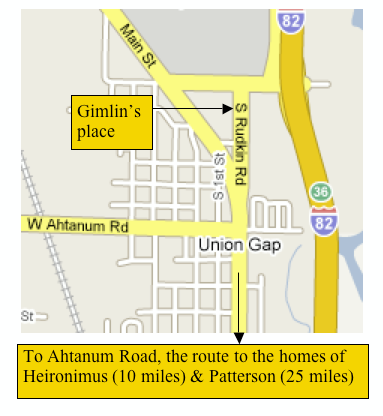
I should have said in my just-preceding comment, about Heironimus’s reticence being best explained by his lawyer’s likely request not to dilute the exclusiveness of the story they wanted to sell, that Heironimus was similarly closed-mouth about another matter than his involvement in Patterson’s documentary: He refused to comment on whether or not he wore an ape suit, as Les Johnson had said (TMoB, pp. 148–49). He was also cagey about the extent of his familiarity with Patterson (TMoB, pp. 145–46 & 150–51).
=========
There is the slight wrinkle that if DeAtley became involved only after the PGF was filmed then how did he know Heironimus through Roger well enough to recall his appearance decades later?
1. It’s not too surprising they might have met at some family gathering. DeAtley married into Patterson’s family (Patterson’s sister Iva). Heironimus was close to the Mondor family, into which Patterson married. (Brother Howard lived with the Mondors for a year or so.)
2. Heironimus might have been along for the ride after the two of them had gone riding in the forest when Roger decided to visit his sister, DeAtley’s wife, whom he was close to. Heironimus might have wanted to see her again too, for old times' sake.
3. Heironimus might have accompanied Patterson on some of his numerous visits to Harvey Anderson’s camera shop. (I’ve interviewed four former employees, but I haven’t posted what they told me yet.) One of them said that half the time Patterson was accompanied by a big, silent guy. It might have been Heironimus. (I asked John Ballard, a big guy who has a chapter in Long’s book, if it had been him and he denied it.) If so, he might have accompanied him to DeAtley’s home and encountered DeAtley.
4. Maybe Patterson recommended Heironimus for occasional work for his company, like guarding a site at night, or driving a truck to pick up a spare part that was needed, or doing something on a weekend.
A meeting via mutual pre-PGF involvement in a hoax isn't the only way they might have met through Roger. It's only one possibility.
==========
DeAtley almost certainly came with Roger to Wallace's home in Toledo.
There’s no basis for your certainty other than how it fits nicely into your preferred narrative. There is no evidence that DeAtley was interested in Bigfoot or Patterson’s schemes. (His testimony to the contrary is emphatic and forthright, FWIW.)
Heironimus never said Patterson mentioned being funded. His only reason for his suspecting DeAtley’s involvement was DeAtley’s (supposed) receipt of the film he mailed in early March.
One subtle indication that DeAtley wasn’t a pre-PGF funder is this: He didn’t demand to see a film of Bob Heironimus doing his practice walk, as he likely would have if he’d been looking at spending $1000 for Heironimus’s services, and another $1000 for Patterson’s expedition.
Heironimus didn’t describe any filming, or even still photography, of his practice-walks at Patterson’s place, either in Long’s book (e.g., TMoB, pp. 344–45) or in any of his interviews. Presumably he would have if it had happened—he could hardly have missed seeing the filmer or dismissed his presence as not worth mentioning. He noticed and mentioned that Patty Patterson was watching through a kitchen window. (She could have been the filmer if one was wanted—or Gimlin, who was also in attendance.)
Such a film is the sort of thing Patterson might have wanted to study for flaws in Bob’s walk. Anyhow, that’s the explanation he could give to Heironimus for the filming.
More to the point, it’s the sort of thing a funder who was in on the hoax would have wanted to study for believability. Think about it. A “witting” funder, as PGF-skeptics and Heironimus have claimed Al DeAtley was, would certainly have asked to see how realistic Heironimus’s “Bigfoot” looked in a trial run. It’s the least he’d ask, especially if he were a hard-ass tightwad like DeAtley.
Can you imagine him—or any “witting” rich man—funding a three-week, three-horse, two-man, far-off movie without asking for a preview of it in a less exotic setting? Why not? Can you imagine him just taking Patterson’s word for it that Heironimus’s walk looked “perfect”?? (Maybe
you can, but if so that’s why you’re not a rich man.) If necessary to meet a funder’s demand, he need only have had Heironimus come back for a second practice walk. (In one interview Heironimus said he went to Patterson’s place for a walk “once or twice.”)
Also, could you imagine Patterson not filming the practice-walk if he had no funder yet, but hoped to land one, who might be one who was only in it for the money, like DeAtley? If he really thought the walk was perfect, as Heironimus alleges (below), a film of it would be the selling tool he needed.
The film stock needn’t have been anything expensive or hard to process. It could have been 8mm Ektachrome, which could have been developed in a home darkroom. It could have been shot in an 8mm camera rented for a day for peanuts—or loaned by the funder if he owned one.
According to Heironimus, his trial run satisfied Patterson. (The following is one of several similar quotes.):
Bob Heironimus—I only walked, like I say, two or three times and they said, “That’s perfect. That’s just what we want.”
—Seth Shostak’s “Skeptical Sunday” radio show, section 5-H, 8/1/2004
But if Heironimus had looked as laughable in it as he did in the Cow Camp re-creation attempt, Patterson wouldn’t have got a dime—just a horselaugh.
=========
Wallace was the owner of the stompers used for the hoaxed tracks at Blue Creek Mountain Rd and Bluff Creek that were used as the reason for Patterson and Gimlin coming to Bluff Creek.
There is some evidence that his stompers match one of the 1958 tracks on the under-construction Bluff Creek Road—a crack in both. But Meldrum makes a good case against most of the 1958 track-hoax claims; see his
Sasquatch—Legend Meets Science, pages 60–68. Those pages also discuss and dismiss most (but not all) other footprint-hoax claims, like the 1967 Blue Creek Mountain finds. John Green is quoted on page 68:
“We counted six hundred tracks at Bluff Creek one day in 1967. They showed great variation. The idea that they all could have been made by one carved foot is just nonsense.”
===========
That's the same hoaxer who was collaborating with the managing editor of the Times-Standard Laurence "Scoop" Beal as admitted by his wife after he passed away.
It’s likely that Wallace hoaxed some of the prints that were found in the months preceding Jerry Crew’s arrival at the newspaper with his plaster casts. But that doesn’t mean all of them were. Wallace’s may have been copycat efforts; I’ve read arguments to that effect.