• Quick note - the problem with Youtube videos not embedding on the forum appears to have been fixed, thanks to ZiprHead. If you do still see problems let me know.

David Chandler jumps the shark

Ok
Mice not rats. I should have known something was amiss when that mattress rambled across the landscape.

You Explained that and I understand.

Now try it with your description of KE, mass and momentum wrt your previous unintelligible statements.

We still await consise explanations for "KE... minus p", and upward mass vector.
 
Depends how well the web of concrete, rebar, and trusses resist the initial crash.
Yes - of course - that was the scenario I based my thoughts on. And I'm not just "hairy guessing". Here's why - the two extremes are:
1) A clean cut "Wile E Coyote" hole the exact size and shape as the tank; AND
2) A clean shear of of floor from columns with little or no damage to the floor slab and joists.

And it is near dead certain reality would fall between those two extremes. So a patch of floor structure - larger than the tank - not all the floor - and it is broken - folded, bent but the bits still hanging together by reo and other steel bits. So a saggy "sheet anchor".

PLUS I have not explained how the failure would be limited/bounded in the other direction - going "around" the building parallel with outer perimeter/core. And in that direction there is no obvious limit. BUT clearly it would be far less that 100% of the floor.
Beach uses a total floor span max load of 29E6 tons. JSO had the numbers for per square foot or meter.
Yes. I'm aware of the limits in both directions. BUT the event would not be at either of those extremes. The tank would not fail the full floor area of the "OOS" - only the bit near where the tank was dropped. And I allowed for a partially quantified range of options. "Radially" it would be between the two extremes - and "peripherally" it would go some distance from "Wile E Coyote" and the actual distance does not change my postulated results - because it is accommodated in the open ended guess at 2-3-4 or maybe a couple more floors.
I don't picture the part of the floor span that fails , remains intact. It's going to deform into a somewhat parabolic shape. Concrete will shatter, its not high strength concrete..
Which is the exact scenario I predicted - excuse the unusual brevity of my writing on this rare occasion. And "shatter" probably is too optimistic. Low strength or not it would break into clumps which remain tied by reo - re-bar if you prefer.
The combo of bent trusses with a tank in the center with concrete rubble mostly lagging behind slightly, will hit next floor span << Agreed - that is the scenario I'm proposing BUT >> at greater velocity than first impact.,,,, << You are assuming the "greater" - remember it is the second and later floor impacts we are discussing. I'll back my "engineer gut feeling judging (AKA "guessing" :o )" and so on. << Yes - but the "How many so ons is what we are discussing.
But I readily admit I know more physics than applied structures physics.( colloquially referred to as engineering)
 
Which is the exact scenario I predicted - excuse the unusual brevity of my writing on this rare occasion. And "shatter" probably is too optimistic. Low strength or not it would break into clumps which remain tied by reo - re-bar if you prefer.

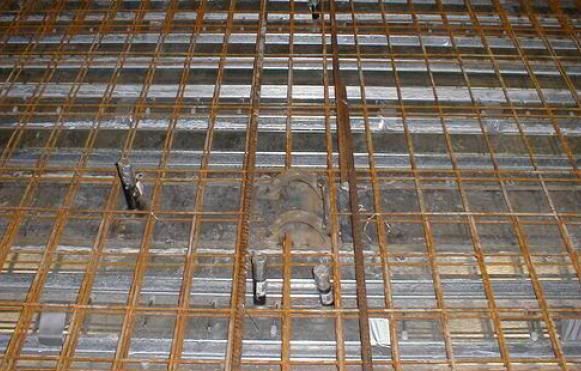
Wasn't the OOS slab just reinforced with wire mesh? That would still probably hold clumps together that cracked without much shear, but I wouldn't expect it to withstand the shear where the tank hit.
 
Wasn't the OOS slab just reinforced with wire mesh? That would still probably hold clumps together that cracked without much shear, but I wouldn't expect it to withstand the shear where the tank hit.

1rebarwithwiremesh.jpg

http://i286.photobucket.com/albums/ll116/tjkb/1rebarwithwiremesh.jpg

Had some rebar and the mesh. When all the rebar was in a stack for the entire floor, it looked like a lot, but ...
 
Wasn't the OOS slab just reinforced with wire mesh? That would still probably hold clumps together that cracked without much shear,...
Yes. Or near enough - little more than nominal slab reo. But it wouldn't ALL fail at the tank outline.

...but I wouldn't expect it to withstand the shear where the tank hit.
sure - if the floor was supported close to the line of impact it would most likely shear both concrete and embedded reo.

BUT the support of the floor is needed to provide the necessary equal and opposite reaction to the tank drop impact to create the shearing action. And at that "Wile E Coyote" line immediately next to the tank the support for the reaction is the flexible floor spanning whatever distance from the support columns - perimeter or core. So it would be a competition between the applied downwards shear at that line versus the resistance from the slab which results from bending moment between the point of application of download and the more remote support of columns. (PLUS the support in the "other direction - along the OOSpace - is even less defined.) And all that is complicated by the 3D realities but for this guesstimate the main point is that we recognise that there is not a lot to create the resistance for the undoubted large down force to cause the shear. I'm betting "bendiness, bounce and breakup into lumps of floor held by reo" wins over pure shear. :rolleyes:

AND - so far I'm that is only a static viewpoint for first attempt at defining the mechanism. Whilst the event would be very much dynamic. The dynamic effects would obviously move the end result closer to your "shear at the Wile E Coyote" line. Closer IMO - not all the way.

As I said it is still gut feel guessing (AKA "alleged sound experienced professional judgement" but "guessing" will do :)) But the odds are IMO against a clear tank outline cut by shear right at the tank outline AKA a "Wile E Coyote" silhouette.

And through out this sequence of posts I've covered my arse as to how far out from the tank the effective break would come. I don't see ALL the reo bars breaking - either immediately in shear OR slightly later in tension. I see a "sheet" of bits of broken concrete under the tank and extending some distance beyond it - all linked by a lot or a few surviving reo bars in tension - the lot pulled up around the tank similar to the end of a sock. And more "sock ends" accumulating floor by floor. Each one would broaden and defocus the impact load - ultimately causing the penetration to stop.

Certainly not at the first impacted floor. But one or two or several floors beyond that.

(There is one "maybe" I've not even looked at - I'm taking it for grated that the tank would penetrate the first floor. ;) )

But it is fun thinking it through - and a change from the Chandler/Szamboti level of alleged engineering idiocies :D
 
Again, nobody is contesting that. When you say "floor" you mean literally just the flat span of poured concrete and truss that people walk upon. When I say "floor" I mean the entirety of the space that the elevator moves through from level to level, thus including the exterior and interior support columns which your side like to pretend didn't exist. The "floor" that resists and diminishes the momentum of the falling floor above it includes all of those features, the stairwells, the machinery, the articles, etc.

If I actually believed you could somehow consolidate all of the upper tower's momentum onto weak floor joints while miraculously bypassing the outer box columns, stairwells, inner columns, etc we wouldn't be having this discussion.
As you've been already told, the stairwells, the machinery, the articles, all these things are not structural elements. Columns, beams, girders, trusses are. From the point of view of the collapses, it only matters how much load each floor was carrying. It doesn't matter if there were stairwells, elevators, machinery, wallboard or wallpaper. Out of the structural elements and the per-floor load, it makes no difference what was on each floor with respect to the collapses.

Now, vertical elements (columns) need the support of horizontal elements (trusses, beams, girders) in order to perform their function. A long, high column without intermediate horizontal supports can resist much less weight without buckling than one which has these supports. This comes from Euler's formula, which for both ends fixed it can be expressed as:

F=4π²EI/L²

The relevant bits for this discussion are L, which is the length of the span between the ends of each section of the column, and F, which is the maximum (critical) vertical load on the column. The shorter the length, the more force (load) the column can resist without becoming unstable, and the proportion is inversely quadratic: double the length means a quarter of the force.

By "section" I mean the span between laterally supported ends; in buildings that's typically one floor, because that's where the horizontal elements are usually placed.

The building's stability depends on these lateral supports. More so on tall buildings. For the towers, the floors collapsed first, in pancake. That deprived both the core and the perimeter of lateral support. The perimeter peeled away like a banana; most of it toppled laterally. The core lost stability and also gave way, presumably also having a good amount of internal horizontal supports affected the same way as the outer floors. Part of both cores remained standing for a bit before they finally collapsed too, and we can see many horizontal elements missing in one of them.

For WTC7 the situation is a bit more complicated because horizontal progressive collapse comes into play. But the very same mechanism is what's believed to have caused column 79 to fail (lack of horizontal support for several floors, after they collapsed). Horizontal spread roughly works like this: when a column buckles, the horizontal elements it's attached to no longer support the columns next to it. That causes them to lose their lateral support and buckle in turn, and so the collapse spreads horizontally.

 
I'm not ignoring gravity, I'm noting that it has been in play all along, and the strength of the construction already overcame the force of g on those members. You folks want to instantly liberate PE for an entire floor (my definition here, not yours) without accounting for the KE required to do so and the consequential loss in v, which reduces p for the falling mass.
That's true. And you keep ignoring two facts:

1) Once released, the new floor contributes to the total crushing energy, because its PE starts to convert into crushing KE.
2) The decelerated floor still has PE, and since it keeps falling, that energy keeps being converted into KE which keeps building up. At that point, it has liberated only one floor worth of its PE, not the whole height. It still has a lot of reserve PE available to convert into crushing KE.

Both PE to KE conversions contribute and make the total energy build up. You can see it as a build-up of mass (if you add the masses and calculate the total energy) or as a build-up of KE (if you consider the impacting and impacted floor as separate and calculate their energies then add them up)


There is no build up in m from new floor compaction because the floor is crushed on an axis which already carried it, so what you get is a net depleting KE.
This is plain wrong. The axis didn't carry it. The columns did. Once detached from the columns, it's available to keep crushing. The columns then lose their horizontal support and buckle.
 
Would it be D-baggy to use exponential notation.

Actually, the D-baggy thing is not to use exponential notation and rub all those zeros into the opponent's face :o

Pretty straight forward. I look forward to you continuing
I am not betting on notconvinced addressing this. Truthers know well how not to be led to understanding.
 
Last edited:
That's true. And you keep ignoring two facts:

1) Once released, the new floor contributes to the total crushing energy, because its PE starts to convert into crushing KE.
2) The decelerated floor still has PE, and since it keeps falling, that energy keeps being converted into KE which keeps building up. At that point, it has liberated only one floor worth of its PE, not the whole height. It still has a lot of reserve PE available to convert into crushing KE.

You get to attribute p (high kinetic load) to the first floor(s) of falling building, but the moment you have impact, the v of that lower floor is roughly zero, as it is simply crushed against itself. The added PE is nowhere near the PE you got when x number of floors got to descend through y vertical space. So you get less KE after impact, less to no PE released, and a system which comes to a halt well above the ground.


This is plain wrong. The axis didn't carry it. The columns did. Once detached from the columns, it's available to keep crushing. The columns then lose their horizontal support and buckle.

You've misunderstood. I think of the columns as the axis, as that is the longest dimension. I see the floor (my definition) as being crushed upon the columns, so net KE decreases.

Trying to see things your way here.... Crushed columns along the axial path would likely release their floor (YOUR definition) upon the next one. What is the KE of JUST the floorspan falling one story? Taking into account the KE it would lose crushing desks, people, cabinets, etc....
 
That's true. And you keep ignoring two facts:

1) Once released, the new floor contributes to the total crushing energy, because its PE starts to convert into crushing KE.
2) The decelerated floor still has PE, and since it keeps falling, that energy keeps being converted into KE which keeps building up. At that point, it has liberated only one floor worth of its PE, not the whole height. It still has a lot of reserve PE available to convert into crushing KE.

I think you need to draw a distinction between the mass and the velocity of the falling building here. It's as if you are attributing equal importance to both, whereas in fact the velocity is squared, and mass isn't in the kinematic equations.
 
I think you need to draw a distinction between the mass and the velocity of the falling building here. It's as if you are attributing equal importance to both, whereas in fact the velocity is squared, and mass isn't in the kinematic equations.

This has to be one of the most idiotic posts I've ever seen, in response to a post which only refers to potential and kinetic energy. Are you actually trying to look stupid?

Dave
 
... The added PE is nowhere near the PE you got when x number of floors got to descend through y vertical space. So you get less KE after impact, less to no PE released...

Disregarding the egregiously non-physics language that gives away your total cluelessness...
How do you know this? Have you done any calculation.

Formally, you claim

A > B

Where
A = The kinetic energy dissipated by structural resistance, crushing, etc
B = The kinetic energy won from PE by descend through some vertical space "y"

Do verify that A > B, you need to estimate A and B and at least provide a lower numerical bound for A and an upper numerical bound for B.
Have you done this? If yes, please show the numbers!
If not, explain how else you know that some A is greater than some B!
 
Disregarding the egregiously non-physics language that gives away your total cluelessness...
How do you know this? Have you done any calculation.

Formally, you claim

A > B

Where
A = The kinetic energy dissipated by structural resistance, crushing, etc
B = The kinetic energy won from PE by descend through some vertical space "y"

Do verify that A > B, you need to estimate A and B and at least provide a lower numerical bound for A and an upper numerical bound for B.
Have you done this? If yes, please show the numbers!
If not, explain how else you know that some A is greater than some B!

Ah yes, it's our old friend, the Unevaluated Inequality Fallacy. Thanks for highlighting it; I always enjoy seeing a new one in the wild.

Dave
 
This has to be one of the most idiotic posts I've ever seen, in response to a post which only refers to potential and kinetic energy. Are you actually trying to look stupid?

Dave
No Dave. The top block gets to 19mph in falling one floor height. Maybe you can explain the energy balance. It should arrest within 6 floors.
As for looking stupid, aren't you the guy who backed down from debating me live? Do it. I'll ram your own arrogance right through you and we'll see who is stupid.
 
No Dave. The top block gets to 19mph in falling one floor height. Maybe you can explain the energy balance. It should arrest within 6 floors.

Because the next one-floor drop gets it right back to 19mph, with added mass. Somewhat faster, in fact, as its fall wasn't fully arrested at first impact.

This is 'duh!' stuff, gerrycan.
 
Because the next one-floor drop gets it right back to 19mph, with added mass. Somewhat faster, in fact, as its fall wasn't fully arrested at first impact.

This is 'duh!' stuff, gerrycan.

okay, so ignoring your "duh stuff" bs, how would this achieve a constant acceleration? You said it would get back up to 19mph. that would presume a fall of about 13.5 ft at freefall from rest every time the upper block impacts the floor directly below it. There's "duh" for ya.
There's no way that the tower can fall in anything like 14s given your "gets it right back to 19mph" presumption.

ETA - I think I see where you went wrong now - you got constant speed confused with constant acceleration.
DUH
 
Last edited:

Back
Top Bottom