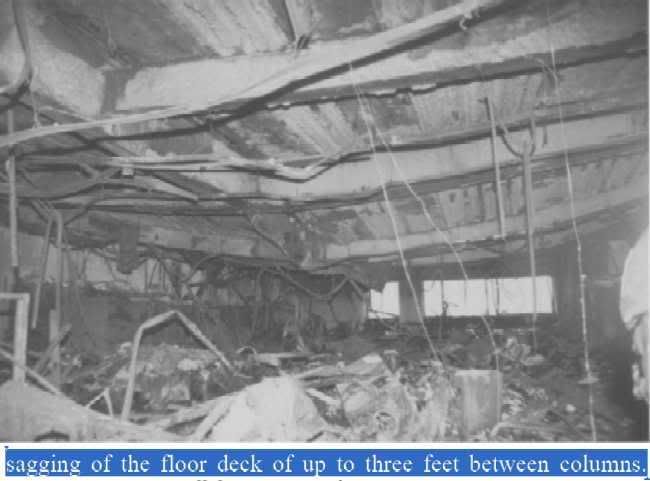
The fact of the matter is, WTC 7 performed better than code and there is no reason to change codes to make it better.
Truthers shifted their focus to WTC 7 only after their claims regarding the Twin Towers failed to achieve any traction. Because they were the primary targets of the terrorists and because so many people died in the subsequent fires and collapse, these structures were subject to much greater scrutiny, leaving little ambiguity for conspiracy theorists to drive a wedge.
WTC 7 was a secondary casualty, and presented no special danger or controversy. Hence the investigation into its ultimate loss didn't need to be as rigorous. Because of that, Truthers have more holes into which to drive an inconsequential wedge. They trump up the alleged importance of this structure. But it really doesn't matter in the grand scheme of things. It imposed no extraordinary loss of life or property, and it performed admirably despite impediments in its design purity (i.e., the need to accommodate a power substation) and inevitably fatal damage.
You can't make them collapse proof, no one would pay to build them.
Starting in 2002 clients were willing to pay fairly exorbitant costs for armored cores, multiple egress routes, etc. after learning the specifics of WTC 1 and 2. Not so anymore. A decade hence we've gone back to relatively similar building designs as WTC 7.
Engineer and author Henry Petroski writes extensively about this. People are willing to pay for the engineering they think solves the ephemeral concerns of the day. One day people are worried about cost. The next day they're worried about survivability. People's priorities change.
In a similar vein we don't build ships to be unsinkable. We build ships to stay afloat for long enough that the passengers can be rescued. After
Titanic sank,
Britannic was built to replace her. And
Olympic was hauled into dry dock to have her watertight bulkheads extended the full height of the hull, as
Britannic had been built to do. This was not so that these ships would be unsinkable, but because the original design principles of the
Olympic class liners had left a loophole.
Titanic's bulkheads were built such that once they were overtopped, the hull would already have shipped enough water to be unsalvageable. However it was understood following the loss of
Titanic that had the bulkheads extended higher, the ship would have remained afloat for longer (although eventually have sunk) and that rescue ships would have had more time to arrive.
Engineers do not design for capability beyond that which is required, because that's expensive and it doesn't help. Certain scenarios are considered inevitably fatal and no effort is meant to address them. This was made awkwardly evident by the
Challenger space shuttle loss in which it was revealed that the crew survived the initial deflagration and breakup. That had not previously been considered a survivable event. Hence there was no engineering to cover that scenario.
Ideally a building will survive a catastrophic injury until the last occupant has reached minimum safe distance. Then, if inevitable, it will collapse. it's ideal because the building will have fulfilled its highest obligation at the least cost. The joke goes that any jackass can build a bridge that stands up, but it takes an engineer to build a bridge that
just barely stands up.