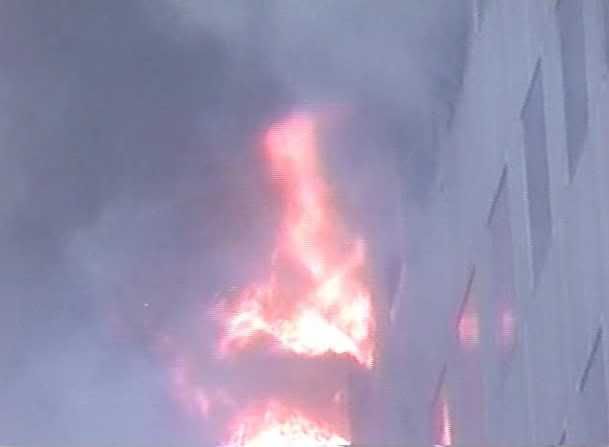
...As I stated above, your questions may - or may not - be relevant. Your questions are secondary to the fundamental questions, such as:
How can asymmetrical damage result in symmetrical collapse?
Fundamentals first.
Ah, here we have it, the crystalized moment that may neatly symbolize the difference between the way Truthers think and how the rest of us do. It's rare that it presents itself so obviously and unambiguously, so I feel an obligation to discuss it for a minute, even though that discussion may not be received in the way I might hope.
You say my questions may or may not be relevant. But you see,
they cannot not be relevant. Yes, that's a double negative, but there's no better way to express it. Every claim ever made by anyone anywhere carries with it a whole slew of connections and consequences that also must be true for that claim to be valid. For instance, suppose I were to suddenly announce "I am president of the U.S.!" For that claim to be true, a number of questions must be answered. What has become of George W? How did a complete nobody like me get elected (especially since it isn't even November)? How come no one has reported this amazing and unprecedented event? And so on. I can't just wave away those questions and say "Fundamentals first." If I want my claim to be taken seriously, I have to explain how that whole chain of questions can be answered. And here's the important part: If I can't answer
a single one of those questions, then my whole claim collapses like a house of cards. I can't just pick and choose what I feel like answering and what I don't. If just one of those followup questions cannot be answered, boom! there goes my claim.
Now back to Silverstein. OK, maybe "pull it" to some people in some very specific context means "demolish." But it can mean a whole lot of other things, most of which are far more likely in the situation Silverstein spoke the phrase. So at best, you have a tiny spot of gray on an otherwise black-and-white situation. But this immediately raises all sorts of followup questions -- each one of which must be answered, or all go out the window. You can't simply ignore it. And as I pointed out, those questions cannot be navigated by a reasonable mind and still at the end of the day conclude "pull it" has anything at all to do with demolition.
Since this responds to the original claim by the professor mentioned in the OP, I suppose I could end here. But since you've gone beyond this, I'll address what you feel is another anomaly, the fact that WTC7 collapsed at all. You dismiss the fact that virtually all the experts in the world accept the reason for collapse as structural damage and fire, stating that the majority is often wrong. But far more often, the majority is right! Simply being considered wrong by the majority gives you no special standing at all, since for every Galileo that turns out in the end to be right, there's 1000 Bozos that were wrong all along, like everyone thought. And when it comes to an expert majority, you're facing an uphill battle -- especially when you have zero evidence on your side, other than the fact that a large building collapsing is unusual. Well, guess what? September 11, 2001 was a highly unusual day. And implying that something has never happened before, so it couldn't possibly ever happen, is to say that nothing ever happens for the first time. Sure, first times can be surprising to some people -- but when there's a very rational explanation for the event, you don't have to invoke some unseen forces. And in the end, you still have all those other questions to answer.
So you see, building a case on what Silverstein may have meant when he said "pull it," or pointing out the obvious fact that large buildings don't collapse very often, is attempting to build something out of nothing. You have to answer all the questions -- every one of them -- because if even a single one of them is impossible to explain in Truther terms, the whole thing vanishes into thin air. It's all or nothing -- that's the way reality works.