Moderated WTC 1 features list, initiation model / WTC 2 features list, collapse model

Seymour Butz post 159: "Only in your imagination does your statements challenge NIST's."

Seymour, Only in you imagination and the imaginations of many others does the NIST description of the collapse initiation sequence match what is observed. This is provably so.

In reality there was less than 1 degree leaning of all vertical features during the initiation sequence, the antenna tilting at a different angle than the north wall, no measurable structural hinge at all, and the antenna leaned for over 9 seconds and visibly sagged about 2 feet before any downward perimeter movement was detected, including the SW corner.

This is the observable and measurable reality. Posters will have to mentally shut out these features, pretending they do not exist, to continue to believe the NIST description is correct.
 
This is the observable and measurable reality. Posters will have to mentally shut out these features, pretending they do not exist, to continue to believe the NIST description is correct.

You cannot visually document thermal induced creep.

You cannot challenge the load transfer estimates that NIST gives you.

You are the one that needs to deny this reality - that your visual analysis is virtually useless in an engineering report.

Your have self identified yourself as a "seeker of truth" about the events of 9/11. You cannot admit that you have wasted hundreds of hours counting pixels on a computer screen. You cannot admit that an engineering analysis trumps counting pixels every time.

You have wasted your life with this.

Therefore, you will deny reality until your autumn years, continuing to cry bout how perfect your analysis was.

You are deluding yourself.
 
Major Tom,

Please take your quarrel with Seymour Butz in a PM before you get an infraction or possibly banned. This is why Truthers can't control themselves. :rolleyes:
 
Seymour post 162: "You cannot visually document thermal induced creep."

You can document movement and slight movement or change in position in the pre-release region.

Seymour: "You cannot challenge the load transfer estimates that NIST gives you."

Since we see creep, sagging and downward movement in the antenna before any downward movement along the perimeter, including the SW corner, any load transfer equations that do not account for that will look pretty silly at this point. Are those the ones you mean? The ones that support south perimeter failure?

Seymour: "You are the one that needs to deny this reality - that your visual analysis is virtually useless in an engineering report."

The best documentation of WTC1 early movement, correct tilt angle and timing over which the initial failure occurred to date is considered virtually useless in an engineering report which predicts few of the observed features? Interesting viewpoint.

Your engineering reoprt and load transfer estimates trump what you can measure and see with your own eyes? And which of us is living in an abstract dream?

Your adulation of your chosen authorities and their theories have hypnotized you into blocking out from your mind what your own eyes can see. Why support a theory which does not match measurables and observables?
 
Last edited:
excasest002.gif


All you need do is compare antenna movement with movement of the SW corner fire and the distinct window washer device on the NW corner to see the basic early building movement with your own eyes.

Trace data takes this movement back to 9.5 seconds before visible collapse., when it first became detectable.

Using key points on the antenna, SW corner fire, NW corner and NE corner allows anyone to determine that the early movement is of a concave deformation of the roof.

Not rocket science, so how can so many people still pretend the observed movement doesn't exist?

This is a psychological question. If you cannot acknowledge features exist, debating the internal inconsistencies can be avoided.
 
Last edited:
All you need do is....
Not rocket science, so how can so many people still pretend the observed movement doesn't exist?

This is a psychological question. If you cannot acknowledge features exist, debating the internal inconsistencies can be avoided.
That is the problem, it is rocket science and you don't have the degree needed to understand the event so you make up delusions.

Explain in detail how this supports your delusion of CD. Use some math and differential equations to help.
 
Here are NIST's conclusion for WTC1.

I've copied them for you directly from NCSTAR1-6D, Chapter 5, pg. 313-314.

I've numbered each.

Now you can take each of your observations and tell us: "This observation negates NIST's claim(s) A13 & C4 because …"

And then explain clearly & precisely why, of course.

___

Aircraft Impact
A1. The aircraft impacted WTC 1 at the north wall.

A2. The aircraft severed or heavily damaged Columns 112 to 151 between Floors 94 and 98 on the north wall.

A3. After breaching the building’s perimeter, the aircraft continued to penetrate into the building.

A4. The north office area floor system sustained severe structural damage between Columns 112 and 145 at Floors 94 to 98.

A5. Core Columns 503, 504, 505, 506, 604, 704, 706, 805, and 904 were severed or heavily damaged between Floor 92 and Floor 97.

A6. The aircraft also severed a single exterior panel at the center of the south wall from Columns 329 to 331 between Floor 93 and Floor 96.

A7. In summary, 38 of 59 columns of the north wall, three of 59 columns of the south wall, and nine of 47 core columns were severed or heavily damaged.

A8. In addition, thermal insulation on floor framing and columns was also damaged from the impact area to the south perimeter wall, primarily through the center of WTC 1 and over one-third to one-half of the core width.

A9. Figures 2–2, 2–14, and 2– 18 summarize aircraft impact damage to exterior and core columns and floors of WTC 1.

A10. Gravity loads in the columns that were severed were redistributed, mostly to the neighboring columns.

A11. Due to the severe impact damage to the north wall, the wall section above the impact zone moved downward as shown in Figs. 4–9 and 4–13.

A12. The hat truss resisted the downward movement of the north wall and rotated about its east-west axis, which reduced the load on the south wall.

A13. As a result, the north and south walls each carried about 7 percent less gravity loads at Floor 98 after impact, the east and west walls each carried about 7 percent more loads, and the core carried about 1 percent more gravity loads at Floor 98 after impact (Table 5–3).

A14. Column 705 buckled, and Columns 605 and 804 showed minor buckling.


Unloading of Core
B1. Temperatures in the core area rose quickly, and thermal expansion of the core was greater than the thermal expansion of the exterior walls in early stages of the fire.

B2. This increased the gravity loads in the core columns until 10 min after impact (Table 5–3).

B3. The additional gravity loads from adjacent severed columns and high temperatures caused high plastic and creep strains to develop in the core columns in early stages of the fire.

B4. More columns buckled inelastically due to high temperatures.

B5. Creep strain continued to increase to the point of collapse (see Fig. 4–81).

B6. By 30 min, the plastic-plus-creep strains exceeded thermal expansion strains.

B7. Due to high plastic and creep strains and inelastic buckling of core columns, the core columns shortened, and the core displaced downward.

B8. At 100 min, the downward displacement of the core at Floor 99 became 2.0 in. on the average, as shown in Fig. 4–37.

B9. The shortening of core columns was resisted by the hat truss, which unloaded the core over time and redistributed the gravity loads from the core to the exterior walls, as can be seen in Table 5–3.

B10. As a result, the north, east, south, and west walls at Floor 98 carried about 12 percent, 27 percent, 10 percent, and 22 percent more gravity loads, respectively, at 80 min than the state after the impact, and the core carried about 20 percent less loads as shown in Table 5–3.

B11. The net increase in the total column load on the south wall, where exterior wall failure initiated, was only about 10 percent due to the downward displacement of the core (see Fig. 5–3).

B12. At 80 min, the total core column loads reached their maximum.

B13. As the floor pulled in starting at 80 min on in the south side, the south exterior wall began to shed load to adjacent walls and the core.


Sagging of Floors and Floor/Wall Disconnections
C1. The long-span trusses of Floor 95 through Floor 99 sagged due to high temperatures.

C2. While the fires were on the north side and the floors on the north side sagged first, the fires later reached the south side, and the floors on the south side sagged.

C3. Figure 5–4 shows vertical displacements of Floors 95 through 98 determined by the full floor models at 100 min.

C4. Full floor models underestimated the extent of sagging because cracking and spalling of concrete and creep in steel under high temperatures were not included in the floor models, and because the extent of insulation damage was conservatively estimated.

C5. The sagging floors pulled in the south wall columns over Floors 95 to 99.

C6. In addition, the exterior seats on the south wall in the hot zone of Floors 97 and 98 began to fail due to their reduced vertical shear capacity at around 80 min, and by 100 min about 20 percent of the exterior seats on the south wall of Floors 97 and 98 failed, as shown in Figs. 5–4 and 5–5.

C7. Partial collapse of the floor may have occurred at Floors 97 and 98, resulting from the exterior seat failures, as indicated by the observed smoke puff at 92 min (10:19 a.m.) in Table 5–2, but this phenomenon was not modeled.


Bowing of South Wall
D1. The exterior columns on the south wall bowed inward as they were subjected to high temperatures, pull-in forces from the floors beginning at 80 min, and additional gravity loads redistributed from the core.

D2. Figure 5–6 shows the observed and the estimated inward bowing of the south wall at 97 min after impact (10:23 a.m.).

D3. Since no bowing was observed on the south wall at 69 min (9:55 a.m.), as shown in Table 5–2, it is estimated that the south wall began to bow inward at around 80 min when the floors on the south side began to substantially sag.

D4. The inward bowing of the south wall increased with time due to continuing floor sagging and increased temperatures on the south wall as shown in Figs. 4–42 and 5–7.

D5. At 97 min (10:23 a.m.), the maximum bowing observed was about 55 in. (see Fig. 5–6).


Buckling of South Wall and Collapse Initiation
E1. With continuously increased bowing, as more columns buckled, the entire width of the south wall buckled inward.

E2. Instability started at the center of the south wall and rapidly progressed horizontally toward the sides.

E3. As a result of the buckling of the south wall, the south wall significantly unloaded (Fig. 5–3), redistributing its load to the softened core through the hat truss and to the south side of the east and west walls through the spandrels.

E4. The onset of this load redistribution can be found in the total column loads in the WTC 1 global model at 100 min in the bottom line of Table 5–3.

E5. At 100 min, the north, east, and west walls at Floor 98 carried about 7 percent, 35 percent, and 30 percent more gravity loads than the state after impact, and the south wall and the core carried about 7 percent and 20 percent less loads, respectively.

E6. The section of the building above the impact zone tilted to the south (observed at about 8 ̊, Table 5–2) as column instability progressed rapidly from the south wall to the adjacent east and west walls (see Fig. 5–8), resulting in increased gravity load on the core columns.

E7. The release of potential energy due to downward movement of building mass above the buckled columns exceeded the strain energy that could be absorbed by the structure.

E8. Global collapse ensued.

 
Tom, for completeness th3ere are a few more items to add to youir list. You forgot about the items in bold.


1-6D, pg 314:

Bowing of South Wall

The exterior columns on the south wall bowed inward as they were subjected to high temperatures, pull-in forces from the floors beginning at 80 min, and additional gravity loads redistributed from the core. Figure 5–6 shows the observed and the estimated inward bowing of the south wall at 97 min after impact (10:23 a.m.). Since no bowing was observed on the south wall at 69 min (9:55 a.m.), as shown in Table 5–2, it is estimated that the south wall began to bow inward at around 80 min when the floors on the south side began to substantially sag. The inward bowing of the south wall increased with time due to
continuing floor sagging and increased temperatures on the south wall as shown in Figs. 4–42 and 5–7. At 97 min (10:23 a.m.), the maximum bowing observed was about 55 in. (see Fig. 5–6).

Buckling of South Wall and Collapse Initiation

With continuously increased bowing, as more columns buckled, the entire width of the south wall buckled inward. Instability started at the center of the south wall and rapidly progressed horizontally toward the sides. As a result of the buckling of the south wall, the south wall significantly unloaded (Fig. 5–3),
redistributing its load to the softened core through the hat truss and to the south side of the east and west walls through the spandrels. The onset of this load redistribution can be found in the total column loads in the WTC 1 global model at 100 min in the bottom line of Table 5–3. At 100 min, the north, east, and
west walls at Floor 98 carried about 7 percent, 35 percent, and 30 percent more gravity loads than the state after impact, and the south wall and the core carried about 7 percent and 20 percent less loads, respectively. The section of the building above the impact zone tilted to the south (observed at about 8°,
Table 5–2) as column instability progressed rapidly from the south wall along the adjacent east and west walls (see Fig. 5–8), resulting in increased gravity load on the core columns. The release of potential energy due to downward movement of building mass above the buckled columns exceeded the strain
energy that could be absorbed by the structure. Global collapse ensued.


1-6draft, p 288, Table 9-5 titled "Observations for WTC1", fifth entry:
and
1-6D, p 312, Table 5-2, last entry

Tower began to collapse – first exterior sign of collapse was at
Floor 98. Rotation of at least 8 degrees to the south occurred before
the building section began to fall vertically under gravity.

1-6draft p 290, figure 9-8 on probable collapse initiation sequence for WTC1:

3. Collapse Initiation
• The inward bowing of the south wall induced column instability, which progressed rapidly horizontally across the entire south face.
• The south wall unloaded and tried to redistribute the loads via the hat truss to the thermally weakened core and via the spandrels to the adjacent east and west walls.
The entire section of the building above the impact zone began tilting as a rigid block (all four faces; not only the bowed and buckled south face) to the south (at least about 8º) as column instability progressed rapidly from the south wall along the adjacent east and west walls.
• The change in potential energy due to downward movement of building mass above the buckled columns exceeded the strain energy that could be absorbed by the structure. Global collapse then ensued.

1-6draft, p 294:

Buckling of South Wall and Collapse Initiation

The inward bowing of the south wall increased as the post-buckling strength of bowed columns continued to reduce. The bowed columns increased the loads on the unbuckled columns on the south wall by shear transfer through the spandrels. Consequently instability progressed horizontally, and when it engulfed the entire south wall, it progressed along the east and west walls. Moreover, the unloading of the south wall resulted in further redistribution of gravity loads on the south wall to the east and west walls and to the thermally weakened core via the hat truss. At 100 min, the north, the east, and the west walls at Floor 98 carried about 7 percent, 35 percent, and 30 percent more gravity loads than the state after impact, and the south wall and the core carried about 7 percent and 20 percent less loads, respectively. The section of the building above the impact zone began tilting to the south at least about 8° as column instability progressed rapidly from the south wall along the adjacent east and west walls, as shown in Fig. 9–13. The change in potential energy due to downward movement of building mass above the buckled columns exceeded the strain energy that could have been absorbed by the structure. Global collapse ensued.


1-6draft, p 317:

Finding 26: The WTC 1 building section above the impact and fire area tilted to the south as the structural collapse initiated. The tilt was toward the side of the building that had the long span floors. Video records taken from east and west viewpoints showed that the upper building section tilted to the south. Video records taken from a north viewpoint showed no discernable east or west component in the tilt. A tilt to the south of at least 8 degrees occurred before dust clouds obscured the view and the building section began to fall downwards.

>>>>>>>>>>>>>>>>>

You cannot choose some NIST observations and ignore others. Please include these NIST quotes on your list. If you do not, you prove my point about people who mentally block out facts that they do not want to see or address.

Your list must be an accurate representation of the NIST's claims, not a list trimmed to bolster your subjective viewpoint.
 
1-6draft, p 317:


Finding 26: The WTC 1 building section above the impact and fire area tilted to the south as the structural collapse initiated. The tilt was toward the side of the building that had the long span floors. Video records taken from east and west viewpoints showed that the upper building section tilted to the south. Video records taken from a north viewpoint showed no discernable east or west component in the tilt. A tilt to the south of at least 8 degrees occurred before dust clouds obscured the view and the building section began to fall downwards.

So, MT, at what angle do you think the dust clouds obscured the view?
 
Reactor Drone,

3rd Hardfire debate between Tony Szamboti and R Mackey:

http://www.youtube.com/watch?v=kDvDND9zNUk

At 11:35 R Mackey shows a graphic of WTC1 tilting 8 degrees about a north wall pivot axis. He says this is how the NIST describes WTC1 collapse initiation.

Reactor Drone, do you think R Mackey is wrong? Is he misinterpreting the NIST quotes while you are interpreting them correctly?
 
Please note that at the 14:50 mark in the Hardfire debate, R Mackey shows a set of graphics by the noble Greg Urich. These images also show progressive hinged tilt from 0 to 8 degrees.

How did both Greg Urich and R Mackey get that crazy 8 degree tilt idea?

Reactor Drone, do R Mackey and Greg Urich misunderstand the NIST description of WTC1 tilt? Are they wrong while you are correct?
 
Here is the graphic R Mackey presents in Hardfire, at the 11:35 mark.

139482298.png


Please listen to his explanation around the 11:35 mark and the 14:50 mark.

Is he wrong to visualize the NIST collapse initiation description this way? It seems to me he correctly drew it just as the NIST describes it.

I think Gregory Urich drew the NIST description correctly, too.


Both R Mackey and Greg Urich read the NIST report and drew their visualizations just as the NIST described.


Reactor Drone and TFK, maybe if you just draw a sketch like they did of how you read the NIST's WTC1 geometry, tilting and falling motion, we can spot the differences between your interpretations and the Mackey interpretation. Please provide a visual which includes that important interaction between cloud and antenna that, according to you, the NIST mentions 4 times, while totally omitting the tilt angle over which the columns originally failed from their report.
 
Last edited:
personally I think the 8° is pretty accurate. I did a measurement myself and got 7.8°.

revisedcalmesant.jpg


I believe your own data supports this but you're not reading it right. Examining your drop data/rotation curves here you say the measured points obviously don't move together but adjusting the scale so that 1° =0.5s ( a figure you provided) shows the graphs lining up almost perfectly. Further more it shows the roofline still following a slow rotaion drop well beyond the 3.6 degrees of tilt (when the blue roof-ball1 line hits 12.5m ), a drop of barley 1 pixel in the Sauret footage. From this, the nist report and my own measurement I believe the 8° figure is much more accurate than your 1° claim.
 
"You always have the same frame twice?" :confused:
At 30FPS for HD each frame is split into two which gives you 60FPS.
1080p (progressive scan)
60FPS each full frame is repeated.
1080I (interlaced)
60FPS but each frame contains only half the picture so when you combine them at 30FPS you get the full picture per frame. (using less bandwidth, noticeable only on larger TVs)
 
Reactor Drone, we are measuring tilt angle of the antenna and the north wall at the time that the NW corner fails. We must first know in what frame the NW corner failed.

messpunkte.png


We measure south antenna tilt by measuring how the distance between the pink and blue markers on the antenna changes (a-b)

We measure the north wall tilt by measuring how the distance between the yellow marker and the 98th floor changes (r-98).

We want to measure these 2 quantities at the time the NW corner fails, at about frame 224.

You are trying to measure tilt using the quantity b-r at about frame 300? Two problems: b-r doesn't measure tilt if the antenna and NW corner do not move as two points on a rigid body. If the antenna sags into the perimeter, b-r cannot measure a real angle. If points b and r do not remain rigid relative to each other, b-r cannot be used to measure tilt like you are doing.

Please ask yourself what the south tilt angle of the antenna is in about frame 224. That is your real antenna tilt angle. It is quantity a-b. Just project the value of a-b in frame 224 to the angle vs drop chart on the left to get the real angle. You will find it is within 1 degree.

Also, please ask yourself what the north wall tilt angle is around frame 224. That is your real north wall tilt angle. You will find it is less than the antenna tilt at that moment.

The north wall or antenna tilt are nowhere close to 8 degrees when the NW corner fails. They are less than 1 degree. Use quantities a-b and r-98 around fram 224 to determine the real tilt of real objects. Don't use b-r because one point is on the roof and one is on the antenna. If the antenna sags into the roofline, which it does as shown below, b-r cannot be used to measure tilt of anything.

You are using b-r at about frame 300. Why b-r? Why frame 300?
>>>>>>>>>>.

This graph tracks a point on the antenna (yellow) and a point on the NW corner (blue). Notice that the antenna has already sagged considerably before the NW corner starts to move downward. The two points are not moving together as points on a rigid body. We can see that the failure point of the NW corner is around frome 224 because the velocity curve starts to take off at that moment.

image00029.png


We can see the yellow line begins to slowly move downward about frame 135 but the NW corner does not begin to slowly move downward until about frame 215. We can tell from the antenna velocity curve that the antenna downward velocity does not take off unti about frame 215

If the antenna and NW corner points rotate together as if on a rigid body, then what is all that antenna movement before frame 215? This antenna movement between frame 130 and 215 is even visible to the naked eye and we can see the NW corner and SW corner are not moving with the antenna.

This 2 ft antenna sag between frames 130 and 215 without any downward movement of the NW corner is the reason we cannot use a point on the antenna and another on the perimeter to measure the true tilt. You cannot use b-r to measure tilt because the antenna is moving relative to the perimeter, but you can use a-b for antenna tilt and r-98 for north wall tilt until frame 224.

If you do that you get the correct angles of objects in frame 224, when the NW corner fails.
 
Last edited:
At 30FPS for HD each frame is split into two which gives you 60FPS.
1080p (progressive scan)
60FPS each full frame is repeated.
1080I (interlaced)
60FPS but each frame contains only half the picture so when you combine them at 30FPS you get the full picture per frame. (using less bandwidth, noticeable only on larger TVs)

Right and thanks for clarifying. The video that these guys are analyzing is from 2001, which means it was most like a Beta that has been converted God knows how. There is no chance it was 1080p, so how could there possibly be "the same frame twice" in the video in question? Just curious.

Again, I reiterate for Major_Tom and femr2 - you are counting the number of angels dancing on the head of a pin. Displacement activity, rather than real world stuff. What you are doing is no different than the JFK or bigfoot people "seeing" things in blurry still photos. The only difference is that it is motion video vs. stills. The outcome is still the same -- your work has zero effect on the real world.
 
Why support a theory which does not match measurables and observables?

Because visual observables are worthless.

You cannot visually document creep of the columns.

Your view of what failure means is limited to what results in a quick, observable movement that was captured on video.

Column failure may result in absolutely zero visual clues.

You fail.

And will continue to fail.

Remember this when you're old and gray.
 
Because visual observables are worthless.
Nonsense.

You cannot visually document creep of the columns.
Then IB does not exist then eh ?

Your view of what failure means is limited to what results in a quick, observable movement that was captured on video.
Nonsense.

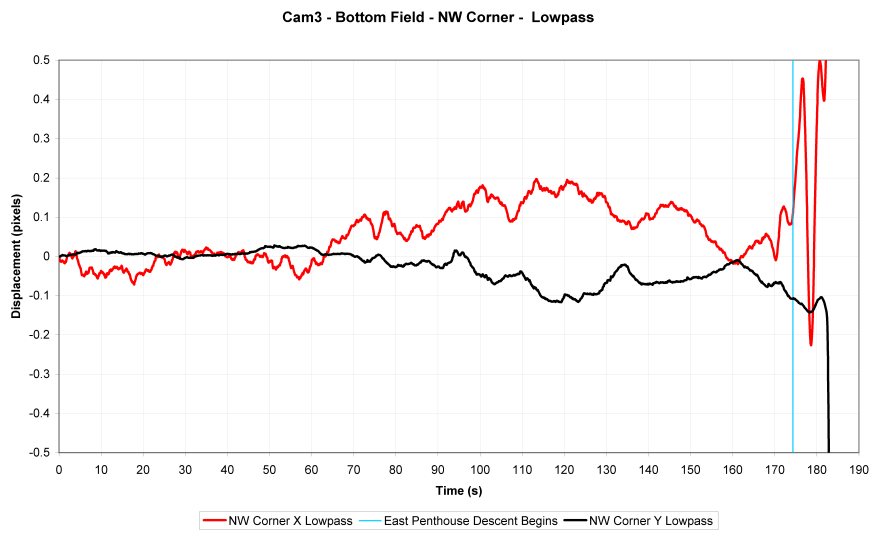
666377698.png


A trace of WTC 7 movement over a ~3 minute period. 0.1 pixel ~= 2 inch.

Not quick. Not observable by eyeballing.
 
Then IB does not exist then eh ?

What are ALL of the columns doing?

Which have unloaded due to creep?

Which are NOW approahing ultimate load bearing capacity due to that load transfer?

You goombas have no idea.

A trace of WTC 7 movement over a ~3 minute period. 0.1 pixel ~= 2 inch.

Not quick. Not observable by eyeballing.

Hooray.

You can discern gross movements of the entire building. You proved my point, moron, cuz you have zero analysis that shows what failed first, etc that results in that movement.

Your failure will escape you, just like MT's.
 
What are ALL of the columns doing?
No idea. Simply pointing out the stupidity of your comment, which results in a FTFY for your original verbage...

You can visually document creep of columns.

In addition, by gathering information it is trivially simple to make very valid inference about what other building elements must be undergoing. For example, descent of the antenna must involve movement of something underneath it. Thinking through implications for the hat truss reduces possibilities.

You can discern gross movements of the entire building.
Extremely fine movement of multiple individual building elements separately.

Not quite getting this, are you.

You proved my point, moron
Nonsense suffixed with childish name-calling. A sure sign of hand-waving and weak position.

cuz you have zero analysis that shows what failed first, etc that results in that movement.
Hello ? Entire thread, multiple threads over at the911forum. Just because you choose to ignore such doesn't mean it doesn't exist.
 

Back
Top Bottom