Moderated WTC 1 features list, initiation model / WTC 2 features list, collapse model

There seems to be an incredibly low attention span.

I suggest you start with point #1, gather agreement/disagreement, then move to point #2.

Won't be possible without some kind of moderation, as there is not likely to be many local members prepared to have an opinion on even the simplest of observations. Quite why is beyond me. The noise level is already pretty high.
I think you need to put all these together (side by side) with what NIST describes in a uniform time line. Then show how some of these "sub-pixel" movements actual mean something.
 
I think you need to put all these together (side by side) with what NIST describes in a uniform time line.
Do you have any issues with any of the items listed by MT, or not ?

Then show how some of these "sub-pixel" movements actual mean something.
These observations don't really need too much in the way of *sub pixel movement* tracing.

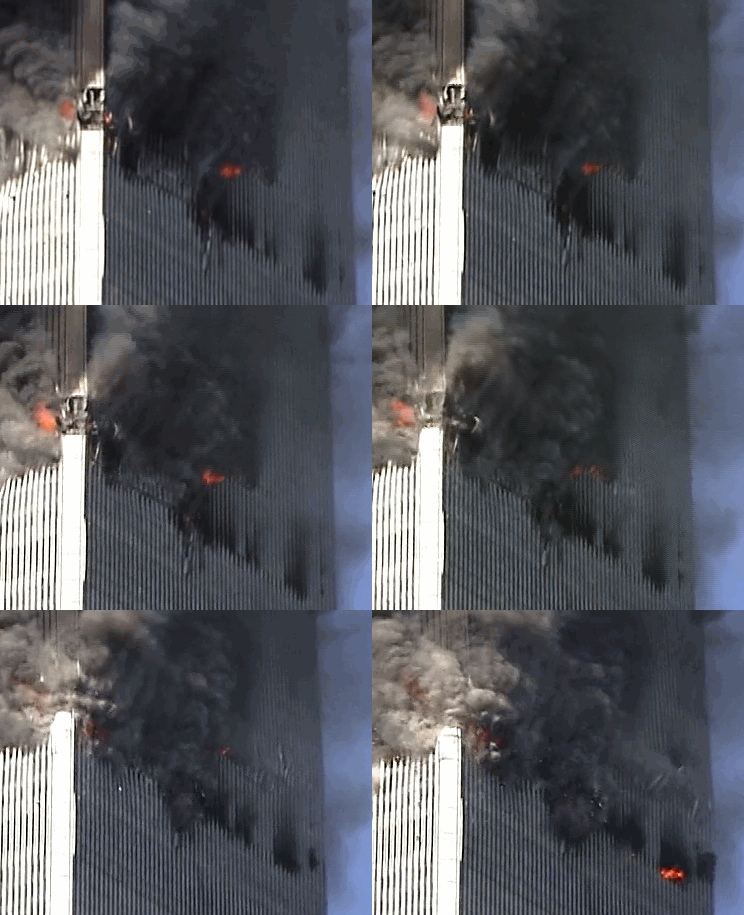
Take the image I just posted a few minutes ago...

437537321.png


Any observations you could make about it ?
 
Do you have any issues with any of the items listed by MT, or not ?


These observations don't really need too much in the way of *sub pixel movement* tracing.

Take the image I just posted a few minutes ago...

[qimg]http://femr2.ucoz.com/_ph/6/437537321.png[/qimg]

Any observations you could make about it ?

I can. You are wasting your life on trivia.
 
So that's 2 calls for you to produce some data of your own, rather than waving your hands around, for you to turn around and ignore the request. Great stuff tfk.

Here's a quick draft for ya. Takes very little effort...

http://femr2.ucoz.com/_ph/6/437537321.png

Note the green line eh.

30*1000/1001 fps by the way ;)

You can make as many calls for me to produce data as you want. This is YOUR hobby, not mine.

I've got other things taking up my time.

Meanwhile, yours is a typically useless response.

Until you explain exactly how you determined all of your data.
AND produce the curves prior to that point as well.

I'm not interested in the prospect of trying to draw out of you all the details that you should provide right off the bat.

And this is exactly why you'll have to get someone else to annoy.
 
Do you have any issues with any of the items listed by MT, or not ?
I don't know. You guys post too many graphs and GIF that unless you've been following every bit of your details it becomes confusing to the point of uselessness.


These observations don't really need too much in the way of *sub pixel movement* tracing.

Take the image I just posted a few minutes ago...

[qimg]http://femr2.ucoz.com/_ph/6/437537321.png[/qimg]

Any observations you could make about it ?


Perfect example. What's exactly is your point? I know exactly nothing about "pixels" as they relate to the real world. If your trying to convince scientist write a scientific paper, For the rest of us , get to the point. Put your findings side by side and explain how your observations are not related to the larger observations that NIST describes.
 
Produce your data on the smoke exhaust timing vs. the fire downward motion timing.
...et voila...
http://femr2.ucoz.com/_ph/6/437537321.png

Meanwhile, yours is a typically useless response.
It's exactly what you requested Tom.

I know you can clearly see why I've posted it for you. I've shown you that your hand-waving assertion that the smoke ejecta began at the same time as the fire moved downwards is pure bunkum. Perhaps time to stop waving your hands around Tom. Reminds me of that oft-used phrase...

"Oh, it looks like..."

Tell you what, Here's another couple of trivially simple observations from the supplied graph...

1) Antenna first.
2) Then fire.
3) Then NW Corner.

Care to hazard a guess at what that could imply for initiation sequencing ?
 
I don't know. You guys post too many graphs and GIF that unless you've been following every bit of your details it becomes confusing to the point of uselessness.

Eh ? There's a list of 40 links in the OP.

Simply follow the link and if you disagree with any of the observations, say so and why.

Simple enough.
 
Kind of a funny exchange we are having. I am trying to get you to acknowledge what actually exists (in the forum of a feature list) and you are trying to find ways to not notice the events that actually happened.

Kind of sums up the whole "debate" for me. You prefer a fantasy NIST approved conception of collapse initiation to looking at the real thing in images and data.

I often see that posters have a preference for abstract fantasy over visual evidence and actual measurements. This is the hardest barrier to cross in this forum, the preference for NIST interpretations over what we can measure for ourselves and see with our own eyes.

It's a colossal waste of time to do it the way you suggest.

First give some indication (thru your logic) that investigating any particular parameter is worth the time. Do this by showing that the measurement plays some role in your "NIST got it wrong" thesis.

It's simple:

Tell us what you intend to prove & why it's significant.
Prove it.
Synopsize.
 
Eh ? There's a list of 40 links in the OP.

Simply follow the link and if you disagree with any of the observations, say so and why.

Simple enough.
I did follow the links. I found it painful and very difficult to follow. Most of the observations are self evident. Personally I don't have the time to study every pixel of the towers if I'm not convinced there's any reason to doubt the only logical explanation as to why the towers fell, NIST's.

That's why I said put it side by side and explain how it's not a consequence or effect of the larger events NIST points out.

As tfk said "this is not my hobby" It's your job to show how all this actually matters.
 
...et voila...
http://femr2.ucoz.com/_ph/6/437537321.png


It's exactly what you requested Tom.

I know you can clearly see why I've posted it for you. I've shown you that your hand-waving assertion that the smoke ejecta began at the same time as the fire moved downwards is pure bunkum. Perhaps time to stop waving your hands around Tom. Reminds me of that oft-used phrase...

"Oh, it looks like..."

Tell you what, Here's another couple of trivially simple observations from the supplied graph...

1) Antenna first.
2) Then fire.
3) Then NW Corner.

Care to hazard a guess at what that could imply for initiation sequencing ?

It's not what I requested. You apparently can't read.

And it ain't my job or my inclination to try to pull information out of you.

I gave you exactly what I think is the reason that I consider the curve you posted as "useless". It followed the word "Until..." in my previous post.

You chose to ignore it, while posting snark.
Your typical crappola.

Meanwhile, I have made no assertions on this issue. You have.

I said that it looks to me (by eyeball) that the fire starts down earlier than the SUDDEN INCREASE IN smoke ejecta begins.

You assert otherwise.

Prove it.

Or don't.

I don't care.

Post what you think it means in a competent "if this, then that" outline.

Or don't.

I don't care.


BTW, this is precisely why I asked you to detail how you determine your data. There is zero way that the sudden increase started 2 full seconds before the fire started to descend, as your graph states.

Your typical obfuscation, misdirection, abysmal definition of terms or events.
 
Last edited:
Most of the observations are self evident.
Exactly. It's not complicated. Very simple observations.

Are there any you disagree with ?

Personally I don't have the time to study every pixel of the towers
There's no need for you to so. As above, the observations really are quite simple and, as you say, self-evident.

It's easy to assume this is more complicated than it is due to the frankly disturbing level of overcomplication some other posters are seemingly obsessed with.

if I'm not convinced there's any reason to doubt the only logical explanation as to why the towers fell, NIST's.
Is that conclusion simply *fire weakened structure* ? If it's more complex than that, then you're talking about the NIST specific initiation scenario. If the NIST initiation scenario is shown to be wrong, what's your viewpoint... ?

That's why I said put it side by side and explain how it's not a consequence or effect of the larger events NIST points out.
Well it's not up to me to drive MT's thread, but as he stated above, once there's a general agreement that the simple list of observations are not *fiction* then such can progress.

It stops that convenient circular discussion where, once observations are correlated arguments ensue about the validity of the original observations.

So, any problem with any of the basic observations ?

It's your job to show how all this actually matters.
Nope, it's a discussion thread.
 
I said that it looks to me (by eyeball) that the fire starts down earlier than the SUDDEN INCREASE IN smoke ejecta begins.

ROFL.

No, Tom, you said...

Failures that happened further away from the window would have produced longer delays. But in ALL cases, some part of the upper portion of the towers HAD to have begun to collapse BEFORE the smoke began to pour out of the window.

My eyes confirm this when looking at your video. (http://img690.imageshack.us/img690/9109/femrnew.gif) With a margin that doesn't require video analysis.

The ball of fire clearly (to me) begins to descend BEFORE, not after, the smoke begins to get pushed out of the windows. My reference is your red arrow moving across the screen. The point at which the smoke starts pouring out has the arrow at a significantly later point in its motion than when the fire begins to descend.

This negates the comment that Major Tom made that "the smoke begins emerging before any part of the periphery of the building begins to descend.

You are free to offer your speculation as to how what Major Tom said could be correct: that the smoke began pouring out before any downward motion of the periphery of the building. But your own gif video seems to dispute that.


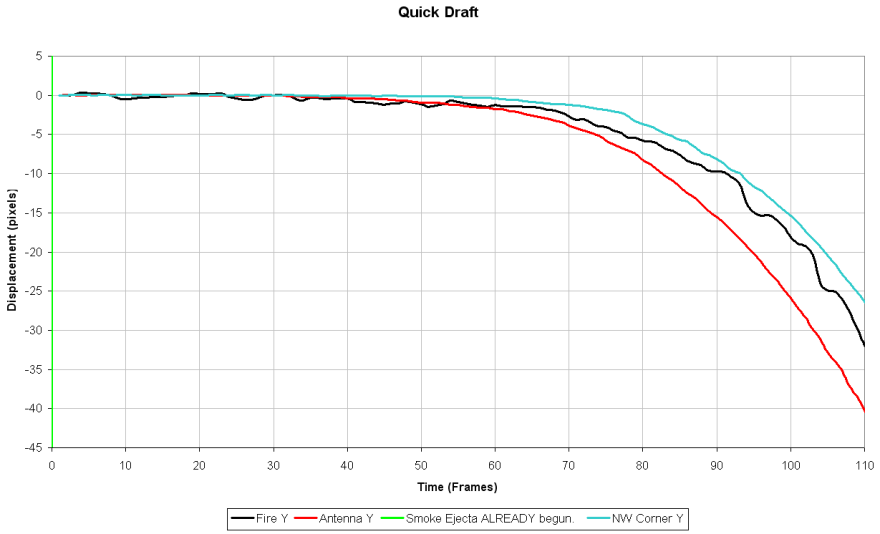
And so, I offered you visual positional trace graph data to show you what Major Tom said was correct: that the smoke began pouring out before any downward motion of the periphery of the building...

Said graph.

You assert otherwise.
I don't only assert, I provide you with vertical position/time data.

BTW, this is precisely why I asked you to detail how you determine your data.
Read femr2 video data analysis thread from the beginning again Tom. You are a funny laddy at times.

There is zero way that the sudden increase started 2 full seconds before the fire started to descend, as your graph states.
Did you have a particular waft of smoke in mind ? :)
Looks that way. You'll argue with your own shadow on that front I'm sure, so tell you what. Grab the GIF, grab the frame you think the smoke ejecta starts on. Stick a red arrow pointing at it. Then you'll have no room for confusion. Without that, you are waving your hands at a random bit of smoke you're not willing to specify.

Get on with it Tom, or bow out again.

(Oh, btw, what makes you think the arrow indicates the point in time that specific smoke is ejected ? Bothered to look in any detail whatsoever ?)
 

ROFL all you want.
ROFL for another decade of failed "sub-pixel analysis". Signifying nothing.

No, Tom, you said...

tfk said:
The ball of fire clearly (to me) begins to descend BEFORE, not after, the smoke begins to get pushed out of the windows. My reference is your red arrow moving across the screen. The point at which the smoke starts pouring out has the arrow at a significantly later point in its motion than when the fire begins to descend.

This negates the comment that Major Tom made that "the smoke begins emerging before any part of the periphery of the building begins to descend.

[emphasis added]

You'll excuse me. I assumed that, since smoke had been pouring out of it the building for almost 2 hours at this time, you'd realize that the "begins to get PUSHED out of the windows" would refer to the sudden increase in smoke.

Apparently I overestimated...

And so, I offered you visual positional trace graph data to show you what Major Tom said was correct: that the smoke began pouring out before any downward motion of the periphery of the building...

Said graph.

It's obvious what you mean by your interpretation of the gif.
It's obvious to me what I mean in my interpretation of the same gif.

My interpretation of when the smoke starts pouring out is different than yours. And my eyes served me just fine in producing the timing for MY interpretation of the gif.

This is exactly why I suggested - twice, and twice ignored by you - that you clarify how you determined your start point.

Why don't you do YOUR job & explain YOUR data now. But being clear ain't your style, is it.

Read femr2 video data analysis thread from the beginning again Tom.

Not a snowball's chance in hell.

You don't want to make your case, that's perfectly fine with me.

Did you have a particular waft of smoke in mind ?
Looks that way. You'll argue with your own shadow on that front I'm sure, so tell you what. Grab the GIF, grab the frame you think the smoke ejecta starts on. Stick a red arrow pointing at it. Then you'll have no room for confusion. Without that, you are waving your hands at a random bit of smoke you're not willing to specify.

Get on with it Tom, or bow out again.

Your hobby. Your passion. Your past time. Your delusion.

YOU do YOUR work.

Or not.

I'll sit here & giggle.
 
TFK, in your last post you prove why looking at these events is important. You make so many mistakes in your observations, yet are clearly ignorant that you are making mistakes.

You have no clue what actually happened during the collapse initiation sequence and the events leading up to it. You prove it constantly by making mistakes.

Many other posters may not notice how many mistakes you make because they, like you, have absolutely no clue what actually happened during the intiation sequence.

Not only that, but when you are shown what are maybe the first correct measurements of the initiation sequence you have ever seen, you are puzzled as to why it matters.

Do you have any clue that the 95th floor ejections started earlier than the 98th fl ejections in the same gif you are looking at? It is on the features list.

How can you be so ignorant that you don't even know where the first ejections emerge in a gif that is right in front of your face??????

How many years of comments and you don't even know where the first visible ejections emerge? Please enlighten us as to why 95th floor ejections at that time are consistent with the NIST description of initiation.

You didn't even know the existed so how could you answer??

You are the perfect example as why a list of real attributes and accurate measurements are important.


The list is a list, nothing more. My claim is that the list is correct. You have yet to show one particular attribute that has been described incorrectly.

If the features on the list are correct, perhaps even a well-trained monkey can spot which attributes contradict the NIST conclusions in a fundamental way.

The number of attributes that contradict a south perimeter-led collapse on the list is a bit overwhelming. You can't figure out the differences between the NIST conclusions and the actual recorded features by yourself?

You seriously cannot figure out how the listed features contradict the NIST description of events? You hide in your own ignorance of the initiation sequence and demand I explain to you what is already clear in visual evidence and measurements?


We'll go over the features one by one if necessary.
 
Last edited:
We also see sharp pressure pulses in WTC2 before any slab movement can explain them

Please notice what happens across the north face as the building just starts to tip:

Luigi_Cazzaniga_47.gif


The best clip of the event is here:
http://www.youtube.com/user/femr2?&MMN_position=312:312#p/u/5/wbDmofuyqp0


If we look for the first dust ejections in the images below, we can see that the tilt angle was still minimal when these sharp pulses were seen progressing westward along a single floor assembly. The pulses are so powerful that we see the shock through the aluminum facade. There is virtually no tilt during this interval as verified below:

collapse9smhj6.jpg


So both towers experience forceful over-pressurization with no or little movement during the initial column failure sequence.
 
Last edited:
For the most part the list describes well known collapse features, you even use NIST quotes to indicate some of the events. Much of your commentary and conclusions seem to be poorly backed up with evidence and what evidence you do try and present is often lacking adequate detail, with graphs having inadequate labeling and seemingly random start points on frames.There's generally no attempt to link events to a standard time, even when using the same footage for different features.

revisedimage00001.jpg


Above is an example of one of your graphs with an altered version below it for comparison. In this graph a predicted plot of points on a rotating building is compared to your trace data. Due to the use of different scales for time the graphs, as presented, displayed a marked difference but when changed to give matching scales on both axes present strong support for rotation being the main cause of the antenna "drop".

I don't know whether this is part of a deliberate attempt to deceive or just a lack of effort on your part but it doesn't help your case.
 
once there's a general agreement that the simple list of observations are not *fiction* then such can progress.

This is a lie.

You 2 do NOT need our agreement to expose your cd delusions.

MT has definitely already done that by postulating that the core columns being unbolted as the only viable explanation for the collapse.
 
If we look for the first dust ejections in the images below, we can see that the tilt angle was still minimal when these sharp pulses were seen progressing westward along a single floor assembly. The pulses are so powerful that we see the shock through the aluminum facade. There is virtually no tilt during this interval as verified below:

[qimg]http://www.sharpprintinginc.com/911/images/pagemaster/collapse9smhj6.jpg[/qimg]


Those images clearly show an easily noticeable (and therefore structurally significant) tilt in the third frame. Every column visible in the top half of the frame is bent to the left relative to its bottom half. This differs from the two earlier frames (and hence, is not a photographic artifact), and it becomes progressively more pronounced in the subsequent frames. (Note that this does not mean that there is no tilting in the second or first frame, just that it is not as evident on casual examination; there could be some tilting that would require more precise measurement techniques to reveal. Using a good straightedge on a magnified image of the first two frames, I think I can detect a tilt in the second frame that is not in the first, but I wouldn't stake my reputation on it.)

Even a tilt too small to be easily visible could move a lot of air. If one floor drops one inch at one side, that decreases the volume of the space immediately below it by about 1 part in 250 (assuming 90% air volume). At an atmospheric pressure of 14.7 psi, that causes an overpressure of about 0.059 psi. That doesn't sound like much, but over the area of a single window, that's 150 pounds of force. And all that's being moved by that force is some smoke. If there were time for the pressure to equalize, 1700 cubic feet of smoke-filled air would be ejected. But of course the tilt continued so vastly more smoke followed in the subsequent fractions of a second.

So we have a case here where an inch of movement causes a volume change of 1700 cubic feet. I therefore would not find it at all surprising if the effects of the volume change were visible before the movement itself. In the sequence of images posted, they appear simultaneously, which is even less surprising.

Respectfully,
Myriad
 
Last edited:
This whole line of argument goes nowhere. The "smoke ejection" stuff has been kicked around by Truthers forever. You can back-solve the fluid motion to estimate either (a) the pressure, if it was caused by those still silent "explosives," or (b) the volumetric change within, if it was caused by a local failure, such as of a section of floor.

Solutions to case (a) yield a pressure well below 1 PSI. Not enough to do a damn thing.

Similarly, there are numerous expellations of smoke, not just near the onset of total collapse. Some happen well before. Again, see NCSTAR1-5A. This is entirely expected in a burning structure.

Nothing here supports the mad notion that secret, silent, fireproof bombs detonated the outer ring of core columns, or whatever insane theory the Truthers are mincing about without daring to actually state clearly this time. Nothing at all. You fail to consider the many ordinary explanations for whatever minutiae you've seized upon this time.
 
R Mackey and Myriad, you honestly believe that natural air pressure fluctuations are causing the sharp outward punches which are clearly pushing the aluminum facade pieces outwards with considerable shock?

AIr pressure mainly from slab movement is you explanation for the observed sharp pulses that can deliver shock impulses to metal?
 
Last edited:

Back
Top Bottom