You seem to be suggesting that viewpoints are based simply by *eye-balling* video.
Typical meaningless babble. "… viewpoints are based simply by…" WHOSE viewpoints. MT's? Mine? NIST's? Yours?
Typical incompetent interpretation of a couple of simple sentences. I never said anything remotely akin to your nonsense.
First, MT mangles the very simple sentence that I wrote. And now you follow suit. Typical.
Why don't you (or MT) try answering the statement that I DID make, instead of trying (and failing) to shoehorn in your own meanings.
If so you are far from correct.
But I didn't say anything of the sort. So YOU are far from correct.
Video observations are indeed performed, correlated with each other, but the primary means of determining movements is based upon your ol' favorite subject...video feature tracing...as well you know.
blah, blah, blah.
Here's the problem, femr.
You bought a program. The wrong program for the job, according to Russ Anderson (its creator), who wrote to me (as I informed you) "SynthEyes is a visual effects tool, not a surveying tool."
But it can provide position & motion info from the film. IF A COMPETENT person is guiding the program, of course.
Then you turn the program loose to do its tracking. Another comment from Mr. Anderson: "Certainly you can degrade the imagery in ways that will affect accuracy. This is artist-controlled --- ultimately you are limited by the skill/accuracy/time of your tracking artist."
You have stated that you do no intervention into the tracking process. So the skill level you bring to the table is "do nothing".
I've seen you perform none of the analyses necessary to precisely determine the position, orientation & motions of the multiple cameras. A crucial starting point for a real analysis.
I've seen you perform none of the 3D spacial transforms necessary to convert two dimensional angular position info from multiple, sequenced cameras taken from known precise positions to true 3D geometry. With error analyses, of course.
tfk said:
Not even NIST's engineers, with advanced degrees & centuries of experience, can tell, by merely looking at the exterior of the building, what parts failed first. That is why they went to the enormous effort of constructing FEA models, and running numerous simulations to find the scenarios that "most closely matched the external evidence". And then they were able to distinguish viable from non-viable scenarios. And to make EDUCATED, INFORMED assertions about the sequence of events.
...which they got WRONG.
Yawwnnn.
So you assert.
Why don't you (or Major Tom) try "a chain of logic".
A bunch of "if this … then that" statements. Where each statement, and its proven validity, leads inexorably to your conclusion.
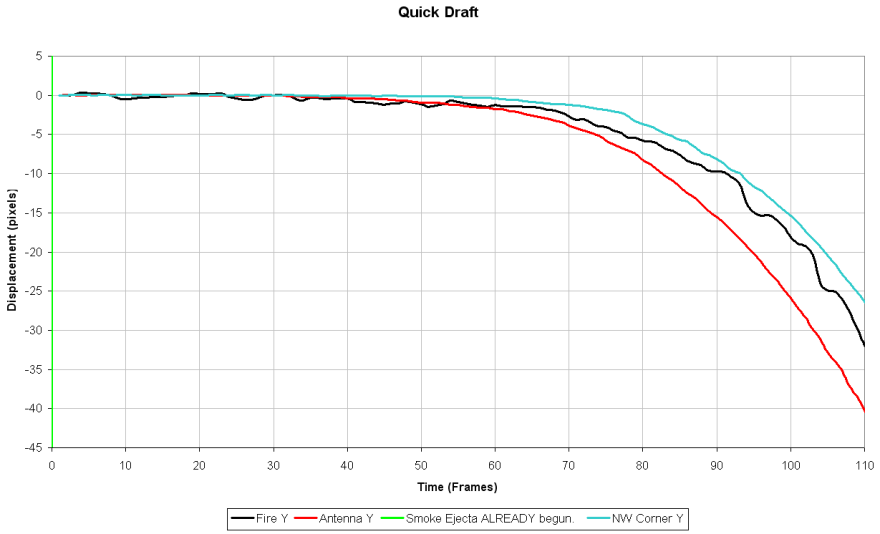
Trace data *disagrees* with their interpretation.
Chain of logic, please.
Core-led initiation suggestions are not based upon a single observation, but correlation of multiple features.
Chain of logic, please.
Where is your trace data Tom ? I'll post feature trace data showing exactly what moved when, once you've put your analysis on the table. No substanceless hand-waving please.
Post whatever you want. Or post nothing. I couldn't care less.
My proof is the following:
Evidence from video: the emergence of the smoke from that particular office space had absolutely none of the characteristics (violence & speed) of any explosive nature. Ergo, it was caused by an increase in pressure associated with a decrease in the volume of the room.
During the collapse, things fell downwards, not upwards.
Ergo some upper portion of some room fell downwards FIRST, causing the volume of the office space to decrease, pushing the smoke laden air out of the window.
The speed of sound in air is about 1000 ft/sec. I estimate that the minimum distance that the pressure wave would have had to travel in order to push smoke out of the window is about 3 feet (if the ceiling immediately above the window collapsed. Putting a minimum time delay between that ceiling collapsing and the smoke being pushed out of the window at about 3 milliseconds.
Failures that happened further away from the window would have produced longer delays. But in ALL cases, some part of the upper portion of the towers HAD to have begun to collapse BEFORE the smoke began to pour out of the window.
My eyes confirm this when looking at your video. (
http://img690.imageshack.us/img690/9109/femrnew.gif) With a margin that doesn't require video analysis.
The ball of fire clearly (to me) begins to descend BEFORE, not after, the smoke begins to get pushed out of the windows. My reference is your red arrow moving across the screen. The point at which the smoke starts pouring out has the arrow at a significantly later point in its motion than when the fire begins to descend.
This negates the comment that Major Tom made that "the smoke begins emerging before any part of the periphery of the building begins to descend.
You are free to offer your speculation as to how what Major Tom said could be correct: that the smoke began pouring out before any downward motion of the periphery of the building. But your own gif video seems to dispute that.
That you are incapable of understanding such a simple process is not everybody elses problem Tom. Given your own, very limited, area of expertise it is clear that the field you mention is FAR outside that. You have shown repeatedly you are very inexperienced with the field.
blah, blah, blah.
Say what you want. Say nothing. Play games with definition of terms. Play games with what you're gonna show & what you're not gonna show.
I couldn't care less.
And I'm not gonna get into that crap with you again. You ain't worth the time.