kevsta
RBL CHeck Failed

- Joined
- Jun 28, 2007
- Messages
- 4,016
So don't spend more than you earn. It's not complicated.
well apparently it is, judging by success rates of implementing your very simple advice.

So don't spend more than you earn. It's not complicated.


Nothing has anything to do with the topic under discussion. It's a fantasy.
I believe the Twilight movies are somewhat related.
Nothing has anything to do with the topic under discussion. It's a fantasy.
are Oilprice.com was fortunate enough to speak with the world’s leading energy economist, Professor James Hamilton. James is a professor in the Economics Department at the University of California, San Diego.
He has been a visiting scholar at the Federal Reserve Board in Washington, DC as well as many of the Federal Reserve Banks; and has also been a consultant for the National Academy of Sciences, Commodity Futures Trading Commission and the European Central Bank and has testified before the United States Congress. You can find more of his work on his website Econbrowser
And if you look at current fundamentals, it’s not hard to imagine big moves in either direction coming fairly quickly. The price of oil would surely collapse if we saw a significant economic downturn in China (something nobody can rule out) or if Iraq succeeds in producing even half of its ambitious production targets (though I personally consider the latter unlikely). On the other hand, a military confrontation with Iran could produce a pretty spectacular price spike. If the Strait of Hormuz were to close, for example, it would represent a shock to world production that in percentage terms would be 3 times as big as the 1973-74 OPEC embargo.
Because the demand for oil is so insensitive to the price over the short run, and because there is little excess capacity in the world at the moment, even small disruptions or additions could produce big price changes. For this reason, I do not have a lot of confidence in anybody’s near-term oil-price forecasts.
On the other hand, I think we understand pretty clearly the main factors behind the overall increase in oil prices since 2005. Demand for oil, particularly from the emerging economies, has grown significantly, and we have had a hard time increasing global production. The single most likely outcome is that both conditions will continue to be with us. The most likely scenario is that the next decade will look something like the last, with oil prices volatile but exhibiting an upward trend.
James Stafford: For the past century or so, economies have generally been built upon energy. The economies with access to plentiful, cheap energy have developed the most. With the stagnation of oil production growth, how do you suggest economies could continue to grow from here? Should we stop expecting to see constant economic growth as the norm?
James Hamilton: I think this has put a significant burden on the oil-consuming countries. These economic problems have been compounded by the fact that some of the key manufacturing that once came out of countries like the United States and Japan has now been taken over by the emerging Asian economies.
James Stafford: Whenever oil prices spike politicians are quick to blame speculators and oil companies for manipulating the markets. Are you in agreement with this – are speculators and oil companies to blame? Or are there other factors that are overlooked deliberately or otherwise by the mainstream media?
James Hamilton: The story is pretty simple, and even though politicians may try to distort it, you’d hope that the media would do a better job of reporting the truth than they have. World oil production was basically stagnant between 2005 and 2008, even though world GDP was up 17%. With economic growth like that you’d normally expect increased demand, particularly from the rapidly growing emerging economies, and in fact China did increase its consumption by a million barrels a day over these 3 years. But with no more oil being produced, that meant that the rest of us-- the U.S., Europe, Japan-- had to reduce our consumption. It took a pretty big price run-up before that happened. To those claiming the price is too high, I would ask, how high do you think the price had to go to persuade Americans to reduce oil consumption by a million barrels a day?
James Stafford: Could you let us know your thoughts on the shale revolution. How do you see it playing out and do you think we have been oversold on shale’s potential?
James Hamilton: This is a real success story, and a primary reason that U.S. production is now rising rather than falling. But there are several key points to keep in mind. First, it is not cheap to produce oil with these methods-- tight oil is never going to be the reason we get back to $50/barrel. Second, we’re likely to face much steeper production decline rates from individual wells than was the case for conventional oil production. The same also applies to deepwater production. So those who think these new technologies will put us back in the world we once knew are in my opinion missing the big picture.

ok then, once again, I'll play. "what" exactly is a fantasy?
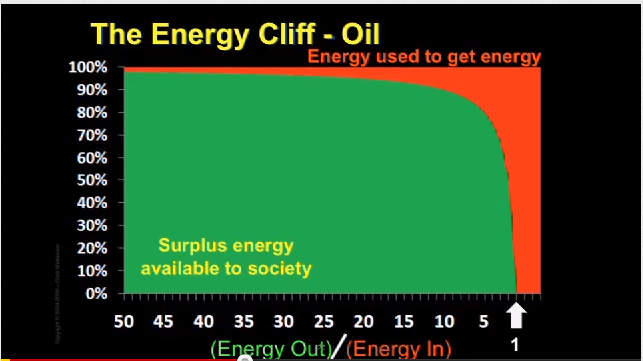
...that exponential demand cannot be met by flat production, without dramatically increasing prices? or that declining EROEI means the exponential curve works against us on the way down?
but yea, its only goldbugs isnt it.
Is it the case that an exponential function has to collapse critically instead of changing to some other type of function?
Are there historical examples of this pattern in action -- I expect there must be many and my guess is that other factors come online to replace those that go off. For example, the use of gold in components might be switched to silver and then to copper as prices rise and supply falls.
How do you know where you are on the curve and what forces the curve to maintain it's shape?

That.ok then, once again, I'll play. "what" exactly is a fantasy?
exponential demand

Does that mean that you would support banning governments from spending more than they take?So don't spend more than you earn. It's not complicated.

I am a sound money advocate. Everyone who has read any of my posts knows that. I am also very suspicious that inflation is as "tame" as the official numbers suggest (my grocery bill last week was up an average 10% over the previous week for the same basket of goods, with 3/4 of the items showing a price increase).
For answers to this and many other questions, I will continue pushing this book:http://www.amazon.com/God-Gold-Brit...in+america+and+the+making+of+the+modern+world
Look up it's reviews - this is not some scammer's tools, it meshes well with a number of also well received volumes that carry backwards (in subject, not time of writing) on market financials before the British Empire by covering from when the Bries took over and when they gave over the control to the US. AND it covers why those who tried to take over the Brit gov't to control spending and borrowing levels were wrong and had no understanding of how the system workded - just as those one the same path here/now do not understand same. Major premise: nobody is top forever, things change, BUT if you meet the principles the earlier centers followed you can make it last longer and have some influence on the next to take top place. As a subtle hint, the Republickers are the ones who are missing the boat - if they really intend to follow the crap they thrust into the willing mouths of their true believers.
Not necessarily. A blanket ban on borrowing could end up doing more harm than good.Does that mean that you would support banning governments from spending more than they take?
Assuming there are no alternatives and demand is inelastic. The problem is that those are huge assumptions, so basically, that curve models fairyland, not reality.As I understand it, the exponential function picture higher up in this thread is supposed to model a finite resource becoming scarcer as demand increases (exponentially) while supply fades (fixed or nearly so).
So, status quo then (keep the debts coming).Not necessarily. A blanket ban on borrowing could end up doing more harm than good.
False dichotomy.So, status quo then (keep the debts coming).
So what's the third option? Trust politicians to start exercising restraint?False dichotomy.

There's not a "third" option, there's an open spectrum of policies and means to achieve them.So what's the third option? Trust politicians to start exercising restraint?

But "don't spend more than you earn." wasn't supposed to be complicated.There's not a "third" option, there's an open spectrum of policies and means to achieve them.