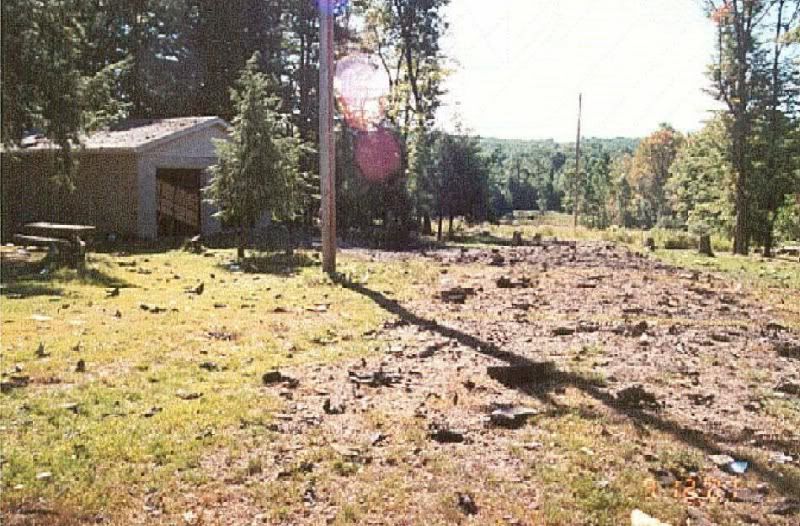
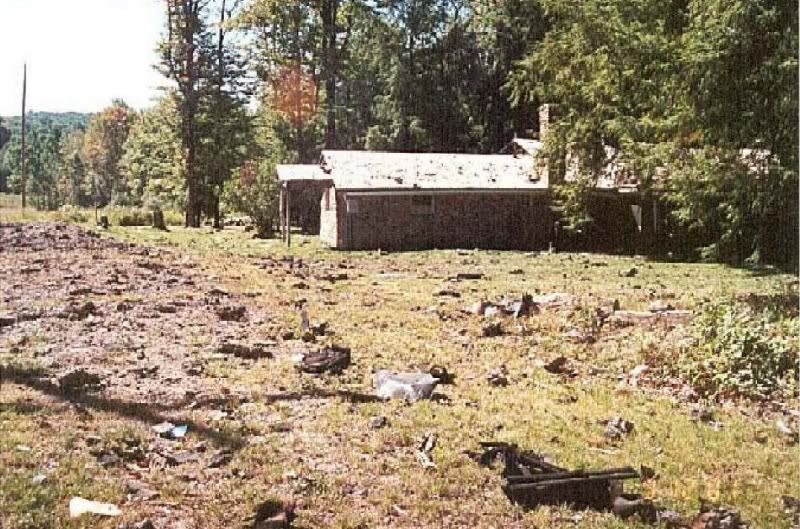
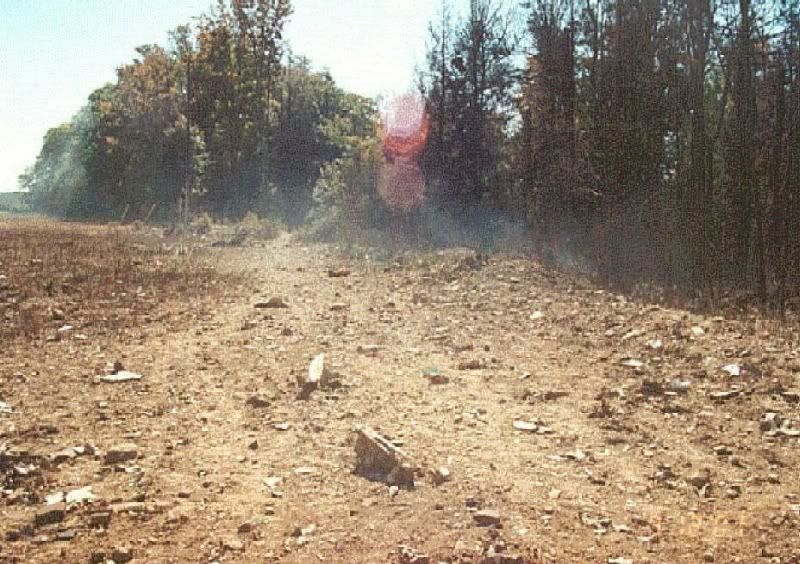
"It didn't look like a plane crash because there was nothing that looked like a plane," Barron said.
"I never seen anything like it," Barron said. "Just like a big pile of charcoal." - post-gazette.com (09/12/01
How many times is it necessary to post this stuff for you ridiculous frauds?
(From Gravysites):
First Responders and Investigators at the Crash Scene see Aircraft Wreckage, Body Parts, Fires, Smell Jet Fuel
At Shanksville, which was by far the smallest of the three 9/11 crash scenes, over 1,100 people from 74 agencies and organizations worked at the scene. Including civilian volunteers, many of whom joined an organized effort to collect aircraft parts, the number of crash scene workers reaches well over 1,500.
On 9/11 alone, these included: • 8 Police Departments • 7 EMS Services • 8 Fire Departments • 10 Emergency Management Agencies • NTSB • ATF • FBI • CISM • Red Cross • United Airlines Source: PowerPoint presentation by Rick Lohr, Director of the Somerset County Emergency Management Agency. Download it here as a PDF (numerous photos, several shown on these pages)
Volunteer first responders on 9/11 included:
Shanksville Volunteer Fire Company, Stoystown Volunteer Fire Company, Central City Fire Department, Berlin Fire Department, Friedens Volunteer Fire Department, Listie Volunteer Fire Company, Somerset Volunteer Fire Department, Somerset Ambulance Association, Hooversville Volunteer Fire Department, and the Hooversville Rescue Squad.
"Shanksville Volunteer Fire Company Assistant Fire Chief Rick King and three firefighters were the first responders on the scene with an engine and a tanker. Shanksville Fire Chief Terry Shaffer also responded from 10 minutes away.
While enroute to the scene, there was a concern for the potential of large numbers of casualties. Chief Shaffer requested additional ambulances and EMS units dispatched to the scene. Two ambulances from outside the county were also alerted but were placed in service while responding. Upon arrival, firefighters found small pieces of the plane, spot fires, and a large quantity of fuel scattered across a wide debris field. A quick survey of the scene found no survivors. Additional resources were requested from County Control, which included additional suppression companies and the Somerset Fire Company’s hazardous materials team. Federal authorities, including the FBI and NTSB, arrived relatively quickly to secure the site and begin the evidence collection and body recovery process.
...Members of the Shanksville and Stoystown departments spent about 1500 hours at the crash site. (Source: "The Role of the Volunteer Fire Service in the September 11, 2001 Terrorist Attacks" pp 58-60. PDF)
"We think it is fascinating that all these people from across the United States want to see the crash site. It is interesting to talk with them," said King. ...When King and his crew arrived, they saw what smoking pieces remained of the plane. “There were small pieces everywhere and small signs of human remains. It was total destruction.” Source
"After calling for backup from several area fire companies, King and the other firefighters, who had never responded to an airplane crash, surveyed the scene. None of them was prepared for what they saw. King recalls the paper strewn in the trees and clothing and shoes scattered on the ground. There were no bodies, he says. Just body parts. 'That's when the sheer destruction of the crash really hit home,' he says." Source (pdf)
Excerpts from "Courage After the Crash: Flight 93" by Glenn J. Kashurba. SAJ Publishing, 2002.
King: "We stopped and I opened the door. The smell of jet fuel was overpowering. I will never forget that smell; it is really burnt into my mind. ...I walked down the power line and got my first glimpse of human remains. Then I walked a little further and saw more."
Shanksville VFD firefighter Keith Curtis: "I walked up to where the tire was on fire, probably a hundred feet past the crater. It was a big tire. I was thinking that this is a big jet. I hit it good with the hose and put it out. I stopped and 'poof,' it just started on fire again."
Firefighter Mike Sube: "We made our way to a small pond. That's where I observed the largest piece of wreckage that I saw, a portion of the landing gear and fuselage. One of the tires was still intact with the bracket, and probably about three to five windows of the fuselage were actually in one piece lying there. ...There were enough fires that our brush truck was down there numerous times. ...I saw small pieces of human remains and occasionally some larger pieces. That was disturbing, but what was most disturbing was seeing personal effects."
Lieutenant Roger Bailey, Somerset Volunteer Fire Department: "We started down through the debris field. I saw pieces of fiberglass, pieces of airplane, pop rivets, and mail...Mail was scattered everywhere. ...the one guy who was with us almost stepped on a piece of human remains. I grabbed him, and he got about half woozy over it."
[People who were early to the scene didn't know what to expect. While some people were impressed by how small the crater was, others were impressed by how large it was.] Reporter Jon Meyer, WJAC-TV, Johnstown: "There was a spot at the end where the emergency crews were gathering. I could see that it was smoking and burning a little bit. So I ran as fast as I could towards that spot. I ran right up to the crater. I was standing a few feet away, looking down into it. I was overwhelmed by the crater's depth and size, but there was nothing that I could identify as having been an airplane, except that there was this incredibly strong smell of jet fuel."
Gerry Parry, Berlin Volunteer Fire Department: "I stopped and talked to the custodian, Don Stutzman. He and a teacher, Mike Sheeler, and I were standing in the corner of the parking lot when we felt and heard the explosion. If I had been turned the other direction, I might have seen it go down. We saw the smoke immediately. ...It felt too large to be a strip mine explosion, and usually, we have some idea when they are going to happen."
Bill Baker, Somerset County Emergency Management Agency: "There was debris everywhere. You couldn't step without walking on a piece of plane part, fabric, or some kind of debris. When they said it was a 757, I looked out across the debris field. I said, "There is no way there is a 757 scattered here. At that time, we didn't know that it was in the hole. The jet fuel smell was really strong...There were plane parts hanging in the trees."
Conspiracists who claim that there was no fire, wreckage or human remains at the crash site refuse to acknowledge or contact the volunteers and other first responders who put out the fires and viewed and collected the wreckage and remains.
When former firefighter Dave Fox arrived at the scene, "He saw a wiring harness, and a piston. None of the other pieces was bigger than a TV remote. He saw three chunks of torn human tissue. He swallowed hard. 'You knew there were people there, but you couldn't see them,' he says." Source
Local FBI agent Wells Morrison told author Glenn Kashurba what he saw when he arrived at the crash site: "We arrived in the immediate area and walked up to the crater and the burning woods. My first thought was, 'Where is the plane?' Because most of what I saw was this honeycomb looking stuff, which I believe is insulation or something like that. I was not seeing anything that was distinguishable either as human remains or aircraft debris." (Glenn Kashurba, Courage After the Crash, 2002, p. 110)
Faye Hahn, an EMT, responded to the first reports of the crash. She says: "Several trees were burned badly and there were papers everywhere. We searched. ... I was told that there were 224 passengers, but later found out that there were actually forty. I was stunned. There was nothing there." (David McCall, From Tragedy to Triumph, 2002, pp. 31-32)
"Those who were there moments later say the smoking wreckage looked like a pile of scrap metal in a pit, until you focused more closely and saw the other kinds of fragments among the debris." Source
Excerpt from Red Cross article "Pennsylvania Disaster Workers Respond to Flight 93 Tragedy"
"King said the Red Cross has been on the scene from the beginning, providing food and water to more than 600 exhausted workers from local fire departments, FBI, ATF, NTSB, FEMA, state police and coroners' offices from around Pennsylvania. "I've seen the Red Cross at the command center, down with the media crews, and around the perimeter," King said. "They're doing a great job. They've definitely got their ducks in a row in a pretty hectic situation."
Nearly 70 Red Cross staff and volunteers have been working 12-hour shifts to provide round-the-clock service to the federal and state emergency workers and investigators. Five Red Cross Emergency Response Vehicles (ERVs) are on the scene to provide food and water. "It's been very warm, and the work has been slow and laborious under the hot sun," Dulashaw said. "We encouraging everyone to stay hydrated."
After FBI hazardous materials response teams examined the remains of the wreckage and determined levels of toxic and flammable materials were low enough for workers to proceed safely in protective gear, investigators fanned out — searching around the soot-rimmed crater the plane left in the ground, and walking into the gash it cut in the nearby woods.
Investigators are using yellow and red flags to stake spots around the site to mark where they had located parts from the aircraft, human remains or personal items belonging to the plane's 38 passengers and seven crewmembers. The painstaking, inch-by-inch search turned up the plane's cockpit voice recorder and flight data recorder on Thursday, the "black boxes" that could explain what happened Tuesday after hijackers took control of the plane, and how apparent heroic acts of a few passengers prevented the aircraft from reaching its intended target in Washington, D.C."
Somerset County Coroner Wallace Miller has spent almost every waking hour at the crash site with FBI agents, and is now in charge of identifying all of the passengers. "The FBI were the people that I really interacted with the most. I must tell you that I'm gonna feel better about paying my Federal Income Tax estimates now than I did prior to September 11th." Source
"Flight 93 crash site left most of the horror to the imagination"
Terrorism in Shanksville: A Study in Preparedness and Response
Beyond September 11th: An Account of Post-Disaster Research – The Crash of United Flight 93 in Shanksville, Pennsylvania (PDF)
Homeland Security Report on Flight 93 (PDF)
Investigators on-site Shanksville "Day of Terror: Outside tiny Shanksville, a fourth deadly stroke"
FBI ends site work, says no bomb used (Sept. 25, 2001)
Contact information for some flight 93 crash scene responders
Shanksville Volunteer Fire Co, Shanksville, PA 15560. Terry Schaffer, Chief; Rick King, Ass't Chief
Somerset County Emergency Services 100 East Union Street, Somerset, PA 15501
Westmoreland County Dept. of Emergency Management 12 Court House Square Greensburg, PA 15601
Pennsylvania Emergency Management Agency Harrisburg, PA 17101