Two important points. It is energy growth not economic growth, and on a straight line curve of 2.3% which is improper, and it is assuming a source other than ultimately solar. But what he also didn't calculate was the absorption and emission are in near-perfect balance now, but any significant change from other nuclear sourced energy would immediately change that to increase emission over absorption. Where that balance ultimately lands is based on greenhouse gasses in the atmosphere, and has nothing to do with economic growth. Unless of course the economy is based on increasing CO2 in the atmosphere.
Strawman.
Ok, I'll say again. This is not related to the amount of CO2 in the atmosphere. It assumes we have stopped using fossil fuels, that we are using things like solar, fission, and/or fusion, and/or some other undiscovered energy source, so your CO2 comment is redundant. Yes, we'll be able to cool the planet a bit by increasing biodiversity and sucking up some CO2, but that is a limited in the extreme when faced with such huge increases in energy consumption.
It’s based upon the idea that when we use energy, it gives off waste heat. And the impact of that waste heat is calculated by radiative power scales as the fourth power of temperature, which the above accounts for. As you can see, the next 200 years will not see any noticeable impact, as the amount of waste heat we generate would not impact on the current climate. The rate of heat production from the increase in energy consumption will radiate out, but will also result in a warmer world. In other words, the greater the rate, the hotter we get, and the more heat gets radiated out.
It is only when we continue to increase our energy consumption, that we eventually impact the Earth directly in this way. Reducing CO2 in the atmosphere to some lower level would only move the line slightly. It would not make the above sustainable.
Also, why is 2.3% improper? We have had growth of about 2.9% fairly consistently averaged out over the long term. With a levelling off of world population, and this would drop a bit. 2.3% is just a reasonable guide, taking this into account. In fact when energy efficiency measures are maxed out, it could be too low as we generally see a 1% improvement in efficiency which would eventually disappear, but in the end, it doesn’t actually matter what the exact value is, as it is used to show what effect a percentage value has on growth.
A growing economy will result in an increase in energy consumption. You can decide that we want to slow it down to 1% per year, but we will still reach that limit at some point. You can decide that the economy will be based more upon virtual transactions to slow the growth in energy, but it will still lead to increase in energy as each measure we implement is used to its extreme. There is only so much one can do, but I don't want you to think I'm being a doom-monger, I'm not. What this shows is that we need to look at a measure of how much development is enough, when our population is living to some level of comfort, we can say "enough". This could actually be beneficial for the welfare of a country, and even the world.
I can see where you might assume economic growth does depend on increasing CO2 in the atmosphere, being that energy from fossil fuel use does just that, (both drive economic growth and drive increasing CO2 emissions).
Strawman
Again, this is not what I am saying, and you are ignoring what I have already said. Again, for your benefit – this is not about increasing CO2 in the atmosphere or burning fossil fuels.
You probably should have paid more attention to the phrase the author stated himself:
I have already stated that the above is illustrative. That it simply shows the current model is not sustainable. I am not saying we will fry the Earth, but that the current trajectory is heading that way. These are very different things.
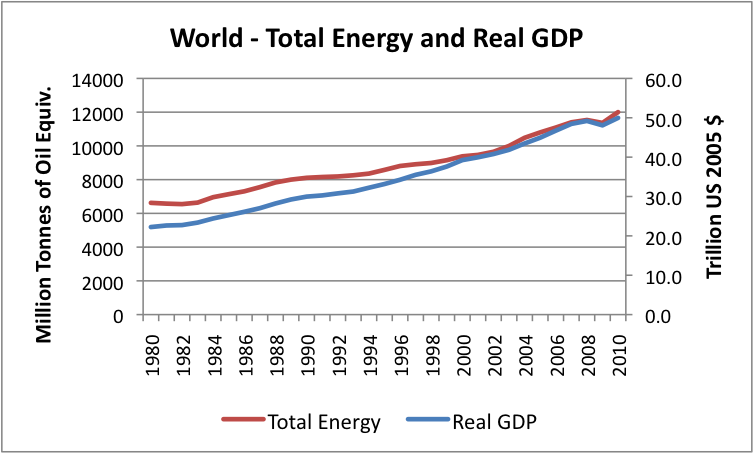
The point is that our economy is based upon energy use, that when our economy grows, so too does our energy consumption. Energy efficiency will not fix that in the long term (as I have shown), neither will substituting technologies, and even though our population is set to level off, the economic model the world works to is one of growth.
We need a point where we say "enough", where we can say that a person or country has enough stuff, or luxury goods, or wealth or even some level of happiness etc, but to do so is a whole new economic model. The measure for how much is enough is wide open for debate as well. Many say GDP is a poor measure, that we need a better way off assessing how well off a country is. But ultimately, we must look at our economic system, in a new way.
There is a New Scientist article from 2008 that touches upon this, but is sadly behind a paywall mostly:
But are these efforts to save the planet doomed? A growing band of experts are looking at figures like these and arguing that personal carbon virtue and collective environmentalism are futile as long as our economic system is built on the assumption of growth. The science tells us that if we are serious about saving Earth, we must reshape our economy.
http://www.newscientist.com/article...ort-how-our-economy-is-killing-the-earth.html