What can individual people do about global warming?

To clarify, do you mean that we should literally work less? Or do you mean that we should switch over to activities that help the environment when we're not engaging in our main occupation?

Either. I'm not one to dictate how people should lead their lives, but I do believe in informed decisions.

Earning less, so you spend less is only going to be realistic if we work less in the first place.

Earning lots (and working lots) works if that work is to help the environment.

There are many ways to do this, and people have their own ways of doing things, so you don't want some standard model at that level.
 
Last edited:
Not having a good day with posting, but here goes...


As I have already said, this all assumes we have stopped using fossil fuels, this is if we went for renewables 100%, or a mixture of that and fusion (or fission of course), so sucking up CO2 shouldn't be an issue. Its about the waste heat we emit when our economy has grown so much produce so much heat on Earth, that we heat it up.

The power of biodiveristy is another very limited resource in this scenario, as we will need to:
a. Feed the billions of people to a comfortable standard.
b. Install solar panels over much of our land mass.

So where do we plant all of this extra vegetation?

In the more immediate time frame, I'm all for reforestation of course, especially in areas where it will have an effect:
http://climateviewer.com/2013/10/09/terraforming-earth-geoengineering-megaplan-starts-now/
-See map.

As for space, are you seriously suggesting that we could have such a space faring society in under 300years? It would mean sending a not-insignificent number of people into space in that time, which brings us back to the issue of energy. Have you thought about how much energy that would take? How much it would cost? How safe it would be?

Don't get me wrong, I'm a big fan of space exploration, be it robotics, or even manned flight. Its hugely inspirational, and can be profitable etc. but I cannot see how we can overcome the difficulties of space flight so that we can expand it to such scales. And yes, I have heard of space elevators.
Ok first of all, the primary driver of global cooling isn't the forests, it's the grasslands/savannas.[1] Mature forests are generally (with a few exceptions) nearly carbon neutral. (only about ~10% the total carbon sink [2]) Forests are important for their moderating effect and important for certain other ecosystem services, so don't get me wrong. We do need to care for them, but it's the grasslands/savannas that will need to end up both feeding the bulk of the population and driving global cooling enough to counter industrial civilization's warming effect.
Secondly about 40% of the planet's land surface is under agriculture of some form or another.[3] As a general rule most of that land is in a highly degraded state due to agriculture. (about 1/2 the forests and as much as 90% of the grassland is degraded to one degree or another) However, it need not be. There are regenerative forms of agriculture that produce more food per acre and simultaneously sequester carbon in the soil. And the way they do that is almost always have a live green plant growing in the soil at all possible times. ie. polyculture [4][5][6] Also solar panels are not incompatable with agriculture either. [7] Wind is actually ultimately solar in origin too, and wind power is also compatable with agriculture.

The most important thing to remember though is that if agriculture is changed to a net carbon sink worldwide, then fossil fuel carbon emissions worldwide don't have to be dropped to zero. Yes they have to be reduced dramatically, but not to zero. That makes it possible and practical at current technology levels. It does however require some major infrastructure changes, and that is beyond what an individual can do alone, so outside the actual topic of this thread. Others and I already gave our input as to what individuals can do to help.
 
Last edited:
Ok first of all, the primary driver of global cooling isn't the forests, it's the grasslands/savannas.[1] Mature forests are generally (with a few exceptions) nearly carbon neutral. (only about ~10% the total carbon sink [2]) Forests are important for their moderating effect and important for certain other ecosystem services, so don't get me wrong. We do need to care for them, but it's the grasslands/savannas that will need to end up both feeding the bulk of the population and driving global cooling enough to counter industrial civilization's warming effect.
Secondly about 40% of the planet's land surface is under agriculture of some form or another.[3] As a general rule most of that land is in a highly degraded state due to agriculture. (about 1/2 the forests and as much as 90% of the grassland is degraded to one degree or another) However, it need not be. There are regenerative forms of agriculture that produce more food per acre and simultaneously sequester carbon in the soil. And the way they do that is almost always have a live green plant growing in the soil at all possible times. ie. polyculture [4][5][6] Also solar panels are not incompatable with agriculture either. [7] Wind is actually ultimately solar in origin too, and wind power is also compatable with agriculture.

The most important thing to remember though is that if agriculture is changed to a net carbon sink worldwide, then fossil fuel carbon emissions worldwide don't have to be dropped to zero. Yes they have to be reduced dramatically, but not to zero. That makes it possible and practical at current technology levels. It does however require some major infrastructure changes, and that is beyond what an individual can do alone, so outside the actual topic of this thread. Others and I already gave our input as to what individuals can do to help.

I'm sure all of this is true, but it doesn't change the finite nature of what I mentioned. Notice I didn't say we wouldn't be able to feed the population (I would not like to say either way, but I like to think that we could, with a stablised population), but that the amount of energy we will need in a growing economy will increase. Sucking up CO2 through biomass is fine when addressing issues relating to fossil fuel use and AGW, but in the future we could use so much energy that we physically heat up the Earth directly.

With that 2.3% increase each year, measures such as planting more biodiversity to increase cooling would only buy us a few more years (or decades at best) before we would need to cut back on our total energy use.

Try to remember though, that many of these specific numbers don't actually matter. We could have a growth rate higher or lower, we could have new energy technologies coming through, but all they would do would be to adjust the point at which we heat up the Earth and we have to cut our total energy use. It would not make a growing economy sustainable.
 
Its simple maths.
If energy use grows by 2.3% each year here is how it will look:


-The key points are:
*Maxed out solar panels on land at 20% efficiency (an efficiency achievable today)
*Maxed out solar panels on land at 100% effiency (to hell with the laws of thermodynamics for the moment)
*Maxed out solar panels covering the whole of the Earth
*Using energy equal to the total output of the sun (obviously, the surface of the Earth will be rather hot! See below).

The green text is to give a sense of perspective.

Here is the effect of using those levels of energy:

Notice the first 200ish years, we don't notice anything, but due to the increase being proportionate (2.3%), rather than increasing by a set level, the issue compounds.

Originally from here:
http://physics.ucsd.edu/do-the-math/2011/07/galactic-scale-energy/

Again, I must point out that the purpose here is to show that economic growth is not sustainable. Any measure we make to help the issue simply shifts the line a bit to the right. Many large scale solutions would simply give us a few decades, and so the only sustainable solution is to have a steady state economy.

Before criticising the above, please ensure you read what I have already written earlier.
 
Last edited:
Before critising the above, please ensure you read what I have already written earlier.
Your argument has so many flaws it is hard to know where to begin. I am not even going to try and list them all. First you forgot the caption.

Earth surface temperature given steady 2.3% energy growth, assuming some source other than sunlight is employed to provide our energy needs and that its use transpires on the surface of the planet. Even a dream source like fusion makes for unbearable conditions in a few hundred years if growth continues. Note that the vertical scale is logarithmic.
Two important points. It is energy growth not economic growth, and on a straight line curve of 2.3% which is improper, and it is assuming a source other than ultimately solar. But what he also didn't calculate was the absorption and emission are in near-perfect balance now, but any significant change from other nuclear sourced energy would immediately change that to increase emission over absorption. Where that balance ultimately lands is based on greenhouse gasses in the atmosphere, and has nothing to do with economic growth. Unless of course the economy is based on increasing CO2 in the atmosphere.

I can see where you might assume economic growth does depend on increasing CO2 in the atmosphere, being that energy from fossil fuel use does just that, (both drive economic growth and drive increasing CO2 emissions). However, that is by no means a given. If sequestering carbon had an appropriate economic value (and it should) then growing that particular sector of the economy would actually have the opposite effect. It would still be economic growth, but not necessarily energy growth (as defined by his assumptions) or AGW either one.

You probably should have paid more attention to the phrase the author stated himself:
This analysis is an easy target for criticism
 
Last edited:
Two important points. It is energy growth not economic growth, and on a straight line curve of 2.3% which is improper, and it is assuming a source other than ultimately solar. But what he also didn't calculate was the absorption and emission are in near-perfect balance now, but any significant change from other nuclear sourced energy would immediately change that to increase emission over absorption. Where that balance ultimately lands is based on greenhouse gasses in the atmosphere, and has nothing to do with economic growth. Unless of course the economy is based on increasing CO2 in the atmosphere.
Strawman.
Ok, I'll say again. This is not related to the amount of CO2 in the atmosphere. It assumes we have stopped using fossil fuels, that we are using things like solar, fission, and/or fusion, and/or some other undiscovered energy source, so your CO2 comment is redundant. Yes, we'll be able to cool the planet a bit by increasing biodiversity and sucking up some CO2, but that is a limited in the extreme when faced with such huge increases in energy consumption.

It’s based upon the idea that when we use energy, it gives off waste heat. And the impact of that waste heat is calculated by radiative power scales as the fourth power of temperature, which the above accounts for. As you can see, the next 200 years will not see any noticeable impact, as the amount of waste heat we generate would not impact on the current climate. The rate of heat production from the increase in energy consumption will radiate out, but will also result in a warmer world. In other words, the greater the rate, the hotter we get, and the more heat gets radiated out.

It is only when we continue to increase our energy consumption, that we eventually impact the Earth directly in this way. Reducing CO2 in the atmosphere to some lower level would only move the line slightly. It would not make the above sustainable.

Also, why is 2.3% improper? We have had growth of about 2.9% fairly consistently averaged out over the long term. With a levelling off of world population, and this would drop a bit. 2.3% is just a reasonable guide, taking this into account. In fact when energy efficiency measures are maxed out, it could be too low as we generally see a 1% improvement in efficiency which would eventually disappear, but in the end, it doesn’t actually matter what the exact value is, as it is used to show what effect a percentage value has on growth.

A growing economy will result in an increase in energy consumption. You can decide that we want to slow it down to 1% per year, but we will still reach that limit at some point. You can decide that the economy will be based more upon virtual transactions to slow the growth in energy, but it will still lead to increase in energy as each measure we implement is used to its extreme. There is only so much one can do, but I don't want you to think I'm being a doom-monger, I'm not. What this shows is that we need to look at a measure of how much development is enough, when our population is living to some level of comfort, we can say "enough". This could actually be beneficial for the welfare of a country, and even the world.
I can see where you might assume economic growth does depend on increasing CO2 in the atmosphere, being that energy from fossil fuel use does just that, (both drive economic growth and drive increasing CO2 emissions).
Strawman
Again, this is not what I am saying, and you are ignoring what I have already said. Again, for your benefit – this is not about increasing CO2 in the atmosphere or burning fossil fuels.

You probably should have paid more attention to the phrase the author stated himself:
I have already stated that the above is illustrative. That it simply shows the current model is not sustainable. I am not saying we will fry the Earth, but that the current trajectory is heading that way. These are very different things.

The point is that our economy is based upon energy use, that when our economy grows, so too does our energy consumption. Energy efficiency will not fix that in the long term (as I have shown), neither will substituting technologies, and even though our population is set to level off, the economic model the world works to is one of growth.

We need a point where we say "enough", where we can say that a person or country has enough stuff, or luxury goods, or wealth or even some level of happiness etc, but to do so is a whole new economic model. The measure for how much is enough is wide open for debate as well. Many say GDP is a poor measure, that we need a better way off assessing how well off a country is. But ultimately, we must look at our economic system, in a new way.

There is a New Scientist article from 2008 that touches upon this, but is sadly behind a paywall mostly:
But are these efforts to save the planet doomed? A growing band of experts are looking at figures like these and arguing that personal carbon virtue and collective environmentalism are futile as long as our economic system is built on the assumption of growth. The science tells us that if we are serious about saving Earth, we must reshape our economy.
http://www.newscientist.com/article...ort-how-our-economy-is-killing-the-earth.html

 
Last edited:
What can individual people do about global warming?


Stop breathing so much!!!! and don't breathe out the CO2...........
 
Strawman
Again, this is not what I am saying, and you are ignoring what I have already said. Again, for your benefit – this is not about increasing CO2 in the atmosphere or burning fossil fuels.

Oh but it is about greenhouse gasses. That's your flaw. The whole argument you are making ignores the biggest driver of AGW. Economic growth is irrelevant as to whether we heat the planet or cool the planet unless economic growth is tied to increasing or decreasing greenhouse gasses.

Think of it this way. A forest fire releases "waste heat" from the chemical reaction of rapid oxidation. However, that is waste heat and supplies zero to the economy. In some economic models it might even be considered an economic loss. Take those same trees and burn them releasing the exact same heat, but use that heat to produce something and in that case they add to the economy. How much of course depends on how society values the work done and the cost to produce it. But from an AGW context there is no difference. The only thing that matters is how quickly that heat is radiated into space. The primary determining factor for that is greenhouse gasses. Further if the way you burned those trees to supply that energy for the economy included producing something like biochar, then actually there would be carbon sequestration and it could be conceivable that additional economic gain could be had while actually helping to mitigate AGW.

So yeah, the authors are correct. We must reshape our economy. However, that does not necessarily mean the reshaped economy must be limited to no economic growth. It all boils down to society placing the appropriate value to sectors of the economy that mitigate AGW. Do that and suddenly economic growth becomes a good thing for both our pocket books and mitigating AGW.
 
Last edited:

Ultimately, food at the local Walmart, on average, has about 11% of its average carbon footprint due to transportation and refrigeration issues. With a lot of the fruits and vegetables the overwhelming majority of the cost is due to transportation and storage issues, so buying locally or even better growing your own (and canning excess) does make a difference, the exception to this is when it comes to meats and dairy products. With meat production the overwhelming carbon cost is in production. The way to eat meat and avoid this production carbon cost is to focus on your carbon footprint when you shop for your meat. Get to know the farmers actually raising the animals you will eat. Get pasture raised meat from a local producer being butchered at a local shop. You lose almost all the benefits if you have to drive more than 10miles to pick up your weekly meat, but if it's that far get a new energy efficient deep freeze and buy your meat in bulk once every month or two. Oh, and don't hesitate to explore other options, a small group of chickens can keep a couple in eggs and supplemental meat with a minimum of daily effort and upkeep expense.


Freakonomics is not reading I would recommend to any critical thinker. http://www.americanscientist.org/issues/pub/freakonomics-what-went-wrong/1

Tomatoes grown in Spain used less energy according to its LCA than UK tomatoes (for UK customers):
http://randd.defra.gov.uk/Default.a...ore&Location=None&Completed=0&ProjectID=15001
-Owing to less energy during production. The same can happen when buying apples, where locally grown will need storage when bought out of season, but if you import, you may get an apple with a lower LCA result.

I'm not sure that comparing greenhouse tomatoes in England with field grown tomatoes in Spain is a reasonable comparison.
 
Looks like the forum is shutting down next week, I just wanted to acknowledge those here whom I consider friends and fellow forum members. Feel free to contact me through PM and I will share email address to those who do not have it. It has been fun, I will miss the discussions!
 
Ultimately, food at the local Walmart, on average, has about 11% of its average carbon footprint due to transportation and refrigeration issues. With a lot of the fruits and vegetables the overwhelming majority of the cost is due to transportation and storage issues, so buying locally or even better growing your own (and canning excess) does make a difference, the exception to this is when it comes to meats and dairy products. With meat production the overwhelming carbon cost is in production. The way to eat meat and avoid this production carbon cost is to focus on your carbon footprint when you shop for your meat. Get to know the farmers actually raising the animals you will eat. Get pasture raised meat from a local producer being butchered at a local shop. You lose almost all the benefits if you have to drive more than 10miles to pick up your weekly meat, but if it's that far get a new energy efficient deep freeze and buy your meat in bulk once every month or two. Oh, and don't hesitate to explore other options, a small group of chickens can keep a couple in eggs and supplemental meat with a minimum of daily effort and upkeep expense.
I said mileage was not always the best measure. It often is of course, but its not a catch all rule.


I'm not sure that comparing greenhouse tomatoes in England with field grown tomatoes in Spain is a reasonable comparison.
Comparing tomatoes with tomatoes is not comparing apples with oranges, LOL.

Seriously though, this is a valid comparison, as if I were buying tomatoes in the UK (I wouldn't, as tomatoes are the work of the devil), I would have to take this into account.

Earlier, I mentioned apples. If I bought apples here in the UK in September/October, it would be worth buying UK apples, as they would have been picked fairly recently. However, if I bought them in say May/June, the UK apples would have been kept in cool storage from the picking season the previous year, so I would have been better buying some from a different country, who's picking season is nearer the date of purchase.

Food mileage is not always the best measure of carbon footprint.
 
Last edited:
Oh but it is about greenhouse gasses. That's your flaw. The whole argument you are making ignores the biggest driver of AGW. Economic growth is irrelevant as to whether we heat the planet or cool the planet unless economic growth is tied to increasing or decreasing greenhouse gasses.
You missed the bit about the laws of physics, the release of waste heat, and a 2.3% energy increase each year. I've mentioned it more than once, so I don't know why you did.

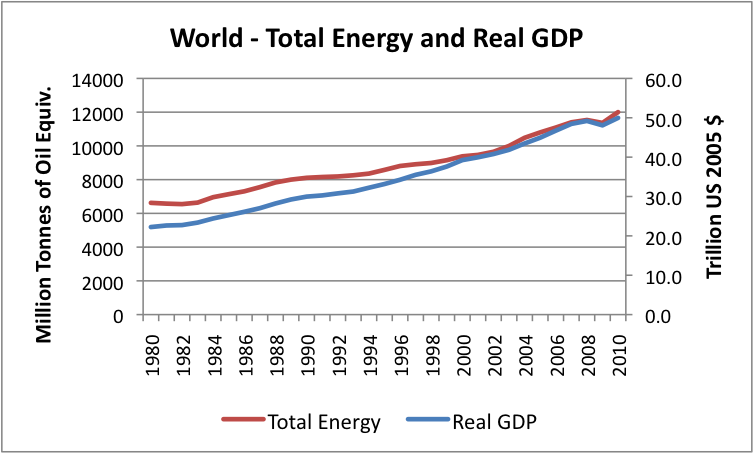
GDP follows energy consumption:
world-total-energy-and-real-gdp.png

http://ourfiniteworld.com/2011/11/1...le-to-decouple-gdp-growth-from-energy-growth/

So yes, economic growth is linked to energy growth. Currently that’s tied to burning fossil fuels, but in the future model I showed earlier, I wrote:
even if we used just solar panels, the Earth will be unbearably hot in a few hundred years
And later I said:
But going over to renewables (which of course I support), doesn't make a growing economy sustainable, as it still gives off heat. It simply puts us on a longer trajectory before we heat up the Earth (see above).
And:
Even if we stop using fossil fuels all together, and go fully to renewables (and/or build a few fusion reactors for luck), we will still heat the Earth, and feel the effects in under 300years, assuming a 2.3% growth rate. In 400 years, we will boil the Earth.
And later:
As I have already said, this all assumes we have stopped using fossil fuels, this is if we went for renewables 100%, or a mixture of that and fusion (or fission of course), so sucking up CO2 shouldn't be an issue. It’s about the waste heat we emit when our economy has grown so much produce so much heat on Earth, that we heat it up.
And later still:
but that the amount of energy we will need in a growing economy will increase. Sucking up CO2 through biomass is fine when addressing issues relating to fossil fuel use and AGW, but in the future we could use so much energy that we physically heat up the Earth directly.

With that 2.3% increase each year, measures such as planting more biodiversity to increase cooling would only buy us a few more years (or decades at best) before we would need to cut back on our total energy use.

And:
Again, I must point out that the purpose here is to show that economic growth is not sustainable. Any measure we make to help the issue simply shifts the line a bit to the right. Many large scale solutions would simply give us a few decades, and so the only sustainable solution is to have a steady state economy.
And again here:
This is not related to the amount of CO2 in the atmosphere. It assumes we have stopped using fossil fuels, that we are using things like solar, fission, and/or fusion, and/or some other undiscovered energy source, so your CO2 comment is redundant. Yes, we'll be able to cool the planet a bit by increasing biodiversity and sucking up some CO2, but that is a limited in the extreme when faced with such huge increases in energy consumption.

It’s based upon the idea that when we use energy, it gives off waste heat. And the impact of that waste heat is calculated by radiative power scales as the fourth power of temperature, which the above accounts for. As you can see, the next 200 years will not see any noticeable impact, as the amount of waste heat we generate would not impact on the current climate. The rate of heat production from the increase in energy consumption will radiate out, but will also result in a warmer world. In other words, the greater the rate, the hotter we get, and the more heat gets radiated out.
So, I fail to see why you tried to tie it in with the release of greenhouse gasses, after I have repeatedly stated that it’s based upon burning no fossil fuels, and therefore releasing no excess greenhouse gasses into the atmosphere.


And yet you say:
Think of it this way. A forest fire releases "waste heat" from the chemical reaction of rapid oxidation. However, that is waste heat and supplies zero to the economy. In some economic models it might even be considered an economic loss. Take those same trees and burn them releasing the exact same heat, but use that heat to produce something and in that case they add to the economy. How much of course depends on how society values the work done and the cost to produce it. But from an AGW context there is no difference. The only thing that matters is how quickly that heat is radiated into space. The primary determining factor for that is greenhouse gasses. Further if the way you burned those trees to supply that energy for the economy included producing something like biochar, then actually there would be carbon sequestration and it could be conceivable that additional economic gain could be had while actually helping to mitigate AGW.
A forest fire is insignificant, on the scale I am addressing (but I see your point, irrelevant as it is), as is any biomass burning that we could conceivably consume on Earth (while also feeding 10+billion people). It is true that what matters is how quickly the heat is radiated, but if we produce heat at such a rate through such large scale energy use, that we heat the atmosphere faster than we can send the heat into space, the Earth will get hotter (see chart in previous post). Reducing CO2, using biochar etc are all nice techniques, but it will not make an economy sustainable, it will only give us a few more years growth before we max out each measure, as they are all finite in nature.

Remember, it’s not about how much CO2 we release in this situation (as we assume we have stopped burning fossil fuels), but how much heat we generate through an ever growing economy.

Even if we could suck out even more CO2 from the atmosphere, so that it’s lower than some pre-industrial level, it would still only allow a few more years/decades of growth in this situation, regardless of the technology we use to generate the power.

So yeah, the authors are correct. We must reshape our economy. However, that does not necessarily mean the reshaped economy must be limited to no economic growth. It all boils down to society placing the appropriate value to sectors of the economy that mitigate AGW. Do that and suddenly economic growth becomes a good thing for both our pocket books and mitigating AGW.
Giving externalities some value could be a solution, but only if it puts a cap on economic growth before the point illustrated above is reached. If it allows growth indefinitely (at any percentage growth) it will not be sustainable, as it will result in an increase of energy consumption and the release of more waste heat, heating up the Earth, as shown above, even if we stop using fossil fuels and stop releasing greenhouse gasses into the atmosphere.
 
You missed the bit about the laws of physics, the release of waste heat, and a 2.3% energy increase each year. I've mentioned it more than once, so I don't know why you did.
I didn't miss it. I said you were wrong. Big difference. Your biggest fallacy is in assuming that just because we might use more energy from the sun, and possibly might increase that use 2.3% per year, that somehow the energy supply from the sun is increasing at 2.3% per year. That is incorrect. The sun's energy reaching the earth does vary a bit, but nowhere near increasing at 2.3% per year. The difference would be how much energy we humans use for economic gain, not how much energy the sun radiates to the earth.

But what humans CAN and do effect is the rate the waste heat radiates back into space. We effect that with various activities, but the primary is increasing atmospheric CO2 from FF emissions and largely breaking the natural carbon cycle back into our soils.

Your second biggest fallacy is assuming because currently economic growth is directly tied to increased energy use, that necessarily means ALL economic growth MUST be tied to increased energy use. That also simply isn't true. Change the economic model and the energy relationship changes.

Those two false assumptions when combined are what's destroying your whole argument IMHO.
 
Last edited:
I didn't miss it. I said you were wrong. Big difference. Your biggest fallacy is in assuming that just because we might use more energy from the sun, and possibly might increase that use 2.3% per year, that somehow the energy supply from the sun is increasing at 2.3% per year. That is incorrect. The sun's energy reaching the earth does vary a bit, but nowhere near increasing at 2.3% per year. The difference would be how much energy we humans use for economic gain, not how much energy the sun radiates to the earth.
I make no such assumption, I assume the output of the sun is pretty much constant.
I assume we can max out the energy we get from the sun, and use other sources. I even reiterated this, so for a third time here is an example:
this is if we went for renewables 100%, or a mixture of that and fusion (or fission of course),
Or indeed some other unexplored energy source.


But what humans CAN and do effect is the rate the waste heat radiates back into space. We effect that with various activities, but the primary is increasing atmospheric CO2 from FF emissions and largely breaking the natural carbon cycle back into our soils.
Already covered why you are wrong in the context of this discussion.

Again, this assumes we have stopped using fossil fuels. Why do you continue to make this mistake?

You are stuck in the idea that this is about conventional AGW topics. Its not.

Your second biggest fallacy is assuming because currently economic growth is directly tied to increased energy use, that necessarily means ALL economic growth MUST be tied to increased energy use. That also simply isn't true. Change the economic model and the energy relationship changes.
Continuing to misrepresent what someone says speaks volumes.

I didn't say all economic growth, I said total economic growth. Can you think of a way that economic growth would be possible without an increase energy use?

All activities have some energy use in some way, and so as the economy grows, so too will our energy usage. We live on a finite planet. If we max out the energy consumption, until we cannot consume anymore, how would the economy grow further?

There is only one mechanism for getting rid of all that waste heat, and that is (infrared) radiation. Reaching boiling point in 400 years would occur with 2.3% growth no matter what technology we used (even some system we haven't thought of yet.)

Again, I'll say it: Sucking out some CO2 will make little difference. It would buy some time, but it wouldn't make a growing economy sustainable, as such an issue is finite in nature. Leaving aside that CO2 is generally benefitial to plants so you woudn't want to suck out too much.

Edit: Your problem seems to be that you're stuck in the present, when I'm talking about the future, given a growing economy.
 
Last edited:
Earlier, I mentioned apples. If I bought apples here in the UK in September/October, it would be worth buying UK apples, as they would have been picked fairly recently. However, if I bought them in say May/June, the UK apples would have been kept in cool storage from the picking season the previous year, so I would have been better buying some from a different country, who's picking season is nearer the date of purchase.

Food mileage is not always the best measure of carbon footprint.

Indeed, the best bet is to only buy seasonal foods during their local season, can or store them as you wish until they are used. This is certainly a wiser and more economical solution as well as being much more rational than such solutions as striving not to earn any extra income/wealth because you would be tempted to spend it in ways that might increase your carbon footprint. Considered thought in all your decisions and choices, eliminate the impulsive, unconsidered purchases and decisions, and you can eliminate much of your carbon footprint with no higher price than thinking about how your carbon footprint is impacted by those choices and decisions before you make them.
 
I make no such assumption, I assume the output of the sun is pretty much constant.
I assume we can max out the energy we get from the sun, and use other sources.
But don't consider that economic growth is possible without increased energy use and even possible with decreased energy use.


You are stuck in the idea that this is about conventional AGW topics. Its not.
And the reason it isn't conventional in this case is because you are wrong.


I didn't say all economic growth, I said total economic growth. Can you think of a way that economic growth would be possible without an increase energy use?
Easily. In sectors of the economy that require high energy use, using energy more efficiently and/or replace them with economic models that don't require any increased input at all to be more productive. Cuba is a prime example of an economy that collapsed due to extreme reduction of energy inputs but that recovered and started growing again once the economic model changed. Especially in agriculture. Now they produce much more at a tiny fraction of the previous high energy inputs.

There is only one mechanism for getting rid of all that waste heat, and that is (infrared) radiation. Reaching boiling point in 400 years would occur with 2.3% growth no matter what technology we used (even some system we haven't thought of yet.)
2.3% growth of what? Energy? Population? Economy? Atmospheric CO2? Infrared radiation? The idea that we could actually boil the oceans directly by energy use is kinda ridiculous actually. Sure we can warm the climate, but even that the sun does. We just increase the greenhouse gasses. MacDoc explained your error there.

Again, I'll say it: Sucking out some CO2 will make little difference. It would buy some time, but it wouldn't make a growing economy sustainable, as such an issue is finite in nature. Leaving aside that CO2 is generally benefitial to plants so you woudn't want to suck out too much.
It's not emissions or sequestration alone either one. It is a complex cycle. Even in it's degraded ecological state the vegetation of the planet absorb almost 1/3 the total CO2 in the atmosphere every year.....and the processes of decay release as much as well. All that activity is using energy and transferring energy from one form to another. It is a constant cycle that is quite frankly huge in comparison. There is absolutely no chance by any foreseeable technology that we could possibly "suck out too much" CO2. As soon as you tried, biological decay and forest fires etc would put it right back. All we can do is make tiny adjustments to that cycle.

Short answer is you still are wrong in making the assumption that increasing the economy necessarily requires increasing energy use, or that the economy has to change the net thermal content of the planet.
 
Indeed, the best bet is to only buy seasonal foods during their local season, can or store them as you wish until they are used. This is certainly a wiser and more economical solution as well as being much more rational than such solutions as striving not to earn any extra income/wealth because you would be tempted to spend it in ways that might increase your carbon footprint. Considered thought in all your decisions and choices, eliminate the impulsive, unconsidered purchases and decisions, and you can eliminate much of your carbon footprint with no higher price than thinking about how your carbon footprint is impacted by those choices and decisions before you make them.
Exactly!
 
But don't consider that economic growth is possible without increased energy use and even possible with decreased energy use.

...

Short answer is you still are wrong in making the assumption that increasing the economy necessarily requires increasing energy use, or that the economy has to change the net thermal content of the planet.

So what are some examples of economic growth models that employ neutral or decreased energy usage? And what can we do about it individually? (Apologies if you already answered this and I missed it.)
 
So what are some examples of economic growth models that employ neutral or decreased energy usage? And what can we do about it individually? (Apologies if you already answered this and I missed it.)
The Cuban model is a good place to start.[1] Of course they were forced into it by the collapse of the USSR, which combined with the US embargo forced their economic collapse as well. So they were forced to rebuild their economy from the ground up without high energy inputs.
 
Last edited:

Back
Top Bottom