• Quick note - the problem with Youtube videos not embedding on the forum appears to have been fixed, thanks to ZiprHead. If you do still see problems let me know.

What book is everyone reading at the moment? Part 2.

Forgotten Populists: When Farmers Turned Left to Save Democracy. Steve Babson. Mission Point Press, 2023. ISBN 978-1-958363-79-9. 65 pp.

A short history of the People's Party of the 1890s, taken from a much longer MS which I hope will soon reach print. It's well and clearly written, and concludes with some plain talk about the utter backasswardness of using "populist" to label our current swarm of reactionaries. Babson asks, Why not just call them demagogues? They are in fact anti-populists, outright enemies of workers and farmers, and committed pilot fish of industrialists and bankers.

The scholarly lumber begins on page 52, and it's meaty good reading by itself.
 
"Y" is for Yesterday by Sue Grafton.

This is the last of the author's Alphabet mystery books, all with titles that include a letter of the alphabet. The series started with '"A" is for Alibi' back in the 80s. I started reading them about 1990 when '"G" Is for Gumshoe' was published, read the ones I missed and have read them all as they've been published over the years. The author planned to end the series with a book titled '"Z" is for Zero' but died before the book was written.

The stories all feature a private detective name Kinsey Millhone. She was a cop for a few years but left to become an insurance investigator, then a PI. The books are mostly first-person narrative from her point of view, and are presented as have been written after the events of the book.

I've liked the books (I did read all 25 after all), the bit of novelty of a woman PI who is smart, persistent and maybe slightly OCD is interesting, and her character is well written. There are many other continuing characters and they sometimes come into the main story, but are often a B story involving them and Kinsey. The mysteries are pretty good, often murder, some action scenes (usually toward the end) but a not huge amount. I guess they are "PI Procedural" stories in the main, as we watch Kinsey sniff around for facts and put them together, often at the last moment.

The last book follows the formula, and I thought was well done and entertaining, with some suspense. It concerns a mystery about a killing 10 years prior and weaves scenes from the time of that original crime with scenes from the book's present. It does involve maybe a little more personal drama for Kinsey then some. I think maybe the author was setting up for a wrap up of some of the personal threads from over the years that would be in final book, but I guess we'll never know for sure.

I enjoyed it (and the series in whole). In some ways they feel kind of like the John D. MacDonald "Travis McGee" books where we also watch the story from mostly inside the protagonist's head, but written from a female perspective. And I loved the "Travis McGee" books.
 
Frida: A Biography of Frida Kahlo by Hayden Harrera, 1983.

An excellent biography of the Mexican artist, Frida Kahlo.

I'll be seeing her (and Diego Rivera's) paintings at an exhibition next month, so I'm brushing up on my knowledge.

I read this about 30 years ago but it seems quite fresh now. :o

It has 440 footnotes but reads smoothly without needing to check each one.
 
My autobiography.
171649694a02f168.jpg
 
Haven't started it yet, but I just picked up Children of Memory by Adrian Tchaikovsky, the third in the Children of... series.
 
Finished another freebie from one of those Free Little Library kiosks. John Steinbeck's Travels with Charley: In Search of America. A classic I had never read, it has a very accessible style and makes me think I could write something similar myself, albeit with a lot less talent.
Interesting road trip where much of nothing happens, but it is enjoyable to read of his encounters with people from all over the country. That is, until it takes a rather dark turn in the last couple chapters when he's going through the South. This is in 1960, and is an ugly section written from the POV of a Northerner, or a sane person. Nevertheless, I thought it made a great summer read.
Next I'll probably pick up something uplifting, like his "The Grapes of Wrath".

(edited to add)
I just remembered that I had skipped the Introduction, with good reason. A long time ago, I read a "Classic" edition of Lord of the Flies, and started with the Introduction, of course. The writer gave away a MAJOR plot point in the story, the climax, really, in the guise of doing some "analysis". I was thoroughly incensed (and was only still like, in high school.) I haven't read a whole lot of classic literature but it's now a standing rule to skip any Introduction.
I did go back and read the intro to this one, and yes, the writer hit on almost all the major beats, that would have taken the effect away from the actual writer of the book. Why not put it as an Afterword, damn it? Then at least I could treat it like a Bonus Feature on a DVD.

(edited to add more)
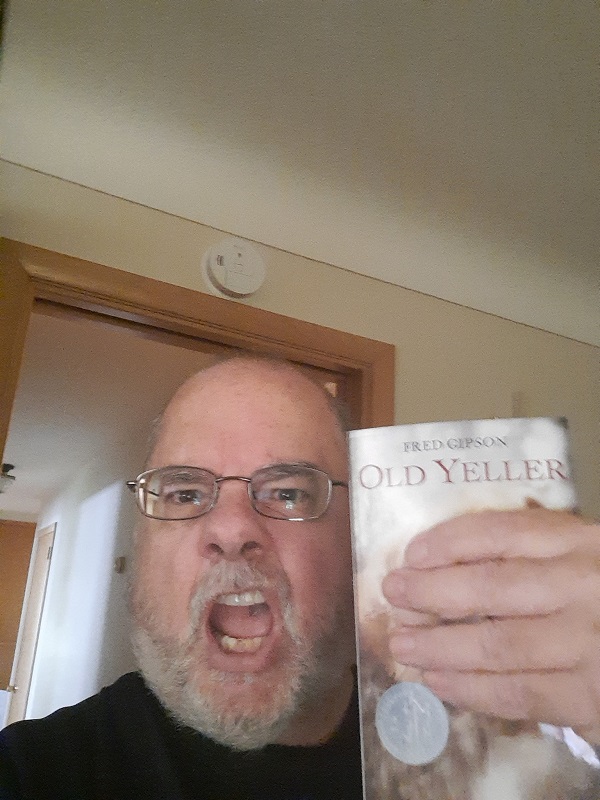
I just started Old Yeller since I had it (see above). The protagonist/narrator says what he does at the end on the very first page of the book! However, this is fair because it is part of the narrative. It may be just as effective when I get to it.(I've only previously seen the movie. Once.) I have to wonder if first-time readers, unaware of the movie, might have forgotten the mention of it by the time they get to it.
 
Last edited:
Finished Old Yeller yesterday. Wow, if there was any book I'd recommend for a younger, maybe newer reader, it's this one. Older readers, too. I'd think it would work much better as a class-assigned reading than a lot of the ones I had, even Tom Sawyer or Huck Finn. (Don't get me started on A Separate Peace or Catcher in the Rye...)
Easy, engaging, fast read. I don't remember the movie much (except for the one scene) so I'm not sure how much they used, but the book covers a lot in a short time. Great, great stuff.
 
... Cthulhu's Reach - Lovecraftian Horror on the Ocean Floor by Sean Benoit,


Someone on another forum concluded, based on the sheer number of short story anthologies this "author" has published in just the last three months, that the stories are AI generated, which certainly explains a lot. This guy isn't a terrible author; he isn't an author at all.
 
Haven't started it yet, but I just picked up Children of Memory by Adrian Tchaikovsky, the third in the Children of... series.


I have just started on it. I have already read 2/3. It's as good as the first two, so far!
I was happy to see that
corvids
had been 'uplifted' in this one. I assume cetaceans will make an appearance if he continues beyond the trilogy. :)

Lords of Uncreation is next on my list for this summer.
 
I have just started on it. I have already read 2/3. It's as good as the first two, so far!
I was happy to see that
corvids
had been 'uplifted' in this one. I assume cetaceans will make an appearance if he continues beyond the trilogy. :)

Lords of Uncreation is next on my list for this summer.

I'm nearly finished with Red Mars by Kim Stanley Robinson, so I'm going to start it after that.
 
Forgotten Populists: When Farmers Turned Left to Save Democracy. Steve Babson. Mission Point Press, 2023. ISBN 978-1-958363-79-9. 65 pp.

A short history of the People's Party of the 1890s, taken from a much longer MS which I hope will soon reach print. It's well and clearly written, and concludes with some plain talk about the utter backasswardness of using "populist" to label our current swarm of reactionaries. Babson asks, Why not just call them demagogues? They are in fact anti-populists, outright enemies of workers and farmers, and committed pilot fish of industrialists and bankers.

The scholarly lumber begins on page 52, and it's meaty good reading by itself.


I think the word has two very different things. When conservatives use it, it means any politician who promises to do something for the majority of the population: universal health care, free education from kindergarten to college, taxing the rich, a minimum wage that enables people to earn a living with just one job: "Bernie Sanders and Alexandria Ocasio-Cortez, self-described democratic socialists, are examples of modern left-wing populist politicians in the United States." (Left-wing populism, Wikipedia).

Whereas, "Right-wing populism, also called national populism and right-wing nationalism, is a political ideology that combines right-wing politics and populist rhetoric and themes. Its rhetoric employs anti-elitist sentiments, opposition to the Establishment, and speaking to or for the "common people"." (Right-wing populism, Wikipediia)

The book looks interesting. I'll kindle it. I have just started reading The Big Myth.
 
I've finished A Place of Greater Safety by Hilary Mantel (The swedish version is translated into three books). Great book and I'm so sad that Mantel is not here any longer to bless us with great literature.

Will continue with The Nickelboys by Colson Whitehead.
 
Around the World in 80 Days.

I found it a little amazing that this book is so accessible considering it was written in 1873. I only vaguely recalled the Cantinflas movie, in that it being in Cinerama format (on TV), and that it was mostly forgettable. The book was a pretty easy read but I didn't care for the travelogue sections that just listed places without any descriptions. This was an unabridged and annotated version, the annotations which helped sometimes with certain obscure or foreign (read: British) references.

I was surprised that there was no balloon travel (which was a main selling point of the movie), although a balloon is mentioned once. A decent read for all ages. I know there are several versions of the movie -- I'm not really interested in seeing the one I saw again, and I heard the Jackie Chan version is awful. I may look into viewing a more recent one. Or I'll just watch The Great Race again.
 
Last edited:
Finally getting around to "American Prometheus" a biography of J Robert Oppenheimer, and the main source for the upcoming movie, which looks really, really, good.Though the book willhave to go some to top Richard Rhodes "The Making Of The Atomic Bomb" as a boon on the Manhatten Project.
 
Last edited:
Around the World in 80 Days.

I found it a little amazing that this book is so accessible considering it was written in 1873. I only vaguely recalled the Cantinflas movie, in that it being in Cinerama format (on TV), and that it was mostly forgettable. The book was a pretty easy read but I didn't care for the travelogue sections that just listed places without any descriptions. This was an unabridged and annotated version, the annotations which helped sometimes with certain obscure or foreign (read: British) references.

I was surprised that there was no balloon travel (which was a main selling point of the movie), although a balloon is mentioned once. A decent read for all ages. I know there are several versions of the movie -- I'm not really interested in seeing the one I saw again, and I heard the Jackie Chan version is awful. I may look into viewing a more recent one. Or I'll just watch The Great Race again.

The whole balloon sequence was created for the movie, because Balloons were so assoicated with Jules Verne.
Yeah, all the post 1956 versions of the novel have been terrible.They junk the Verne charecters, basically.
 
I hardly ever read fiction. The latest book I am reading is called' outsider art' published by Thames and Hudson. It is of interest to me as it deals with the art of largely self taught mentally ill people, and I have schizophrenia. Although I am not self taught and spent three years at art college. I have hundreds of art books I have never read. I only looked at the pictures. But I a now redressing that error and reading my way through them.
 
I hardly ever read fiction. The latest book I am reading is called' outsider art' published by Thames and Hudson. It is of interest to me as it deals with the art of largely self taught mentally ill people, and I have schizophrenia. Although I am not self taught and spent three years at art college. I have hundreds of art books I have never read. I only looked at the pictures. But I a now redressing that error and reading my way through them.

I don't mind an art book that has mostly pictures (but at least include the artist, medium, size, and year), but I also have many that go into some depth about their plates, from the artists themselves. I am not a fan of art analysis books.
 
Finally getting around to "American Prometheus" a biography of J Robert Oppenheimer, and the main source for the upcoming movie, which looks really, really, good.Though the book willhave to go some to top Richard Rhodes "The Making Of The Atomic Bomb" as a boon on the Manhatten Project.

I recently saw an interview with Rhodes where he said he consulted on the movie. :)
 

Back
Top Bottom