USA has lost its AAA credit-rating from S&P's

Sounds like wishful thinking to me. I don't think even the Republicans have the stomach for what will occur if we cut 40% in spending that largely benefits the poor and elderly. My guess is that any "correction" done will include a combination of spending cuts, revenue increases, the wind-down of wars and other limited-time expenditures, and (hopefully) an improved economy.

-Bri
Nope, you've got it exactly reversed.

Spending will be reduced to match revenue, either by design or it'll be forced on us by the rest of the world. May be a few years, might be ten years. Looking at the numbers, seems like it's more like a few years than ten.

So it really doesn't matter what you think or want or would prefer (or I..., or any of us).

Well, spending and revenue will have to be balanced, or at least brought closer together. The voters will have to decide whether that will be done by spending less or by taxing more, or by some combination.


Of course, in order to have the voters make an informed decision, they would have to have legitimate alternatives. Politicians would have to stop promising something for nothing. The Republicans would have to stop saying that tax cuts increase revenue. The Democrats would have to stop saying that increased spending increases revenue. The Republicans would have to stop saying, "Reduce spending" or "If we privatize it we'll get it for free" and start saying, "Eliminate this program" or "Cut Social Security benefits." The Democrats would have to stop saying, "All we have to do is tax those other guys", and instead present a realistic tax plan that actually generates enough money to pay the bills. Such a realistic plan will necessarily involve middle class tax hikes.

In short, politicians from both parties will have to stop lying.

I'm not optimistic.
 
Sounds like wishful thinking to me. I don't think even the Republicans have the stomach for what will occur if we cut 40% in spending that largely benefits the poor and elderly.

Indeed. Most (~85%) US government spending falls under Defence, Social Security, Medicare and Medicaid. People who vote Republican do not want cuts to any of these things because they likes their military and they are generally older and like benefits to people in their age group.

Cuts to any of these would be political suicide for Republicans, they won’t do it. Any notion that there could be “40%” spending cuts made by Republicans is absurd in the extreme.

(Oh and as for “people will stop lending the US money”. Well there just isn’t any signs of it, in fact just the opposite people are rushing to lend the US money, so much so they will accept near 0 real returns in order to do so. )
 
Nope, you've got it exactly reversed.

Spending will be reduced to match revenue, either by design or it'll be forced on us by the rest of the world. May be a few years, might be ten years. Looking at the numbers, seems like it's more like a few years than ten.

So it really doesn't matter what you think or want or would prefer (or I..., or any of us).
Spending cuts and tax rate increases. It doesn't matter what we prefer we must live within our means. Of course we have the means (see GDP). So, let's do the reasonable thing. Cut spending and raise tax rates.
 
And the capacity for revenue? What is the measure of capacity? Isn't it GDP? What percentage of GDP is our debt?

Depending on the source, hovering between 70% and 75% in 2008, but it seems to have risen a lot partially due to the various crisis and wars, and so it 2011 you seems to have as much as greece (all debt public+federal) at 100%: PS: same as greece and otehr PIIGS had :D.

800px-Federal_debt_to_GDP_-_2000_to_2010.png


Go here if you want to have a detail public/gross debt and evolution :
http://en.wikipedia.org/wiki/United_States_public_debt#Valuation_and_measurement
 
Last edited:
Depending on the source, hovering between 70% and 75% in 2008, but it seems to have risen a lot partially due to the various crisis and wars, and so it 2011 you seems to have as much as greece (all debt public+federal) at 100%: PS: same as greece and otehr PIIGS had :D.

If you look at public debt from the CBO data as a percentage of GDP the U.S. is at 62% compared to Greece which was at 144%.

From an article from PolitiFact concerning comparisons of debt between the U.S. and Greece:

While the United States hasn’t yet reached the debt-to-GDP levels of the countries he cited, it’s on on its way there. But it’s not clear that attaining those debt levels would cause the catastrophic economic damage he implies.

Other countries with high debt-to-GDP ratios haven’t imploded, but specifically citing nations like Ireland and Greece implies that disaster is near for the United States economy. In reality, the United States, with its ability to control its own monetary supply, has lots more going for it than Ireland or Greece.​

-Bri
 
Last edited:
.... the United States, with its ability to control its own monetary supply, has lots more going for it than Ireland or Greece.[/INDENT]

-Bri
ABSOLUTELY!

That might buy us a year or two!

:rolleyes:
 
Spending cuts and tax rate increases. It doesn't matter what we prefer we must live within our means. Of course we have the means (see GDP). So, let's do the reasonable thing. Cut spending and raise tax rates.

Don't fall into the trap of believing that GDP is fixed.

The rational thing is to get the economy growing and fix the unemployment problem. Once that is accomplished, we can work on the remaining deficit by cutting spending and raising tax rates.
 
Last edited:
ABSOLUTELY!

That might buy us a year or two!

:rolleyes:

Given that Greece has a GDP the size of the Dallas-Fort Worth metroplex, I'm not sure it can really be used as a valid comparison. That is not to say that we don't have a problem, but I don't think you can use Greece as a predictor of what's going to happen in the U.S.

-Bri
 
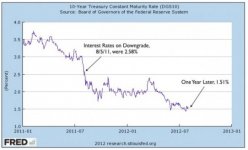
Maybe the government should thank S&P for the downgrade:
U.S. 10-Year Note Yield Drops Below 2%

Benchmark 10-year yields declined 57 basis points last month, the most since a 71 basis-point drop in December 2008, touching a record low of 1.97 percent on Aug. 18. Two-year notes have hovered at almost the record low 0.1568 percent after the Fed pledged Aug. 9 to keep the fed funds rates in a zero to 0.25 range until at least mid-2013.

The rally comes as bond investors have reduced their expectations for inflation as breakeven rates on Treasury Inflation-Protected Securities, or TIPS, are hovering near the lowest since October 2010. The breakeven inflation rate, calculated from yield differences on 10-year Treasury notes and inflation-indexed U.S. government bonds of similar maturity, has fallen to 2.04 percent from a high this year of 2.65 percent reached on April 11.
 
Apparently S&P is back to awarding AAA ratings to securities backed by subprime mortgages.

Subprime Mortgage Bonds Getting AAA Rating S&P Denies to U.S. Treasuries

Standard & Poor’s is giving a higher rating to securities backed by subprime home loans, the same type of investments that led to the worst financial crisis since the Great Depression, than it assigns the U.S. government.

S&P is poised to provide AAA grades to 59 percent of Springleaf Mortgage Loan Trust 2011-1, a set of bonds tied to $497 million lent to homeowners with below-average credit scores and almost no equity in their properties. New York-based S&P stripped the U.S. of its top rank on Aug. 5, saying Washington politics were making the country less creditworthy.
 
Just so everyone knows, here on planet earth, you literally don't know what the **** you're talking about. Surprise!


http://www2.goldmansachs.com/our-firm/press/press-releases/current/redeem-stock.html

This is a rhetorical question. Feel free to not post one of your usual worthless one-liners in response. But shouldn't a Warren Buffett fanboy actually know something about Berkshire Hathaway, and Warren Buffett?

Owning a non-majority of a company makes them a subsidiary?

:dl: :dl: :dl: :dl:

Great!!! My brother passed away about 6 months ago. He left me some McDonald's shares. Not a whole lot, maybe a few hundred shares (the estate hasn't been settled yet). But using the special "logic" introduced in this thread, McDonald's is now a subsidiary of mine!

So, I would like to take this opportunity to announce free Big-Macs for everyone, starting January 1st!!! I can do this, of course, because McDonalds is a subsidiary of mine!!

THC
 
Last edited:
Wow. I didn't realize I was so far behind in this thread. Anyhow, some 2 months later, it seems like a non-event.

Sorry for dragging it up.
 
Last edited:
During the 1980s, two things happened that are often overlooked by those who wish to credit tax policy with any sort of economic improvement.

First, the microprocessor revolution got into full swing, resulting in huge productivity gains, especially in the area of industrial automation. Second, the early 1980s was period that saw a huge transition of women from home to work, which meant a dramatic increase in the workforce population even though there was no such growth in the overall population.

These two things together meant more people working, and each worker producing more.

Of course the economy grew. How could it not?

I challenge anyone to provide any meaningful correlation between any aspect of tax policy in the United States and any macroeconomic variable. Any aspect of tax policy would include income tax rates, capital gains tax rates, marginal tax rates, estate tax rates, or anything else that says how or how much taxation occurs. Macroeconomic variables would include GDP, unemployment, inflation, interest rates, changes in any of those, or any of the other statistics generally used to measure the collective health of the US economy. You can't do it, because there simply is no correlation.

You can cherry pick data and say that after this or that president raised or lowered taxes the economy got better or worse, but I can turn around and show you a different case where a different president did the same thing, and the results were opposite, or where a different president had the same result, but with completely different tax policies. We talk a lot about this stuff, but the data shows that the state of the economy has almost no relation to what the IRS is doing to us at any given time.

And if I'm wrong, prove it. It's simple data. Show it. I've asked for it often enough, and looked for it often enough, to convince me that it doesn't exist, but all you have to do is show me one such statistic, and you can prove me wrong.

Sadly, though, politicians will continue to claim that they have some sort of magic bullet that will jumpstart the economy, and incredibly, people will vote for them, especially if they are promising something for nothing.

So, since anyone who actually understands statistics can see that no correlation exists, why don't we give up trying to fix the economy by manipulating the tax code, and instead use the tax code to raise the money that we need to pay the bills. If we did that, maybe the world might have a little bit more confidence that we won't default on the debt.

Presumably you also apply this logic, in spades, to Clinton's balanced budget, where he got lucky private investment dumped trillions into new Internet startups starting the year he threw up his hands and said, "I give up! Unbalanced budgets as far as the eye can see!"
 
Given that these self same credit agencies totally failed to predict the collapse of 2008 maybe it is time to tell them to go get stuffed
 

ISF - Join now!

Every member here is approved by hand. No bots, no spam, just people who care about evidence and honest debate.

Membership is free!

Create your free account

Back
Top Bottom