• Security incident: ISF was recently accessed by intruders. Please change your password, and change it anywhere else you used it. Read more

Upcoming parliamentary elections in Germany

I just would like to add that that Germany of today is nothing like the Germany of then. And the transformation happened earlier than you might think, with the coal-steel pact of the late 1950s, culminating in an actual friendship treaty with France in, I believe, 1963.

The overwhelming majority of Germans, and I mean OVERWHELMING, are anything but what the NAZIs were. Their education system does a good job of teaching what happened back then. Their political system is a parliamentary system with a couple of extra tweeks to make sure that personality cult cannot rule the day as it did back in those dark times. Their justice system has more checks and balances than our own. Their constitution comes very close to our own, again, with some tweeks that would make 1st amendment lovers cringe in the USA, but which the Germans deemed necessary for themselves (§ 130, BGB), which makes it illegal to do or say things that glorify the times of Hitler and the NSDAP.

I, as an American Jew, have grown very fond of the Germans. Their openness, their willingness to debate hard and fair, and their warmth to most all other peoples makes living here by and far a very pleasant and rewarding experience.

It says a lot when the International Cantors Assembly, which met in Berlin in 2011, raved about how the city and the people have changed, how truly welcome they felt. Wow.

Yes, there are some right-extremists in Germany, percentually far less than in the USA. Yes, there are integration problems with some demographics. But by and far, Germany is experiencing the longest period of domestic tranquility in its entire history and I think it would be fitting to mention that on this thread.

If there would be a country in Europe I would truly worry about vis-a-vis right-extremism, it would be Hungary, not Germany.
 
bundestagswahl2013.jpg


Continuation of the OP:

(now that I am not a newbie anymore...)

TWO VOICES (VOTES)

In German elections, when you go to vote for the parliament, you get to vote twice.

-once for the Representative of your choice
-once for a party.

So, you will always see lots of placards with sentences like "2. Stimme für _____" (2nd vote for (pick-a-party))


Party lists of members are made to match the distribution of results from the SECOND VOTE (the party vote). Officially, the Bundestag has nominally 598 members, but the results of the second vote can cause what is called an overhang, or "Überhangmandat", and then seats are tacked onto the total so that the proportional representation is correct. So, right now, there are 622 seats in the German Bundestag. This is caused by larger parties winning additional single-member constituencies above the totals determined by their proportional party vote. Which is also why, in a close election, where either one or the other coalition is very close to 48.6%, you first have too see the exact calculations for an overhang seat here or there that could make all the difference.

Not all German representative districts even have a specific person running for a representative seat, in which case, a person from the list of the winning party is chosen.

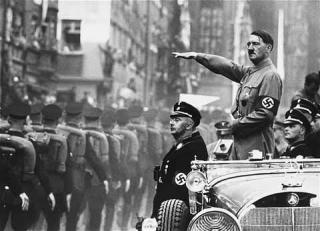
The Germans decided that this method of choosing removes personality cult as much as possible from voting, remembering that it was such a strong personality cult that brought Hitler to power in the 1933 elections.

The Bundestag.

Whichever party (or coalition) wins the election gets to put up their man (or woman) to be Chancellor(in), and that person also sits in the Bundestag as a normal representative of his or her district as well. Can make for some very live debates in the Bundestag. Since the smaller party that is in the winning coalition gets to put up the Vice-Chancellor (who is also the foreign minister), that person also sits in the Bundestag.

Imagine, under that system in the USA, President Obama sitting in a joint session of Congress for four hours a day.... wow....

There is another chamber: the Bundesrat (The Federal Council), but it is not officially a chamber as it is not elected. The Bundesrat is comprised of coalitions of people who represent the political make up of their respective provinces and since provincial elections are staggered over 4 years, the makeup of the Bundesrat changes some after each provincial election. The makeup of the Bundesrat can be adjusted as many time as 5 times a year, depending. Members of the Bundesrat are required to do block-voting, in other words, one vote overall for each province, essentially. That is very similar to the unit rule prescribed in the US consitution for the election of the Vice-President in the case of an electoral tie. Because many of Germany's 16 provinces are themselves coalition governments (sometimes even a grand-coalition as we saw on the national level in 2005), if the voting block from any one province is not unified in it's decision, then it must abstain from that vote.

There is no doubt that the Bundesrat is the underdog of the two houses of the German parliament, but it has one BIG advantage: no legislation can even be put forth for a vote in the Bundestag (where most of the action is) before the Bundesrat has given its blessing to that legislation. I suppose you could call that the German version of check-and-balances.

Any changes in the German constitution requires a clean 2/3 vote in both houses of the German parliament to pass.

Germany also has a President. Well actually, it has two:

The Bundespräsident (The Federal President) and the President of the Bundesrat (who is the 4th most powerful person in Germany).

The Bundepräsident is apppointed by the chancellor and serves for life, if he wishes. In international relations, he is called an "Excellency". Well, actually, he is elected by a federal convention, but it is 100% likely to follow the advisement of the Chancellor. So, the dog wags the tail wags the dog. Although the German president is given some duties, he is mostly a figurehead these days. For instance, according to German law, the Bundespräsident is supposed to hammer out and sign treaties, but actually, the Vice-Chancellor/Foreign Minister (currently: Guido Westerwelle) does that, and then the Bundespräsident gives his signature. Most Germans see the Bundespäsident as the friendly grandfather of the nation, a man who gives a warm Christmas or New Years speech and then the rest of the time, you never hear from him. I bet that not even 10% of all Germans, when asked, could tell you who the current Bundespräsident is (Joachim Gauck). The Bundespräsident has two official state homes: one in Berlin and one in Bonn.

The other President: Bundesratspräsident, is the head of the Bundesrat.

-------------------------------------------------------

As you can see, the German system is quite different from ours, and yet, it functions actually very effectively.

Voter requirement: german national, living in Germany for at least 3 months prior to the election.
 
Last edited:
Whichever party (or coalition) wins the election gets to put up their man (or woman) to be Chancellor(in), and that person also sits in the Bundestag as a normal representative of his or her district as well. Can make for some very live debates in the Bundestag. Since the smaller party that is in the winning coalition gets to put up the Vice-Chancellor (who is also the foreign minister), that person also sits in the Bundestag.

That is a tradition, not a law, by the law.

Also, technically, you should have written "Foreign Minister (who is also the Vice Chancellor)". Foreign Minister is the day job, Vice Chancellor is just a back-up function.

Germany also has a President. Well actually, it has two:

The Bundespräsident (The Federal President) and the President of the Bundesrat (who is the 4th most powerful person in Germany).

The Bundepräsident is apppointed by the chancellor and serves for life, if he wishes. In international relations, he is called an "Excellency". Well, actually, he is elected by a federal convention, but it is 100% likely to follow the advisement of the Chancellor.

I seem to recall there´s a vote every five or six years. Also, the convention doesn´t follow the Chancellor´s advice. Its distribution of voter affiliations can be different from the parliament´s.

So, the dog wags the tail wags the dog. Although the German president is given some duties, he is mostly a figurehead these days. For instance, according to German law, the Bundespräsident is supposed to hammer out and sign treaties, but actually, the Vice-Chancellor/Foreign Minister (currently: Guido Westerwelle) does that, and then the Bundespräsident gives his signature.

He is also supposed to check the constitutionality of all laws that are passed before signing them - although for some past Presidents, that was merely rubber-stamp duty.

Most Germans see the Bundespäsident as the friendly grandfather of the nation, a man who gives a warm Christmas or New Years speech and then the rest of the time, you never hear from him. I bet that not even 10% of all Germans, when asked, could tell you who the current Bundespräsident is (Joachim Gauck).

It´s not quite that bad.

Also, the Bundespräsident is - unless he´s making a serious effort to the contrary, like Wulff did - almost always quite popular. The cynic in me assumes that´s because he lacks the power to make unpopular decisions.
 
That is a tradition, not a law, by the law.

Also, technically, you should have written "Foreign Minister (who is also the Vice Chancellor)". Foreign Minister is the day job, Vice Chancellor is just a back-up function.


I seem to recall there´s a vote every five or six years. Also, the convention doesn´t follow the Chancellor´s advice. Its distribution of voter affiliations can be different from the parliament´s.


He is also supposed to check the constitutionality of all laws that are passed before signing them - although for some past Presidents, that was merely rubber-stamp duty.


It´s not quite that bad.

Also, the Bundespräsident is - unless he´s making a serious effort to the contrary, like Wulff did - almost always quite popular. The cynic in me assumes that´s because he lacks the power to make unpopular decisions.

True, in ARD or ZDF, he is more often than not called the "Aussenminister", but I have just as often seen him titled "Vize-Kanzler" . 6 of one, 1/2 dozen of the other.

The convention has almost always voted for the candidate that the Chancellor has recommended. Can you name me even one time since the Gründerzeit where the convention did not do this?

Yes, the Bundespräsident is supposed to check the constitutionality of laws, but long before they reach his desk, they will have been double and triple checked in the Bundesrat and sometimes in the Bundestag - so, yes, you are right, it is a matter of rubber stamping. Again, the tail wags the dog wags the tail!!

I just tried to put this all up in the more general of terms for US-American readers. It is all a little more complex than this, but the gist of it all is that the German electoral system and it's relatively unspoken system of checks and balances, though quite different than the US-American system, is a very, very good system. I think the Germans can be proud of the energy and time and thought they have put into the actual nuts-and-bolts of electioneering.
 
Is there anything new or interesting happening?


The AfD leader has been attacked on stage by some "antifascist" black block goons - he wasn't seriously hurt. That gave them a sympathy boost but they'll still have a hard time hitting the 5% hurdle. Yesterday Merkel met Steinbrück in a TV debate - 17,6 million watched, I had better things to do. Polls show a small "lead" for Steinbrück in "who won the debate", which doesn't matter as Steinbrück has only a theoretical chance of becoming Chancellor.

Other than that: nothing new. Mutti bleibt.
 
The AfD leader has been attacked on stage by some "antifascist" black block goons - he wasn't seriously hurt. That gave them a sympathy boost but they'll still have a hard time hitting the 5% hurdle. Yesterday Merkel met Steinbrück in a TV debate - 17,6 million watched, I had better things to do. Polls show a small "lead" for Steinbrück in "who won the debate", which doesn't matter as Steinbrück has only a theoretical chance of becoming Chancellor.

Other than that: nothing new. Mutti bleibt.

Just to point out: We Germans do not vote for the persons (like USA'ians do for the president), we vote for parties. But the media likes personalities, and forces the parties to pre-select persons. The problem for Steinbrück is that he's way less popular than his party (SPD. In truth, all likely candidates from the SPD would suffer the same problem), and that Merkel is way, WAY more popular than he is.
 
Just to point out: We Germans do not vote for the persons (like USA'ians do for the president), we vote for parties. But the media likes personalities, and forces the parties to pre-select persons. The problem for Steinbrück is that he's way less popular than his party (SPD. In truth, all likely candidates from the SPD would suffer the same problem), and that Merkel is way, WAY more popular than he is.

I think it´s not so much that Merkel is popular - it´s more like people think there´s no really pressing reason to vote her out.
 
I think it´s not so much that Merkel is popular - it´s more like people think there´s no really pressing reason to vote her out.

Not according to the polls they make, for instance after the "big duel" (which was neither). There's always a question of "who is more sympathetic".

I fail to see why this matters. I do not have to like the dude/dudette to appreciate the quality of his/her work.
 
The worst case scenario would, of course, be that Tony Abbott wins this election as well.
 
99074f54e3b17f64e.gif


^ this seems to be the average feeling about tomorrow. The latest polls only show one interesting development - the AfD comes closer to the 5% hurdle. If they make it into the parliament, the chances of the current coalition forming the government again would sink, as in last effect not the percentage of votes, but the number of seats decide and if the AfD gets seats, those come from the pool the other parties would have gotten otherwise.

So if they make it, it will likely be a "great coalition" CDU/CSU/SPD, if not it isn't unlikely that it stays as it is because the FDP will sure get enough votes "lent" from the CDU/CSU to make it into the Bundestag, despite the fact that they only got a miserable 3,3% in Bavaria last week. In case they fail, there is a theoretical possibility of a coalition with the Green Party, but that would sure be weird for both sides, even if the Greens are well integrated into the establishment these days and it has already happened on regional level.

In any case, Merkel stays in office.

It looks like the "party" with the greatest increase will be the non-voters.
 
Last edited:
Wow, around 20 views on this thread during the last five hours. Well, this election IS boring, I think I admitted it already. :D

Ok, here's a ...uhm... political song while we are holding our collective breath.

 
Ok you were all too shy to ask but I know you wanna know, so here's my reasoning. ;)

I really thought about not voting at all this time, given that the four parties who will somehow form the government amongst each other are very similar to the "block parties" in the DDR - they have a consensus in almost every really important topic going beyond small local or personal issues. Germany is a part of NATO and the "western" alliance, that's how it is and we are lucky that the NSA has access to all our data and filters out the evil-doers among our Muslims. And while we stay away from the front lines and prepare to pay instead of fight, we share the path of bringing all those wonderful "western" finance capitalism achievements to the poor people of the rest of the world. That's the consensus, and I disagree with it.

Now I could, like I did in every election since 1998 where I last voted for the Greens, vote for "the left", DIE LINKE, but they will enter the parliament anyway, with a safe 8-10%. Or I could vote for the new AfD who challenge some "without alternative" myths of the block, but come across not exactly close to my view of society.

So I just watched a speech by the leader of the new AfD, Bernd Lucke, and thought it was very strong on the Euro thing and ok on the other topics - I didn't scream "Nazi" while he was talking. Here:


I think that I want their voice heard in the parliament. They aren't going to form the government, so it's not that risky to help them to take the 5% hurdle even if it isn't the party made from scratch for me. It is a vote against the block, though.

Now i'm going to watch a speech of my favorite German politician, the fire brand Sahra Wagenknecht, and I want her to convince me that I have to vote at all ... and maybe that would trigger me to vote AfD. She won't mind as DIE LINKE is safe, and if the current coalition fails, helped by the AfD reaching parliament, it could help Steinbrück and the Greens to consider a coalition with DIE LINKE which would force them to do real "left" politics, Sahra might think - but I say it won't happen.


For me, voting means to literally walk across the street into a school mensa where friendly voluntars are waiting for me to put my ballot into the urne, and they will count it honestly. I checked that out once in the advent of the internet, voting for the Trotzkiites, and among the 2-3 thousand voters in my district, there was only one vote for them announced on the internet page. I was convinced that it was mine.. The existence of this trustworthy voting system, while most of the world including Yankistanis don't have anything like it, is what would cause me a bad conscience if I'd stay home tomorrow.
 
Last edited:
Sahra did her duty and I went voting for the AfD. :D

And they are about to jump over 5%. The early prognosis now out (90 minutes after end of voting) have them at 4.9% and my experience says that the small parties tend to be underrepresented in the early estimates. That would be the sensation of the evening.

The FDP seems to be out at 4.6%, and the CDU/CSU is the big winner with 42.5% in the early estimates. If FDP AND AfD don't make it, Merkel's party could even get the absolute majority of seats and govern alone. :eye-poppi
 
Some Germans I know in other parts of the internet are extremely upset, but I can't understand why exactly :p .

"Nach dem Wahlergebnis besauf ich mich jetzt erst mal. Facepalm, Deutschland... Picard-Level Facepalm!"
 
So we have more than 15% of the votes without representation in the parliament. And CDU/CSU apparently will need a coalition partner for the seat or two they seem to run short of the "absolute majority" with their 41.5% of 71.5% of people entitled to vote who went for it. And non of the candidates for such a coalition have less than 60 seats. Bizarre. Almost a textbook illustration of the undemocratic nature of the 5% rule.
 

ISF - Join now!

Every member here is approved by hand. No bots, no spam, just people who care about evidence and honest debate.

Membership is free!

Create your free account

Back
Top Bottom