dudalb
Penultimate Amazing

Magz care to explain what is wrong with Deutschland today?
Probably that these guys are not in control anymore....
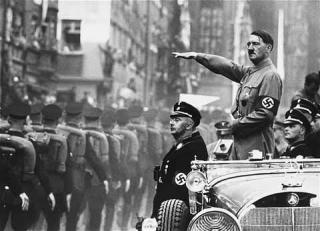
I can see Magz singing
"Don't Be Stupid
Be A Smarty
Come and Join
The Nazi Party".

Magz care to explain what is wrong with Deutschland today?
As opposed to the No-Really-We-Swear-We're-Not-Nazis NDP, eh?
Should've received more.

Not Hitlery enough for him.
I amgiving serious thought to going back to Germany


Whichever party (or coalition) wins the election gets to put up their man (or woman) to be Chancellor(in), and that person also sits in the Bundestag as a normal representative of his or her district as well. Can make for some very live debates in the Bundestag. Since the smaller party that is in the winning coalition gets to put up the Vice-Chancellor (who is also the foreign minister), that person also sits in the Bundestag.
Germany also has a President. Well actually, it has two:
The Bundespräsident (The Federal President) and the President of the Bundesrat (who is the 4th most powerful person in Germany).
The Bundepräsident is apppointed by the chancellor and serves for life, if he wishes. In international relations, he is called an "Excellency". Well, actually, he is elected by a federal convention, but it is 100% likely to follow the advisement of the Chancellor.
So, the dog wags the tail wags the dog. Although the German president is given some duties, he is mostly a figurehead these days. For instance, according to German law, the Bundespräsident is supposed to hammer out and sign treaties, but actually, the Vice-Chancellor/Foreign Minister (currently: Guido Westerwelle) does that, and then the Bundespräsident gives his signature.
Most Germans see the Bundespäsident as the friendly grandfather of the nation, a man who gives a warm Christmas or New Years speech and then the rest of the time, you never hear from him. I bet that not even 10% of all Germans, when asked, could tell you who the current Bundespräsident is (Joachim Gauck).
That is a tradition, not a law, by the law.
Also, technically, you should have written "Foreign Minister (who is also the Vice Chancellor)". Foreign Minister is the day job, Vice Chancellor is just a back-up function.
I seem to recall there´s a vote every five or six years. Also, the convention doesn´t follow the Chancellor´s advice. Its distribution of voter affiliations can be different from the parliament´s.
He is also supposed to check the constitutionality of all laws that are passed before signing them - although for some past Presidents, that was merely rubber-stamp duty.
It´s not quite that bad.
Also, the Bundespräsident is - unless he´s making a serious effort to the contrary, like Wulff did - almost always quite popular. The cynic in me assumes that´s because he lacks the power to make unpopular decisions.

Is there anything new or interesting happening?

The AfD leader has been attacked on stage by some "antifascist" black block goons - he wasn't seriously hurt. That gave them a sympathy boost but they'll still have a hard time hitting the 5% hurdle. Yesterday Merkel met Steinbrück in a TV debate - 17,6 million watched, I had better things to do. Polls show a small "lead" for Steinbrück in "who won the debate", which doesn't matter as Steinbrück has only a theoretical chance of becoming Chancellor.
Other than that: nothing new. Mutti bleibt.
Just to point out: We Germans do not vote for the persons (like USA'ians do for the president), we vote for parties. But the media likes personalities, and forces the parties to pre-select persons. The problem for Steinbrück is that he's way less popular than his party (SPD. In truth, all likely candidates from the SPD would suffer the same problem), and that Merkel is way, WAY more popular than he is.
I think it´s not so much that Merkel is popular - it´s more like people think there´s no really pressing reason to vote her out.


 .
.
