erwinl
Illuminator

- Joined
- Sep 5, 2008
- Messages
- 4,073
Well, I don't know how the Titan worked, but I know a bit about older types of deep-sea vessels.
Carbon fibre is at least partially conductive, so I doubt Bluetooth (which works in the microwave band) can penetrate it very well, if at all. It certainly can't penetrate metal, not even tin foil.
Lower wavelengths could probably go through the CF hull, such as the ones used in NFC.
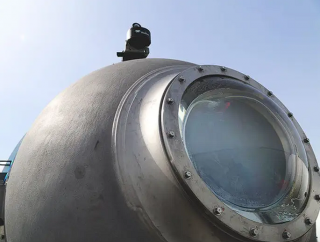
In traditional bathyscaphes, where the hull is a metal sphere, all functions going through the hull, i.e. windows, hatches, wires, are essentially made in the same way: Cones. A suitable conical hole is made in the hull, and a conical glass pane (VERY thick), or hatch, or insulator with a centre wire, is fitted into the hole. There are of course seals or gaskets and retaining rings or opening mechanisms as appropriate, but what keeps the opening shut and water-tight is the pressure from outside. Thus, the pressure on, say, a window is transferred to the surrounding hull through the conical shape and balances the forces from the hull. So, if made right (there will be a bit of engineering to figure out the exact slope of the cone), the holes will not weaken the hull significantly.
Presumably, the window of the Titan was made in this way. This also explains why it was not present when the wreckage was recovered: It was simply blown outwards by the explosive phase of the implosion. ... And being made of acrylic, it was probably shattered.
Come to think of it: While the CF cylinder would be more or less conductive, it would probably be possible to apply a voltage between the end domes and thus have a way to pass a signal to the outside equipment. It would be a single channel, but you could probably pass an USB channel through that way. It would have a very low impedance, but that is only a question of a proper driver.
Hans
Thank you!

This makes things somewhat clearer for me.
And yes, I had forgotten about the conductivity of Carbon fiber. Good point.