
You seem to invent something new for which there is no evidence whatsoever, solely in order to justify that your creator has created the universe.We are talking about two completely different realms.
Everything in the physical realm was created by the Creator.
The Creator lives in the spiritual realm. And is pre-existent.

You are using an out of date browser. It may not display this or other websites correctly.
You should upgrade or use an alternative browser.
You should upgrade or use an alternative browser.
Three "Myths" Atheists Believe - Bart Ehrman
- Thread starter Rusty Tyler
- Start date
Parallel universes are science fiction. There is no evidence that they exist.Are parallel universes possible?
Maybe I should explain the difference between the religious fantasy realm, and the many universes of some theories within theoretical physics. If a test can be devised to show that the alternative universes do not exist (falsification), then these alternative universes have some scientific justification. I sincerely doubt that there is some way falsifying the spiritual realm, but if the religious believers can devise one, they will get scientific attention.
W.D.Clinger
Philosopher

Scientific explanations of the big bang generally start here:Explain the big bang. Where did it come from? And what caused it?
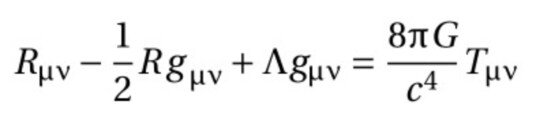
When @Rusty Tyler understands those 16 equations, we can move on to the next steps in the explanation.
It is ludicrous, even hilarious, to watch folks whose rejection of science has left them with absolutely no command of the basics to go about demanding explanations of the science they have worked so hard to prevent themselves from ever understanding.
In a previous episode of this thread, only a day or two ago, I listed a number of things @Rusty Tyler uses every day without having the least idea of HOW or WHY they work. He continued to insist we tell him the HOW and WHY of the science that explains HOW and WHY they work. For most of the items I listed, the HOW and WHY starts with quantum mechanics. For one of the items I listed, the HOW and WHY starts with the no-cloning theorem which, despite being a basic fact of quantum mechanics, is a mathematical triviality. Its proof fits on a single slide:
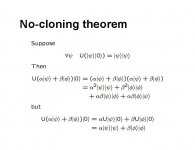
My purpose in presenting these two examples of scientific explanations is to suggest we make a point of responding to @Rusty Tyler's hilarious demands for scientific explanations of HOW and WHY by providing him with the very first step(s) of a scientific explanation. Not as science for dummies, but as though we are communicating with someone who sincerely wants to understand the science.
@Rusty Tyler won't understand those explanations, of course, but he wouldn't understand the science for dummies version either.
Gord_in_Toronto
Penultimate Amazing

- Joined
- Jul 22, 2006
- Messages
- 26,940
Foster Zygote
Dental Floss Tycoon

- Joined
- Jun 24, 2006
- Messages
- 23,532
And not everyone understands the formal, scientific definition of theory. In science, a theory is hierarchically above a fact (apologies to Stephen Gould, with whom I disagree on that point a bit). A theory is made of facts - facts are the building blocks of theories - and theories connect facts together to show how they are related to each other. They are extensively tested either experimentally or abductively. We don't hear creationists complaining about acceptance of the "theories" of electromagnetism, gravity or chemistry.Not everyone believes in the THEORY of evolution.
The term evolutionist identifies those who do.
You may have watched the podcast interview in the video, but you clearly didn't understand it. Ehrman admits that he doesn't have a detailed definition for the context in which he's using the word 'myth' here, and I'm not sure I agree with his definition based on what he's said. But he is most definitely not saying that scientific hypotheses like expansion cosmology, abiogenesis and consciousness are untrue beliefs in the context that you're implying for 'myth'. He is, in fact, an atheist who accepts that each of the things you mentioned occurred. And he even understands expansion cosmology enough to correctly state that the "Big Bang" doesn't represent a moment when everything springs into existence from nothing - that there is no "before the Big Bang". More importantly he clearly states that he isn't a scientist, and that while he is very much interested in those subjects, he has no expertise in them.
More interesting, to me, is what Ehrman is an expert in. He is a history professor specializing in Christian textual criticism and the earliest history of Christianity. His academic position is that Jesus was an apocalyptic Jewish rabbi (informally, as he actually predated the post-temple formal rabbinical tradition) who gathered a moderate following who were expecting a fulfillment of prophecy of the return of the House of David to the rule of Israel and the expulsion of the Roman occupation. He then, not surprisingly, got himself executed for sedition (the Romans didn't execute people for violating Jewish religious law). At some point a few of his followers claimed that he'd returned from the dead, and that this was all part of the plan, which was still going as intended. His view is that there is little of the historical Jesus to be found in the various ancient texts available, both canonical and apocryphal, and that most of these accounts, many of which differ from one another significantly, are the inventions of their authors.
If you're going to cite Ehrman regarding subjects in which he claims no expertise, then you really should be seriously considering what he has to say about Christianity, the history of which is a subject in which he does have academic expertise.

It's fan fiction.You seem to invent something new for which there is no evidence whatsoever, solely in order to justify that your creator has created the universe.
Rusty Tyler
Graduate Poster

I don't agree with everything he says, but he does make some good points. (as atheists do)If you're going to cite Ehrman regarding subjects in which he claims no expertise, then you really should be seriously considering what he has to say about Christianity, the history of which is a subject in which he does have academic expertise.
Debates between him and Dan Wallace are interesting. Dan usually kicks his butt though.
JayUtah
Penultimate Amazing

What's important is that scientific explanations of my clumsy bar staff begin there too. That equation perfectly explains why a glass falls from the tray and smashes on the ground.Scientific explanations of the big bang generally start here:
View attachment 72644
When @Rusty Tyler understands those 16 equations, we can move on to the next steps in the explanation.
When faced with advanced math, the response from reluctant lay people is that they don't understand it, and because they don't (and likely many others don't either) it can mean anything or nothing, and no one would know the difference. No one knows what an upside-down V is, for Chrissakes! At best, in their view, it's just science trying to bamboozle people to give atheists something to cling to. At worst, it's Satan working through science to confuse and defeat the faithful.
What this equation also explains, however, is such things as gravitational lensing. The big Rs and the big T combined to give us a geometry where light thinks it's traveling in a straight line but is in fact curving around a massive object. And since this is happening to light, we can see it happen. We saw it happen a hundred years ago, and many times since. That's how we know this is probably the right equation. That and the falling bar glass, which it predicts too.
And people like Lemaître, who still had every reason to believe in God, understood what this equation meant in terms of how things in the Universe move with respect to each other and what that would look like when viewed from any point, and helped arrive at the "OMG!" finding.
Now this is the "...For Dummies" explanation, which still has value. My experience teaching complex subjects has suggested that imprecise gesticulations are first more valuable at delivering concepts than notation. Not that I'm a talented enough dancer to express tensors with my hands, but presenting notation as a first pass tends to make even smart students' eyes glaze over.
Last edited:
JayUtah
Penultimate Amazing
On what points, exactly? You're trying to cite him as an expert in science when he is no such thing, and his declarations aren't accepted by people who do have expertise in science. Would you accept me as an expert in Christian belief and practice?I don't agree with everything he says, but he does make some good points.
Try to work out why that is.Debates between him and Dan Wallace are interesting. Dan usually kicks his butt though.
We've had extensive discussions here regarding the historisity of Jesus and his ideas have often come up. I think he misses an idea in his construction of a historic Jesus and that is an imposter Jesus came along after the death of Jesus and that kick started the resurrection myth.And not everyone understands the formal, scientific definition of theory. In science, a theory is hierarchically above a fact (apologies to Stephen Gould, with whom I disagree on that point a bit). A theory is made of facts - facts are the building blocks of theories - and theories connect facts together to show how they are related to each other. They are extensively tested either experimentally or abductively. We don't hear creationists complaining about acceptance of the "theories" of electromagnetism, gravity or chemistry.
You may have watched the podcast interview in the video, but you clearly didn't understand it. Ehrman admits that he doesn't have a detailed definition for the context in which he's using the word 'myth' here, and I'm not sure I agree with his definition based on what he's said. But he is most definitely not saying that scientific hypotheses like expansion cosmology, abiogenesis and consciousness are untrue beliefs in the context that you're implying for 'myth'. He is, in fact, an atheist who accepts that each of the things you mentioned occurred. And he even understands expansion cosmology enough to correctly state that the "Big Bang" doesn't represent a moment when everything springs into existence from nothing - that there is no "before the Big Bang". More importantly he clearly states that he isn't a scientist, and that while he is very much interested in those subjects, he has no expertise in them.
More interesting, to me, is what Ehrman is an expert in. He is a history professor specializing in Christian textual criticism and the earliest history of Christianity. His academic position is that Jesus was an apocalyptic Jewish rabbi (informally, as he actually predated the post-temple formal rabbinical tradition) who gathered a moderate following who were expecting a fulfillment of prophecy of the return of the House of David to the rule of Israel and the expulsion of the Roman occupation. He then, not surprisingly, got himself executed for sedition (the Romans didn't execute people for violating Jewish religious law). At some point a few of his followers claimed that he'd returned from the dead, and that this was all part of the plan, which was still going as intended. His view is that there is little of the historical Jesus to be found in the various ancient texts available, both canonical and apocryphal, and that most of these accounts, many of which differ from one another significantly, are the inventions of their authors.
If you're going to cite Ehrman regarding subjects in which he claims no expertise, then you really should be seriously considering what he has to say about Christianity, the history of which is a subject in which he does have academic expertise.
Rusty Tyler
Graduate Poster
No.You're trying to cite him as an expert in science when he is no such thing,
I'm citing him as one of your fellow atheists.
I thought he made good points about the faith required to believe in evolution.
The how and why of...
1. The Big Bang: ...
2. The Origin of Life (Abiogenesis): ...
3. The Emergence of Consciousness: ...
Source video
Foster Zygote
Dental Floss Tycoon
- Joined
- Jun 24, 2006
- Messages
- 23,532
I was only briefly summarizing his views. I'm not sure if he's ever specifically excluded that possibility or not. Personally, I think it's a highly plausible hypothesis. We're talking about a time long before photography, so to know what someone looked like (Unless it was someone influential enough to have an artist render a passable life portrait. And even then, how many people are really going to see it?) you had to actually have seen that person up close. And as it doesn't seem that Jesus was especially famous outside of a limited region, it's likely that far more people had heard of him than actually saw him. So someone else coming along and saying, "I'm Jesus, back from the dead", whether he was knowingly lying or a kook who believed it himself, could certainly give genesis to the story of resurrection, especially among a population steeped in magical thinking.We've had extensive discussions here regarding the historisity of Jesus and his ideas have often come up. I think he misses an idea in his construction of a historic Jesus and that is an imposter Jesus came along after the death of Jesus and that kick started the resurrection myth.
Foster Zygote
Dental Floss Tycoon
- Joined
- Jun 24, 2006
- Messages
- 23,532
Irrelevant. He is not an expert in any of those fields, even if he had explicitly said what you think he said, which he did not, his opinions regarding those subjects are no more valid than your own.No.
I'm citing him as one of your fellow atheists.
I thought he made good points about the faith required to believe in evolution.
The how and why of...
I was only briefly summarizing his views. I'm not sure if he's ever specifically excluded that possibility or not. Personally, I think it's a highly plausible hypothesis. We're talking about a time long before photography, so to know what someone looked like (Unless it was someone influential enough to have an artist render a passable life portrait. And even then, how many people are really going to see it?) you had to actually have seen that person up close. And as it doesn't seem that Jesus was especially famous outside of a limited region, it's likely that far more people had heard of him than actually saw him. So someone else coming along and saying, "I'm Jesus, back from the dead", whether he was knowingly lying or a kook who believed it himself, could certainly give genesis to the story of resurrection, especially among a population steeped in magical thinking.
1. The Big Bang: ...
2. The Origin of Life (Abiogenesis): ...
3. The Emergence of Consciousness: ...
Source video
W.D.Clinger
Philosopher
(The first equation below was typeset by me, as part of a document I will be publishing. The next two equations are screen shots from Wikipedia, because I was too lazy to typeset them just for this thread.)

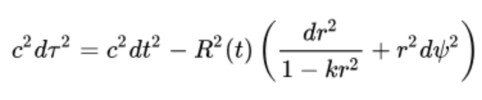
is one of that equation's exact solutions, and that's the solution that fits solid empirical evidence.

is one of that equation's exact solutions, and that's the solution that fits solid empirical evidence.
No, those equations and their consequences are not myths, and they are not accepted on blind faith. Those equations summarize decades of hard work, the kind of intellectual effort he himself has apparently never put forth, and that hard work was driven by empirical evidence, not wishful thinking.
It's worth pointing out that the equations shown above were so astonishingly counter-intuitive that it took years and a great deal of empirical evidence to convince the scientific community that those equations and their consequences truly describe aspects of the universe in which we live. The same is true for the equations and consequences of quantum mechanics.
Scientists did not accept the theories of relativity and quantum mechanics because they wanted to believe comforting myths. They were forced to accept those theories because, as much as they wanted to reject those uncomfortable theories, observable reality has established those theories as the most precisely accurate and well-established theories in all of science.
And the reason that equation explains what you just said is thatWhat this equation also explains, however, is such things as gravitational lensing. The big Rs and the big T combined to give us a geometry where light thinks it's traveling in a straight line but is in fact curving around a massive object. And since this is happening to light, we can see it happen. We saw it happen a hundred years ago, and many times since. That's how we know this is probably the right equation. That and the falling bar glass, which it predicts too.
is one of that equation's exact solutions, and that's the solution that fits solid empirical evidence.
And the reason Lemaître understood what that equation meant for the universe is thatAnd people like Lemaître, who still had every reason to believe in God, understood what this equation meant in terms of how things in the Universe move with respect to each other and what that would look like when viewed from any point, and helped arrive at the "OMG!" finding.
is one of that equation's exact solutions, and that's the solution that fits solid empirical evidence.
Here, however, there's some value in glazing the eyes of someone who (hilariously) thinks he's such a smart student that he can win debating points by demanding scientific explanations of HOW and WHY, as though the scientists he's debating have absolutely nothing to say about such things. He genuinely wants to think the science expressed by those equations is a myth, believed by scientists as a matter of blind faith (which is, after all, his own preferred mode of inquiry).Now this is the "...For Dummies" explanation, which still has value. My experience teaching complex subjects has suggested that imprecise gesticulations are first more valuable at delivering concepts than notation. Not that I'm a talented enough dancer to express tensors with my hands, but presenting notation as a first pass tends to make even smart students' eyes glaze over.
No, those equations and their consequences are not myths, and they are not accepted on blind faith. Those equations summarize decades of hard work, the kind of intellectual effort he himself has apparently never put forth, and that hard work was driven by empirical evidence, not wishful thinking.
It's worth pointing out that the equations shown above were so astonishingly counter-intuitive that it took years and a great deal of empirical evidence to convince the scientific community that those equations and their consequences truly describe aspects of the universe in which we live. The same is true for the equations and consequences of quantum mechanics.
Scientists did not accept the theories of relativity and quantum mechanics because they wanted to believe comforting myths. They were forced to accept those theories because, as much as they wanted to reject those uncomfortable theories, observable reality has established those theories as the most precisely accurate and well-established theories in all of science.
Last edited:
It's something we know has happened throughout history and was happening around the time a historic Jesus would have lived.I was only briefly summarizing his views. I'm not sure if he's ever specifically excluded that possibility or not. Personally, I think it's a highly plausible hypothesis. We're talking about a time long before photography, so to know what someone looked like (Unless it was someone influential enough to have an artist render a passable life portrait. And even then, how many people are really going to see it?) you had to actually have seen that person up close. And as it doesn't seem that Jesus was especially famous outside of a limited region, it's likely that far more people had heard of him than actually saw him. So someone else coming along and saying, "I'm Jesus, back from the dead", whether he was knowingly lying or a kook who believed it himself, could certainly give genesis to the story of resurrection, especially among a population steeped in magical thinking.
He is no fellow atheist of mine.No.
I'm citing him as one of your fellow atheists.
...snip..
JayUtah
Penultimate Amazing
He's not my "fellow" anything. He's certainly not any sort of fellow scientist. And yes, you're trying to cite him as an expert in science.I'm citing him as one of your fellow atheists.
...which involved him trying to say what those sciences are, and getting it massively wrong.I thought he made good points about the faith required to believe in evolution.
Foster Zygote
Dental Floss Tycoon
- Joined
- Jun 24, 2006
- Messages
- 23,532
Atheism isn't a doctrine. There is no "Orthodox Atheism", or "heretical Atheism". Atheism is simply a lack of belief in gods. Even on this forum, most of us are not bound together by atheism, but rather our commitment to the scientific methodology. You may as well tell Jay you're citing one of his fellow Americans, for all the relevance Ehrman's statements have regarding science.No.
I'm citing him as one of your fellow atheists.
I thought he made good points about the faith required to believe in evolution.
The how and why of...
1. The Big Bang: ...
2. The Origin of Life (Abiogenesis): ...
3. The Emergence of Consciousness: ...
Source video
Rusty Tyler
Graduate Poster
Blasphemy.We've had extensive discussions here regarding the historisity of Jesus and his ideas have often come up. I think he misses an idea in his construction of a historic Jesus and that is an imposter Jesus came along after the death of Jesus and that kick started the resurrection myth.
1 Corinthians 15:17 NIV
And if Christ has not been raised, your faith is futile; you are still in your sins.