Moderated The validity of classical physics - Part 2

Yeah, I just thought it might be fun to write to a tyre company as if doing a school project or something, asking whether the contact patch pushes a wheel from behind the axle, and, like SHURELY it can't pull the wheel!?!!?!? I might do that anyway.
May be a little work of your own, may give them more time to do theirs.

When that cart has enough power to do wheel stands, you may have a point. However, they are plain wheels, so why don't you Google that?
You can look up the train link cited in this threads. You won't like it.
 
Let's take this mess one step at a time. First, why is your balloon power curve different than it was before?
It's the same. Perhaps the colour or legend is different. The balloon is the larger of the two traces. Exactly the same as before. That is obvious.
Can somebody add the word "same" to the terms that humber does not understand?

Okay, I'll lead you by the hand. On your first graph, there is something called "Balloon Power". The curve passes through the origin. On the second graph, there is something called "Balloon Power". It is represented by the same symbol. It does not pass through the origin, and has a completely different shape. We changed nothing about the balloon. This curve should not have changed. Once you fix that, we'll address the other errors.
 
V max moves to 0.8WS.

Here I go again, sticking my neck out and saying that according to the power curves on the new graph (which has a new balloon power curve) V max would be 0.6WS. I'd like to see the former balloon power curve on the new graph, too, humber. Have a look at it.
 
You refute nothing. A tethered balloon in constant wind generates no power, for the same reason a house in wind does not. Power = force * velocity. Velocity is zero, so the power is zero.

Humber, you are completely and demonstrably wrong according to the most basic and fundamental mechanics and dynamics principles.

When you tether a balloon in wind there is both force and velocity present. Power is the time rate of energy transfer, remember that Humber, say it 10 times out aloud! Power is the time rate of energy transfer! If you don't get that you are not qualified to make any statement here at all! You are in the deepest contempt!!

If you genuinely cannot understand and need help, do like the rest of us, ask with humility. Until you get a hold of this basic premise, nothing else you try to say about force, work or energy is likely to make any sense. Do not go on like an old hopeless fool, it is too sad and pathetic.
 
Last edited:
When you tether a balloon in wind there is both force force and velocity present.

just to clarify, you mean the velocity of the air molecules relative to the balloon, right?


Humber, if I nailed you to the ground, and fired a bunch of high speed peas at your head, I could turn the system into a (not very efficient) power generator by capturing sound/heat energy from the peas bouncing off your delicious skull.
 
When you tether a balloon in wind there is both force force and velocity present. Power is the time rate of energy transfer, remember that Humber, say it 10 times out aloud! Power is the time rate of energy transfer!.
Hang on, he isn't wrong about this point (hard as that may be to believe). If the balloon is tethered to the ground, then it's not moving, so although the wind is blowing against it, there's no motion of the object in question, and therefore no work being done, and therefore zero power. Although for some reason his second graph is wrong in that regard.

Of course, a balloon tethered to the ground is not a particularly interesting thing with regard to this discussion.
 
just to clarify, you mean the velocity of the air molecules relative to the balloon, right?

Yes of course SD, the Balloon is doing work on the atmosphere, providing a drag in the airflow. That drag x the wind speed is the power delivered to the atmosphere. Of course work is also being done in speeding up the earth. The balloon is tending to slow the wind and speed up the earth. The process is rather inefficient as it tends to dissipate most of the energy to turbulent airflow, and the earth is rather too massive to notice any effect. Humber doesn't like it. But then Humber refuses to understand it, and so will deny it.
 
Humber, you are completely and demonstrably wrong according to the most basic and fundamental mechanics and dynamics principles.

When you tether a balloon in wind there is both force and velocity present. Power is the time rate of energy transfer, remember that Humber, say it 10 times out aloud! Power is the time rate of energy transfer! If you don't get that you are not qualified to make any statement here at all! You are in the deepest contempt!!

If you genuinely cannot understand and need help, do like the rest of us, ask with humility. Until you get a hold of this basic premise, nothing else you try to say about force, work or energy is likely to make any sense. Do not go on like an old hopeless fool, it is too sad and pathetic.

Semper. A book on table under the influence of gravity, is met by a force from the table. There is force, but no motion, so no work or power.

A tethered balloon is the same. There is certainly force, but the balloon goes nowhere, so no power is consumed.
You are quite mistaken. There is no energy transfer other than perhaps some local losses, but they do no work on the balloon. You don't say of the wind against a building, that it is powering the building. Power = force * velocity.
When the balloon moves, then work is being done by the balloon against its motion with the air, and in this case, of the skater.
 
just to clarify, you mean the velocity of the air molecules relative to the balloon, right?
You are confusing matters. If the wind blows over your stationary car, then there will be losses due to friction, but that is not powering the car.

Humber, if I nailed you to the ground, and fired a bunch of high speed peas at your head, I could turn the system into a (not very efficient) power generator by capturing sound/heat energy from the peas bouncing off your delicious skull.

That would be the energy of the peas, some of which is lost during the collision. In that case, you are simply dissipating energy and wasting peas.
I like peas.


http://www.iop.org/activity/educati...cs/Mechanics/Work energy power/page_3843.html
A sample calculation; power = force × velocity.

http://physics.about.com/od/glossary/g/work.htm

Definition: Work is defined (in calculus terms) as the integral of the force over a distance of displacement.

Definition: Power is the time rate at which work is done or energy is transferred. In calculus terms, power is the derivative of work with respect to time.
 
Semper. A book on table under the influence of gravity, is met by a force from the table. There is force, but no motion, so no work or power.

A tethered balloon is the same. There is certainly force, but the balloon goes nowhere, so no power is consumed.
You are quite mistaken. There is no energy transfer other than perhaps some local losses, but they do no work on the balloon. You don't say of the wind against a building, that it is powering the building. Power = force * velocity.
When the balloon moves, then work is being done by the balloon against its motion with the air, and in this case, of the skater.


Humber, we have come to the point where we clearly realize your misunderstanding.

You believe the energy flow of a book sitting on a table equates with the energy flow of an earth tethered balloon in the wind.

If you cannot resolve this problem, you are utterly hopeless in dealing with any concept in this forum.
 
Oh, did I misinterpret what you said? Do you want to try and state you position again? You've only yourself to blame if nobody understands you.

Humbermeister.
"You need constant force and energy to maintain riverspeed." #2
Well, you posted it. I have no recall of the context. It's not a matter of being misrepresented, but your wonderful howler.

The paper is about the velocity of water in channels (culverts). It has nothing to do with the ability of an object to travel at the speed of the water. Nothing whatsoever.

The other interpretation of my statement could be that of the river itself, but that is oxymoronic. The river is the power source in the cited paper. Not only that, but it is water flowing under the influence of gravity (always the case one way or the other) but specifically, in that of sloped channels.

I give that effort, 4 flat-cats.
Would you like to try again?
 
Humber, we have come to the point where we clearly realize your misunderstanding.

You believe the energy flow of a book sitting on a table equates with the energy flow of an earth tethered balloon in the wind.

If you cannot resolve this problem, you are utterly hopeless in dealing with any concept in this forum.

Don't be ridiculous, sempter, I am doing no such thing. The point being that work and "energy flow" are not related to static objects like a book on table. There is certainly force opposing gravity, (the molecular forces of the table) which is why the book does not break through it to the ground.
You are taking a very strange view here. "Equivalence" is not wrong of course, but that does not mean that you cannot misconstrue it.

This is the idea of power and work:

http://www.iop.org/activity/educatio...page_3843.html
A sample calculation; power = force × velocity.

http://physics.about.com/od/glossary/g/work.htm

Definition: Work is defined (in calculus terms) as the integral of the force over a distance of displacement.

Definition: Power is the time rate at which work is done or energy is transferred. In calculus terms, power is the derivative of work with respect to time.
 
That's quite a theory you have there, Caveat Sempter.
Do you think that there might be some energy needed to supply the KE that a moving object attains?
The drag you speak of is quite different. When the object is moving, it meets drag opposing that motion, even if it is powered by the wind. No doubt you disagree.
However, the logical conclusion of your argument is that a turbine with fixed blades, should deliver power. If not, then the blades should reach a temperature commensurate with the power that is delivered when it is rotating. The wind cannot force power onto a turbine. If there is no load, and so work, then less energy is taken from the wind as it passes over the blades.

Really Sempter? A tethered balloon powers the Earth?
Someenergy is lost to heat as you say, but that happens to some degree, at all surfaces that meet the wind.

Not my theory Humber, an obvious manifestation. So you really have no idea do you? And you have no excuse. All the information is at your disposal, you make assertions everywhere about all kinds of physics yet you clearly haven't the first clue, very disappointing indeed. I do not condemn you for ignorance Humber, the acquisition of knowledge is a privilege which I am grateful to have had, what is really important is that I know I will continue to be grateful for learning.

I do condemn your behaviour here, attempting to change people's minds toward ignorance, blindly and arrogantly assuming you know the truth, when it is all too apparent that you are significantly in deficit.

However Mr Humber, it is good news, very positive, because you now have the opportunity. You can honour yourself and others here by acknowledging your failing and moving on toward awareness. Be honourable Mr Humber.
 
Last edited:
No, subclauses may have single commas.
Indeed they may, but that's my point: there wasn't one. Anyway, it doesn't matter. Write as you feel, fit. I just wondered, if, youwere as ineducable on other subjects as you is on fizikx.

Oh, then yes. What about him?

ETA: Is that single commas,, in contrast to double commas?
 
Last edited:
You refute nothing. A tethered balloon in constant wind generates no power, for the same reason a house in wind does not. Power = force * velocity. Velocity is zero, so the power is zero.

The delusion I am referring to is the delusion that the results on a treadmill will be different from those in the "real" wind. You are correct that the power is zero when the skater is stationery (hanging on to a tree for dear life, probably). The force is at a maximum, but, because the skater isn't moving, the power (force x velocity) is zero.
 
Can somebody add the word "same" to the terms that humber does not understand?

Okay, I'll lead you by the hand. On your first graph, there is something called "Balloon Power". The curve passes through the origin. On the second graph, there is something called "Balloon Power". It is represented by the same symbol. It does not pass through the origin, and has a completely different shape. We changed nothing about the balloon. This curve should not have changed. Once you fix that, we'll address the other errors.

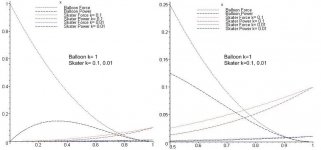
Let's try again. Assumption (1) The balloon remains the same, but the skater's CdA is reduced from 1.0 to 0.1? You should not need this. It is quite clear from the equations. Not only that, but "common sense"; one is falling, the other rising...
I have included k=0.1 and k=0.01, with expanded scale. Note the different colors.
This is the same as the original, with two values of skater k.
 

Attachments

  • g3.jpg
    g3.jpg
    46.3 KB · Views: 8
Last edited:
The delusion I am referring to is the delusion that the results on a treadmill will be different from those in the "real" wind. You are correct that the power is zero when the skater is stationery (hanging on to a tree for dear life, probably). The force is at a maximum, but, because the skater isn't moving, the power (force x velocity) is zero.

CORed, best you don't fall for the same mistakes as Humber. Please always reference your statements on power. Power is the time rate of energy transfer. The skater is exerting force on the wind, the wind by definiton has velocity. The skater is doing work on the wind but since the skater is in static equilibrium with the earth, she is luckily not in herself having to supply the energy, but is transferring it from the earth.
 
Try again. Assumption (1) The balloon remains the same, but the skater's CdA is reduced from 1.0 to 0.1? You should not need this. It is quite clear from the equations. Not only that but "common sense" one is falling, the other rising...
I have included k=0.1 and k=0.01, with expanded scale. Note different colors.
This is the same as the original, with tow values of skater k.

It doesn't matter Humber, if you cannot properly define the energy flow, any statement you make about "power" will be meaningless.
 
The delusion I am referring to is the delusion that the results on a treadmill will be different from those in the "real" wind. You are correct that the power is zero when the skater is stationery (hanging on to a tree for dear life, probably). The force is at a maximum, but, because the skater isn't moving, the power (force x velocity) is zero.

OK, CORed.
But the wind is not the same. When the observer is fixed to the belt so traveling with it, then that is perhaps representative of that observer moving (say, running) in still wind. That is not the same as a stationary observer in moving wind. Also, the power comes from the belt (road) and not the (air) wind.
That is why kites and balloons do not behave as they should.
 

ISF - Join now!

Every member here is approved by hand. No bots, no spam, just people who care about evidence and honest debate.

Membership is free!

Create your free account

Back
Top Bottom