Moderated The validity of classical physics - Part 2

The counter-rotation video shows nothing. Two wheels in parallel, not in series as in the cart. Laughable.

The 'Physics on a Shoestring' is simply flawed. The elastic members provide a load for the cart, so the friction of the wheels is increased. It can then develop a thrust against the belt. It is a measure of the restrained friction to the belt.

The initial drag stretches the elastic bands, so storing energy, which later accelerates the cart through 'zero'.
When there is a load, the cart can develop thrust, but not without an external load. Further proof, that TAD do not understand their own designs.

I think that the cart can be said to do something like 10cm/sec. A 13km belt has been suggested. At that speed, the cart would take 3 to 4 hours to traverse. At 10mph/16kph, that is about 48km of belt passing under the wheels.
 
Last edited:
A brilliant analysis. I can't believe you're onto us. Those shoestrings we used to constrain the cart were carefully calibrated by a friend at NASA to do exactly as you say - and still look like generic shoestrings. Don't even get me started on the magic duct tape. How about the phone books? I'm surprised you didn't mention them. Or the faked "level" with the frozen fluid to make the bubble hold at dead center even though the deck was tilted down like 20 degrees?
How do you confabulate magic from that? It's another DOH! moment.
A defense of "hoax" to hide your flawed methods. The cart does no more than before, but with 'shoestrings' to make a small change. Risible.

ETA:
Try it with the treadmill level.

We see the cart moving from being restrained from rearward motion, to being restrained from forward motion. If not elastic in some way, (though they clearly are) the shoestrings have no effect in between. Conclusive proof of nothing. Too banal to be a hoax.

I assume we can take the hopping and hovering as read. I don't suppose we got that past anyone.

You can't face up to it.

Update to counter-rotation video:

attachment.php
 

Attachments

  • skates.jpg
    skates.jpg
    77.3 KB · Views: 121
Last edited:
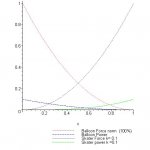
As soe others have pointed out, humber's Maple graph is correct. It shows how to solve a pair of simultaneous equations to show the answer to a question that nobody asked: what is the steady-state speed of a skater being pulled by a balloon, if the skater has the same cross-sectional area and drag coefficient as the balloon?

As mender noted (I think it was mender), by using a larger balloon or a smaller skater, you can get the intersection to move closer to windspeed, as close as you choose, actually. Drop the skater and what do you get? There's a force accelerating the balloon at any speed that is less than windspeed, so only at windspeed will it stop accelerating. And if the balloon is pulling a pulley, with one end of the pulley rope going to the skater, and the other going to a stake in the ground, then provided the intersection happens at a speed that is more than 50% of windspeed (let's just use a balloon with a CdA that's 10 times that of the skater), then since the skater's speed is twice that of the balloon, the skater's speed will be greater than the wind speed.

The required power is clearly available. Thanks for showing that, humber. Congratulations for once again seeing past your misconceptions and showing that everybody else was right all along. Feels good, doesn't it?
 
Last edited:
As soe others have pointed out, humber's Maple graph is correct. It shows how to solve a pair of simultaneous equations to show the answer to a question that nobody asked: what is the steady-state speed of a skater being pulled by a balloon, if the skater has the same cross-sectional area and drag coefficient as the balloon?
As mender noted (I think it was mender), by using a larger balloon or a smaller skater, you can get the intersection to move closer to windspeed, as close as you choose, actually.
I can recall having this very discussion with you where you insisted that was not so. Another moment of "realisation", I expect.
Not as close as you like. The equations tell you that. You boasted "mathematics is one of the languages I speak" It seems not.
There is no physically realizable solution to those equations, that will yield windspeed.

Drop the skater and what do you get?
So away with the mathematics and reason, to fantasy.
Don't do things by halves. Drop the balloon as well.

There's a force accelerating the balloon at any speed that is less than windspeed, so only at windspeed will it stop accelerating. And if the balloon is pulling a pulley, with one end of the pulley rope going to the skater, and the other going to a stake in the ground, then provided the intersection happens at a speed that is more than 50% of windspeed (let's just use a balloon with a CdA that's 10 times that of the skater), then since the skater's speed is twice that of the balloon, the skater's speed will be greater than the wind speed.
More "just so" stories.
Power = force * velocity. The load cannot demand of the balloon, what it cannot supply. Gearing may better match the load to the cart, much as a gearbox does to a car engine, but the final velocity is determined by the power of the engine. Cars with higher low-end torque, may accelerate faster.
So it is with the wind. Gearing may better match the available force to the load. During acceleration, there is also the energy that the KE needs, as well as the drag load.
At lower speeds, the balloons power is greater, while the skater's demand is lower. That is the point!. So, of course, gearing can improve acceleration under that condition. Of course!. You are expected to realise that.
The power generated by the balloon determines the terminal velocity, as the graphs show.

The required power is clearly available. Thanks for showing that, humber. Congratulations for once again seeing past your misconceptions and showing that everybody else was right all along. Feels good, doesn't it?

No, you have failed again, jjcote. You must have more feet than a centipede.
 
Last edited:
Yes, jj, that was me. I proposed the large balloon or parachute, one of sufficient size to get the skater to 80 or 90% of the wind speed. I feel that this is realistic and when plugged into humber's graph, easily shows that the power to move the skater faster than the wind speed is available. There is no intrinsic limitation.

As humber and many others have said, the top speed is only limited by the power available. Only humber thinks that there is a wind speed barrier that contradicts that.
 
Last edited:
What do you expect? Power = force * velocity. No velocity, no power.


The cart will show a result not like the wind. That makes the treadmill false.
The maximum force is only available when actually traveling back with the belt. It falls to zero at beltspeed. Real objects behave like the curves, and not like the treadmill.

The same delusion I refuted in the original thread. For a load towed by a parachute, the results will be identical on the treadmill and the "real" wind.
 
River Velocity

1. "You need constant force and energy to maintain riverspeed." #2​

The introduction of: ENG5300 Engineering Applications in the Earth Sciences: RiverVelocity 1August2002
Prepared by: John S. Gierke, Ph.D.

provides the simple formula for calculating the average river velocity (actually 2 of them but I'll use the first since it's metric).

Manning Formula: V=un/n•Rh2/3•S1/2
Since the force comes only from the sloop S and the weight of the water, it is obvious that changing any of the other parameters while maintaining a constant V means that S and therefore the Force is not constant. Same for Energy.
 
Try it, humber. Make another graph. This time, we'll use a smaller skater, so use 0.1 for CdA for the skater. But we're going to use the pulley gearing, so for the skater's speed, use double the balloon's speed. See where the power curves cross.

(I feel so special being on humber's "canned insults" list, with these comments about my countless bullet-ridden feet. I guess I must have pretty bad aim, though, because I haven't hit one yet.)

Some mathematician. You will not get to windspeed. The only possibility is if Cda is zero or id toy can get more than 100% from the wind.
When you double the speed, you need 4 times as much power, because that power is proportional to V^2.
You see JJcote, not only do I understand the problem, but how you would respond. You are special, which is why I do the shooting.

I look forward to your next attempt to show your mathematical or linguistic skills. Now that I understand a little more about you, I must insist that you stop suggesting that you have degree, or that you have the faintest notion about Drela's paper.
 
Yes, jj, that was me. I proposed the large balloon or parachute, one of sufficient size to get the skater to 80 or 90% of the wind speed. I feel that this is realistic and when plugged into humber's graph, easily shows that the power to move the skater faster than the wind speed is available. There is no intrinsic limitation.

As humber and many others have said, the top speed is only limited by the power available. Only humber thinks that there is a wind speed barrier that contradicts that.

Please supply the equation that provides that solution, Mender. Do remember, that when you change the coefficient from one, you must square that too. It'
Also, You will note, that the case is idealized, so I have even allowed for 100% power transfer. The pint is that there is no solution that includes windspeed.
Do you think I don't realise that a big balloon will provide more power? I anticipated that, Mender. Do I need to publish more, or will you see your error before then?
 
You will not get to windspeed.

Nonsense. A free-floating balloon will quickly achieve windspeed. A balloon dragging a skater will go much faster than the wind due to the negative drag of the skater.
 
The same delusion I refuted in the original thread. For a load towed by a parachute, the results will be identical on the treadmill and the "real" wind.

You refute nothing. A tethered balloon in constant wind generates no power, for the same reason a house in wind does not. Power = force * velocity. Velocity is zero, so the power is zero.
 
1. "You need constant force and energy to maintain riverspeed." #2​

The introduction of: ENG5300 Engineering Applications in the Earth Sciences: RiverVelocity 1August2002
Prepared by: John S. Gierke, Ph.D.

provides the simple formula for calculating the average river velocity (actually 2 of them but I'll use the first since it's metric).

Manning Formula: V=un/n•Rh2/3•S1/2
Since the force comes only from the sloop S and the weight of the water, it is obvious that changing any of the other parameters while maintaining a constant V means that S and therefore the Force is not constant. Same for Energy.

So many mistakes, so little time. That did take you a long time to respond.
Anyway, it's quite funny, yet embarrassing at the same time. I though that not knowing (-2)^2= (2)^2 was bad enough....

So, firstly, we need to remove gravity by making S= 1; we are not talking about waterfalls or water running down a hill. That can eject canoes from the water. Do you have the formula for that?
Of course, the formula is not for a canoe or other object, but for the stream itself, so the formula does not include force, as that is implicit in the rule of thumb that this equation represents, meaning that it represents the relative velocities of rivers, according to slope and hydraulic radius etc.
You should get together with jjcote. He says he is good at math.
 
Last edited:
Some mathematician. You will not get to windspeed. The only possibility is if Cda is zero or id toy can get more than 100% from the wind.
When you double the speed, you need 4 times as much power, because that power is proportional to V^2.
You see JJcote, not only do I understand the problem, but how you would respond.
Are you going to make a new graph or not?
(As if I don't know the answer to that question...)

Do remember, that when you change the coefficient from one, you must square that too.
Square the coefficient? How about that! Which list does this go on?
 
"Moronic" has. When someone figures out how to act like me, "sporkesque" will be coined. Acting like you is trivial.
Imitation is only effective when it is not distinguishable. Like a fake Rolex.
I think Barney Rubble is close.

Can humber actually be so confused as to think a balloon drifting freely with the wind is the same as a balloon dragging a skater? Perhaps.

Imitation is only effective when it is not distinguishable. Like a fake Rolex.

He thinks that a skater being dragged by a balloon, is like skater being dragged by a balloon, whereas you think that it is what is known as "something entirely different".
I wonder if an MSc in Aero, realises that there is a relationship between force, power and velocity?
That must be one of the lectures you say you missed.
Also, you should not advise Mender that the equation is I say it is. At least be consistently wrong.
 
Are you going to make a new graph or not?
(As if I don't know the answer to that question...)


Square the coefficient? How about that! Which list does this go on?

Now you say you have demonstrated that if you make the CdA 0.1 or (10 for the balloon) I am wrong. You do understand normalization, I presume?
You can either post the formula, so that I can graph it, or do so yourself.
Either way, it will be demolished .You should "see" that no physically realizable solution will yield a windspeed result.
It is crystal clear, maximally simplified, and free of all confounding factors that would, in fact, make the position worse for you. A simple "intuition pump".
Dan_O's belated comeback was funny, don't you think?
 
Last edited:
Now you say you have demonstrated that if you make the CdA 0.1 or (10 for the balloon) I am wrong. You do understand normalization, I presume?
You can either post the formula, so that I can graph it, or do so yourself.
Sure, but normalization means that you can set one of the coefficients to 1, and scale the other one appropriately. It doesn't mean that you can insist that all coefficients be 1 at the same time.

Same equations that you graphed before.
CdA is still 1 for the balloon, CdA is now 0.1 for the skater.
(Or if you prefer, CdA is 10 for the balloon, and 1 for the skater.)
Vskater = Vballoon * 2.
Let's see the graph.
 
I would think not knowing 2 + 2 = ? is worse. You've still failed to answer that riddle.

Would that help you cover your embarrassment? Let's see.

There are tribes in the Amazon, speakers of Mundduruku, who do not have words for numbers greater than 5. In fact, they use expressions equivalent to 'handful', but that may actually represent any number from 5 to 9, nor do they stick rigidly to those words below 5.
It does cause them a lot of bother, but they stick with it. Fascinating.
(Science, 15 October 2004)
Perhaps you would like to pose your question to one of them. You do not have the capacity to support the question you pose. Way above your head.
 
Sure, but normalization means that you can set one of the coefficients to 1, and scale the other one appropriately. It doesn't mean that you can insist that all coefficients be 1 at the same time.

Same equations that you graphed before.
CdA is still 1 for the balloon, CdA is now 0.1 for the skater.
(Or if you prefer, CdA is 10 for the balloon, and 1 for the skater.)
Vskater = Vballoon * 2.
Let's see the graph.

No, you may normalise one, and make the other proportional. Let's see the exact equations you used, please. You say you are right. You should have nothing to fear.

ETA:
Normalise the wind to 100%. Now you can make the cd of the skater what you like. V max = 0.8 wind
The power efficiency will not be maintained in this way. 'K' is parametric, and I have not given the wind a source impedance. So it will be worse when exact. The principle is clear, jjcote.

What you are saying, jjcote, is that if the skater is shrouded by an aerodynamic cowl, he will go faster.
Of course. What you, and it seems all of you, fail to realize, is the work done is then less. If you can lower your work to zero, you don't need the wind once accelerated, and perhaps not even need that caveat. Real carts demand real power.


CdA=0.1skater_01.jpg
 
Last edited:
BTW, spork, I loved your latest long one analysing what humber's motivation might be. I think it's very likely to be accurate, and was very amusing.

If spork = humber then it's the greatest hoax of the century (oh, that's only 9 years - this or last century combined!).

I'm thinking humber = rec-prop is more likely. Sorry Recursive Prophet, if that's not the case, but your endless worshipping of humber's abilities to entrance experts for a hundred pages, and his possible greater insights into physics just seem a little far-fetched.

The gusts problem is one of the things that the treadmill addresses. You then say that you agree that it might not be a correct demonstration of the claim. There is adequate information in the original thread, and a little in this, about relative motion, to clear that up. It comes down to just that: the fact (not humber's kind, you understand, but an actual one) that a moving surface passing still air is, for anything within that system, completely equivalent to moving air passing over a still surface. Indeed most of the hundred pages have been dedicated to explaining that what we consider in that simple bit of text "still", is just a relative term. Air and ground or belt are moving relative to each other, and that gives the same conditions for the cart. It can't check out how fast the ground is moving without having learned advanced trigonometry and having an astrolabe handy, and even then, nobody really knows how fast anything is moving.

This is one simplified version of it, however, although the data is not to be taken as too accurate: Galaxy Song.
 
No, you may normalise one, and make the other proportional. Let's see the exact equations you used, please. You say you are right. You should have nothing to fear.

ETA:
Normalise the wind to 100%. Now you can make the cd of the skater what you like. V max = 0.8 wind
The power efficiency will not be maintained in this way. 'K' is parametric, and I have not given the wind a source impedance. So it will be worse when exact. The principle is clear, jjcote.

Oh brother, I didn't expect you to botch this so badly.
Let's take this mess one step at a time. First, why is your balloon power curve different than it was before? We changed only the parameters of the skater. The balloon power curve should be the same as it was, with zero power when the balloon is not moving. I think you can readily agree to that.
 

ISF - Join now!

Every member here is approved by hand. No bots, no spam, just people who care about evidence and honest debate.

Membership is free!

Create your free account

Back
Top Bottom