Humber,
This is yet another manifestation of your lack of understanding of frames of reference. You insist that a balloon moving relative to the earths surface is being "Propelled". If it is not moving WRT the air around it, it is motionless in that frame of reference and doesn't require any "Propulsion". Indeed, as it has no net force upon it, it requires a force to change it's velocity.
"Frames of reference" have nothing at all to do with balloons or windcarts.
The balloon needs power to get where it is, and then some to remain at a velocity less than the wind. Unless the object is a zero load, there must be a difference of velocity between the air and object to
feed the power to it. It is power, because if a cable from the ground is used to bring the balloon to windspeed, there is not only force required, but that force must
lead the balloon. The puller must travel at windspeed, and that means work and power. (Power = force *velocity).
It works both ways. Take a simple (approximated) example. A weather balloon travels at 9.5m/s in a 10m/s wind, and is capable of producing 100W. If a load of 10W is added by a tiny skater on the ground, and the skater is traveling at balloon speed, he needs a force of F = Power/velocity = 10W/9.5ms = 1.05N.
If the force of the wind on the balloon is related to V^2, then its velocity must fall by V^2 = 1.05N so V =1.025m/s.
That is, (Vwind-Vballon) =1.025m/s less than without the skater.
That is crude because they interact; a slower skater demands less power... but that is solved by the graphical method, or directly by the simultaneous equations.
You still have not made any explanation about what force is generated by a balloon, that is traveling at the same speed as the air around it, to change it's velocity.
The balloon does not travel at windspeed, so power is required to make it move with the wind.
So know we read that air has a surface tension and that buoyancy is something about surface tension. Stupid me that thought that buoyancy also exist far from the surface and that buoyancy is about pressure differences.
It is about
density differences. The analogies become ever more strained because it should be clear, and not require more tortured explanations. You should see some things as being, as Christoph said; "the way the world works"
Perhaps a better analog is to directly include buoyancy. Take a tall glass tube and put a ping-pong ball at the bottom. Pour water down the
inside of the glass, to represent the denser air being pulled to ground by gravity. That flow will certainly be in opposition to the balls rise, but of course, it will float up because it is buoyant.
What if the density of the water were to fall with height, as air does?
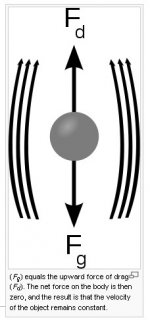
The ball would rise, slowing as the buoyancy falls, to come to a stop when gravity exceeds the water's ability to make it rise. The "excess" water would flow by, something like this.
The ball is stationary w.r.t the ground, but there is still flow. The forces of fluid drag and gravity are in balance.
In practice, it is gravity that
produces the
air flow, so that would stop when the ball stops rising.
The ball is stationary, so if you stop pouring, it will still stay where it is, with the "static" buoyancy matching the force of gravity.
The balloon stops rising, when is has the equivalent density of the surrounding air; when it is "like" air. Friction, viscosity or surface tension may in principle hold it in place, but not being exactly like air, because having a rigid surface for example, means it cannot actually move precisely
with the air, so will move at some velocity w.r.t that moving air.
If you raise and object to height, it gains gravitational potential energy. Should you drop it, you get it back as KE. If you pull the balloon to ground, your work gives it potential energy, some of which is dissipated on the way up, and some is stored as gravitational potential energy in the balloon at height. If the average velocities are the same in each direction, that energy loss, is the same on the way up, as the way down. It takes just as much work to travel "against" the flow as "with it".
If you see the ball as rising in air, and mentally turn the whole thing 90 degrees, clockwise, that is like an object in downstream flow moving left to right. The force is no longer from gravity, but from the flow itself.
The maximum forces may change, and when, but not the work.