Moderated The validity of classical physics - Part 2

That is one way of expressing it. If you Wikki drag you get:
http://en.wikipedia.org/wiki/Drag_(physics)
Rayleigh's equation is the force (Fd) upon the object due to drag between the object and the flow. For a free object moving downwind, that represents the propulsive force.
Rayliegh's is a simplified equation that assumes that the fluid loses all its energy once it has passed to the front of the object. ( Though there can be such "dead zones" both front and rear)
He does not distinguish between that force, and the self-generated drag that opposes that motion when propelled by that force, but lumps it together.
When teased out to its components, there is a balance between those forces that determines the maximum velocity, ans so denying the conclusion that there is no drag at windspeed.
Stokes' is another simplification. Knowing which equation to use is a problem in itself. It depends upon object size, Reynold's number...

All those definitions of classify drag as a force. There is no way that your phrase can make sense:

Do not confuse the force upon an object that is exerted through drag, with drag.
 
Christoph,

A question asked of and ignored by Humber.... What happens if an aircraft flying into wind suddenly turns downwind?

Some years ago I was doing a lot of flying up in Alaska, both Air Force and private aircraft. I learned that down wind turns are dangerous when at low altitudes, particularly if you are doing lazy eights or circling around something of interest on the ground. The aircraft can lose energy and stall. Yes, I am aware that there is controversy about this, but I tested it myself and I am convinced down wind turns at low altitude are potentially dangerous if you are watching the ground and not paying enough attention to the instruments.
 
Friction is best thought of as a field. Take a piece of sandpaper and lay it flat. It is obvious, or should be obvious, that if you run an object along that sandpaper, in any direction, the object’s motion will be opposed by a frictional force. The direction of the frictional force will be exactly opposite to the direction of the object. Friction exists on the sandpaper in all directions as a field, but the frictional force only has the vector quality conferred upon it by the object travelling in a specific direction! Until the object moves in a specific direction, the friction of the sandpaper has NO direction, it is a field! This is a bit more advanced than the basic physics concept, but it is absolutely correct. Frictional forces only exist as a vector by virtue of the directivity of the object opposing the friction, and frictional forces always act in direct opposition to the opposing object! The friction does not require any “intelligence” to do this, this is the way this world works!

I'll skip the stuff about friction being a "field". I'd just like you to answer my question. I'll restate it:

You say that frictional force is opposite to the direction of motion. In your opinion, how should this direction of motion be measured? Relative to the Greenwich meridian? Relative to the nearest bit of the earth's surface? Relative to the "ether"?
 
All those definitions of classify drag as a force. There is no way that your phrase can make sense:

Have it your way, but it does nothing for your case. How about "Do not assume that drag is only what you think it to be"
 
I'll skip the stuff about friction being a "field". I'd just like you to answer my question. I'll restate it:

You say that frictional force is opposite to the direction of motion. In your opinion, how should this direction of motion be measured? Relative to the Greenwich meridian? Relative to the nearest bit of the earth's surface? Relative to the "ether"?

How do YOU measurethe direction of the wind? By the position of the milky way, by the time of day, or by your horoscope?
 
The point is: The balloon never is at wind speed, except for brief transients. It cannot stay there in a perfectly balanced state for very long!

Untrue, since at wind speed the system is in stable equilibrium: any small disturbance that causes a difference of speed between the balloon and the air will create a drag force tending to bring the speed of the balloon back to that of the air. If wind speed is constant, the balloon stays at wind speed the whole time.
 
Hi Ross, welcome back.

How many times do we have to ask that question, humber, Christoph?

Shall we break it down first:

1. Do you agree that the interaction between the balloon and the air is identical in both cases?

Then maybe we will make some progress.

No, of course not, and neither do you or Modified. Neither of you were willing to say that a balloon held out of a car window when driving downwind at wind speed, would behave like one inside the car.
 
No, of course not, and neither do you or Modified. Neither of you were willing to say that a balloon held out of a car window when driving downwind at wind speed, would behave like one inside the car.
Well, that's pretty difficult to support. I say that it would behave the same, except in the trivial ways that might be caused by the complexities of that scenario, such as the wheels turning, the proximity of the boundary layer, etc. These are fairly small effects, even so, and I do not see any reason why the balloon should behave significantly differently in the still air of the downwind travelling interior or the downwind travelling exterior. I thought Modified made a similar statement, but maybe I imagined it.

It is a bit of a cheat, though, to avoid the more useful (and original) scenario of a constant wind with a neutral-buoyancy balloon floating along in it, in which even those minor disturbances would disappear. It seems a deliberate complication to involve travelling vehicles and windows and people holding balloons out of them. Unless your intention is merely to avoid the issue, it would seem sensible to discuss the relatively perfect scenario of a large body of air moving at absolutely the same velocity high in the atmosphere, a long way away from trees, rotating car wheels and the like. So would you agree that for such a balloon moving at windspeed there is no difference from the condition of it being earth-stationary in earth-stationary air?

Let me guess. No, of course you don't.
 
How do YOU measurethe direction of the wind? By the position of the milky way, by the time of day, or by your horoscope?

That's not an answer to my question. You say that frictional force in in the opposite direction to motion: I want you to explain how you decide what is the direction of the motion.

I'll make it easier for you. I'll say how I measure the direction of friction, then you can say if you agree or disagree:

Friction is a force resisting the relative motion of two elements in contact with one another. The direction of the frictional force of object A on object B is in the opposite direction to the that of the motion of object B relative to object A.
 
It is nearly impossible to keep up with this thread so lets just catch up to here.

No, of course not, and neither do you or Modified. Neither of you were willing to say that a balloon held out of a car window when driving downwind at wind speed, would behave like one inside the car.

If I were traveling down the road DIRECTLY in the direction of the a perfectly flowing free (non-turbulent) stream of air wind and at EXACTLY the speed of this free flowing (non-turbulent) stream of air and I rolled the window down and held out a very accurate anemometer and measured 0 on the display then I held out a smoke bomb and the smoke showed no signs of air movement in relationship to me and then placed the neutrally buoyant balloon out the window, what force do you believe exists that was unmeasurable by anemometer or smoke trail that will force the balloon to fall back with respect to the vehicle?
 
Yes, I am aware that there is controversy about this, but I tested it myself and I am convinced down wind turns at low altitude are potentially dangerous if you are watching the ground and not paying enough attention to the instruments.

Yes, if you are watching the ground, as you tend to use too much rudder because of "Apparent slip"- the visual sensation that the aircraft is slipping in the turn as you are trying to judge it's path through the air by watching it's path over the ground. The fact that you acknowledge that turning by instruments negates this, and you MUST be aware that the aerodynamics of the situation are the same whether high or low, should show you that the aircrafts turning performance is unchanged by the presence or otherwise of the wind. The aircraft flys due to the relative airflow around it, and it makes no difference to the aircraft wether that air is moving relative to the ground.

In exactly the same way, the dynamics of a balloon are identical in still air or in a constant wind. The balloon moves at the speed of the wind, whether that is zero or 160kts.
 
No, of course not, and neither do you or Modified. Neither of you were willing to say that a balloon held out of a car window when driving downwind at wind speed, would behave like one inside the car.

Then what is the difference between the interaction of the air and a balloon at rest, or one at windspeed?

In both cases the air molecules are not flowing over the surface of the balloon as they are travelling at the same speed as the balloon, so how do they produce different forces in both situations?
 
How do YOU measurethe direction of the wind? By the position of the milky way, by the time of day, or by your horoscope?

By whatever means is relevent to my situation.

If I want to know my aircrafts ground-speed, I need to know the speed of the air relative to the ground.

If I want to set my aircraft up for maximum range, ditto.

If I want to set my aircraft up for maximum endurence I couldn't care less about the airs speed relative to the ground, I Only care about it's speed relative to the aircraft- Same for calculating stall speeds, buffet boundaries, Takeoff saftey speeds etc.

You seem to share with Humber a reverence for the earths surface as a point of reference. It is no more valid than any other.

An object off the Earths surface interacts with the air around it. The velocity with which that air is moving relative to the ground is neither detectable nor relevant to the Aerodynamics of an object that isn't ON the ground.
 
Well, that's pretty difficult to support. I say that it would behave the same, except in the trivial ways that might be caused by the complexities of that scenario, such as the wheels turning, the proximity of the boundary layer, etc. These are fairly small effects, even so, and I do not see any reason why the balloon should behave significantly differently in the still air of the downwind traveling interior or the downwind traveling exterior. I thought Modified made a similar statement, but maybe I imagined it.

You didn't imagine Modified's response, which is why I mentioned it. Perhaps the differences are small; what would you expect, fireworks?
It's a balloon, a mechanically simple device moving in a bulk media, and so has a limited repertoire. However, that suggests that the differences do not mean that the two situations are alike, but of how different they really must be. The motion of the balloon in the real-wind case also tells a tale of how it got there. That is not so with the balloon within the car. It doesn't tell of it's history, because it has no provenance.

The days when one person could know and understand all of the scientific knowledge there was to know, are long gone. The Devil is in the details that you choose to ignore. "Thought experiments" are not real in a detailed sense, not are they intended to be.


Here is a good, but far from complete book about particle motion in fluids.
(The whole book is presented, so it's a good freebie)

http://books.google.nl/books?id=P9Q...=X&oi=book_result&resnum=6&ct=result#PPP21,M1

Page 30 shows where the standard equations are applicable. If you scan the equations within the book, you will see familiar bits and pieces. Stokes here, Rayleigh there, but a lot more on top. Perhaps continuing research may complete the task of fully updating those two gentlemen.

Here is a useful reference.
http://ocw.mit.edu/NR/rdonlyres/Mec...D6D-4560-966D-5FA20515560B/0/2005reading5.pdf

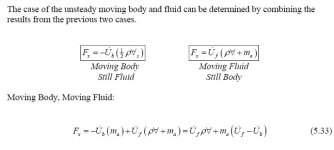
Look for D'Lambert's paradox, (pages 2 and 3). Unsteady moving fluid; Unsteady moving body pages (8 and 9)

attachment.php


Lots of stuff here:
http://ocw.mit.edu/NR/rdonlyres/Ear...F823A6E-569C-4D51-8205-9ED308C2457F/0/ch3.pdf

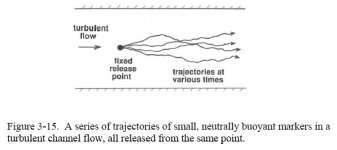
The trajectories of Fig 3-15 page 52, show that turbulence is rather a random affair.
attachment.php


It is a bit of a cheat, though, to avoid the more useful (and original) scenario of a constant wind with a neutral-buoyancy balloon floating along in it, in which even those minor disturbances would disappear.

It would be very difficult, if not impossible to even artificially generate such a flow, and the presence of the body would immediately destroy it. At the small scale level, the Universe appears not to be deterministic.
"Buoyancy" is not a magical property, but is of the air and gravity. In free-fall, downward motion, its drag reaction, and so terminal velocity, are a result of the same force of gravity. Buoyancy is a result of gravity.

Thermal motion, turbulence and many other effects, means that halcyon "windspeed" is not possible.

It seems a deliberate complication to involve travelling vehicles and windows and people holding balloons out of them. Unless your intention is merely to avoid the issue, it would seem sensible to discuss the relatively perfect scenario of a large body of air moving at absolutely the same velocity high in the atmosphere, a long way away from trees, rotating car wheels and the like. So would you agree that for such a balloon moving at windspeed there is no difference from the condition of it being earth-stationary in earth-stationary air? Let me guess. No, of course you don't.

You guessed well. Christoph said he agreed that 'hypothetically', you are correct. I wouldn't even go that far. The hypothetical case is so limited, that it pretty much only agrees with itself. It is not remotely didactic, because it is a made-to-measure strawman.

 

Attachments

  • ScreenH02 Feb. 17 05.10.jpg
    ScreenH02 Feb. 17 05.10.jpg
    25.5 KB · Views: 75
  • ScreenH01 Feb. 17 04.59.jpg
    ScreenH01 Feb. 17 04.59.jpg
    30.9 KB · Views: 76
Under some conditions, a balloon can travel faster than the wind.


This graph shows the effect of a variable wind which switches between 10 and 15 m/s. The horizontal axis is the fraction of time that the wind is at the higher velocity. The blue line is the mean wind speed, the green line is the RMS wind speed and the Red line is the velocity of an object that has reached equilibrium between the forces due to the two wind speeds.
 
That's not an answer to my question. You say that frictional force in in the opposite direction to motion: I want you to explain how you decide what is the direction of the motion.

I'll make it easier for you. I'll say how I measure the direction of friction, then you can say if you agree or disagree:

Friction is a force resisting the relative motion of two elements in contact with one another. The direction of the frictional force of object A on object B is in the opposite direction to the that of the motion of object B relative to object A.

Imagine that the air is a layer of fluid say, 10m thick, and sitting on its surface tension is a balloon. If you pull the balloon down to ground, you will stretch that surface tension like an elastic band, that when released, would launch the balloon back to the surface. Buoyancy is something like that.

"Friction" operates over the entire surface, and in all possible directions; the result of the motion of air upon the small-scale roughness of the balloon. (Wind is molecular random motion, larger scale random motion; swirls, shears, streets, on top of perhaps a more predictable flow in one general direction. The direction of bulk flow.)
Friction couples the air to the balloon, allowing the force of gravity upon the denser air to drive the balloon upwards. Eventually, the forces balance out, but not completely, all of time.

Drag propelling an object is also like that, with the drag coupling the object to the force; but drag is lossy. The force may be proportional to V^2, but the power demand is proportional to V^3 as the references will aver.
An object can therefore never reach windspeed, but if the level of work is low enough, as in a neutrally buoyant balloon, the power loss may be so low, that it gets close. The penalty is that the work must be low, meaning that such an object cannot power any load, let alone a useful one, yet maintain even that state. The smallest load upon your neutrally buoyant balloon would cause it to fall, if not to the ground, but at least a little bit.
 
Drag propelling an object is also like that, with the drag coupling the object to the force;

Humber,

This is yet another manifestation of your lack of understanding of frames of reference. You insist that a balloon moving relative to the earths surface is being "Propelled". If it is not moving WRT the air around it, it is motionless in that frame of reference and doesn't require any "Propulsion". Indeed, as it has no net force upon it, it requires a force to change it's velocity.

You still have not made any explanation about what force is generated by a balloon, that is traveling at the same speed as the air around it, to change it's velocity.
 
So know we read that air has a surface tension and that buoyancy is something about surface tension. Stupid me that thought that buoyancy also exist far from the surface and that buoyancy is about pressure differences.
 
Imagine that the air is a layer of fluid say, 10m thick, and sitting on its surface tension is a balloon. If you pull the balloon down to ground, you will stretch that surface tension like an elastic band, that when released, would launch the balloon back to the surface. Buoyancy is something like that.

The combined efforts of Christoph and Humber (Crumber?) produce a completely new explanation of buoyancy: surface tension. I find the old explanation using pressure differences much easier to understand. You seem to be saying that if the balloon is "sitting on the surface tension" at 10m, when I pull it down the "elastic band" will bring it back to where it was. Did I understand you right?
 
By whatever means is relevent to my situation.

If I want to know my aircrafts ground-speed, I need to know the speed of the air relative to the ground.

If I want to set my aircraft up for maximum range, ditto.

If I want to set my aircraft up for maximum endurence I couldn't care less about the airs speed relative to the ground, I Only care about it's speed relative to the aircraft- Same for calculating stall speeds, buffet boundaries, Takeoff saftey speeds etc.

You seem to share with Humber a reverence for the earths surface as a point of reference. It is no more valid than any other.

An object off the Earths surface interacts with the air around it. The velocity with which that air is moving relative to the ground is neither detectable nor relevant to the Aerodynamics of an object that isn't ON the ground.


I am not making the ground plane the principal plane, or according it any importance that it does not rightfully have. You, as a pilot should understand better than most, that the ultimate objective of any transport aircraft is to get between two points on the surface of the earth as fast (and safely) as possible That is, two points on the ground! You are of course interested in fuel usage and other considerations, but when flying passengers from Nome to Fairbanks, they are interested in how long it takes to get from one place to the other, relative to the ground, and they could care less what the aircraft is doing relative to the wind! The ground plane is still the most practical reference for most people. But even if you begin your analysis by only considering the relative velocity vectors of the wind and the aircraft, by working through the derivation backward you still arrive at the velocity relative to the ground. It all depends on your primary interest, doesn’t it?
 

ISF - Join now!

Every member here is approved by hand. No bots, no spam, just people who care about evidence and honest debate.

Membership is free!

Create your free account

Back
Top Bottom