• Quick note - the problem with Youtube videos not embedding on the forum appears to have been fixed, thanks to ZiprHead. If you do still see problems let me know.

The Turin Shroud: The Image of Edessa created in c. 300-400 AD?

That would generate the same issue, though. A bas relief mask is still a 3D object. The only difference is that it has a background, rather than being free standing.

Edti: Why go through all this silliness? Wouldn't it be simpler (if the chemistry proved accurate), to just paint the image with oil, then shake and bake?

Yes, but linen, wet linen especially (as used in my Model 10) has an amazing ability to mould to SHALLOW relief, as is the case with bas relief, as distinct from full 3D. Try imprinting the back of your own hand if you don't believe me. Note the absence of creases, distortion etc. The first stage unwashed imprint, straight from the oven, looks for all the world like a close-fitting glove.

Where's the silliness in imprinting off a human body, if the aim was to promote the imprint as the actual one left by the crucified Jesus on Joseph of Arimathea's linen? It was virtually guaranteed to attract medieval pilgrims from far and wide, a rival attraction to the (then) celebrated Veil of Veronica, that being an 'inferior' face-only imprint.

Paint the image in oil? That would put too much oil into the fibres of the linen, probably interfering with image-development, and one could not be sure of the flour sticking only to the oil - it would get into the interstices of the dry, oil-free weave as well and then colour those too in the oven, giving a messy result.

The genius of the Shroud was to model the sweat/blood whole body imprint in a one-off session onto an up-and-over sheet of EXPENSIVE herringbone-weave linen. Business model: avoid any risk of a dud result by using one, or more probably two, REAL 3D human subjects as templates. (Why spoil the ship for a ha'penny worth of tar etc?)
 
Now you are contradicting yourself. First you say the fidelity is because you are using real human subjects as templates, then you are talking about shallow relief masks. Doesn't that void the whole point of your technique right there?
 
What fidelity? the figure on the shroud has wrong proportions to be taken from a real body and the head is all wrong unless the model was a freak.
 
You have enough posts now I believe to be posting links directly yourself. Otherwise you can put links in the format "www dot whatever dot com" and someone else can make the link for you. That is acceptable practise here.

Never mind "him checking out his pre-conceptions". How about you explain the obvious distortions, such as the overly long arms and odd head size, and tell us if you have satisfied yourself that a contact print, of whatever method or technique, would have produced such odd looking features?

Some say it's the fingers that are too long, rather than the arms (something on which I have no strong opinion). But I did a critique recently on the 33 bullet-pointed challenges that Mark Antonacci made to Shroud sceptics at the end of his 2000 book. Point 11 addressed the problem of the fingers (no mention of arms) thus:


Incorporate specific effects of a draped cloth that fell through a body region – such as blood marks displaced into the hair, motion blurs at the side of the face and in the neck/throat region and below the hair, along with elongated fingers.

Here's how I responded:

"Have just had an idea that links those alleged “motion blurs” (to which this proponent of contact-imaging is favourably disposed in principle) AND, surprisingly perhaps, those “elongated” fingers too. Previously I have suggested two factors that might make fingers look elongated, while not entirely convinced they were the whole explanation (they being an imaging under contact pressure of metatarsal bones in the back of the hand, adding to the apparent length of the fingers, and a bridging of linen between finger bones, making the fingers look slimmer (and longer?) than they really are.

I now have an entirely new explanation.

One, or probably two naked male volunteers were laid head to head on the floor, face up/face down as previously described. The face-up volunteer was instructed to cross hands over groin region before being oiled and sprinkled with white flour. (But it’s actually quite hard to do full cover and protect genitals if one’s head stays in contact with the floor -one’s arms are not long enough, as others before me have pointed out). Next step: wet linen was draped on top. Now comes the eye-watering part of this account. Along came one or more artisans to manually pat down the linen to capture the surface relief, including those two crossed hands. Are you thinking what I’m thinking, dear reader? Yes, our subject suddenly winced on account of his hands being ill-positioned to offer full protection. He raised his head from the floor, both in surprise and maybe protest, using the opportunity to move his hands further down. Hey presto, one has an explanation for the claimed blurring of the image, not only for the groin region (fingers then appearing too long) but for the face and head too! One may even have an explanation for the allegedly tipped-forward/downward head, previously ascribed to rigor mortis, or the unsatisfactory look to the junction of chin and neck, maybe even that prominent so-called “crease” at chin level. All this assumes that imprinting occurred off a real face. While I think it occurred off a real torso/limbs, that would not exclude separate imprinting of a head, correction “head” from a bas relief, e.g wooden carving, as proposed by Luigi Garlaschelli in his powder frottage model – a real face being tricky for contact-imprinting on account of the nose and other sharp relief."


Yup, I could give a link (to most recent posting on my specialist Shroud site) but I'm still wary about putting in links here, given the charges of self-publicity, click-baiting, channelling traffic to one's own site bla bla. I'm only here for efficient dissemination of IDEAS. Links to the closely-argued detail can wait.
 
Now you are contradicting yourself. First you say the fidelity is because you are using real human subjects as templates, then you are talking about shallow relief masks. Doesn't that void the whole point of your technique right there?

Think of it as a necessary compromise. It's one thing to manufacture a bas relief for the face, if you know ahead of time that contact imprinting does not work for a real face. Why go to the trouble of manufacturing a whole body statue or bas relief if your pilot experiments had shown that one could obtain a satisfactory imprint from torso and limbs using one or more real human subjects?

There are other examples one could cite of hard-headed compromises, like the "wounds" being shown entirely by blood (or "blood") with no evidence of punctures, lacerations, cuts from scourging etc. in the sepia BODY IMAGE. But don't tell the pro-authenticity-tendency I said so. The latter is convinced - to a man and woman - that it can see real wounds, and which indeed gets away with describing them as such in all its publications, peer-reviewed included, using the terms "blood" and "wounds" interchangeably. Such is the messianic tunnel vision that is sindonology...
 
I have already responded in some detail to particular comments made here to my experimentally-based Model 10 (flour-imprinting). I refer to the one or two that are worded in moderate and clearly-articulated language.

So try me on the issues that may concern you. But do please confine comments to the science (hypothesis formulation and testing etc). That's what I do, that's why I'm here - to discuss the science. If I continue to get the needless flak, for no apparent reason, then I shall move on. Pronto.

How...interesting that your insistence on confining comments to "the science" includes characterizing easy objections as "flak".

Ack. Ack.
 
Some say it's the fingers that are too long, rather than the arms (something on which I have no strong opinion). But I did a critique recently on the 33 bullet-pointed challenges that Mark Antonacci made to Shroud sceptics at the end of his 2000 book. Point 11 addressed the problem of the fingers (no mention of arms) thus:


Incorporate specific effects of a draped cloth that fell through a body region – such as blood marks displaced into the hair, motion blurs at the side of the face and in the neck/throat region and below the hair, along with elongated fingers.

Here's how I responded:

"Have just had an idea that links those alleged “motion blurs” (to which this proponent of contact-imaging is favourably disposed in principle) AND, surprisingly perhaps, those “elongated” fingers too. Previously I have suggested two factors that might make fingers look elongated, while not entirely convinced they were the whole explanation (they being an imaging under contact pressure of metatarsal bones in the back of the hand, adding to the apparent length of the fingers, and a bridging of linen between finger bones, making the fingers look slimmer (and longer?) than they really are.

I now have an entirely new explanation.

One, or probably two naked male volunteers were laid head to head on the floor, face up/face down as previously described. The face-up volunteer was instructed to cross hands over groin region before being oiled and sprinkled with white flour. (But it’s actually quite hard to do full cover and protect genitals if one’s head stays in contact with the floor -one’s arms are not long enough, as others before me have pointed out). Next step: wet linen was draped on top. Now comes the eye-watering part of this account. Along came one or more artisans to manually pat down the linen to capture the surface relief, including those two crossed hands. Are you thinking what I’m thinking, dear reader? Yes, our subject suddenly winced on account of his hands being ill-positioned to offer full protection. He raised his head from the floor, both in surprise and maybe protest, using the opportunity to move his hands further down. Hey presto, one has an explanation for the claimed blurring of the image, not only for the groin region (fingers then appearing too long) but for the face and head too! One may even have an explanation for the allegedly tipped-forward/downward head, previously ascribed to rigor mortis, or the unsatisfactory look to the junction of chin and neck, maybe even that prominent so-called “crease” at chin level. All this assumes that imprinting occurred off a real face. While I think it occurred off a real torso/limbs, that would not exclude separate imprinting of a head, correction “head” from a bas relief, e.g wooden carving, as proposed by Luigi Garlaschelli in his powder frottage model – a real face being tricky for contact-imprinting on account of the nose and other sharp relief."


Yup, I could give a link (to most recent posting on my specialist Shroud site) but I'm still wary about putting in links here, given the charges of self-publicity, click-baiting, channelling traffic to one's own site bla bla. I'm only here for efficient dissemination of IDEAS. Links to the closely-argued detail can wait.

See the previous threads about objections to the genital-concealing "shroud slouch"...
 
Think of it as a necessary compromise.
It's one thing to manufacture a bas relief for the face, if you know ahead of time that contact imprinting does not work for a real face. Why go to the trouble of manufacturing a whole body statue or bas relief if your pilot experiments had shown that one could obtain a satisfactory imprint from torso and limbs using one or more real human subjects?

There are other examples one could cite of hard-headed compromises, like the "wounds" being shown entirely by blood (or "blood") with no evidence of punctures, lacerations, cuts from scourging etc. in the sepia BODY IMAGE. But don't tell the pro-authenticity-tendency I said so. The latter is convinced - to a man and woman - that it can see real wounds, and which indeed gets away with describing them as such in all its publications, peer-reviewed included, using the terms "blood" and "wounds" interchangeably. Such is the messianic tunnel vision that is sindonology...

You appear to have misspelled ad-hoc rationalization.
 
Why go to the trouble of manufacturing a whole body statue or bas relief if your pilot experiments had shown that one could obtain a satisfactory imprint from torso and limbs using one or more real human subjects?
It's clearly not the imprint of a real body, because the proportions are wrong. So your question is irrelevant.
 
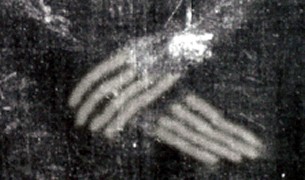
I was asked earlier to supply an image of my imprinted hand. Let's see if image insertion works. Here's my hand imprint immediately after the oven-heating step, but before the final image-attenuation (achieved via vigorous water-washing).

dsc00013-plumped-up-1st-stage-p-soap-v-my-hand.jpg
 
I have already responded in some detail to particular comments made here to my experimentally-based Model 10 (flour-imprinting). I refer to the one or two that are worded in moderate and clearly-articulated language.

So try me on the issues that may concern you. But do please confine comments to the science (hypothesis formulation and testing etc). That's what I do, that's why I'm here - to discuss the science. If I continue to get the needless flak, for no apparent reason, then I shall move on. Pronto.

Why do you then avoid issues that torpedoe your thesis?
 
This is the same hand imprint before v after washing. It's the lower washed half I consider to be a promising model for the Shroud body image (faint, fuzzy, negative (tone-reversed), responsive to 3D-rendering software, bleachable etc etc.

dsc00049-washed-v-unwashed.jpg
 
The "before" picture is interesting, but unenlightening. It's the "after" picture which will be more telling.

The problem you've got with this theory is that the hand looks like a hand, and not like the Doctor Who make-up artists have been at it. Same with the disproportionate head. Furthermore, there doesn't appear to be anything other than "it looks something like the same" to support this notion, whereas we like actual evidence here.
 
Kindly state (or restate) your objection, abaddon, and I'll endeavour to answer it.
(Isn't "torpedo" a bit strong a term to be deploying so early when dealing with a scientific model?)
 
Last edited:
Kindly state (or restate) your objection and I'll endeavour to answer it.

OK. Two points:

1/ The shape on the shroud can't have come from a body contact print because it isn't human-shaped.

2/ It is possible to come up with any number of plausible methods of producing the image on a sheet of linen. There is no evidence available to pick one method over another, so this attempt by you, worthy and plausible as it is to try, can never rise to anything more certain than "might be".
 
Last edited:
OK. Two points:

1/ The shape on the shroud can't have come from a body contact print because it isn't human-shaped.

2/ It is possible to come up with any number of plausible methods of producing the image on a sheet of linen. There is no evidence available to pick one method over another, so this attempt by you, worthy and plausible as it is to try, can never rise to anything more certain than "might be".

Sorry, but I disagree profoundly with both of those points. It might be best to dispense with detailed reasons - which take time to compose - unless you're genuinely interested in hearing them.
 

Back
Top Bottom