I edited as I read the rest of your post and did not realize you guys had responded.
1. Of the 11 in the 60s given by this site, 9 use drawings related to embryology. When they say they are not Haeckel's drawings, is this like the NCSE that said textbooks did not use Haeckel's drawings because they colored them in?
Repeating Wells again, I see.
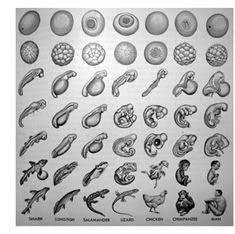
But no, I don't mean that. I mean that they start using diagrams like this:
That's from the "blue" (or molecular biology) version of the final 1963 version of the textbook released by the Biological Sciences Curriculum Study, a group set up in 1959 specifically to review the state of biology textbooks in America and create a textbook more in line with actual, current scientific knowledge (the BSCS was led by active, working bio scientists).
The diagram above is not Haeckel's. It's not taken from anything Haeckel ever did in his lifetime, either, since it depicts animals he never examined, and depicts almost three times as many intermediate embyrological stages as he did. These depictions are also drawn from scratch from new embryos - you'll note that they include the yolk sacs that Haeckel omitted from his drawings.
The "yellow" (or cellular biology) version of the same textbook, also published in 1963, even rearranges the order of animals in the diagram, to make it resemble Haeckel's "fish-bird-man" left to right progression even
less.
Why do you think the actual biologists behind the BSCS effort to bring textbooks more in line with current knowledge changed diagrams, randman? Why did they abandon Haeckel's diagrams and
make their own? Why would they go to such lengths to make their new diagrams as
unlike Haeckel's as possible?
2. I used the site as a reference because they acknowledge some obvious weaknesses in evo claims, but the point of the article is to condemn creationists for this error if you read it closely. The authors have a strong bias. This would be like reading a democratic article trying to put their best spin on something.
No, it's to explain the spike in the use of Haeckel's drawings and diagrams derived from them. Which it does.
3. Where is your data from the 70s and 80s? I showed you examples of textbooks using data Haeckel, including a large majority of ones available for one state in the 80s. You've provided very little but just keep saying things without having any real basis for them.
For example, who told you Haeckel had declined in use in the 60s, 70s, and 80s and then textbooks starting using him again in the 90s?
I already told you. You just happen to not have liked the answer because Wells told you not to like it.
That's not how textbook writing works and some embryologists taken a renewed interest in the Biogenetic Law is not going to cause that.
Actually, yes it does, depending on who a particular textbook is targeted at. That's why college textbooks go through so many editions - to keep up with recent developments in the fields of science they are introductions to.
A textbook using more up to date drawings would not go back and start using Haeckel all of the sudden in the 90s. Maybe you figure it's harder to show textbooks before the internet and so are trying to throw out some confusion here.
Well, that kinda depends on why they're using him and what they're saying about him, doesn't it? Which is what I've been trying to tell you.