
think big, real big, you can do it, ask for help and direction
Come on, Bob. Still waiting for proof of your expertise here. And that picture of the space elevator.

think big, real big, you can do it, ask for help and direction
what burns through faster in your home fireplace, a log of wood or the steel grate that supports the wood?Correct. I am drawing the distinction carpenters draw between timber and lumber. Lumber is generally thin enough to burn through or reach failure before the limiting properties kick in.

is this like one of those self stroage bins?
I think that you need to look at the big field here, not a shed like structure, we're talking massive steel beams and girders of immenses size and strength, steel specifically designed and tested to withstand forces 10 times greater in heat and energy that the steel faced in the wtc.
think big, real big, you can do it, ask for help and direction

hahahahahahahahah Martensiting. Omfg you buddy are hilarious - I don't know whether to put you on ignore or risk lowering my IQ reading such drivel, as a metallurgist I dunno if I can take the stupid anymore, but I do need to refute this for the benefit of everyone else.Originally Posted by bob the analyst
care to explain why the NIST failed to use microscopic techniques, such as an SEC, scanning electron microscope in their analysis? There's still no evidence of martensiting effect, yet they claimed yield and strenght loss and tensile and plasticity and that can not happen with out showing and verifying a martensiting, plus several others, then of course you have to compare it against the original core samples from the original steel heats for a comparison
I've never heard the term "martensiting" before, because it's not used. I've got text books going back to the 1960's and it's not in any of those so I googled it and got 30 results! LOL I believe he's trying to refer to the transformation of austenite to martensite. i.e the martensitic transformation.
However it's plainly obvious that he doesn't understand what martensite is or how it is produced (rapid cooling from the austenitic phase via a diffusionless, shear transformation producing a metastable BCT structure - with usually Ms around 220°C and Mf around 90°C but this obviously varies with composition).
Firstly there isn't any martensite present in A36, because it's not quenched - the predominant microstructure for A36 (rolled) steel is elongated or banding of pearlite and ferrite (due to rolling). Can't possibly contain martensite and the material specifications don't require it. It's a silly thing to need to do for a structural steel because it would add huge cost.
Secondly, if he is claiming that the fires couldn't reach the AC3 temperature then it would be impossible for any martensite to form because in order to produce martensite you have to quench from above the AC3 temp - he's arguing mutually exclusive points and debunking himself!
Thirdly, even if the fires heated steel to 1000°C the resulting cooling rate would not be quick enough to transform the micro-structure to (a percentage of) martensite, therefore the idea of claiming "no martensite in the cooled steel microstructure indicates yield and strength loss" is a red herring.
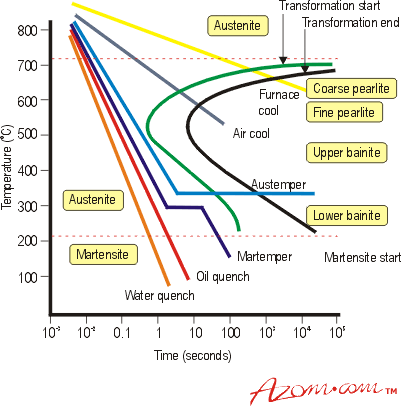
Fourthly, and this does make me chuckle, the whole point behind quenching to martensite is that the resulting structure produces a higher yield point and a stronger steel, the opposite of what BTA claims! It does this at the expense of ductility (it's brittle) and therefore it's common practice to temper martensite.
There is absolutely no reason to look at original samples from heats, the likelyhood is they are long thrown away. The mill(s) would have produced steel to an accepted international or American standard. Also the only thing you have to do is perform metallurgical analysis on specimens taken from WTC steel that was not affected by fire. This was also done and the results conformed to the relevant material specifications - this is in the NIST report, I've read that very section.
SEM including EDX/EDX analysis was also carried out in the metallurgical analysis (although it's not the be all and end all)
http://911research.com/wtc/evidence/metallurgy/WTC_apndxC.htm
I believe the interweb term is PWNED or OWNED. I await your answer, sidestep, ignore, goal-post move with hilarity!
what burns through faster in your home fireplace, a log of wood or the steel grate that supports the wood?
that one was easy enough...NEXT!
I guess that you have what experts call reading dyslexia, basically reading comprehension, I said that this kid designs buildings and is an architect as MUCH AS I DESIGN SPACE ELEVATORS--IT WAS SARCASM-MAYBE IT WENT OVER YOUR HEAD-YES, IT DID GO OVER YOUR HEADGame, Set and Match.

What part of "more or less horizontal" don't you understand?You can't just say that and make it true. You have to find the vertical component of it's speed, know its terminal velocity, and how high it fell from, to determine if it had 0 vertical velocity when it left the building.
I guess that you have what experts call reading dyslexia, basically reading comprehension, I said that this kid designs buildings and is an architect as MUCH AS I DESIGN SPACE ELEVATORS--IT WAS SARCASM-MAYBE IT WENT OVER YOUR HEAD-YES, IT DID GO OVER YOUR HEAD

Digging out that evidence of the Space Elevator design work, Bob? It's all a bit quiet over there, as they say.

do you have the Scottish version of their NIST report handy, let's compare notesI am talking about a steel framed warehouse. If it made of steel framing then according to you it cannot collapse because fire does not affect steel. This building proves you wrong.
Or are you admitting that fire can, in fact, affect steel so badly it collapses?
That's no way to talk to Heiwa's kid brother. Bully

No, Bob, you're trying to evade the point.
You tried to call me out on professional qualifications and experience. Specifically, I design and construct tall buildings for a living. And you, it would appear, don't.
Now let's be quite clear. Are you absolutely sure about this? Think carefully before you answer, because otherwise you're going to have to show that you design space elevators for a living.

 . Would you be able to give me a specific reference on where I can find those codes? Even if they're not online, I work at a university, so I could always find a way to look them up somehow.
do you have the Scottish version of their NIST report handy, let's compare notes
do you have the Scottish version of their NIST report handy, let's compare notes
what burns through faster in your home fireplace, a log of wood or the steel grate that supports the wood?
that one was easy enough...NEXT!

From your post Bob, just explain in your own words what stress relief is please...and how it relates to the construction of the WTC complex.where did you get the idea that stress relief of steel, which has many areas and techniques-processes we're talking about here, was a test in and of itself?
On a more substantive point, Architect: You and others have mentioned before that the European building codes have been modified to take into account the findings from the NIST Reports. I'm having trouble locating the modified ones online, mostly because I'm no architect or engineer, so I don't know what the hell I'm doing when I try to look this stuff up
And also: I'm not doing this for bob the talker;
good for you, great find, do you understand wht this chart means and what it says...you see, the steel would have to start looking in this fashion as it broke down, in an element basis, yet the NIST reports what...all areas and facets have to have shown the steady and progressive breakdown for steel, joint, truss and member failureBob; I do believe you missed a post from this fellow