care to explain why the NIST failed to use microscopic techniques, such as an SEC, scanning electron microscope in their analysis? There's still no evidence of martensiting effect, yet they claimed yield and strenght loss and tensile and plasticity and that can not happen with out showing and verifying a martensiting, plus several others, then of course you have to compare it against the original core samples from the original steel heats for a comparison
hahahahahahahahah Martensiting. Omfg you buddy are hilarious - I don't know whether to put you on ignore or risk lowering my IQ reading such drivel, as a metallurgist I dunno if I can take the stupid anymore, but I do need to refute this for the benefit of everyone else.
I've never heard the term "martensiting" before, because it's not used. I've got text books going back to the 1960's and it's not in any of those so I googled it and got 30 results! LOL I believe he's trying to refer to the transformation of austenite to martensite. i.e the martensitic transformation.
However it's plainly obvious that he doesn't understand what
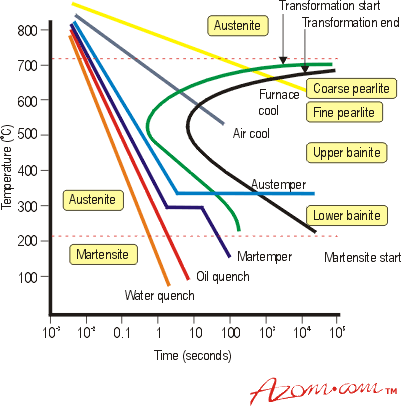
martensite is or how it is produced (rapid cooling from the austenitic phase via a diffusionless, shear transformation producing a metastable BCT structure - with usually Ms around 220°C and Mf around 90°C but this obviously varies with composition).
Firstly there isn't any martensite present in A36, because it's not quenched - the predominant microstructure for A36 (rolled) steel is elongated or banding of pearlite and ferrite (due to rolling). Can't possibly contain martensite and the material specifications don't require it. It's a silly thing to need to do for a structural steel because it would add huge cost.
Secondly, if he is claiming that the fires couldn't reach the AC3 temperature then it would be impossible for any martensite to form because in order to produce martensite you have to quench from above the AC3 temp - he's arguing mutually exclusive points and debunking himself!
Thirdly, even if the fires heated steel to 1000°C the resulting cooling rate would not be quick enough to transform the micro-structure to (a percentage of) martensite, therefore the idea of claiming "no martensite in the cooled steel microstructure indicates yield and strength loss" is a red herring.
Fourthly, and this does make me chuckle, the whole point behind quenching to martensite is that the resulting structure produces a higher yield point and a stronger steel, the opposite of what BTA claims! It does this at the expense of ductility (it's brittle) and therefore it's common practice to temper martensite.
There is absolutely no reason to look at original samples from heats, the likelyhood is they are long thrown away. The mill(s) would have produced steel to an accepted international or American standard. Also the only thing you have to do is perform metallurgical analysis on specimens taken from WTC steel that was not affected by fire. This was also done and the results conformed to the relevant material specifications - this is in the NIST report, I've read that very section.
SEM including EDX/EDX analysis was also carried out in the metallurgical analysis (although it's not the be all and end all)
http://911research.com/wtc/evidence/metallurgy/WTC_apndxC.htm
I believe the interweb term is PWNED or OWNED. I await your answer, sidestep, ignore, goal-post move with hilarity!