Moderated Steel structures cannot globally collapse due to gravity alone

If you are not amazed than you fail to grasp that there is no mechanism in this situation that can convert the downward force into lateral force sufficient to hurl 4 ton frame sections up to 600 feet. There were many thrown 400-500 feet.

I'm sorry you are so uneducated.

What velocity would a steel frame section have to attain if it came from the altitude of the 80th floor. Are your maths up to calculating that?

If so, show me, and I'll correct your work.
 
Look at the videos. The large frame sections are falling close to the towers. There were no 400-500 foot high sections that could hinge and account for the sections in front of the Winter Garden as you are implying.

Videos prove otherwise. face it. you have been debunked. note the red arrows, scroll to 5.24 in the video.

Google Video This video is not hosted by the ISF, the ISF can not be held responsible for the suitability or legality of this material. By clicking the link below you agree to view content from an external website.
I AGREE
 
Last edited:
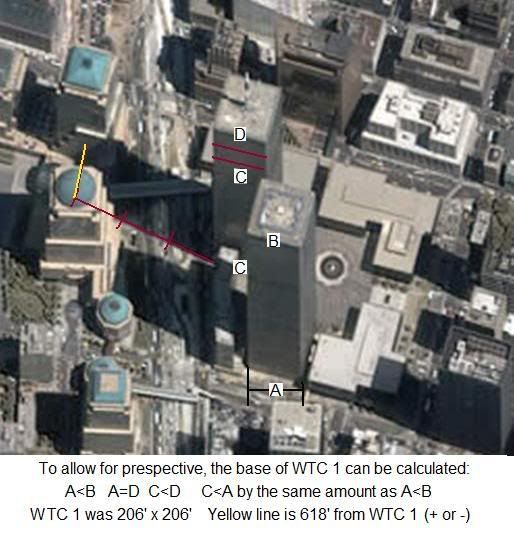
Try using a photograph instead of a not-to-scale drawing.

But since you claim to know about these things, Chris, how far should perimeter sections of the towers have traveled, in top-down collapses not aided by explosives? You know, on what do you base your claim that something is amiss here?
Things fall straight down. Exterior framework sections could be pushed out a short distance and hinging could cause sections to fall a little further. I would estimate 100-200 feet max.​
 
Try using a photograph instead of a not-to-scale drawing.
photographs are to scale? did you bother to read the caption of that drawing? As a carpenter do you construct structures using drawings? or only photographs of buildings taken a mile high in the sky?
Things fall straight down. Exterior framework sections could be pushed out a short distance and hinging could cause sections to fall a little further. I would estimate 100-200 feet max.

Argument from incredulity. The building is a quarter mile high. yet you incredulously believe that objects can only land within 15% of their total height when pushed from behind by debris.
 
Last edited:
Try using a photograph instead of a not-to-scale drawing.​
Which part of the map is not to scale? Be specific. Also, care to place a wager on this?

Things fall straight down.
Unless another force acts on them, right? If I'm standing and you push me hard on the chest, do I fall straight down? Aren't you the one who said the top of the south tower shouldn't have fallen straight down, and wasn't your refusal to read the six explanations for why it did the reason I put you on ignore recently?

Exterior framework sections could be pushed out a short distance and hinging could cause sections to fall a little further. I would estimate 100-200 feet max.
1) On what analysis of the actual structures and collapses do you base your estimate? What work have you done?

2) How do you account for the facts that the detonations that would be thousands of times larger than demolitions detonations are not seen or heard, nor are their secondary effects, e.g. light debris being blasted far ahead of the heavy sections that you say are hurled by explosives?


Last edited:
Calculate the time-to-fall, Chris. Not hard. Then calculate how fast you need to go to cover 600 feet in that time. Its not very fast.
Depends on the height you're starting from, of course, but Chris isn't capable of making the simplest calculations. Anyway, just as he fabricates everything else about 9/11, he fabricated the claim that heavy steel sections traveled 600 feet. None did.

I think I figured out what his trouble is, though: he didn't know the Twin Towers were tall buildings. Over a quarter-mile high, in fact. Ain't that something, Chris? You learn something new every day! (Well, I do. Sorry, didn't mean to speak for you.)

879049a4c8c03e2ea.jpg
 
Last edited:
Depends on the height you're starting from, of course, but Chris isn't capable of making the simplest calculations. Anyway, just as he fabricates everything else about 9/11, he fabricated the claim that heavy steel sections traveled 600 feet. None did.

Even 600 feet from a height of 1000 feet assuming a terminal velocity of 175 ft/sec, an 8 second fall time, is only 54 mph.
 
photographs are to scale? did you bother to read the caption of that drawing? As a carpenter do you construct structures using drawings? or only photographs of buildings taken a mile high in the sky?​
That is NOT a to-scale drawing. It says "based on photographs" not "to scale". Building drawings are not required to be exactly to scale. You are supposed to use the measurements noted. No one measures a drawing to get measurements.

C7 said:
Things fall straight down. Exterior framework sections could be pushed out a short distance and hinging could cause sections to fall a little further. I would estimate 100-200 feet max.

Argument from incredulity. The building is a quarter mile high. yet you incredulously believe that objects can only land within 15% of their total height when pushed from behind by debris.
Things fall straight down is a statement of fact, not an argument of incredulity. The 100-200 feet is a reasonable estimate.

How do you account for numerous 4 ton framing sections being ejected 400-500? Are you saying all these sections were ejected at the beginning of the collapse?
 
That is NOT a to-scale drawing. It says "based on photographs" not "to scale". Building drawings are not required to be exactly to scale. You are supposed to use the measurements noted. No one measures a drawing to get measurements.​
you discard a drawing in plan view for this?
you think this more accurately represents conditions at the site than the drawing Gravy posted? Are you for real?

600sidepv2.jpg


Things fall straight down is a statement of fact, not an argument of incredulity. The 100-200 feet is a reasonable estimate.
Not under the conditions that those columns had behind them. They most certainly NOT will fall straight down, Yours is a statement of fantasy, not fact.
How do you account for numerous 4 ton framing sections being ejected 400-500? Are you saying all these sections were ejected at the beginning of the collapse?
No objects were "ejected". This has been explained to you over and over again.
 
Last edited:
That is NOT a to-scale drawing. It says "based on photographs" not "to scale".​
The debris distribution was done from photographs. The map is one that is used for planning purposes in NYC. I ask you again: which part of the map is not to scale? Be specific or withdraw your claim.​


Things fall straight down is a statement of fact, not an argument of incredulity.
All things? No force can cause something to not fall straight down? Care to reconsider that, or are you replacing Heiwa while he's on vacation?

The 100-200 feet is a reasonable estimate.
No, it is pulled straight out of your...imagination. Second time, Chris. Answer the questions.

1) On what analysis of the actual structures and collapses do you base your estimate? What work have you done?

2) How do you account for the facts that the detonations that would be thousands of times larger than demolitions detonations are not seen or heard, nor are their secondary effects, e.g. light debris being blasted far ahead of the heavy sections that you say are hurled by explosives?

3) And why doesn't a single one of these quite thin "blasted" perimeter columns show any blast effects? Why did such huge bolted sections, sometimes 12-15 stories containing dozens of bolted connections, remain together?

Answer the questions, Chris.

 
Last edited:
To humor Chris, here's a photo that should show minimal distortion...you know, the kind they use for maps.

879049a4ce0ec48fc.jpg
 
you discard a drawing in plan view for this?
you think this more accurately represents conditions at the site than the drawing Gravy posted? Are you for real?​

If I didn't know better I'd swear that was done by Christophera. It's completely divorced from reality. I love his addition of "(+ or -)" though.
 
That is NOT a to-scale drawing. It says "based on photographs" not "to scale". Building drawings are not required to be exactly to scale. You are supposed to use the measurements noted. No one measures a drawing to get measurements.

So all of those years I spent hunched over a drafting table with a planimeter were wasted?

Huh.

Do you know the process involved in orthorectifying an aerial photograph? How do you know the images you were showing previously were scaled correctly and do not have any artifacts such as lens distortion?
 
This thread is to demonstrate that steel structures cannot collapse due to gravity alone. The JREF team has offered the Bazant theory as proof that steel structures can collapse due to gracvity alone but the Bazant theory is incomplete and cannot be considered a viable scientific explanation of the collapse.

This paragraph highlights the fallacy of your entire agument, which (as far as I can judge) is a classic example of denying the antecedent.

You are attempting to prove that steel structures cannot collapse due to gravity alone, which is itself an absurd contention as it's well understood that a structure can be defined which is incapable of bearing its own weight. Let's be charitable, and suppose that you're trying to prove that a steel structure, having previously been able to support its own weight, cannot suffer sufficient damage to collapse globally, another absurd statement but one that on the face of it appears slightly less absurd.

Even if you were to demonstrate that Bazant's model were invalid, you would at best have demonstrated that one specific structure would not be expected to collapse globally in one specific scenario. In order to prove that steel structures cannot collapse globally due to gravity alone, you would have to repeat this proof for every possible steel structure in every possible damage scenario. This would include, for example, the scenario of a steel structure which suffers damage sufficient to induce collapse of the lowest two storeys, as in a controlled demolition. You are therefore trying to prove the impossibility of a commonplace occurrence, by disputing the analysis of a specific scenario.

Having said this, I'm done bothering to argue with you. Unless you can produce actual calculations that demonstrate the impossibility of the specific collapse scenario observed, you're just waving your hands.

Dave
 
All things? No force can cause something to not fall straight down?
The statement is clear and correct. What part of 'fall' don't you understand?
You have a habit of misinterpreting what people say and making snot-nose condescending remarks. :mad:
No, it is pulled straight out of your...imagination. [on the other hand, I appreciate quality sarcasm :D] Second time, Chris. Answer the questions.

1) On what analysis of the actual structures and collapses do you base your estimate? What work have you done?
I looked at the videos.

2) How do you account for the facts that the detonations that would be thousands of times larger than demolitions detonations are not seen or heard, nor are their secondary effects, e.g. light debris being blasted far ahead of the heavy sections that you say are hurled by explosives?
"It can't be explosives because it wasn't loud enough." You do not know all there is to know about explosives nor do you know how much the sound can be muffled because no one has tried to muffle the sound before. This is just personal incredulity.

3) And why doesn't a single one of these quite thin "blasted" perimeter columns show any blast effects? Why did such huge bolted sections, sometimes 12-15 stories containing dozens of bolted connections, remain together?
You are asking me to speculate. As we both know, that will result in a condescending diatribe from you. Pass.
 
Last edited:

Back
Top Bottom