I accept published peer reviewed science. I read and try to understand that science.
Increasing soil carbon sequestration is at best a partial solution because the literature says 10-20% of current CO2 emissions.
I do not reject
scientific papers on the liquid carbon pathway. Fungi exist. Soil bacteria exist. Plant sugars (liquid carbon) exists.
You have not presented any science with that states the effect the liquid carbon pathway has on the Roth C model.
I do not blindly believe in
unsupported assertions about the liquid carbon pathway on a blog. The "5-20 tonnes of CO2 per hectare per year" rumor pops up again. Maybe repeated from
Liquid carbon pathway unrecognised
What are those conditions? Where are the sources for those numbers?
I have tried hard to explain this symbiosis with mycorrhizal fungi to you. And yes it is probably from Dr Jones measurements in the field. But those measurements have been repeated too. I have repeatedly given you links over and over.
The problem being many of those repeated results are contained in papers that already filter them once, and then you try and filter them again.
For example, one paper I already gave you also found that rate, but then also takes a multitude of other rates from other systems that are much lower and tries to assume only a small % of land would ever use HPG while our hugely inefficient and destructive factory farming system would not be replaced. So they do NOT show the potential, they show a projection instead.
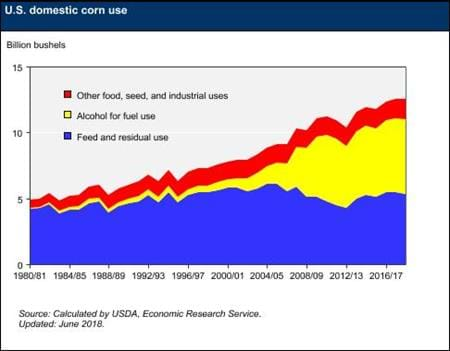
It's an entirely different way of approaching the problem. For example right now in USA here is a chart for the use of corn:
Image courtesy USDA commons
As you can see the vast majority of corn is not used to feed people. All that acreage could and should be put back into prairie and used to raise our animals.
My proposed solution completely eliminates grain based ethanol for fuel and drastically reduces its use as animal feeds, completely eliminating CAFOs based on this dynamic discussed in Scientific American:
It’s Time to Rethink America’s Corn System
This is by far the vast majority of the land growing crops. It of course is a carbon source rather than a sink. It can be improved, but its potential is not even close to the potential of grasslands.
Carbon sequestration potential of switchgrass as a bio-energy crop . In other research done in the central and northern Great Plains, soil organic carbon increased significantly at 0-12 inches and 0-47 inches, with accrual rates of 0.5 and 1.3 ton carbon/acre/yr (equivalent to 1.8 and 4.7 ton CO2/acre/yr), respectively.
1 us ton/acre = 2.2417 metric tonnes/ha
So that means
4 to 10.5 tonnes CO2e/ha/yr
That's pretty damn close to what Jones measured in her case studies in Australia.
But the source I gave you before instead assumes we will stick with inefficient corn alcohol which is a net carbon source.
But if for whatever reason you don't think the University of Michigan knows what they are talking about. It's easy enough to find others who measured the rates.
How about the University of Nebraska?
Soil Carbon Storage by Switchgrass Grown for
BioenergyVariability in SOC change
across sites within the studied agro-ecoregion was significant,
from −0.6 to 4.3 Mg C ha−1 year−1 for the 0–30 cm depth
One ton of carbon equals 44/12 = 11/3 = 3.67 tons of carbon dioxide equivalent
so 2.2 to 15.8 tonnes CO2e /ha/yr and that's only measured to 30 cm deep on a plant with up to 30 feet deep roots!

If you don't like Nebraska then maybe look at any number of the Conservation Reserve Program (CRP) in the USA measured results, and most of the above have not even come close to being optimized for carbon sequestration. Those numbers are almost as good as Jones found and the land managers ranchers and farmer by and large were not even trying.
Just you watch. Set up a carbon market that puts a fee on emissions sources, but pays a dividend to
verified carbon sinks, and watch what happens.

That's when off the charts results like Gabe Brown and Joel Salatin and Colin Seis become the new normal.
https://vimeo.com/189494582



 !
!
