• Quick note - the problem with Youtube videos not embedding on the forum appears to have been fixed, thanks to ZiprHead. If you do still see problems let me know.

Solution to Anthropogenic Climate Change?

It is a lie that I have dismissed peer reviewed papers. I have dismissed your misinterpretations of them by looking at what they actually state. refers to this thread. I did not dismiss "Grazing management impacts on vegetation, soil biota and soil chemical, physical and hydrological properties in tall grass prairie" since I have discussed it in the appropriate Holistic Grazing (split from Cliven Bundy thread) thread.

Allan Savory's invalid propaganda in a white paper about using his debated Holistic Grazing to reverse global warming should be addressed in that thread.

More papers stating known facts that I do not dismiss. We know that changes in agricultural practice can change soil carbon sequestration. The other known fact is that there is no evidence that they are the solution to anthropogenic climate change. As I have noted several times, soil carbon sequestration is a possible additional mechanism to mitigate global warming: Climate change mitigation.

Sceince is not done by YouTube video.
Lots of strawmen and misdirection mumbo jumbo is all I see here. I first present a science paper then I present a lecture proving I have not misinterpreted it. In fact it was you who misinterpreted it, as the authors of the papers state clearly the same interpretation I have said all along.

as for your implication that I claimed they are "the solution to anthropogenic climate change." as if I have stated that soil sequestration alone is the strategy, well that's just wrong. From the OP I said exactly this:
"There are two sides to this and BOTH must be improved, less emissions and more sequestration."

I am the one proposing a holistic solution, unlike many who focus only on fossil fuel emissions like it is a silver bullet.

The problem is of course that we both agree than emissions must be reduced. You on the other hand are in denial of the soil sequestration side of the carbon cycle. Thus it is you who hasn't the balance argument. You are simply in denial and mirroring.
 
I am not "in denial of the soil sequestration side of the carbon cycle"

Lots of strawmen and misdirection mumbo jumbo is all I see here....
Lots of inability to understand my post, Red Baron Farms.
I am not "in denial of the soil sequestration side of the carbon cycle". My post explicitly says that it exists. My post explicitly says that changing practices can increase soil carbon content.

I did get "the" solution wrong. Increasing soil carbon sequestration is at best a partial solution since the scientific literature has estimates of the order of 10% of CO2 emissions. For example, you know about:
We have tested and viable ways ("a holistic solution" that exists and works!) of reducing CO2 levels with a good idea of their economic impacts: Climate change mitigation. Reducing CO2 emissions is existing, working technology. Carbon capture and storage is existing, working technology. Biosequestration is developing technology, e.g. reforestation and zero-till farming practices.
 
Last edited:
Lots of inability to understand my post, Red Baron Farms.
I am not "in denial of the soil sequestration side of the carbon cycle". My post explicitly says that it exists. My post explicitly says that changing practices can increase soil carbon content.

I did get "the" solution wrong. Increasing soil carbon sequestration is at best a partial solution since the scientific literature has estimates of the order of 10% of CO2 emissions. For example, you know about:
We have tested and viable ways ("a holistic solution" that exists and works!) of reducing CO2 levels with a good idea of their economic impacts: Climate change mitigation. Reducing CO2 emissions is existing, working technology. Carbon capture and storage is existing, working technology. Biosequestration is developing technology, e.g. reforestation and zero-till farming practices.
Right. You get the concept, but the rate is what you argue about. We have gone round and round about this before already.

You accept all papers that use the Roth C model and related rates of biomass decay and turnover of carbon to and from soils.

And you reject any and everything to do with this:
Liquid carbon Pathway symbiosis with Mycorrhyzal fungi rates of carbon transfer by humification.

I get it. I am deeply sorry I am incapable of teaching you where you are going wrong. I wish I was a better teacher and could get past your block so you could read your own sources and predict what outcomes will be which. I tried really hard, but you still don't even understand the difference. So I am not sure what to say now?
 
I do not reject scientific papers on the liquid carbon pathway

Right. ...
I accept published peer reviewed science. I read and try to understand that science.

Increasing soil carbon sequestration is at best a partial solution because the literature says 10-20% of current CO2 emissions.

I do not reject scientific papers on the liquid carbon pathway. Fungi exist. Soil bacteria exist. Plant sugars (liquid carbon) exists.

You have not presented any science with that states the effect the liquid carbon pathway has on the Roth C model.

I do not blindly believe in unsupported assertions about the liquid carbon pathway on a blog. The "5-20 tonnes of CO2 per hectare per year" rumor pops up again. Maybe repeated from Liquid carbon pathway unrecognised
Under appropriate conditions, 30-40% of the carbon fixed in green leaves can be transferred to soil and rapidly humified, resulting in rates of soil carbon sequestration in the order of 5-20 tonnes of CO2 per
hectare per year.
What are those conditions? Where are the sources for those numbers?
 
Last edited:
I accept published peer reviewed science. I read and try to understand that science.

Increasing soil carbon sequestration is at best a partial solution because the literature says 10-20% of current CO2 emissions.

I do not reject scientific papers on the liquid carbon pathway. Fungi exist. Soil bacteria exist. Plant sugars (liquid carbon) exists.

You have not presented any science with that states the effect the liquid carbon pathway has on the Roth C model.

I do not blindly believe in unsupported assertions about the liquid carbon pathway on a blog. The "5-20 tonnes of CO2 per hectare per year" rumor pops up again. Maybe repeated from Liquid carbon pathway unrecognised

What are those conditions? Where are the sources for those numbers?
I have tried hard to explain this symbiosis with mycorrhizal fungi to you. And yes it is probably from Dr Jones measurements in the field. But those measurements have been repeated too. I have repeatedly given you links over and over.

The problem being many of those repeated results are contained in papers that already filter them once, and then you try and filter them again.

For example, one paper I already gave you also found that rate, but then also takes a multitude of other rates from other systems that are much lower and tries to assume only a small % of land would ever use HPG while our hugely inefficient and destructive factory farming system would not be replaced. So they do NOT show the potential, they show a projection instead.

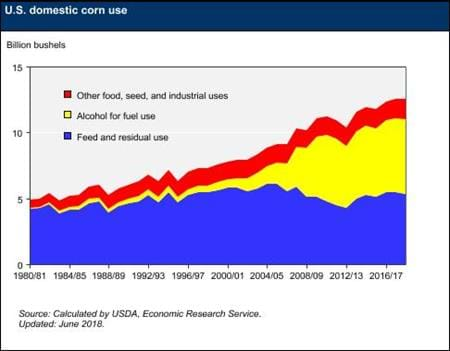
It's an entirely different way of approaching the problem. For example right now in USA here is a chart for the use of corn:
cornuse_450px.jpg
Image courtesy USDA commons
As you can see the vast majority of corn is not used to feed people. All that acreage could and should be put back into prairie and used to raise our animals.

My proposed solution completely eliminates grain based ethanol for fuel and drastically reduces its use as animal feeds, completely eliminating CAFOs based on this dynamic discussed in Scientific American:
It’s Time to Rethink America’s Corn System

This is by far the vast majority of the land growing crops. It of course is a carbon source rather than a sink. It can be improved, but its potential is not even close to the potential of grasslands.

Carbon sequestration potential of switchgrass as a bio-energy crop . In other research done in the central and northern Great Plains, soil organic carbon increased significantly at 0-12 inches and 0-47 inches, with accrual rates of 0.5 and 1.3 ton carbon/acre/yr (equivalent to 1.8 and 4.7 ton CO2/acre/yr), respectively.

1 us ton/acre = 2.2417 metric tonnes/ha
So that means
4 to 10.5 tonnes CO2e/ha/yr
That's pretty damn close to what Jones measured in her case studies in Australia.

But the source I gave you before instead assumes we will stick with inefficient corn alcohol which is a net carbon source.

But if for whatever reason you don't think the University of Michigan knows what they are talking about. It's easy enough to find others who measured the rates.

How about the University of Nebraska?

Soil Carbon Storage by Switchgrass Grown for
Bioenergy
Variability in SOC change
across sites within the studied agro-ecoregion was significant,
from −0.6 to 4.3 Mg C ha−1 year−1 for the 0–30 cm depth

One ton of carbon equals 44/12 = 11/3 = 3.67 tons of carbon dioxide equivalent
so 2.2 to 15.8 tonnes CO2e /ha/yr and that's only measured to 30 cm deep on a plant with up to 30 feet deep roots!:eye-poppi

If you don't like Nebraska then maybe look at any number of the Conservation Reserve Program (CRP) in the USA measured results, and most of the above have not even come close to being optimized for carbon sequestration. Those numbers are almost as good as Jones found and the land managers ranchers and farmer by and large were not even trying.

Just you watch. Set up a carbon market that puts a fee on emissions sources, but pays a dividend to verified carbon sinks, and watch what happens. ;)

That's when off the charts results like Gabe Brown and Joel Salatin and Colin Seis become the new normal.

https://vimeo.com/189494582

 
Last edited:
Impacts of soil carbon sequestration on life cycle greenhouse gas emissions in Midwestern USA beef finishing systems

Across-farm soil organic carbon (SOC) data showed a 4-year C sequestration rate of 3.59 Mg C ha−1 yr−1in AMP grazed pastures. After including SOC in the GHG footprint estimates, finishing emissions from the AMP system were reduced from 9.62 to −6.65 kg CO2-e kg carcass weight (CW)−1, whereas feed-lot (FL) emissions increased slightly from 6.09 to 6.12 kg CO2-e kg CW−1 due to soil erosion. This indicates that AMP grazing has the potential to offset GHG emissions through soil C sequestration, and therefore the finishing phase could be a net C sink.

convert to CO2e 3.59 x 3.67 =
13.1753 tonnes CO2e/ha/yr and yet again another replication of the work Jones recorded, dead center in the 5-20 tonnes CO2e/ha/yr.

And that doesn't even count the fact that we could simultaneously take a similar acreage of corn out of production replacing it with grass. So we are reducing emissions and increasing sequestration simultaneously. Twice the efficacy at 1/2 the cost!
 
What are those conditions? Where are the sources for those numbers?

I have tried hard to explain this symbiosis with mycorrhizal fungi to you. ...
I do not doubt the existence of this symbiosis with mycorrhizal fungi :jaw-dropp!

My point is still that you have not provided any scientific evidence about this symbiosis with mycorrhizal fungi being a significant player in climate change mitigation via soil carbon sequestration.

It is a lie that you have cited sources about Christine Jones' still unsupported assertion in her paper. Those sources need to cite the paper or be about the same subject of her paper with similar calculations.

9 April 2019: What are those conditions? Where are the sources for those numbers?

Carbon sequestration potential of switchgrass as a bio-energy crop. as support for Jenner's paper is also irrelevant because you have given no evidence that Christine Jones' numbers are for switchgrass.

Ditto for Soil Carbon Storage by Switchgrass Grown for Bioenergy

Increasing soil carbon sequestration is at best a partial solution because the literature says 10-20% of current CO2 emissions.
 
Last edited:
What are those conditions? Where are the sources for those numbers?

...yet again another replication of the work Jones recorded, dead center in the 5-20 tonnes CO2e/ha/yr.
Another argument from ignorance about where Christine Jones' numbers come from. She does not give a source or calculation or even a good context so any paper you cite is irrelevant until you answer a basic question.
9 April 2019: What are those conditions? Where are the sources for those numbers?

Impacts of soil carbon sequestration on life cycle greenhouse gas emissions in Midwestern USA beef finishing systems is strangely enough about beef finishing systems in the Midwestern USA. What is compared is feedlot-finished (FL) beef systems versus adaptive multi-paddock (AMP) grazing. The results are:
  • AMP grazing produces more emissions than FL.
  • AMP grazing can sequester large amounts of soil C.
  • The emissions from AMP grazing were offset completely by soil C sequestration.
  • Thus "Soil C sequestration from well-managed grazing may help to mitigate climate change."
Note the units of this paper: "CO2-e kg carcass weight (CW)−1". This is not a "CO2e/ha/yr". There is no area (/ha). There is no rate (/yr).
 
Last edited:
Another argument from ignorance about where Christine Jones' numbers come from. She does not give a source or calculation or even a good context so any paper you cite is irrelevant until you answer a basic question.
9 April 2019: What are those conditions? Where are the sources for those numbers?

Impacts of soil carbon sequestration on life cycle greenhouse gas emissions in Midwestern USA beef finishing systems is strangely enough about beef finishing systems in the Midwestern USA. What is compared is feedlot-finished (FL) beef systems versus adaptive multi-paddock (AMP) grazing. The results are:
  • AMP grazing produces more emissions than FL.
  • AMP grazing can sequester large amounts of soil C.
  • The emissions from AMP grazing were offset completely by soil C sequestration.
  • Thus "Soil C sequestration from well-managed grazing may help to mitigate climate change."
Note the units of this paper: "CO2-e kg carcass weight (CW)−1". This is not a "CO2e/ha/yr". There is no area (/ha). There is no rate (/yr).
Try reading past the abstract please.:covereyes

Averaging data for all three soil types (for S, SL and CL) led to an estimated sequestration rate of 3.59 Mg C ha−1 yr−1 (Table 4).

3.59 MgC/ha/yr converted to CO2e is 3.59 x 44/12 = 13 tonnes CO2e/ha/yr

Greenhouse Gases Equivalencies Calculator
 
Last edited:
The market is betting on climate change

Wolfram Schlenker, Charles Taylor 02 May 2019


Understanding beliefs about climate change is important, but most of the measures used in the literature are unreliable. Instead, this column uses prices of financial products whose payouts are tied to future weather outcomes in the US. These market expectations correlate well with climate model outputs between 2002 and 2018 and observed weather data across eight US cities, and show significant warming trends. When money is at stake, agents are accurately anticipating warming trends in line with the scientific consensus of climate models.
[...]
Our data come from the Chicago Mercantile Exchange, which offers monthly futures contracts for eight cities on two main weather products – cooling degree days, which measure how much cooling is necessary during hot temperatures in summer months, and heating degree days, which measure how much heating is required during cold temperatures in winter months. The contracts are indexed to 65°F, a common standard for utility companies because cooling and heating systems tend to be turned on above and below that level, respectively. For example, a mean daily temperature of 85°F degrees would count as 20 cooling degree days. These daily degree days are then summed over the course of a month or season.
[...]
Futures prices closely follow the predictions of climate scientists, which, on average, appear to have materialised, thus validating the climate models. This close agreement between markets and models implies that traders are taking into consideration the scientific consensus on climate change when making trades. Overall, we find that the market has been accurately pricing in climate change, largely in line with global climate models, and that this began occurring at least since the early 2000s when the weather futures markets were formed.

Doesn't quite fit here but it didn't seem worth its own thread either.
 
What are those conditions? Where are the sources for those numbers?

Try reading past the abstract please.:covereyes
Try understanding what you cite :jaw-dropp!
Impacts of soil carbon sequestration on life cycle greenhouse gas emissions in Midwestern USA beef finishing systems is strangely enough about beef finishing systems in the Midwestern USA. The conclusion is a suggestion that one method of finishing cattle before slaughter could have its greenhouse emissions offset by soil C sequestration.

Christine Jones' article is not about a specific finishing system in the Midwestern USA. :eye-poppi! Her numbers are extremely unlikely to be related to this papers numbers.
This is her article that you cited: Liquid carbon pathway unrecognised
This is her unsourced assertion yet again:
Under appropriate conditions, 30-40% of the carbon fixed in green leaves can be transferred to soil and rapidly humified, resulting in rates of soil carbon sequestration in the order of 5-20 tonnes of CO2 per hectare per year.
You are arguing from ignorance about where Christine Jones' numbers come from. Every paper you come up not citing her with is irrelevant unless we know what she is writing about.

9 April 2019: What are those conditions? Where are the sources for those numbers?
 
First Australian carbon credit units issued to a soil carbon grazing project
Decades after Dr Jones first suggested it, but finally the squashed project has been resurrected and is actually paying.
Jones is not mentioned in that press release. Every soil scientist in the world knows about soil carbon sequestration and has for decades. A "squashed project" rumor.
First Australian carbon credit units issued to a soil carbon grazing project
The credits were received by the Grounds Keeping Carbon Project, which showcases the work of a Victorian innovation and farming system that creates soil carbon in pastures at rates comparable with forests. The Soilkee Pasture Renovator combines cultivation, mulching, aeration and mixed species seeding to improve grazing systems and build soil carbon effectively. The higher the soil carbon levels the more productive and healthy the farm.

'We are very proud to have achieved this formal recognition for Soilkee', said founder, inventor and Gippsland farmer, Niels Olsen. 'The opportunity for expanding regenerative farming and building soil carbon at scale is phenomenal and we are now ramping up our production to deliver on this potential.
This is a project by Niels Olsen using his Soilkee Pasture Renovator. The images are slightly industrial scenes of tractors mulching pasture or spreading mulch.
 
First Australian carbon credit units issued to a soil carbon grazing project
Decades after Dr Jones first suggested it, but finally the squashed project has been resurrected and is actually paying.
Jones is not mentioned in that press release. Every soil scientist in the world knows about soil carbon sequestration and has for decades. Caron credits are also decades old.

A "squashed project" rumor. What Jones did was launch a "Australian Soil Carbon Accreditation Scheme" in 2007 which seems to have died a death naturally. I see announcements of its launch, 2009 and 2010 parliament hearings where she is the representative of the scheme, and nothing much else.

First Australian carbon credit units issued to a soil carbon grazing project
The credits were received by the Grounds Keeping Carbon Project, which showcases the work of a Victorian innovation and farming system that creates soil carbon in pastures at rates comparable with forests. The Soilkee Pasture Renovator combines cultivation, mulching, aeration and mixed species seeding to improve grazing systems and build soil carbon effectively. The higher the soil carbon levels the more productive and healthy the farm.

'We are very proud to have achieved this formal recognition for Soilkee', said founder, inventor and Gippsland farmer, Niels Olsen. 'The opportunity for expanding regenerative farming and building soil carbon at scale is phenomenal and we are now ramping up our production to deliver on this potential.
This is a project by Niels Olsen using his Soilkee Pasture Renovator. The images are slightly industrial scenes of tractors mulching pasture or spreading mulch.
 
Last edited:
Jones is not mentioned in that press release. Every soil scientist in the world knows about soil carbon sequestration and has for decades. Caron credits are also decades old.

A "squashed project" rumor. What Jones did was launch a "Australian Soil Carbon Accreditation Scheme" in 2007 which seems to have died a death naturally. I see announcements of its launch, 2009 and 2010 parliament hearings where she is the representative of the scheme, and nothing much else.

First Australian carbon credit units issued to a soil carbon grazing project

This is a project by Niels Olsen using his Soilkee Pasture Renovator. The images are slightly industrial scenes of tractors mulching pasture or spreading mulch.
Are you drunk again?

Jones range of 5-20 tonnes CO2e /ha/yr is from her own published case studies...published in a farm journal that went bankrupt....so the case studies are no longer available, just a reprint of the results.

By itself her case studies don't really have much scientific value anymore because the journal is defunct and the case studies decades old. EXCEPT that her results are very easily repeatable by just about anyone and everyone who tries. That is indeed the true test of science. Are her results repeatable by completely independent people? And the answer is YES.

The study I linked to is completely different to what Jones did. Even different techniques at restoring soil health. And yet they also had result right in the range Jones reported from her case studies. So yes, this Soilkee Renovator is completely different but it is still pasture cropping and the measured soil carbon increases are 13 tonnes CO2e/ha/yr.

Are you not aware that 13 tonnes CO2e/ha/yr is in the range of 5-20 tonnes CO2e /ha/yr?

So we have a completely independent confirmation that Jones was accurate in her case studies.

I have also given you published confirmation from the US too. All in the range of Jones 5-20 tonnes CO2e /ha/yr

This is easily repeatable by anyone who understand the biophysical process we now refer to as the LCP (liquid carbon pathway). You can do it yourself too if you want. Anyone can. This property of the biophysical mechanism that makes it so easily repeatable is the exact reason why it has use as a global Warming mitigation tool. Because AGW is indeed global and needs to be repeatable globally. and it is
 
I wish I had time to really understand the information in the links you have posted, but I truly appreciate you posting it. It's fascinating stuff, and it gives me hope that scientists are working on real solutions.

The question is whether our political processes will be able to take in the scientific information, and turn that into large scale action on the level that it needs to be effective.
:thumbsup:

I'm late to this thread; I second the sentiment/endorsement, good job, RBF. :thumbsup:
 
Personally, I think the primary answer is one economists have known about for a long time: a robust carbon tax.

Yes, there are important parts of the world where such a thing might not work (Libya, Sudan, maybe even India), but the biggies - the EU, US, China, Russia, Japan, Brazil, Canada, Australia, (most of) OPEC - have sufficiently strong legal, regulatory, etc infrastructures to make such a tax work.

True, there would be very considerable pain, for perhaps hundreds of millions of people; however economists will also tell us that there will also be very considerable gain (albeit with a delay), for most of those who suffer the pain. Pain today to avoid vastly worse pain for one's children and grandchildren.

However, I'm not sure if RBF and his sources have considered the critical importance of carbon sequestration, or reducing the level of CO2 in the atmosphere substantially.

Much human-created CO2 is absorbed by the oceans, which become more acidic. At some point, (almost all?) critters which make shells become unable to do so any more; when that's widespread, some catastrophic ecological changes will begin (far worse than oyster bars becoming extinct). Good news: maybe not until 2100 or so; bad news: it may already be too late.
 

Back
Top Bottom