• Security incident: ISF was recently accessed by intruders. Please change your password, and change it anywhere else you used it. Read more

Smallest possible nuclear weapon

The Davy Crocket was shoulder carried? Wow. Before this thread and the Googlewacking it inspired, I didn't know nukes got that portable. Although, judging from one of the returns I got, the US Army must've been real loose with the definition of the word "portable":

http://www.brookings.edu/FP/projects/nucwcost/davyc.HTM

I mean, if that's what the Army considers man portable, I feel sorry for our soldiers...

Well, anyway... don't know what I can contribute to this discussion besides a call to be wary of stories about suitcase nukes. The site Bonavada linked - http://www.tinyvital.com/Misc/nukes.htm#Suitcase - had a caveat regarding the genesis of such stories, and I've read other articles elsewhere - one example here - that have tried to inject some reality into that myth. In short, there's evidence that claims of such weapons are exaggerations at best, actual fantasy at worst.

Not to derail the thread, but: Did the Davy Crocket warhead actually work? I read some work in a magazine - I'm sorry, I don't recall the magazine itself right now - that implied that just getting nukes down to the size of a refridgerator was already one heck of an accomplishment, nevermind getting one down to the size of a suitcase. But, the XM-388 was quite obviously much smaller than a fridge, so that sort of contradicts that magazine article I'm trying to recall. Although I do have to keep in mind that the this article was, IIRC, discussing fusion weapons, and the XM-388 was a fission weapon, right? So this isn't exactly apples to apples, I admit.

Also: From that PoliticsCentral link above, there's some info that suggests that a small nuke has little longevity:

There are other technical problems: as the radioactive mass decays, it changes shape (a problem called “spalling”) which makes it harder to detonate. And the triggers last only six months before heat renders them inoperable. So as a matter of physics and engineering, the nuclear suitcase is an impractical weapon. It would have to be rebuilt with new radioactive elements every few months.

... so I'm wondering just how functional the Davy Crockett actually was, as well as any other light and portable nuke systems (assuming any others existed). Anyone happen to know?
 
The Davy Crocket was shoulder carried? Wow. Before this thread and the Googlewacking it inspired, I didn't know nukes got that portable. Although, judging from one of the returns I got, the US Army must've been real loose with the definition of the word "portable":

http://www.brookings.edu/FP/projects/nucwcost/davyc.HTM

I mean, if that's what the Army considers man portable, I feel sorry for our soldiers...
not sure if you were being sarcastic but your link makes it clear that i did not in fact recall correctly about the crockett being shoulder-fired :-)

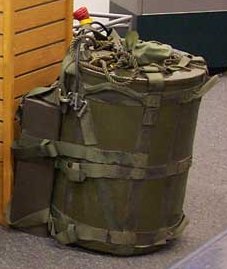
the SADM does appear to be backpack-portable though, if a bit cumbersome
 
Over on Usenet group alt.war.nuclear has short clip from declassified training film on
how to emplace a SADM (Special Atomic Demolition Munition). It was packed in case
weighing in over 150 lbs and took 2 men to move and place. Problem was in airdrops
one of the weapon crew was either injured or landed too far away from other member
and weapon making it impossible to move the SADM by himself.

http://groups.google.com/group/alt....da90e54af2e/9ec48558a20eecad#9ec48558a20eecad

Davy Crockett had number of problems - weapon was fired by time fuse which had to be
preset before firing. Crew would consult range chart to determine time of flight and set
timer. It was vulnerable to winds, either head or cross winds, would mess up calculation
and launch crew could be caught in burst of own weapon. Weapon had minimum
range of 300m, lethal radiation would (for 20 ton, .02kt) extend for 400m giving
reputation as "suicide weapon".

Below is formula for calculating lethal range for nuclear weapons in terms of thermal
(burns), blast injury and radiation.

r_thermal = Y^0.41 * constant_th
r_blast = Y^0.33 * constant_bl
r_radiation = Y^0.19 * constant_rad


If Y is in multiples (or fractions) of
2.5 kt, then the result is in km (and all
the constants equal one). This is based
on thermal radiation just sufficient to
cause 3rd degree burns (8 calories/cm^2);
a 4.6 psi blast overpressure (and optimum
burst height); and a 500 rem radiation dose.


The Davey Crockett warheads were 10 or 20 ton yield
variants of the Mk-54 basic warhead design. 20 tons is
0.008 of 2.5 kt. Using the equations above, the results
are roughly:
r_thermal = Y^0.41 = 0.008^0.41 = 0.138 km (138 meters)
r_blast = Y^0.33 = 0.008^0.33 = 0.203 km (203 meters)
r_radiation = Y^0.19 = 0.008^0.19 = 0.399 km (399 meters)
 
For interested parties, the Nuclear Weapons FAQ offers quite a lot of information about nuclear weapons in general. Sadly it is no longer maintained, but most of the information is still relevant.


ETA: The SADM, or W54 warhead, is not listed as part of the Enduring Stockpile of the U.S. One of the tables lists 154 SADMs disassembled between 1990-1997. I don't know if this was the total number constructed.
 
Last edited:
r_thermal = Y^0.41 = 0.008^0.41 = 0.138 km (138 meters)
r_blast = Y^0.33 = 0.008^0.33 = 0.203 km (203 meters)
r_radiation = Y^0.19 = 0.008^0.19 = 0.399 km (399 meters)
for a 10 ton yield the radii are:

0.104km (104 meters)
0.161km (161 meters)
0.350km (350 meters)

the towers were each 63 meters across, so how does a 161 meter (and that radius, not diamater) nuclear blast get concealed within one?
 
for a 10 ton yield the radii are:

0.104km (104 meters)
0.161km (161 meters)
0.350km (350 meters)

the towers were each 63 meters across, so how does a 161 meter (and that radius, not diamater) nuclear blast get concealed within one?

To be fair, those figures are for damage to humans in a blast in open atmosphere. Walls and things would tend to get in the way. Of course, whether the walls of the trade centers could withstand a blast enough to not only remain standing but also to hide any sign of the explosion is another question, and one to which I rather suspect the answer is "no".
 
not sure if you were being sarcastic but your link makes it clear that i did not in fact recall correctly about the crockett being shoulder-fired :-)

I was poking some gentle fun at the Army, actually. Heavy loads is something I always read soldiers bitching about, plus I recall a real short news clip once on the buildup for the first Gulf War: An airborne soldier picked up a pack that, swear to God, looked nearly 3/4ths as big as he did. He heaved, and with a mighty effort swung the pack onto his back, then bent over and paused for a second, worn out by the simple act of lifting the load. At the end, he looked straight at the camera, and said "Light infantry... HA!".

So when I found that link and saw the weapon, I thought "What poor sap had to carry that??". It was somewhat of an amused thought at the time; I had a brief image in my mind of some officer asking for volunteers, and all the troops looking at each other in dead silence. Figured the poor guy that got "volunteered" to carry it would just be loving his job that day. Anyway... yeah, I can see that it's not a weapon that lends itself to being carried easily.

BTW, I didn't think that weapon was sholder fired; I merely thought it might be carried by an individual infantry soldier, then set up in the field. I'd imagine that the poor sucker who tried to shoulder-fire that would end up in the hospital right quick. Assuming he survived, that is.
 
A supplimentary question:

Are there any suitable radioisotopes that could be made in appropriate quantities wit half lives of the order of months or a few years. Wouldn't they need a lower critical mass?
 
The Special Atomic Demolition Munition (SADM)
SADM%28cropped%29.jpg


http://www.pbs.org/wgbh/pages/frontline/shows/russia/suitcase/comments.html
Do "backpack" nuclear weapons exist?

http://www.foxnews.com/story/0,2933,76990,00.html

Former Russian National Security Adviser Alexandr Lebed in 1997 alleged that up to 100 portable bombs that looked like suitcases were unaccounted for since the 1991 breakup of the Soviet Union. He said the devices have an explosive capacity of one kiloton — the equivalent of 1,000 tons of TNT — and could be activated by a single person, killing as many as 100,000 people.
 
A supplimentary question:

Are there any suitable radioisotopes that could be made in appropriate quantities wit half lives of the order of months or a few years. Wouldn't they need a lower critical mass?

The essential thing is neutron capture cross-section and whether the isotope can obtain more than one fission for every two neutrons produced. Just because a nucleus is unstable that doesn't mean you can make it go BOOM.
 
I don't think the isotope half life would really effect the physical size, or the theoretical limit. (a short HL would make it a bit more unplesant to be around, and also far easier to detect residue of)

the most stable small warhead would be the 0.1 - 0.3kt unboosted primaries used in staged devices. as these have been tested many many many times, and are designed to be small lightweight and reliable and have just enough poke to compress the secondary fuel.

<edit>
en.wikipedia.org/wiki/Image:W87_MIRV.jpg (can't post links yet BAH!)

nice picture of what w87 MIRV Bus, Primaries would be at the bottom of each RV approx dia 25cm, boosted I believe these where at 0.3kt </edit>

you could make smaller by effecting a fizzle I suppse, possibly by allowing package dissasembly befor efficient compression possibly getting as low as 0.05kt, but that might actually be harder to achieve than just using a primary.

IIRC about the davy crocket, Morton Thiokol had an order for a rediculous number of rocket exhaust units that where only used on the Davy Crocket system, around 20k, whether they where all depolyed into active delivery systems is a different matter though
 
Last edited:
Okay. I can set you straight here - cuz I know all about this. There is a limit to how small a nuclear weapon can be because of the critical mass issues and such. This can be reduced somewhat from a standard critical mass by using such things as a "neutron reflector" which reduces the amount of fissile material necessary, but depending on the design, may increase the size of the weapon. Also, the process of boosting, which involves adding a tritium capsule to the center of the fission component can help reduce the weapon's size. The tritium creates a small amount of fusion when the weapon is triggered. Although this does not increase the yield by much directly, it provides neutrons to assure that the fission component does not "fissile"

The thing is there are two ways of looking at it. By small do you mean in size or in mass. In some cases, these may not be the same thing. Adding a beryllium neutron reflector can decrease the weight, by allowing for less uranium or plutonium, which is much heavier, but will increase the diameter of the device.

The W-54 was mentioned here. The W-54 is considered the smallest weapon the US ever created in both mass and yeild and is probably approaching the limits of how small you could make a weapon. The W-54 weighed about 50 pounds and was a very managable size.

The first variation was used on the "Davy Crockett" which was a man-portable launcher. This version was limited to the sub-kiloton range of about 100T-30T. However, that's only explosive yield. It reportedly had a decent kill radius from neutron dose.

But the W-54 is actually capable of considerably higher yields. The variable yeild weapon. It's sometimes known as "Dial-a-yield." The W-54 would later be the basis for the Special Atomic Demolition Munition. This variation allowed for a maximum yeild of at least 1 kiloton, although some reports put it higher: possibly 5 kilotons or so. The highest I've heard is that it could do 10 kilotons but I'd be highly skeptical of that.

So the W-54 takes the prize as the lightest weight weapon and the lowest-yield weapon, or at least, has an option for the lowest yield of any nuclear weapon.

The W48 however was a bit smaller. The W48 nuclear artillery shell was a 6.1 inch diameter artillery shell. It was tested at a yield of about 72T or .0072 kilotons. That's pretty damn small. Later variations with additional boosting may have been able to have a somewhat higher yield, but the design is certainly limited to sub-kiloton yields.

W48_155-millimeter_nuclear_shell.jpg


the W-48 was small but heavy. The sucker weighed in at a good 130 pounds. The thing about the W-48 is that it used something called "Linear implosion" this method of triggering is rather ineffecient. It actually needed three times the fissile material than a standard multi-point implosion weapon. The linear implosion system has only one advantage: it allows for smaller diameters. But because so much material is wasted, and ultimately can contribute to fallout, and because the yeild is so unimpressive, the design only went into limited production.


There is actually a considerable amount of effort which must be put into creating reliable weapons that function at such low sizes and yields. It's beyond the capabilities of any besides major nuclear powers like the US or Russia.

Could a smaller bomb be made? Perhaps the W-54 could be lightened a bit if the safeties exterior shell and other incidental non-critical parts were stripped off.


I doubt many of these exist anymore (if any). The W-54 was taken out of active duty in 1989. Whether they still exist or not, I do not know. But the whole disassembly of nuclear weapons is a bit backed up and behind schedual. I have little doubt that the soviets made similar weapons. However they probably do not have them in active service anymore either. They're just not that useful. Too small to do much other than esculllate a conflict.

 
I don't think the isotope half life would really effect the physical size, or the theoretical limit. (a short HL would make it a bit more unplesant to be around, and also far easier to detect residue of)


It does. With no reflector californium 254 has a critical mass of 4.27Kg by comparison for good old Pu-239 you are looking at about 10KG

http://europa.eu.int/comm/energy/nuclear/transport/doc/irsn_sect03_146.pdf

As far as I know only Uranium and plutonium bombs have ever been built


If the more avialible californium 252 (a bit under 6 KG) and useing the price here:

http://www.straightdope.com/classics/a1_329a.html

that gives us a price of $6,000,000,000,000

could probably get it down to $2,000,000,000,000 with reflectors and stuff.
 

ISF - Join now!

Every member here is approved by hand. No bots, no spam, just people who care about evidence and honest debate.

Membership is free!

Create your free account

Back
Top Bottom