
-
Security incident: ISF was recently accessed by intruders. Please change your password, and change it anywhere else you used it. Read more
You are using an out of date browser. It may not display this or other websites correctly.
You should upgrade or use an alternative browser.
You should upgrade or use an alternative browser.
Russian Presidential Elections
- Thread starter Childlike Empress
- Start date
Childlike Empress
Banned

Doesn't it strike you that a population of 110 million votes the same way?
If with "the same way" you mean Putin came on first in all regions, I wasn't surprised, no. Seen the poll? Read my posts?
If with "the same way" you mean Putin came on first in all regions
First by a long shot, everywhere. Even the Chechen separatists voted for him, funny isn't it?
Childlike Empress
Banned
Seen the poll? Read my posts?
Seen the poll?
Yes, they all overwhelmingly voted for the same candidate.
Read my posts?
Yes, all rubbish.
Virus
Philosopher

- Joined
- Jun 19, 2006
- Messages
- 6,875
If with "the same way" you mean Putin came on first in all regions, I wasn't surprised, no. Seen the poll? Read my posts?
Bridge?
The regions that have the most voter turnout are the ones that voted for Putin more, I guess they really really wanted to vote for him in those parts.
Those high voter turnout areas include Chechnya and Dagestan, usually very hostile (I guess they forgot).
http://www.jamestown.org/single/?no_cache=1&tx_ttnews[tt_news]=39105&tx_ttnews[backPid]=7&cHash=0b9e8552c8063c5a07127b53c4a5afcd
http://www.jamestown.org/single/?no_cache=1&tx_ttnews
Those high voter turnout areas include Chechnya and Dagestan, usually very hostile (I guess they forgot).
So far the symbiosis between Putin and the elites in the North Caucasus has worked out well for the Russian leader. In the March 4 elections, Putin received 99.76 percent of the votes in Chechnya and nearly 93 percent of the vote in Dagestan. Putin won over 92 percent of the vote in Ingushetia and over 91 percent in Karachaevo-Cherkessia (http://dagestan.kavkaz-uzel.ru/articles/202380/, March 5). Paradoxically, it appears that the worse the security situation in a republic, the higher percentage of its electorate voted for Putin, who presided over the deteriorating security situation for more than a decade. In Adygea, arguably the quietest territory in the North Caucasus, Putin received the lowest percentage in the region – a little more than 64 percent (http://www.kavkaz-uzel.ru/articles/202391/, March 5).
http://www.jamestown.org/single/?no_cache=1&tx_ttnews[tt_news]=39105&tx_ttnews[backPid]=7&cHash=0b9e8552c8063c5a07127b53c4a5afcd
http://www.jamestown.org/single/?no_cache=1&tx_ttnews
Last edited:
Childlike Empress
Banned
Yes, they all overwhelmingly voted for the same candidate.
3/1/9 is quite the variety.
Childlike Empress
Banned
They didn't want to make it too obvious.

This ends here, Jo. Forever. Bye.
trustbutverify
Penultimate Amazing

- Joined
- May 5, 2007
- Messages
- 10,544
Seen the poll? Read my posts?
Which, the pathetic fantasist posts or the funny but sad thug worshiping ones?
Cleon
King of the Pod People

Two things going on here:
#1, The Russian elections were obviously severely manipulated, if not fixed outright.
#2, Even if they were free and open, Putin would still likely have won. I think people in the West subconsciously assume that authoritarian thugs are inherently unpopular among the populations they rule, due to the fact that they are, well, authoritarian thugs. This is not necessarily the case. We're talking about a country in which a significant chunk of the population still has a positive view of Josef fricking Stalin.
#1, The Russian elections were obviously severely manipulated, if not fixed outright.
#2, Even if they were free and open, Putin would still likely have won. I think people in the West subconsciously assume that authoritarian thugs are inherently unpopular among the populations they rule, due to the fact that they are, well, authoritarian thugs. This is not necessarily the case. We're talking about a country in which a significant chunk of the population still has a positive view of Josef fricking Stalin.
Complexity
Philosopher
- Joined
- Nov 17, 2005
- Messages
- 9,242
We can only hope that his term as president is very, very short.
What a nasty little man.
What a nasty little man.
NoZed Avenger
Penultimate Amazing
- Joined
- Apr 19, 2002
- Messages
- 11,286
Two things going on here:
#1, The Russian elections were obviously severely manipulated, if not fixed outright.
#2, Even if they were free and open, Putin would still likely have won. I think people in the West subconsciously assume that authoritarian thugs are inherently unpopular among the populations they rule, due to the fact that they are, well, authoritarian thugs. This is not necessarily the case. We're talking about a country in which a significant chunk of the population still has a positive view of Josef fricking Stalin.
Agreed, and #3, the candidates *allowed* to run against Putin were ones who were not real threats to him, regardless.
Childlike Empress
Banned
Two things going on here:
#1, The Russian elections were obviously severely manipulated, if not fixed outright.
#2, Even if they were free and open, Putin would still likely have won. I think people in the West subconsciously assume that authoritarian thugs are inherently unpopular among the populations they rule, due to the fact that they are, well, authoritarian thugs. This is not necessarily the case. We're talking about a country in which a significant chunk of the population still has a positive view of Josef fricking Stalin.
Ah, I see. So "he" had to manipulate the election to prove what an authoritarian thug he is so that people would vote for him. Sure, Cleon. Sounds logical.

In reality #1 didn't happen because #2 is true (although I would formulate it nicer) and there are no serious competitors. Don't forget that in all of Russia's history, the history of their democracy spans twenty years.
And in reality you think that the illogical #1 is "obviously" true because the US media is crying bloody murder ad infinitum and points as proof to the unprofessional NGOs which are payed by your tax payer money to say what they say.
Nicolai Petro, professor of international politics at the University of Rhode Island, who served as the US State Department's special assistant for policy on the Soviet Union under President George HW Bush, gives some advise on How to not lose Russia:
[...] A good place to start would be with a more balanced assessment of the Russian presidential elections. Secretary Clinton now has a rare opportunity to undo the damage that she did in her hasty condemnation of last December's Duma elections. A few simple words of praise for the enormous efforts undertaken by the Russian government in the past two months would place Russian-American relations on a new and much more positive trajectory.
Here are just a few things she could cite:
[...]
- The five registered candidates represent a very broad spectrum of political views, from the communist Gennady Zyuganov who wishes to re-nationalize industry and isolate Russia from the West, to the liberal Mikhail Prokhorov who would like to break up existing national monopolies and join the European Union. The only candidate of any note who was denied registration - social-democrat Grigory Yavlinsky - failed when more than a quarter of his registration signatures were revealed to be forgeries.
- Each candidate received nine hours of free prime time television and radio space (not including four TV and radio channels that offered addition free air time), and up to 18 hours of air time for paid campaign ads. Surveys reveal that, thanks to these and to a slew of televised debates, the public was quite familiar with each candidate's views.
- Finally, in an effort at transparency as yet unmatched in any other country, the election process in all 91,400 polling stations was carried live on the Internet. More than three million visitors each watched an average of 50 minutes of live feed. Democracy advocates should take note - this innovation is cited by 28% of people as the most important reason they trust these election results. This is in addition to an estimated 200,000 registered election monitors from opposition parties, some 700 international election observers, and new, transparent ballot boxes installed in Moscow and other cities. In short, it would be very hard to argue that the Russian government has not done everything possible to ensure a free and fair election, and the Organization for Security and Co-operation in Europe (OSCE) head of mission, Heidi Tagliavini, pointedly refused to label them as not free or unfair. If after these bona fide efforts the official US reaction is still as condescendingly dismissive as it was last December, most Russians will assume that the real purpose of such criticism is to undermine the legitimacy of Putin's presidency. This will in turn cast a long and very dark shadow over future relations at a time when the United States needs Russia more than ever.
I heard that Obama finally congratulated.

theprestige
Penultimate Amazing

Finally, in an effort at transparency as yet unmatched in any other country, the election process in all 91,400 polling stations was carried live on the Internet.
How stupidly naive. We don't need webcams to tell us that people cast ballots. The people themselves can tell us that they cast ballots.
What the people can't tell us is what happened to those ballots. And, interestingly enough, neither can the webcams.
How stupidly naive. We don't need webcams to tell us that people cast ballots. The people themselves can tell us that they cast ballots.
What the people can't tell us is what happened to those ballots. And, interestingly enough, neither can the webcams.
Damien Evans
Up The Irons

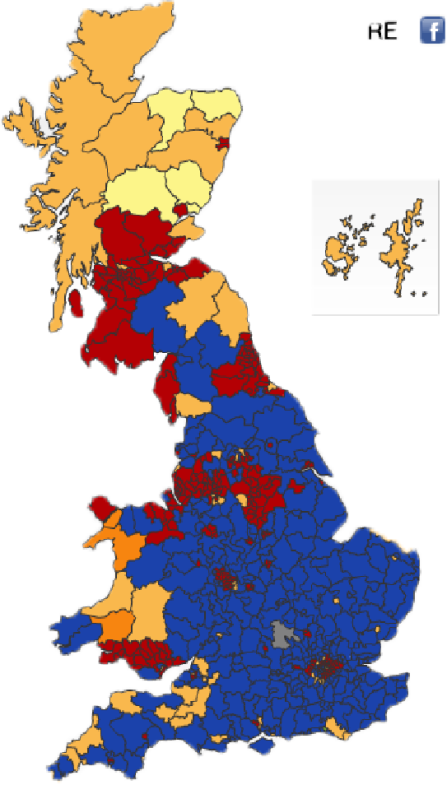
Here's England from 2010:
[qimg]http://i11.photobucket.com/albums/a154/perdalis/6a0105369912fb970b013480aab2c0970c-pi.png[/qimg]
We can see noticeable differences between the North and the South.
See? Normal.
That's not England. It's Britain. That North is Scotland. The middle Western bit is Wales.