Merged Relativity+ / Farsight

Oh yes I do.
No you do not. You seem to think that it starts with preparing the silver atoms somehow so that all the atoms have spins with the same orientation, half spinning one way and half the other way. This seems to be your "two orientations of spin".
This is the only way to explain the results classically.

But heating the silver atoms in a furnace produces atoms with random orientations of spin. That means a random and continuious distribution of spin angular momentum vectors. That should produce a smooth band at the detector. Two bands are seen.

Because atoms are made up of electrons and protons and neutrons, and neutrons decay into electrons and protons and antineutrinos. It's all the same kind of spin.
You forgot about the quarks making up protons and neutrons.
It is all the same "kind of spin" - quantum mechanical spin.

It isn't a classical spinning sphere, but it's classical rotation in terms of wave mechanics. There's no mysticism to it. Not any more.
It isn't a classical spinning sphere, but it's non-classical rotation in terms of wave mechanics (quantum mechanics). There's no mysticism to it. Not any one with some education in physics.

Wrong. It travels through both slits. ....
Wrong. The silver atoms travel through one slit and then another. This is to produce a beam of silver atoms.
There is no "scattering" which is a term better applied to collisions. There is the standard deflection of a dipole interacting with a nonhomogenous magnetic field.
 
No it does not it conclusively shows a photon can (under the right conditions) produce a pair of oppositely charged particles, not just an electron. You are erroneously taking pair production from a photon and claiming it as evidence of just electron production from a photon. You have to show how your single self-bound photon state results in just the change of the electron and pair production simply does not result in just the charge of an electron.

This.
 
... which (if true) one would show by applying the normal laws of fluid mechanics. You'd write down the fluid velocity vector field, ask the Navier-Stokes equation how it evolves, and that tells you how long the soliton lasts and in what direction it moves. (You don't need an analogy with strings or tops or Yrast states or anything)

For real-world electrons, you write down the Dirac spinor and ask the QED equations how long the spinor lasts and in what direction it moves.

For your hypothesis, you write down nothing at all, apply no equations, and go straight to guessing about what analogies you think are appropriate.

Well Farsight? This is where the hypothesis becomes a theory.
 
Apparently these people are tying photons into knots and closed loops with various topological configurations. No mention of any electrons appearing, though. Or "hadronic debris in the main", either.

(Unfortunately, it's a subscription site, so either you have to cough up $23, or go to your local university library, or work on campus. Or, get it mailed to you, like I do.)
I have a copy of the original paper. It is, unsurprisingly, nothing at all like anything Farsight has ever said. It's about creating interference patterns, not about knots in individual photons.
 
There's a minor wording error on wiki, in an article about a specific, technical experiment written by a bunch of anonymous people on the internet, and it isn't even the main article on spin.... and you consider it worth harping on? Why?
Sigh. Because it's a crucial error that you've been schooled in and repeat ad infinitum instead of examining the evidence of pair production and electron magnetic dipole moment. Wake up and smell the coffee sol. There's something rotating in there.

This is part of the reason you're a crank and regarded as such, Farsight. An error on a wiki page does not constitute support for your idea, nor does it represent the view of experts on the topic. It's completely irrelevant - and yet you always focus on such things. The reason is obvious.
Sure thing. You can't deal with the logic, so your only resort is an ad-hominem.

"Initial spin axis"? What are you talking about?
There's two axes of spin. One you can label as the first, the other you can label as the second. Simple.

Utter and complete nonsense. You're just making it more and more clear you don't understand Stern-Gerlach (or even spin and angular momentum at the classical level, for that matter).
LOL. You mean you don't. You think electron spin is something mystical and biblical that surpasseth all human understanding. It isn't.

No. It's proof that it is not "in two dimensions", whatever that might mean.
A classical rotation about an axis results in motion in a plane, and this plane has two dimensions. You can add an additional rotation in an orthogonal plane, and that has two dimensions too. You can repeat with a further rotation in another orthogonal plane, and there's another two dimensions. But there are only three dimensions to space, not six, and we've got three orthogonal rotations, so we assign one to each. Remove one rotation, and it's like spinning a globe and then spinning the spin axis. Simple.

It's a breakthrough that that phrase in a particular wiki is wrong?
No, it's a breakthrough that you've conceded that something you took for granted isn't true. The electron doesn't spin like a planet, but that doesn't mean the spin is non-classical. It's a non-sequitur. The next step should be easy for you.

Nothing's rotating in any normal sense of the word. In the standard model, the spin of the electron is due to the fact that the electron field transforms in the spin 1/2 representation of the massive little group of the Lorentz group. The fact that such representations are possible and relevant follows directly from the invariance of physical law - and specifically the standard model Lagrangian - under the Lorentz group.
Waffle. Don't quote "physical law" at me. That's no better than the bible. Give me evidence. Like the "electron field" is created via pair production. The initial alternating-current photon isn't propagating linearly at c. And now we've spin 1/2 and magnetic dipole moment. Which arises from the motion of current. Come on sol, join the dots.

So what does this have to do with rotation? Well, the little group is SO(3), of which one representation is the action of rotations on 3D space. But electrons do not transform in that representation, they transform in a spinor representation - something with no classical analog.
A spinor is a rotating vector. You know what a vector is, just rotate it. What is the problem!?
 
Waffle. Don't quote "physical law" at me. That's no better than the bible. Give me evidence. Like the "electron field" is created via pair production. The initial alternating-current photon isn't propagating linearly at c. And now we've spin 1/2 and magnetic dipole moment. Which arises from the motion of current. Come on sol, join the dots.
Why should sol join the dots when you refuse to? Show us how a photon moving in a twist can produce charge. Show us the equations for the twist and how that creates the specific phenomena we see in a Stern-Gerlach device. Because so far you have shown us far less than the standard textbook physics you decry.
 
There's two axes of spin. One you can label as the first, the other you can label as the second. Simple.
There is one axis of spin. One you can label as the first, there is no other. Simple.

A spinor is a rotating vector. You know what a vector is, just rotate it. What is the problem!?
A spinor is not a rotating vector. What is the problem?
 
But how does the analogy work? We can't do any physics with your inane analogy. You are saying that the electron is like something from fluid dynamics, but then you say that it isn't governed by fluid dynamics. Can you actually tell us in detail what the electron is governed by?
In detail? Governed by? How typically obfuscatory. It's the motion of stress-energy that started as a +1022keV photon and was transformed into a photon and an electron. And you've had ample detail in the thread and the references.

So, how does a "field excitation" move in a mobius strip and how does this produce the quantized spin, and how does this movement not exceed the speed of light? I suspect that, since you can no more answer this question than any of my other questions, you will simply cry foul and ignore the substantuive issues.
Because it's a stress, like a pressure pulse, moving at c, and it's an alternating displacement current where the amount of displacement rises to 3.86 x 10⁻¹³ m then falls back to zero. In a cubic lattice the sinusoidal electric field amplitude denotes the amount of angular rotation of the lattice lines, and magnetic field amplitude denotes the rate of this angular rotation.

360px-Light-wave.svg.png


A negative amplitude denotes a opposite rotation, like / instead of \. It's a pulse of spacewarp, and when it moves entirely through itself, it's moving through warped space, so it doesn't move in a straight line. The displacement is common to all photons, and at the 2pi wavelength it's in a circular path with all of it travelling entirely through itself, and it cannot escape that circular path. The space it's moving through is being rotated by itself.
 
... which (if true) one would show by applying the normal laws of fluid mechanics. You'd write down the fluid velocity vector field, ask the Navier-Stokes equation how it evolves, and that tells you how long the soliton lasts and in what direction it moves. (You don't need an analogy with strings or tops or Yrast states or anything)

For real-world electrons, you write down the Dirac spinor and ask the QED equations how long the spinor lasts and in what direction it moves.
You need the analogy to understand what a spinor is. Then you break the impasse.
 
In detail? Governed by? How typically obfuscatory. It's the motion of stress-energy that started as a +1022keV photon and was transformed into a photon and an electron. And you've had ample detail in the thread and the references.
How is it obfuscatory to actually ask you how to do something with your theory?

Why can't you walk us through a simple application? You are the one making grand claims, can't you substantiate a simple one?
Because it's a stress, like a pressure pulse, moving at c, and it's an alternating displacement current where the amount of displacement rises to 3.86 x 10⁻¹³ m then falls back to zero. In a cubic lattice the sinusoidal electric field amplitude denotes the amount of angular rotation of the lattice lines, and magnetic field amplitude denotes the rate of this angular rotation.
This is not an answer. How can one take what you have written above and predict the behaviour of an electron moving through a Stern-Gerlach device?
You need the analogy to understand what a spinor is. Then you break the impasse.
So explain the analogy. You have been asked to defend your analogies and you repeatedly refuse.
 
Last edited:
Because it's a stress, like a pressure pulse, moving at c, and it's an alternating displacement current where the amount of displacement rises to 3.86 x 10⁻¹³ m then falls back to zero.

Displacement current is measured in units of electric current density, which is A*m^-2. 3.86*10^-13m is in units of meters. Your units do not match.

You either aren't actually discussing "displacement current" as it is commonly defined (see http://en.wikipedia.org/wiki/Displacement_current), or you are, and you don't understand displacement current.

I'm still waiting on your derivation of 3.86*10^-13m that you claimed you could perform.
 
You misunderstand this rather badly. The photon-photon elastic scattering cross section is vanishingly small and has not been observed at all, ever. (see http://www.springerlink.com/content/emdy0a1g99hejq41/ for a search; the cross section goes as (E_gamma/m_e)^6 for crying out loud.) LEP observed *inelastic* scattering, photon+photon -> e+ e-, and moreover they did this using multi-GeV photons. Your model seems to predict that the photon-photon scattering cross section is as large as the Thompson cross section.
Don't throw up yet another straw man about what my model "seems" to predict. You said I can fire a photon beam through the middle of the densest photon clouds you could possibly imagine (as in, say, femtosecond lasers, or NIF, or NOVA) and it doesn't deflect one bit. What do you think http://www.springerlink.com/content/7vukudpl7vnfv2dn/ is all about? Or DOI: 10.1038/NPHYS1504? Come on ben, get up to speed. Read http://www.physorg.com/news182957628.html along with the paper and understand what they're on about:

Such non-trivial topology of physical fields arises elsewhere in physics, such as flows in fluid dynamics (including Lord Kelvin's vortex atom hypothesis10), quantum condensates6,7 and field theory 11,12. Time-dependent solutions of Maxwell's equations in which all electric field lines have the form of torus knots (knots that can be drawn, without crossing, on a torus) were found in ref. 13.

Why do you think one of the authors contacted Qiu-Hong Hu who was at ABB50/25 in Bristol talking to Atiyah and the rest about this poster:

The Electron, Twisted Photon and Knotted Light

Qiu-Hong Hu, Department of Physics, Gothenburg University and Lightlab Sweden AB (Publ), Fysikgrand 3, SE-412 96, Göteborg, Sweden

Abstract: The Möbius strip is a well known conundrum in mathematics, physics and art. However, its edge as a space curve has been overlooked. It is a closed two turn helix, a so called Hubius helix, the simplest curve possessing handedness, and ought to lie in the position between a circle and trefoil knot on the table of knots but is absent. It is shown when the helix is generated by a photon under a particular quantization condition, the photon becomes an electron, for it turns all attributes of an electron mathematically to its own virtue, including charge, spin, magnetic moment, fine-structure constant alpha, and anomalous magnetic moment (alpha/pi)/2. In this poster, the equations of the Hubius helix are presented. The geometric aspects of the helix and the physical aspects of the electron are identified and related. The connection between the electron, possibly artificial electrons, twisted photons and knotted light are discussed.


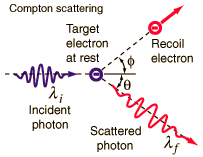
Why doesn't an external photon follow a non-straight geodesic through the curved space in your hypothetical twists?
It does:

comptonr.gif


Great, then your theory also violates Lorentz invariance. Should I await your new non-Lorentz-invariant theory of spacetime?
Yep. Only it isn't my theory. The fine structure constant changes. You can tell.
 
Your definition of the word explanation differs greatly from the accepted meaning, much like your understanding of physics.
LOL, daffy. Such pearls of wisdom. I've just taken a look at some of your posts. Trot off, troll.
 
How is your "spacewarp" created

...snipped anologies gibberish...
An electron is a configuration where the spacewarp is travelling entirely through itself in a double loop, changing its own path constantly, and for this the wavelength has to be 2pi times that common amplitude, or 2.426 x 10⁻¹² m.
First asked 20 April 2010
Farsight,
How is your "spacewarp" created?

The Williamson paper just assumes that space is warped in a specific form somehow to get their photon trapped to make an electron.
The cause cannot be the energy of rhe photon:
This is a really seriously stupid claim, Farsight. The only thing that is known to bend spacetime is energy. We know exactly how much energy a photon has, and therefore we know how much it bends spacetime. Ditto for an electron, a neutrino, a neutron, a planet, etc.

This amount is tiny---absurdly tiny. It's too small to be have any bound states. (If it did have a bound state, it would be what we call a "geon". This possibility has been studied extensively and it doesn't work.) It's too small to have any effects at all, in fact.
(link added)


P.S.
  1. Do you disagree with the experiments that show that spin is intrinsic?
    First asked 22 March 2010
    So far all was have seen is a disturbing lack of knowledge of physics, e.g. your claim that there are only 2 possible orientations of spin and so the silver atoms in the the Stern-Gerlach experiment can only have these 2 orientations (thus the 2 bands).
 
Don't throw up yet another straw man about what my model "seems" to predict. You said I can fire a photon beam through the middle of the densest photon clouds you could possibly imagine (as in, say, femtosecond lasers, or NIF, or NOVA) and it doesn't deflect one bit. What do you think http://www.springerlink.com/content/7vukudpl7vnfv2dn/ is all about?

I think it's about TeV scale photon-photon inelastic scattering, just like the photon-photon interactions at LEP. (In a hypothetical future collider, at that.) Like I said, the cross section scales as (E_gamma/m_e)^6 so when E_gamma is very large the cross section can also become large.

The Berry paper has nothing whatsoever to do with your model; in this paper, you're looking at odd relationships of the polarizations of a propagating laser beam. At no point do the beams do anything other than obey Maxwell's Equations, and at no point do the beams scatter off one another.


That's a sketch of electron-photon scattering; I asked about photon-photon scattering. If you want to insist that electron-photon scattering and photon photon scattering are the same thing in your "model", then I'm happy to continue insisting that your model is wrong.
 
Your theory totally fails to predict the size of an electron

...snipped anologies gibberish...
See the geometry and look at the h in E=hf. It's Planck's constant of action. The dimensionality of action is momentum multiplied by distance. The distance is the same for all photons. It's a displacement, a spacewarp like a gravitational wave is a spacewarp, and regardless of photon wavelength it's always 3.86 x 10⁻¹³ m. An electron is a configuration where the spacewarp is travelling entirely through itself in a double loop, changing its own path constantly, and for this the wavelength has to be 2pi times that common amplitude, or 2.426 x 10⁻¹² m. Hence electrons are always 511keV.
First asked 20 April 2010
Farsight,
The maximum radius of an electron is measured to be 10^-22 meters. This is 9 or 10 orders of magnitude smaller than your prediction :eye-poppi !
(Dehmelt, Hans (1988). "A Single Atomic Particle Forever Floating at Rest in Free Space: New Value for Electron Radius". Physica Scripta T22: 102–110. doi:10.1088/0031-8949/1988/T22/016)
Note that this is a 1988 paper. I am surprised that there is not a more recent paper putting the upper limit even lower.

Can you understand that your fantasy totally fails to predict the size of an electron?
 
Last edited:
You explained nothing. Your provided analogies, "likes", "as", "imagine", and car jacks. You haven't explained why a photon does any of these things. eg, why does a photon bend space in this "special" way...
Because it's stress-energy. It's a pressure pulse blitzing along at c. Pressure makes volume increase, and when this is happening, what we see is action.

...but a neutrino does not.
I didn't say a neutrino didn't. A neutrino conveys energy, it's doing this too. But the action is different. It's rotational.

Additionally, why does an charged particle travel differently through this "car jacked" space, but a non-charged particle does not.
It doesn't. It's like going over a bump. You go up, then down, or down then up, there a symmetry that means your path doesn't change. A charged particle is a pulse of this stuff going through itself with two rotations. A positive particle has one chirality, a negative particle has the other. A non-charged particle is a combination of both. That's why the neutron has a magnetic moment. A charged particle frame-drags the surrounding space, altering the motion of another charged particle like one whirlpool affects another.

Seems like this is always your response when questions are asked with any specificity. You grab the chess board (or perhaps checkers in this case) and throw it across the room like a child.
Not me. You're the one dishing insults.

3.86E-13m, where are you getting it? You claim that "It's the quantum of quantum mechanics. And it's in every picture of the electromagnetic spectrum you will ever see." I've never seen the number in quantum mechanics (except related to the compton wavelength of the electron, which is derived from the mass-energy relation of the electron), much less a picture of an EM spectrum (except that 3.86E-13m is contained somewhere within it).
It's hiding in plain view, Russ. Open your eyes. Every picture of the electromagnetic spectrum shows a common amplitude. The electromagnetic wave propagates through space this way → at c. There's a field variation, but no charge. The electromagnetic field variation goes this way ↑ and this way ↓ at a rate related to wavelength. I said it's like displacement current, and the sinusoidal waveform tells you a slope. That means there's a real physical displacement. And that displacement is always the same.
 
A little article from PhysicsToday (March 2010)

Holograms tie optical vortices in knots


Apparently these people are tying photons into knots and closed loops with various topological configurations. No mention of any electrons appearing, though. Or "hadronic debris in the main", either.
Keep an eye out for these guys, Kalen. They might know more than you think:

Isolated optical vortex knots

Mark R. Dennis1, Robert P. King 1,2, Barry Jack3, Kevin O’Holleran3 & Miles J. Padgett3
Natural and artificially created light fields in three-dimensional space contain lines of zero intensity, known as optical vortices1, 2, 3. Here, we describe a scheme to create optical beams with isolated optical vortex loops in the forms of knots and links using algebraic topology. The required complex fields with fibred knots and links4 are constructed from abstract functions with braided zeros and the knot function is then embedded in a propagating light beam. We apply a numerical optimization algorithm to increase the contrast in light intensity, enabling us to observe several optical vortex knots. These knotted nodal lines, as singularities of the wave’s phase, determine the topology of the wave field in space, and should have analogues in other three-dimensional wave systems such as superfluids5 and Bose–Einstein condensates6, 7.


The 3 in the author list denotes the School of Physics and Astronomy, University of Glasgow.
 
Farsight, to offer that citation as if it has something to do with your theory is to be incredibly dishonest. Their work has absolutely nothing to do with your theory. Now I suspect that you picked that article because you can't understand it, but really, you are effectively lying to people about that article.
 

Back
Top Bottom