Would you like to discuss gravitational conservation of energy, trebor? Only it would seem that for a few people around here, a cat's got their tongue. Because once again, I'm right. And I'm on the right side of the over-unity fence. Guys like edd aren't. Battling the ignorance and woo here on JREF is not easy.

-
Security incident: ISF was recently accessed by intruders. Please change your password, and change it anywhere else you used it. Read more
You are using an out of date browser. It may not display this or other websites correctly.
You should upgrade or use an alternative browser.
You should upgrade or use an alternative browser.
Merged Relativity+ / Farsight
- Thread starter Farsight
- Start date
edd
Master Poster

- Joined
- Nov 28, 2007
- Messages
- 2,120
Suggesting I'm on 'the wrong side of the over-unity fence' is really very inaccurate indeed. I was just pointing out the views of some GR experts in regards to cosmological energy conservation. It is quite wrong to draw parallels to me pointing that out and crackpots who think you can build over-unity devices (you can't because of energy conservation).
W.D.Clinger
Philosopher

Once again, Farsight is wrong.Would you like to discuss gravitational conservation of energy, trebor? Only it would seem that for a few people around here, a cat's got their tongue. Because once again, I'm right.
As often happens, Farsight is wrong because he's railing against a straightforward consequence of the principle he claims to defend, together with the standard terminology of a science Farsight has apparently not studied. In this case, the principle Farsight claims to defend is conservation of energy within a gravitational field, and the science Farsight has apparently not studied is physics.
For his examples, Farsight uses a brick falling within the earth's gravitational field, so let r be the distance from that brick to the center of the earth, K(r) its kinetic energy, and U(r) its potential energy. Conservation of energy says the total energy
E(r) = U(r) + K(r)
is constant. K(r) increases as the brick falls toward the earth's center, so U(r) must decrease as r decreases. Hence U(r) increases as r increases.The potential energy U(r) is always expressed with respect to some arbitrary reference point. For terrestrial applications, engineers can take U(r) to be zero at the earth's surface, and Farsight appears to assume that convention. That convention is too geocentric for physics and cosmology, however, so U(r) is taken to be zero at infinity, which implies U(r) is negative for every finite value of r.
Wikipedia's current article on potential energy explains why this convention was adopted:
(The singularity at r=0 comes from the formula treating the earth or other massive body as a point mass. That's a convenient approximation, so conventions that support that approximation are preferred over conventions that don't.)Wikipedia said:As with all potential energies, only differences in gravitational potential energy matter for most physical purposes, and the choice of zero point is arbitrary. Given that there is no reasonable criterion for preferring one particular finite r over another, there seem to be only two reasonable choices for the distance at which U becomes zero: r=0 and r=∞. The choice of U=0 at infinity may seem peculiar, and the consequence that gravitational energy is always negative may seem counterintuitive, but this choice allows gravitational potential energy values to be finite, albeit negative.
The singularity at r=0 in the formula for gravitational potential energy means that the only other apparently reasonable alternative choice of convention, with U=0 for r=0, would result in potential energy being positive, but infinitely large for all nonzero values of r, and would make calculations involving sums or differences of potential energies beyond what is possible with the real number system. Since physicists abhor infinities in their calculations, and r is always non-zero in practice, the choice of U=0 at infinity is by far the more preferable choice, even if the idea of negative energy in a gravity well appears to be peculiar at first.
I'm sure every cosmologist is wrong about something, but cosmologists aren't wrong about that. Farsight, on the other hand, is wrong about this, just as he's been wrong about most of the things he's discussed in this thread and in his book.I'm afraid some cosmologists are wrong about some things, such as gravitational energy being negative.
Countering Farsight's promotion of ignorance and woo is often easy, but the quantities involved have made it tedious.Battling the ignorance and woo here on JREF is not easy.
Last edited:
HighRiser
Graduate Poster
(snipped for brevity)
Countering Farsight's promotion of ignorance and woo is often easy, but the quantities involved have made it tedious.
Thanks for caring, WDC!

Phooey, edd. I'm with conservation of energy, you're not. And when it comes to GR, I'm the expert, not some guy who thinks the total energy of the universe is zero. If you'd like to beg to differ, I'll be only to happy to hear your views on the brick.Suggesting I'm on 'the wrong side of the over-unity fence' is really very inaccurate indeed. I was just pointing out the views of some GR experts in regards to cosmological energy conservation. It is quite wrong to draw parallels to me pointing that out and crackpots who think you can build over-unity devices (you can't because of energy conservation).
Now do excuse me while I humiliate Clinger. Best if you don't look, because as on previous occasions, it ain't going to be pretty.
Toontown
Philosopher

- Joined
- Jun 9, 2010
- Messages
- 6,595
It beats me how I can see how the back of my own head in a flat universe Toontown. If you'd care to explain how that Asteroids universe actually works, I'm all ears. If you can't, what other options are there?
You're the one who keeps insisting on a flat but finite universe. Vorpal simply proposed a way you could have that. But you're going to see the back of your head in that universe.
It comes down to the definition of flatness, which in turn comes down to what looks flat when viewed from the inside. In that definition, the interior angles of a triangle of any size equal 180* precisely, and the circumference of a circle is precisely 2*pi*r.
I haven't worried my pretty little head about it, but apparently there is the remote possibility of a torus-shaped universe in which the above definition is met. Or maybe some other mathematician's definition of flatness.
The reason I haven't worried my pretty little head about is because I see no need at the moment to abandon the standard cosmological definitions of the 3 kinds of curvature - positive/finite, flat/infinite, and hyperbolic/infinite.
You, however, have previously rejected the standard-mode perfectly flat universe, which is necessarily infinite, which you will not accept, even though you do not want to see the back of your head in a flat universe. Vorpal simply offered you a possible way out of that difficulty, improbable though the possibility may be.
I had previously offered you the alternative of a level 1 multiverse, which is so slightly positively curved that the curvature can't be measured by current methods. But you didn't seem to like that either, having already gone all in against "the Goldilocks multiverse".
So now you're stuck with space that suddenly alters it's nature and becomes a solid barrier at the "edge", beyond which nothing may pass. Which is far stranger than the alternatives you've been offered. In that alternative, you won't see the back of your head. You'll see the front of it, when the light bounces off the edge and comes back to you.
There ain't no easy way out.
http://www.youtube.com/watch?v=nvlTJrNJ5lA
You have to let it be as big as it wants to be, and let the chips fall where they may. It ain't gonna back down.
Last edited:
Oh no I'm not. The last time you said that you were wittering on about electric fields and magnetic fields Clinger, as if the electromagnetic field never happened. Will you ever learn? Highriser, pay attention.Once again, Farsight is wrong.
I've studied it. I've explained it in post #1070. I know this stuff like the back of my hand.W.D.Clinger said:[As often happens, Farsight is wrong because he's railing against a straightforward consequence of the principle he claims to defend, together with the standard terminology of a science Farsight has apparently not studied. In this case, the principle Farsight claims to defend is conservation of energy within a gravitational field, and the science Farsight has apparently not studied is physics.
Yep. You got it Clinger. You need to heft that brick harder to throw it up to a higher r. You have to do more work on it. You have to give it more kinetic energy to get it higher. Bog simple. Tell us something we don't know.W.D.Clinger said:For his examples, Farsight uses a brick falling within the earth's gravitational field, so let r be the distance from that brick to the center of the earth, K(r) its kinetic energy, and U(r) its potential energy. Conservation of energy says the total energy
E(r) = U(r) + K(r)is constant. K(r) increases as the brick falls toward the earth's center, so U(r) must decrease as r decreases. Hence U(r) increases as r increases.
Don't assume anything Clinger. Just stick with the physics. You do work on that brick, you expend energy, and conservation of energy tells you that energy didn't just vanish like edd would have you believe.W.D.Clinger said:The potential energy U(r) is always expressed with respect to some arbitrary reference point. For terrestrial applications, engineers can take U(r) to be zero at the earth's surface, and Farsight appears to assume that convention.
Yeah yeah, we know all that. Only we also know that there's no such thing as negative energy. Just as there's no such thing as negative length. It's a scalar. You can reduce a length, you can have less energy, but you can't have a negative length. In similar vein there's no such thing as negative energy. So the convention that U(r) is negative is misleading. That brick at the top of its arc momentarily motionless is comprised of positive energy. More positive energy than the brick on the ground. You can adopt a convention that invokes negative energy, but it has no foundation in fact.W.D.Clinger said:That convention is too geocentric for physics and cosmology, however, so U(r) is taken to be zero at infinity, which implies U(r) is negative for every finite value of r.
It's an apology Clinger, and I need to have a word with somebody, because escape velocity is not infinitely large. Now is it? So positive potential energy isn't infinitely large either? Is it?W.D.Clinger said:Wikipedia's current article on potential energy explains why this convention was adopted:
...The choice of U=0 at infinity may seem peculiar...
...would result in potential energy being positive, but infinitely large for all nonzero values of r...
No, I'm right about this, and I'm right about most of the things discussed in this thread and the book.W.D.Clinger said:[I'm sure every cosmologist is wrong about something, but cosmologists aren't wrong about that. Farsight, on the other hand, is wrong about this, just as he's been wrong about most of the things he's discussed in this thread and in his book.
LOL, Clinger, all you ever do is fall flat on your face. I'm the one who opposes the woo peddled on JREF. Not you.W.D.Clinger said:Countering Farsight's promotion of ignorance and woo is often easy, but the quantities involved have made it tedious.
ETA: I have to go. Toontown, I'll respond to you tomorrow. Meanwhile if you could remove the word "multiverse" from your post, I'd be grateful.
Last edited:
Reality Check
Penultimate Amazing
I am certainly not going to listen to someone who demonstrates a lot of ignorance about what he is talking about - just read this thread Frau.Reality Check is a pain, Frau. He's one of those guys who just doesn't listen.
When you back up what you say with actual evidence then I will listen and accept what you say, Farsight. But mostly we see supported assertions seeming based on a stance of ignorance.
One example is the electromagnetic field which you are bringing up yet again
 !
!This is really basic:
We have the electric field. We have the magnetic field. We can describe a situation using separate electric and magnetic fields. We can describe a situation using combined electric and magnetic fields. We call combined electric and magnetic fields, electromagnetic fields.
The usage of electric or magnetic fields does not mean that electromagnetic fields do not exist.
The usage of electromagnetic fields does not mean that electric or magnetic fields do not exist.
Reality Check
Penultimate Amazing
Would you like to actually read the dissuasion about gravitational conservation of energy that quite a few people have written (rather than your little lie about "a cat's got their tongue"), Farsight?Would you like to discuss gravitational conservation of energy, trebor? Only it would seem that for a few people around here, a cat's got their tongue.
..snipped usual insults and gibberish about "over-unity"...
FYI: The expansion of the universe does conserve energy.
You'll find cosmologists have a more nuanced view of the conservation of energy.
Ok. I think it still helps as a pointer to why some cosmologists aren't concerned about what may look like non-conservation as the universe expands though.
Actually what we are saying is that you are mistakenly applying classical and special relativity conclusions to general relativity.
In GR, global energy may or may not be conserved: Is Energy Conserved in General Relativity?
You need to learn what science says about conservation of energy, Farsight. It says that energy conservation in GR is not guaranteed: Is Energy Conserved in General Relativity?
Reality Check
Penultimate Amazing
Farsight, If you persist with the delusion that energy is always conserved in GR then you are no expertAnd when it comes to GR, I'm the expert
 .
.Is Energy Conserved in General Relativity?
Reality Check
Penultimate Amazing
Will you ever learn to read, Farsight?The last time you said that you were wittering on about electric fields and magnetic fields Clinger, as if the electromagnetic field never happened.
W.D.Clinger (and other posters) talked about electric fields, magnetic fields and electromagnetic fields.
Highriser and others would have read this thread and know this.
Wrong, Farsight: Gravitational potential energy is negative as you have just acknowledged!Only we also know that there's no such thing as negative energy.
It is the net energy if a system that cannot be negative. So getting back to the (rather dumb) high school example of a thrown brick. Its net energy is always positive. It will always have negative gravitational potential energy.
There is no apology in Wikipedia's current article on potential energy which merely states what every high school student knows - the conversion with potential energy is that it is zero at infinity.It's an apology Clinger,
And you need to learn to read (again!) - no mention of escape velocity in that article
.The problem with setting U = 0 (or any specific value) at r = 0 is that there is a singularity at r = 0 (you have a value divided by zero). So as you take the limit as r -> 0 the potential energy increases without limit. FYI, Farsight, people call this an infinite potential energy.
Thus any calculation that integrates from r = 0 to a finite value of r will fail in that they will give an infinitely large positive potential energy.
You are wrong about GR conserving energy (Is Energy Conserved in General Relativity? ), which hints that you are wrong about most of the things discussed in this thread and some book.No, I'm right about this, and I'm right about most of the things discussed in this thread and the book.
The fact is that you have been shown to be wrong about many of the things discussed in this thread, Farsight.
HighRiser
Graduate Poster
Will you ever learn to read, Farsight?
W.D.Clinger (and other posters) talked about electric fields, magnetic fields and electromagnetic fields.
Highriser and others would have read this thread and know this.
(snipped for brevity)
I certainly don't understand it all, but I do get the impression that Farsight stands alone in his view of reality. From what I can tell that is no wonder.
My thanks for your patience and persistence, RC.

W.D.Clinger
Philosopher
If that were so, Farsight would know these facts:And when it comes to GR, I'm the expert,
- The spacetime interval between two events can be positive, negative, or zero.
- The Ricci scalar can be positive, negative, or zero.
- Electric charge can be positive, negative, or zero.
Oh noes!Now do excuse me while I humiliate Clinger. Best if you don't look, because as on previous occasions, it ain't going to be pretty.

So Farsight knows the gravitational potential energy U(r) is negative for every finite value of r.Yeah yeah, we know all that.W.D.Clinger said:That convention is too geocentric for physics and cosmology, however, so U(r) is taken to be zero at infinity, which implies U(r) is negative for every finite value of r.
Except he doesn't:
Farsight evidently believes scalars can't be negative.Only we also know that there's no such thing as negative energy. Just as there's no such thing as negative length. It's a scalar.
He's quite wrong:
- The spacetime interval between two events is a scalar, and it can be positive, negative, or zero.
- The Ricci scalar is a scalar, and it can be positive, negative, or zero.
- Electric charge is a scalar, and it can be positive, negative, or zero.
When Farsight quoted me, he deleted my parenthetical remark that had already addressed this question.It's an apology Clinger, and I need to have a word with somebody, because escape velocity is not infinitely large. Now is it? So positive potential energy isn't infinitely large either? Is it?W.D.Clinger said:Wikipedia's current article on potential energy explains why this convention was adopted:
...The choice of U=0 at infinity may seem peculiar...
...would result in potential energy being positive, but infinitely large for all nonzero values of r...
The escape velocity from a spherically symmetrical body of mass m is √(2Gm/r), where G is the gravitational constant and r is the initial distance from the center of mass. For m>0 and r=0, the escape velocity given by that formula is indeed infinite. As I explained in my previous post, this singularity at r=0 arises because the formula treats the mass as a point mass. (Equivalently, the formula assumes r is on the surface or above the body of mass m; for r=0, that assumption is the same as assuming a point mass.)
Farsight also believes himself to be the expert on general relativity.No, I'm right about this, and I'm right about most of the things discussed in this thread and the book.

What I really keep insisting on is that we don't have any evidence for an infinite universe. Or for a toroidal universe. The flat finite universe is what you're left with, but it doesn't seem to feature in contemporary cosmology.You're the one who keeps insisting on a flat but finite universe. Vorpal simply proposed a way you could have that. But you're going to see the back of your head in that universe.
No problem.Toontown said:It comes down to the definition of flatness, which in turn comes down to what looks flat when viewed from the inside. In that definition, the interior angles of a triangle of any size equal 180* precisely, and the circumference of a circle is precisely 2*pi*r.
Apparently there is, but nobody can explain how it actually works in a fashion you can actually understand.Toontown said:I haven't worried my pretty little head about it, but apparently there is the remote possibility of a torus-shaped universe in which the above definition is met. Or maybe some other mathematician's definition of flatness.
But there's always been a reason to abandon two out of three as far as our universe is concerned.Toontown said:The reason I haven't worried my pretty little head about is because I see no need at the moment to abandon the standard cosmological definitions of the 3 kinds of curvature - positive/finite, flat/infinite, and hyperbolic/infinite.
If he'd given a coherent explanation that made physics sense, I'd be only too happy to accept it. He didn't, he just gave abstraction with no connection to reality that I could see. Could you?Toontown said:You, however, have previously rejected the standard-mode perfectly flat universe, which is necessarily infinite, which you will not accept, even though you do not want to see the back of your head in a flat universe. Vorpal simply offered you a possible way out of that difficulty, improbable though the possibility may be.
I don't like it because my understanding of relativity makes me think that a homogeneous universe is a flat universe. That's what the FLRW metric starts with, and in that universe (setting expansion aside) light goes straight.Toontown said:I had previously offered you the alternative of a level 1 multiverse, which is so slightly positively curved that the curvature can't be measured by current methods. But you didn't seem to like that either, having already gone all in against "the Goldilocks multiverse".
It doesn't alter its nature, it just ends. Waves can't propagate beyond it. So I speculate that they'll undergo total internal reflection.Toontown said:So now you're stuck with space that suddenly alters it's nature and becomes a solid barrier at the "edge", beyond which nothing may pass.
I don't think it is. The universe is thought to have started as something small and dense, even a "singularity". I'm not keen on singularities myself, but nevermind. With a finite age of 13.8 billion years, it just can't be infinite. I see no method by which it can be some kind of "Asteroids" universe. So I'm left with finite space beyond which there is no space, so there is no beyond it.Toontown said:Which is far stranger than the alternatives you've been offered.
Yeah, the edge of space would be like a mirror. You could look for that kind of thing. You'd see for example galaxies plus their reflections. In the Hubble Ultra Deep Field you can see galaxies that look like galaxies over to the right and down a bit. I'm not saying that is evidence, I'm pointing to that as the sort of thing you might see.Toontown said:In that alternative, you won't see the back of your head. You'll see the front of it, when the light bounces off the edge and comes back to you.
Nice track.Toontown said:There ain't no easy way out.
http://www.youtube.com/watch?v=nvlTJrNJ5lA
You have to let it be as big as it wants to be, and let the chips fall where they may. It ain't gonna back down.
You're still talking abstraction and convention, Clinger, not reality. See wiki for a time-like interval, there's nothing physically negative about two events with a cause–effect relationship. Ricci curvature "represents the amount by which the volume of a geodesic ball in a curved Riemannian manifold deviates from that of the standard ball in Euclidean space". The ball doesn't have a negative volume. And electric charge is again positive or negative purely by convention. I've said before it's related to chiral curvature. Dropping a dimension think of a thin spring steel rod, then bend it into this shape U. Call that positive curvature. Then bend it into this shape ∩. This isn't less curved than the straight rod, you merely call it negative curvature by convention.If that were so, Farsight would know these facts:
- The spacetime interval between two events can be positive, negative, or zero.
- The Ricci scalar can be positive, negative, or zero.
- Electric charge can be positive, negative, or zero.
There's no such thing as a negative distance, Clinger. Or a negative mass. Or negative energy. Like I said gravitational potential energy is only negative by convention, and in all instances what you have is a body with a positive mass comprised of positive energy.W.D.Clinger said:So Farsight knows the gravitational potential energy U(r) is negative for every finite value of r.
Except he doesn't:
"Only we also know that there's no such thing as negative energy. Just as there's no such thing as negative length. It's a scalar."
Farsight evidently believes scalars can't be negative.
I know all that, and when it comes to general relativity I am the expert here. Take a look at The Foundation of the General Theory of Relativity at Doc 30, 3.6 Mbytes See page 185. Einstein says "the energy of the gravitational field shall act gravitatively in the same way as any other kind of energy". That's positive energy, Clinger.W.D.Clinger said:wrong:
If Farsight were an expert on GR, he'd know all that. Farsight's oft-stated claim to expertise in general relativity must be some kind of delusion.
- The spacetime interval between two events is a scalar, and it can be positive, negative, or zero.
- The Ricci scalar is a scalar, and it can be positive, negative, or zero.
- Electric charge is a scalar, and it can be positive, negative, or zero.
Only for brevity.W.D.Clinger said:When Farsight quoted me, he deleted my parenthetical remark that had already addressed this question.
That merely highlights a problem with black holes. An infalling body can be treated in a symmetrical fashion. It doesn't magically acquire infinite speed and infinite energy. Au contraire, an infalling body doesn't acquire any energy at all. Throw a 1kg brick into a black hole, and the mass of that black hole increases by 1kg. Conservation of energy, Clinger, do not dismiss it. It applies to gravity too.W.D.Clinger said:The escape velocity from a spherically symmetrical body of mass m is √(2Gm/r), where G is the gravitational constant and r is the initial distance from the center of mass. For m>0 and r=0, the escape velocity given by that formula is indeed infinite. As I explained in my previous post, this singularity at r=0 arises because the formula treats the mass as a point mass. (Equivalently, the formula assumes r is on the surface or above the body of mass m; for r=0, that assumption is the same as assuming a point mass.)
I've just given you a lesson, now haven't I? Or would you prefer to tell the guys that the black hole mass increases by a 1000000kg. Or some other number?W.D.Clinger said:Farsight also believes himself to be the expert on general relativity.
Last edited:
ctamblyn
Data Ghost

What I really keep insisting on is that we don't have any evidence for an infinite universe. Or for a toroidal universe. The flat finite universe is what you're left with, but it doesn't seem to feature in contemporary cosmology.
Actually, there are a whole host of possibilities left which are consistent with the observable evidence. Those include infinite universes with small positive or negative curvature, flat infinite universes and finite universes with interesting topologies (i.e. not just S3 or ℝ3).
...
Apparently there is, but nobody can explain how it actually works in a fashion you can actually understand.
...
I explained it in very simple terms above (it's just 3D Pacman World). Again, I'm not claiming that space is actually toroidal but there's nothing conceptually complex or a priori impossible about it, and it is quite consistent with GR. You just have to abandon the unnecessary and arbitrary requirement that the space must be embeddable within some larger, Euclidean space. (This is not an issue unique to cosmology, incidentally.)
Yeah, the edge of space would be like a mirror.
Of course, you realise that there is no evidence at all for such a thing (no-one has seen the proposed reflective surface), so why do you not reject this as you did the infinite FLRW models?
Furthermore, if I fire a particle of momentum p at your mirror, according to you it bounces off. How do you reconcile that with the law of local conservation of momentum-energy?
Sigh. Only by Newtonian convention. See above: "the energy of the gravitational field shall act gravitatively in the same way as any other kind of energy". Gravitational field energy is positive, not negative.Wrong, Farsight: Gravitational potential energy is negative as you have just acknowledged!
It isn't a dumb example. What's dumb is thinking that the brick in front of you has any kind of negative energy at all. It has a mass of say 1kg. That's not a negative mass, and its energy-equivalence isn't negative either. Then you lift that brick. You do work on it. Conservation of energy applies. It now comprises more positive energy, and the mass-equivalence of that energy is greater than when the brick was on the floor. There is no actual negative energy anywhere. When you drop the brick you reverse the situation, and the mass-energy of the brick reduces. The Newtonian convention is like measuring height from a reference point in the sky.Reality Check said:It is the net energy if a system that cannot be negative. So getting back to the (rather dumb) high school example of a thrown brick. Its net energy is always positive. It will always have negative gravitational potential energy.
And every schoolkid knows that it's merely a convention. See the next section where it says "thus converting the electrical energy (running the pump) to gravitational potential energy". Positive energy is converted into positive energy.Reality Check said:There is no apology in Wikipedia's current article on potential energy which merely states what every high school student knows - the conversion with potential energy is that it is zero at infinity.
That was me demolishing Clinger's argument. You need to give your brick 11km/s worth of kinetic energy to achieve escape velocity, whereupon the positive kinetic energy is converted into positive gravitational potential energy. You might claim that it originally had negative gravitational potential energy, and now it has zero, but again, it's merely convention. That brick was always comprised of positive energy.Reality Check said:And you need to learn to read (again!) - no mention of escape velocity in that article
Which as I said to Clinger, highlights a problem with black hole singularities. When you drop a 1kg brick into a black hole, the black hole mass increases by 1kg.Reality Check said:The problem with setting U = 0 (or any specific value) at r = 0 is that there is a singularity at r = 0 (you have a value divided by zero). So as you take the limit as r -> 0 the potential energy increases without limit. FYI, Farsight, people call this an infinite potential energy.
Thus any calculation that integrates from r = 0 to a finite value of r will fail in that they will give an infinitely large positive potential energy.
[/quote=Reality Check]You are wrong about GR conserving energy (Is Energy Conserved in General Relativity? ), which hints that you are wrong about most of the things discussed in this thread and some book.[/quote]That article doesn't support your assertion.
LOL, only in your dreams, Reality Check.Reality Check said:The fact is that you have been shown to be wrong about many of the things discussed in this thread, Farsight.
Last edited:
ctamblyn
Data Ghost
And electric charge is again positive or negative purely by convention.
There is no convention I'm aware of in which you can avoid considering some charges as negative. That we take the proton to have positive charge and the electron negative is indeed arbitrary, but that we take them to have opposite signs is not.
Dropping a dimension think of a thin spring steel rod, then bend it into this shape U. Call that positive curvature. Then bend it into this shape ∩. This isn't less curved than the straight rod, you merely call it negative curvature by convention.
You're talking about extrinsic curvature. The intrinsic curvature of both bent rods is zero (assuming you mean to treat them as one-dimensional manifolds).
1D surfaces are fundamentally different to higher-dimensional surfaces - they are always intrinsically flat. When you go up to 2D, things get more interesting. See the following:
Left to right: Hyperboloid of one sheet, cylinder, and sphere.
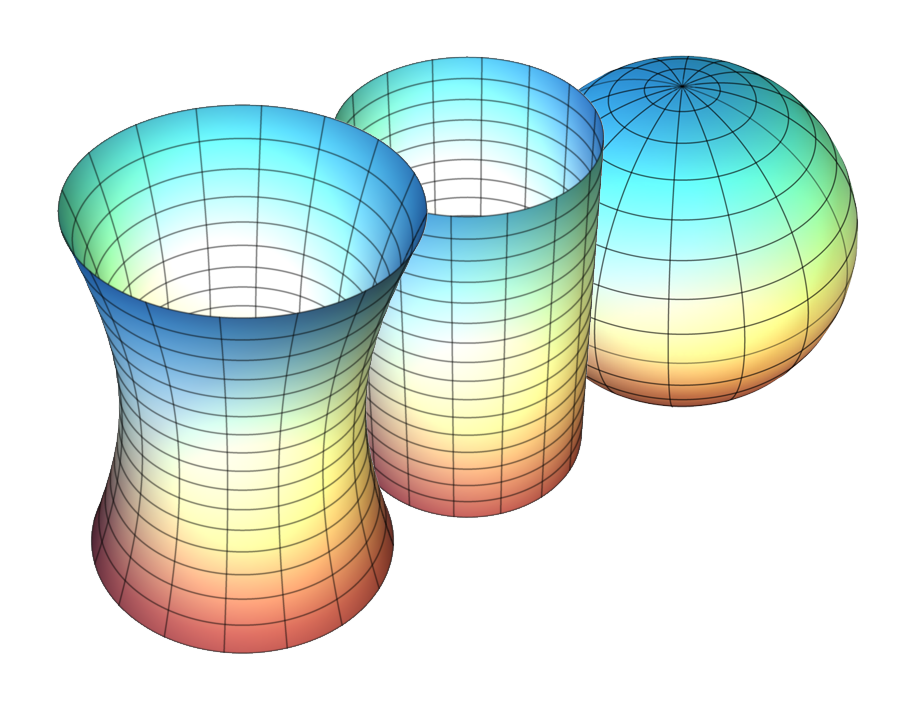
The Gaussian (intrinsic) curvature can be negative (like a hyperboloid of one sheet), zero (like a cylinder) or positive (like a sphere), and there are important qualitative differences between the those cases. Triangles formed from geodesics give the best-known illustration: for a space of negative curvature the internal angles have a sum less than two right-angles, while for a space of positive curvature the sum is greater.
To some extent it is conventional which type of space you call negatively-curved and which you call positively-curved, but that they are oppositely-signed holds for any useful definition of intrinsic curvature.
I don't think any infinite universe is a possibility, ctamblyn, because I don't think an infinite universe can undergo inflation or expand thereafter. And how come a flat finite universe isn't in your list?Actually, there are a whole host of possibilities left which are consistent with the observable evidence. Those include infinite universes with small positive or negative curvature, flat infinite universes and finite universes with interesting topologies (i.e. not just S3 or ℝ3).
So how does it actually work?ctamblyn said:I explained it in very simple terms above (it's just 3D Pacman World). Again, I'm not claiming that space is actually toroidal but there's nothing conceptually complex or a priori impossible about it, and it is quite consistent with GR. You just have to abandon the unnecessary and arbitrary requirement that the space must be embeddable within some larger, Euclidean space. (This is not an issue unique to cosmology, incidentally.)
Because an infinite universe can't expand.ctamblyn said:Of course, you realise that there is no evidence at all for such a thing (no-one has seen the proposed reflective surface), so why do you not reject this as you did the infinite FLRW models?
Note that I said you might die a terrible death. This "edge" isn't going to be like some invulnerable mirror you can bounce cannonballs off. If we say the particle is a photon I suggested it would behave like a ripple reaching the edge of a droplet. I imagine whatever happens re momentum there would apply here.ctamblyn said:Furthermore, if I fire a particle of momentum p at your mirror, according to you it bounces off. How do you reconcile that with the law of local conservation of momentum-energy?
I have to go, but very quickly:
No, the rods were relevant to charge and chirality and curl and electromagnetism, not to intrinsic curvature. Look at an electromagnetic wave....You're talking about extrinsic curvature. The intrinsic curvature of both bent rods is zero (assuming you mean to treat them as one-dimensional manifolds).