• Quick note - the problem with Youtube videos not embedding on the forum appears to have been fixed, thanks to ZiprHead. If you do still see problems let me know.

Question for Ryan Mackey

208 feet of floor slab, floor trusses, ductwork, lighting, cables, interior partitions, furnishings, human beings, and office equipment and supplies do not comprise "free space."

Still think the nose of flight 175 came out the far side of the building, after penetrating the exterior columns in two walls and passing through that "free space," Tony? Or would you like to revise your position?

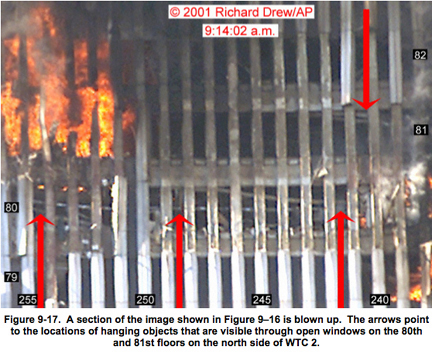
Or perhaps you'd like to explain through which of these holes the nose passed?
[qimg]http://www.internationalskeptics.com/forums/imagehosting/87904736885313f1a.jpg[/qimg]

The reason for my derision, Tony, is that you still refuse to read the NIST report, although I have asked you time and time again to do so. Capisce?


If it isn't part of the fuselage then it is blast material from parts of the fuselage. The photo you show does not refute that. The point is that parts of the plane seem to have made it to the opposite side of the building and the trajectory of UAL Flight 175 on impact supports that notion as it would have a relatively clear path across the 60 foot wide no column office space area on the east side of the tower.

I have read the NIST report Mark. You just say that with no basis. You don't point to specifics and it seems you are doing that for a reason. Did you take note how Ryan showed examples of where he got his information? That is how a debate should take place.
 
Last edited:
I know the radome on the nose is fiberglass to allow the radar to see through it.

By nose I did not mean the actual radome. It should have been obvious. How about part of the fuselage can be seen exiting the opposite side of the building in video. Is that better for you?
Please indicate where the fuselage exited. Fair enough?

87904736885313f1a.jpg
 
If it isn't part of the fuselage then it is blast material from parts of the fuselage. The photo you show does not refute that. The point is that parts of the plane seem to have made it to the opposite side of the building and the trajectory of UAL Flight 175 on impact supports that notion as it would have a relatively clear path across the 60 foot wide no column office space area on the east side of the tower.
Geez, I wonder where you can read a detailed study about that?

:hb:
 
I am largely speaking hypothetically, yes, but it's difficult to imagine a different mechanism at impact.

The aircraft center of mass and center of pressure will line up with the main deck, not the center of area of the fuselage. Roll will therefore not move this to either side. Even if this was not true, we'd be talking about a translation of only a few inches. I fail to see how the roll angle introduces any problems with the impact scenario modeled by NIST.

The center of the main deck is horizontal and in order to give the headroom in the cabin of the 16.5 foot diameter fuselage is probably just below the center of the fuselage. If the aircraft rolls down to the left then the main deck will be more to the right of the core columns.
 
Last edited:
I am wondering if R MacKey can explain one thing - what about secondary debris. The
impact of the aircraft as it ploughed through the building would have picked up anything
in its path - structural materials (exterior columns, pieces of floor truss), interior
partitions, furnishings et al. What would have been the result of these secondary
missiles on the building structure?
 
I know the radome on the nose is fiberglass to allow the radar to see through it.

By nose I did not mean the actual radome. It should have been obvious. How about part of the fuselage can be seen exiting the opposite side of the building in video. Is that better for you?
NO, it was debris exiting. Sorry realcddeal, no thermite will save you and jones. The aircraft impact was over 2066 pounds of TNT energy. It sliced through the WTC just like a karate expert makes quick work of wood and concrete. It is not a trick, it is energy! You can do a simple model of energy and see that the number of columns damaged by 175 was proportional to the energy of 11.

The sad part about your analysis is you lack support and you lack the ability to apply any engineer expertise in a logical fashion. I can do a simple energy analysis, sit down with Robertson and he will agree with me. You can drag out differential equations and all the engineering crap you ever had, and your work is junk; Robertson would rake you over the coals and dump your work in the ash can.

If I was the team leader you would be fired in a second; and I am rusty! If I was the team leader with RM, I would have to study 16 hours a day to catch up. But with you a napkin and a rusty nail can beat your work.
No nose section came out the other side you have lost that point, and I find your work pathetic because you say things like the nose came out the other side! That is misleading others, very pathetic.
 
Geez, I wonder where you can read a detailed study about that?

:hb:

Oh, I forgot you don't do any analyzing yourself. You just collect material. It seems as though if someone you agree with hasn't analyzed it then it couldn't be true.
 
NO, it was debris exiting. Sorry realcddeal, no thermite will save you and jones. The aircraft impact was over 2066 pounds of TNT energy. It sliced through the WTC just like a karate expert makes quick work of wood and concrete. It is not a trick, it is energy! You can do a simple model of energy and see that the number of columns damaged by 175 was proportional to the energy of 11.

The sad part about your analysis is you lack support and you lack the ability to apply any engineer expertise in a logical fashion. I can do a simple energy analysis, sit down with Robertson and he will agree with me. You can drag out differential equations and all the engineering crap you ever had, and your work is junk; Robertson would rake you over the coals and dump your work in the ash can.

If I was the team leader you would be fired in a second; and I am rusty! If I was the team leader with RM, I would have to study 16 hours a day to catch up. But with you a napkin and a rusty nail can beat your work.
No nose section came out the other side you have lost that point, and I find your work pathetic because you say things like the nose came out the other side! That is misleading others, very pathetic.

Do you know what moment of inertia is there beachnut? Hitting the floors edge on is going into their greatest strength. Why don't your karate experts break the board through its longer dimension?

The question isn't about energy. We all know there was a lot of energy there. The question is how it was expended and about the orientation of the aircraft and what the volumetric probabilities were for doing damage to the core columns which was not visible.

I have said that it was most probably impact blast from fuselage parts not the nose.
 
Last edited:
Oh, I forgot you don't do any analyzing yourself. You just collect material. It seems as though if someone you agree with hasn't analyzed it then it couldn't be true.
He a better engineer than you are based on your 9/11 work.
 
Please indicate where the fuselage exited. Fair enough?

[qimg]http://www.internationalskeptics.com/forums/imagehosting/87904736885313f1a.jpg[/qimg]


Are you saying parts of the fuselage couldn't have exited the upper left where the fire is in that photo?
 
Do you know what moment of inertia is there beachnut? Hitting the floors edge on is going into their greatest strength. Why don't your karate experts break the board through its longer dimension?

I have said that it was most probably impact blast from fuselage parts not the nose. What do you think it was that exited the north side of the South Tower?
Engineer? Another dumb statement. OMG, the 4 inch light weight floor was what; a greatest strength event. No, the floor failed just like the columns; You must be unable to grasp 2066 pounds of TNT energy all expended in less than a second. I have to expect 10 core columns damaged and the exterior columns were destroy by the aircraft outline. Check out the energy required to shear a core column and exterior columns. 175 had enough energy to do a lot of damage.

Your main point is to disprove the damage to the building so you can back in explosives or THERMITE! You are failing, and your paper is still full of errors. If I were you, I would take my paper down and stop proving you are unable to do simple engineer estimates.
 
Engineer? Another dumb statement. OMG, the 4 inch light weight floor was what; a greatest strength event. No, the floor failed just like the columns; You must be unable to grasp 2066 pounds of TNT energy all expended in less than a second. I have to expect 10 core columns damaged and the exterior columns were destroy by the aircraft outline. Check out the energy required to shear a core column and exterior columns. 175 had enough energy to do a lot of damage.

Your main point is to disprove the damage to the building so you can back in explosives or THERMITE! You are failing, and your paper is still full of errors. If I were you, I would take my paper down and stop proving you are unable to do simple engineer estimates.

Ok beachwoo, the plane hit the building and it all just blew up. It was just a completely devasting explosion, almost like a nuclear bomb hit it. There is just no way the building could survive those impacts. Who is anyone to question that outcome? Especially with the fire afterward. Nothing could survive that situation. You can go back to sleep now.
 
Last edited:
RealCD, how does a plane going through a building rigged with explosives not affect the demolition charges?
 
Do you know what moment of inertia is there beachnut? Hitting the floors edge on is going into their greatest strength. Why don't your karate experts break the board through its longer dimension?

The question isn't about energy. We all know there was a lot of energy there. The question is how it was expended and about the orientation of the aircraft and what the volumetric probabilities were for doing damage to the core columns which was not visible.

I have said that it was most probably impact blast from fuselage parts not the nose.

The floor slab is strong. But it's not going to develop the strength that you're talking about. What would be the compressive strength of a 4" plate that's 208 feet square? It has a b/t ratio of 624. Something tells me that local failures will occur long before any real compression is developed.

Oh whoops, there we go again, using real engineering.
 
Hello? RealCD, we've got a plane, ramming through a building, which is packed with explosives and ready to implode.

What's going on here? How does that work? Come on.
 
And based on your lack of insightful comments I don't think you are in any position to judge engineering talent.

What did you ever design?
Aircraft approach procedures for first gulf war.
Software for cockpit research projects, and voice recognition at AFWAL.
Assembly language programs to run telephone system from hand radios.
Porch enclosure, 10 by 30, and roof to handle high winds.
System to run hydrogen fueled car economy. Design only.
Design and built, our dining room table, 4x8.
Directed contract, as lead engineer, for differential GPS system.
Directed contract, as lead engineer, for voice recognitions systems studies.
Directed laboratory studies, as lead engineer, as need by human factors engineers.
Directed contact work and contributed to cockpit study for future aircraft display concepts.
Directed and built crew system development branch lab.
Directed projects for Air Force laboratory. I had to make decisions on critical design reviews and guide the final product. Engineering stuff, I think.
Worked on switch gear to run large manufacturing systems.
Built bridges for cars over small rivers.
Designed and built horse jumps (over stuff, love those engineering terms, stuff) for fox hunts.

I designed and built a center channel with 7 drivers. Active crossover with 4 amps, one for each set of 10, 8, and 6 inch drivers, and one amp for the tweeter; the same tweeter used in the Dunlavy Audio Labs Signature SC-VI loudspeaker that cost $25k. The front panel is 2 inches thick wood. I took my daughters old triple bunk beds, I designed and built and used the wood to build the speakers. The top and bottom are 1 inch think, the back 1.5 inch, and the sides are 2 inches. The speaker is 21 to 17 inch deep, 1 foot tall, and 5 feet wide. The woofers share the large enclosure, all the other speaker are in their own 3/4 inch sub enclosure, air tight. You could park a truck on top of the speaker. My grandson helped me build it, he is three. We also built some other speakers designed by other people.

I worked operations as commander/operations officer for a small squadron for Desert Storm. We were a small unit of 10 aircraft and fifteen crews. A lot of engineer end up in management. Not engineering but it helped me understand BS when I see it.
Directed airlift support for Bosnia war; another chance to correct idiots who try to sling BS.

I was educated by some of the top control engineering professors in the world. They would rip up your work so easy. The sad part is none of my training and experience prepares me for your failure to produce facts on 9/11. Do I need more stuff? It is clear my humble experience is not needed to debunk your errors and false information on 9/11.

The bottom line; a napkin and old ink pen can beat your analysis on 9/11. You must have a problem with 9/11; a block of some sort.
 
Last edited:
Ok beachwoo, the plane hit the building and it all just blew up. It was just a completely devasting explosion, almost like a nuclear bomb hit it. There is just no way the building could survive those impacts. Who is anyone to question that outcome? Especially with the fire afterward. Nothing could survive that situation. You can go back to sleep now.
I ripped you paper apart with simple research. Everyone can.

Impact, fire, collapse. Simple stuff you can't even understand. What a total waste of your engineering training. The buildings could survive impacts at slow speed. Not high speed. Slow speed ins below 200 knots. Sorry you lost the engineer contest and your paper is full of errors. Like I said your paper failed peer review by me. An I am just a simple engineer who flew jets for the Air Force. Beat by the Air Force. I also was trained in Aircraft Accident Investigation. Your ideas on the impact are poorly formed. If this was not true we would be agreeing with you.

Have you fixed you paper's errors yet? And how did the explosives survive the impacts and fires, and how did the evil doers know what floor the idiot pilots were going to hit?
 
Are you saying parts of the fuselage couldn't have exited the upper left where the fire is in that photo?
YOU made the contention that the nose of the plane can be seen exiting the building on videos. Not us.

Of course parts of the fuselages exited the buildings. Small parts. Not parts that are recognizable in crash videos, like "the nose," and not whole fuselage cross-sections. Are you beginning to understand how the physical world works, and do you need to be directed again to where you can read a detailed study about this? (Hint: it's real close.)
 
Last edited:

Back
Top Bottom