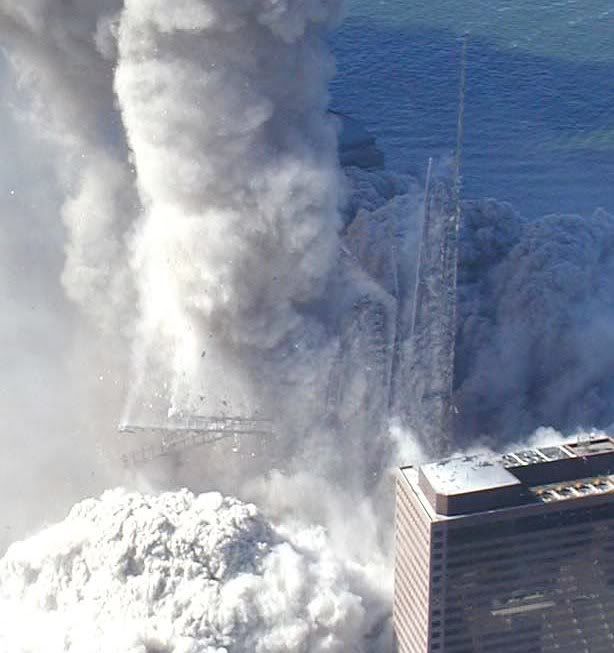
I've got an excellent way you can demonstrate what happened.
You take a piece of plastic drainage pipe about 1 metre long and insert a steel rod the same length.
Now make the steel rod collapse vertically down the pipe.
Good idea, Scooby. But let's do the math to get the thickness of the steel rod correct, okay?
Suppose we assume the steel in the core comprises the entire weight of a fully loaded tower, about 450,000,000 kilograms. This will let you use a lot more steel in the core when you build your scale model, making it stronger. This works out to 75,324 cubic meters of steel. Extended over the 415-meter height of the tower, your mean cross-sectional area of your steel core columns comes to 138 square meters.
In your 1-meter tall square model, that's equivalent to a 2.8 centimeter (just over 1 inch) square steel rod, weighing 6.28 kilograms. That seems pretty strong!
But there's a problem. When you scale a structure, the volume and mass of the steel scale as the cube of the linear scale, which is why your 6.28 kilograms of steel is 1 / (415 * 415 * 415) of the weight of the real tower. But the strength of the columns is proportional to the cross-sectional area of the beam, which scales as the square of the linear scale. Your 2.8-cm square rod is 1 / (415 * 415) as strong as columns with a 138 square meter cross section, but it's only bearing 1 / (415 * 415 * 415) as much weight. So it's 415 times stronger than it should be for the model to really represent the strength of the core.
We could "fix" this by requiring that your 2.8-cm square steel rod, and your pipe, were 415 meters tall instead of 1 meter. That would keep the strength to weight ratio the same as for the full-scale tower. But it would be kind of a funny-looking model. So instead, we divide the cross-sectional area of your model's steel core by a factor of 415, so your model core is now 1.4 millimeters (less than 1/16") square. However, for the strength to weight ratio to be the right, it still has to weigh the same 6-1/4 kilograms, so attach small lead weights to it at regular intevals in such a way that the weights don't add any structural strength. Note that this extra weight doesn't represent the weight of any other part of the towers (floors, etc.), it's keeping the weight correct in scale for your model steel core itself.
Now, how well do you think a 1.4 millimeter steel rod, a meter long, loaded so as to weigh 14 pounds, will stand up? How rigid will it be? We're talking about basically a piece of thick wire here. Even if it doesn't bend, it's going to sway like crazy. So would a 415-meter tall core made of one single solid steel column. That makes it an unusable design for a building. So what you need to do for your model is make it much more rigid, without using any more steel. In other words, you have to shave your 1.4-millimeter wire into much thinner steel filaments, and build a meter-high tower out of it that can support 6-1/4 kilograms of evenly distributed weight. You could do that by making a multi-column core and outer columns and floor trusses, all from filaments that add up to 1 meter of 1.4-millimeter-square wire.
Actually, you'll have to do it with half that amount of wire, to allow for half of the 6-1/4 kilograms of weight to represent other things besides the steel framework, like floor concrete, windows, facing, machinery, furniture, people, etc.
Can this be done? Certainly; it was done full-scale in the real towers, after all. But if you could manage to build such a model (perhaps creating little hollow box columns with walls thinner than aluminum foil), do you think it would be able to arrest progressive collapse if you drop its own top floors onto its lower floors? Do you think its core should be able to topple sideways after being heavily damaged by the rest of the model collapsing around it? Let's see if you're a good enough engineer to get the thing to stand up at all, before you claim that it can arrest collapse or topple in one piece.
Respectfully,
Myriad