• Quick note - the problem with Youtube videos not embedding on the forum appears to have been fixed, thanks to ZiprHead. If you do still see problems let me know.

Question About the WTC Core Collapse

Mr Herbert's your man, you look up and read his post you'll soon work out which columns we're talking about, I think you'll find this post redundant.

In other words, you cannot back up the nonsense you've spewing about metal rods.
 
What remained of the core...and there obviously wasn't much, still had a tenuous linkage.

MM

but
but
but

You said the core must have been CD'd, as it explains the building's collapse at "freefall" speed !!

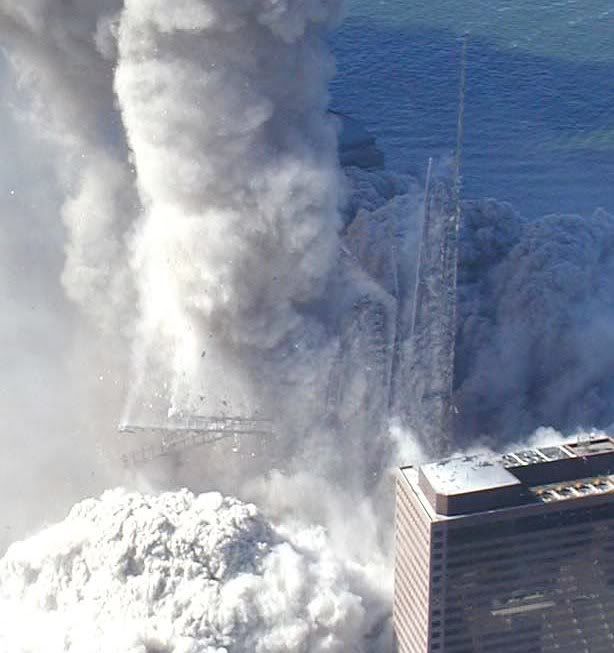
But plenty of both cores were left standing while the wall/floors had hit the ground. Please explain this inconsistency.

(note the dust cloud already well up and away
note the substantial UN CD'D core section of WTC1 )


wtc1peelingcorecropped.jpg
 
Im not sure if you have noticed BUT the Leaning Tower of Pisa hasnt actually fallen over...yet! :D

Mailman


And since the leaning tower of Pisa is essentially stacked masonry. Guess what will happen when it does collapse? I predict the top floor will offset the foundation base by no more that 1 1/2 the diameter and then crumble straight down.
 
but
but
but

You said the core must have been CD'd, as it explains the building's collapse at "freefall" speed !!

But plenty of both cores were left standing while the wall/floors had hit the ground. Please explain this inconsistency.

(note the dust cloud already well up and away
note the substantial UN CD'D core section of WTC1 )


wtc1peelingcorecropped.jpg
And there is part of the core falling to the ground, and it is not at all vertical. In fact, it's horizontal - clearly broke off at a joint and fell over. So much for "vertical collapse".
 
I am reminded of a radio tower tragedy in the Midwest if i recall. They were using a guy derrick on top of this huge tower to place an antennae element. The rigging snapped and sheared off one guy wire. want to know which direction the tower fell? straight down. Figure THAT out.

You might be thinking of the Missouri City, Texas TV antenna tower collapse. We discussed this during one of my classes in school (along with several other cases of mechanical failure, including the famous Tacoma Narrows Bridge), and there is a good overview available here (including some photos and video).
 
I've got an excellent way you can demonstrate what happened.

You take a piece of plastic drainage pipe about 1 metre long and insert a steel rod the same length.

Now make the steel rod collapse vertically down the pipe.

Wow.

Your example fails in so many ways to demonstrate anything relevant that I cannot help but think that you don't actually understand the principles involved, rather than just making poor choices about your models.
 
Im not sure if you have noticed BUT the Leaning Tower of Pisa hasnt actually fallen over...yet! :D

Mailman

Yet you still don't know what 'leaning' means.
How long will they have to keep it there, for you to work it out? ;)
 
Yet you still don't know what 'leaning' means.
How long will they have to keep it there, for you to work it out? ;)

So it's an example of collapsing by toppling over even though it hasn't fallen?

(BTW: it's base is a tad smaller that the WTC towers.);)
 
Wow.

Your example fails in so many ways to demonstrate anything relevant that I cannot help but think that you don't actually understand the principles involved, rather than just making poor choices about your models.

Yeah well guess what - I see a lot of this.
 
Anyway - does Mr Herbert have enough information to answer his question, that's that main thing. I could post some links to some useful resources on the topic?
 
I've got an excellent way you can demonstrate what happened.

You take a piece of plastic drainage pipe about 1 metre long and insert a steel rod the same length.

Now make the steel rod collapse vertically down the pipe.


Good idea, Scooby. But let's do the math to get the thickness of the steel rod correct, okay?

Suppose we assume the steel in the core comprises the entire weight of a fully loaded tower, about 450,000,000 kilograms. This will let you use a lot more steel in the core when you build your scale model, making it stronger. This works out to 75,324 cubic meters of steel. Extended over the 415-meter height of the tower, your mean cross-sectional area of your steel core columns comes to 138 square meters.

In your 1-meter tall square model, that's equivalent to a 2.8 centimeter (just over 1 inch) square steel rod, weighing 6.28 kilograms. That seems pretty strong!

But there's a problem. When you scale a structure, the volume and mass of the steel scale as the cube of the linear scale, which is why your 6.28 kilograms of steel is 1 / (415 * 415 * 415) of the weight of the real tower. But the strength of the columns is proportional to the cross-sectional area of the beam, which scales as the square of the linear scale. Your 2.8-cm square rod is 1 / (415 * 415) as strong as columns with a 138 square meter cross section, but it's only bearing 1 / (415 * 415 * 415) as much weight. So it's 415 times stronger than it should be for the model to really represent the strength of the core.

We could "fix" this by requiring that your 2.8-cm square steel rod, and your pipe, were 415 meters tall instead of 1 meter. That would keep the strength to weight ratio the same as for the full-scale tower. But it would be kind of a funny-looking model. So instead, we divide the cross-sectional area of your model's steel core by a factor of 415, so your model core is now 1.4 millimeters (less than 1/16") square. However, for the strength to weight ratio to be the right, it still has to weigh the same 6-1/4 kilograms, so attach small lead weights to it at regular intevals in such a way that the weights don't add any structural strength. Note that this extra weight doesn't represent the weight of any other part of the towers (floors, etc.), it's keeping the weight correct in scale for your model steel core itself.

Now, how well do you think a 1.4 millimeter steel rod, a meter long, loaded so as to weigh 14 pounds, will stand up? How rigid will it be? We're talking about basically a piece of thick wire here. Even if it doesn't bend, it's going to sway like crazy. So would a 415-meter tall core made of one single solid steel column. That makes it an unusable design for a building. So what you need to do for your model is make it much more rigid, without using any more steel. In other words, you have to shave your 1.4-millimeter wire into much thinner steel filaments, and build a meter-high tower out of it that can support 6-1/4 kilograms of evenly distributed weight. You could do that by making a multi-column core and outer columns and floor trusses, all from filaments that add up to 1 meter of 1.4-millimeter-square wire.

Actually, you'll have to do it with half that amount of wire, to allow for half of the 6-1/4 kilograms of weight to represent other things besides the steel framework, like floor concrete, windows, facing, machinery, furniture, people, etc.

Can this be done? Certainly; it was done full-scale in the real towers, after all. But if you could manage to build such a model (perhaps creating little hollow box columns with walls thinner than aluminum foil), do you think it would be able to arrest progressive collapse if you drop its own top floors onto its lower floors? Do you think its core should be able to topple sideways after being heavily damaged by the rest of the model collapsing around it? Let's see if you're a good enough engineer to get the thing to stand up at all, before you claim that it can arrest collapse or topple in one piece.

Respectfully,
Myriad

 
Last edited:
Yeah well guess what - I see a lot of this.

I'm not surprised.

I'm not going to tell you to let other people dictate what you do (because that's poor advice) but I am going to recommend that perhaps you think about why you are seeing comments like this so often. Perhaps the reason might be that you don't actually have a very good grasp of engineering principles? That's not a bad thing - not everyone needs to be an engineer in order for the world to function (in fact, that might be detrimental) but there are some things that do require some knowledge of in order to make sense of them. One of these is the WTC towers and their collapses on September 11th. If you have an opinion about it, that's fine - but to pretend to know more than you do is just foolish.
 
Good idea, Scooby. But let's do the math to get the thickness of the steel rod correct, okay?

Suppose we assume the steel in the core comprises the entire weight of a fully loaded tower, about 450,000,000 kilograms. This will let you use a lot more steel in the core when you build your scale model, making it stronger. This works out to 75,324 cubic meters of steel. Extended over the 415-meter height of the tower, your mean cross-sectional area of your steel core columns comes to 138 square meters.

In your 1-meter tall square model, that's equivalent to a 2.8 centimeter (just over 1 inch) square steel rod, weighing 6.28 kilograms. That seems pretty strong!

But there's a problem. When you scale a structure, the volume and mass of the steel scale as the cube of the linear scale, which is why your 6.28 kilograms of steel is 1 / (415 * 415 * 415) of the weight of the real tower. But the strength of the columns is proportional to the cross-sectional area of the beam, which scales as the square of the linear scale. Your 2.8-cm square rod is 1 / (415 * 415) as strong as columns with a 138 square meter cross section, but it's only bearing 1 / (415 * 415 * 415) as much weight. So it's 415 times stronger than it should be for the model to really represent the strength of the core.

We could "fix" this by requiring that your 2.8-cm square steel rod, and your pipe, were 415 meters tall instead of 1 meter. That would keep the strength to weight ratio the same as for the full-scale tower. But it would be kind of a funny-looking model. So instead, we divide the cross-sectional area of your model's steel core by a factor of 415, so your model core is now 1.4 millimeters (less than 1/16") square. However, for the strength to weight ratio to be the right, it still has to weigh the same 6-1/4 kilograms, so attach small lead weights to it at regular intevals in such a way that the weights don't add any structural strength. Note that this extra weight doesn't represent the weight of any other part of the towers (floors, etc.), it's keeping the weight correct in scale for your model steel core itself.

Now, how well do you think a 1.4 millimeter steel rod, a meter long, loaded so as to weigh 14 pounds, will stand up? How rigid will it be? We're talking about basically a piece of thick wire here. Even if it doesn't bend, it's going to sway like crazy. So would a 415-meter tall core made of one single solid steel column. That makes it an unusable design for a building. So what you need to do for your model is make it much more rigid, without using any more steel. In other words, you have to shave your 1.4-millimeter wire into much thinner steel filaments, and build a meter-high tower out of it that can support 6-1/4 kilograms of evenly distributed weight. You could do that by making a multi-column core and outer columns and floor trusses, all from filaments that add up to 1 meter of 1.4-millimeter-square wire.

Actually, you'll have to do it with half that amount of wire, to allow for half of the 6-1/4 kilograms of weight to represent other things besides the steel framework, like floor concrete, windows, facing, machinery, furniture, people, etc.

Can this be done? Certainly; it was done full-scale in the real towers, after all. But if you could manage to build such a model (perhaps creating little hollow box columns with walls thinner than aluminum foil), do you think it would be able to arrest progressive collapse if you drop its own top floors onto its lower floors? Do you think its core should be able to topple sideways after being heavily damaged by the rest of the model collapsing around it? Let's see if you're a good enough engineer to get the thing to stand up at all, before you claim that it can arrest collapse or topple in one piece.

Respectfully,
Myriad


Wow. Well done, sir, well done.
 
Good idea, Scooby. But let's do the math to get the thickness of the steel rod correct, okay?

Suppose...

words, words, words (but beautifully written ones, for sure)

Respectfully,
Myriad

Except that by changing the geometry of the model you've changed the structural response - the slenderness ratio, for example, is dependent on the relationship between the length of a column and the radius of gyration (which is dependent on cross-section). You could use the same geometry, but with a different material - except that doing so would present its own set of problems. You haven't mentioned anything about heat transfer either, which can get really nasty with that fourth power in the radiative component.

I have a suggestion: why don't you use sophisticated engineering computer models to perform this simulation? You could enlist the help of knowledgeable persons in performing smaller tests of the elements of your computer model for use in validation, and then you wouldn't have to go through all this trouble. When you finish, you might even produce some sort of report so the public can peruse your work. Sounds like a nifty idea, huh?
 
Last edited:
Except that by changing the geometry of the model you've changed the structural response - the slenderness ratio, for example, is dependent on the relationship between the length of a column and the radius of gyration (which is dependent on cross-section). You could use the same geometry, but with a different material - except that doing so would present its own set of problems. You haven't mentioned anything about heat transfer either, which can get really nasty with that fourth power in the radiative component.

I have a suggestion: why don't you use sophisticated engineering computer models to perform this simulation? You could enlist the help of knowledgeable persons in performing smaller tests of the elements of your computer model for use in validation, and then you wouldn't have to go through all this trouble. When you finish, you might even produce some sort of report so the public can peruse your work. Sounds like a nifty idea, huh?
Who needs that sort of thing when uneducated, inexperienced people can look at youtube videos and using nothing but their imaginations(cause basically, that's all they've got), come up with pretend models using only common materials found around the house. :rolleyes:
 
Hello,

This is my first post & thread so please take it easy on me! For the past year I have been working for the CIA, FBI, FEMA, NIST, and the Bush administration. The location of my work is not classified as I am well known at the ATS site. To them, I am the beast... the shill..the troll...whatever the favorite term for the day is to label someone with common sense.

My problem, i am not at all good with physics and engineering. I had a question asked of me in regards to the last part of the core than remained standing for a short time after the collapse. I was asked WHY it fell straight down after the global collapse had occurred and why it didn't fall "over". I really don't have an educated guess as to how or why.

Not sure if this has ever been brought up in here. I do come in here often to read the threads, but don't recall ever seeing any such question.

Any help you could give me would be much appreciated.

Thanks

Mr Herbert can you post a link to the discussion where you're being asked these questions?

If you leave off the http://www the forum's anti-spam software will let you post the link (once you get to 15 posts, you'll be able to post links regardless).
 

Back
Top Bottom