• Quick note - the problem with Youtube videos not embedding on the forum appears to have been fixed, thanks to ZiprHead. If you do still see problems let me know.

Pyramids - Egypt/Yucatan Connection?

Status
Not open for further replies.
RichardR said:
Great summary. Thanks.

What do you say to the people who claim the Sphinx is older than is conventionally claimed? (Apart from the obvious. ;) )

Is there any reason to think this might be true?

Water weathering and erosion patterns. The body is way more eroded than the face, even if the head was sticking out from the sands most of the time and was exposed to wind and occasional rain. One possibility is that the body is older than thought, and that someone carved his face on it.
 
I don't buy that. the fact is, the body was protected by stationary sand for the last 2-3,000 years, whereas the face was exposxed to the elements the entire time. That will make a HUGE difference in regards to erosion.
 
Frostbite said:
Joshua...

What's new about what you wrote? Good post, but it still doesn't prove or disprove anything. I'm still not convinced that there's no correlation.

Due to the factors I've presented, I'm not convinced that there is any correlation. Aside from the fact that the bases of the two pyramids in question are nearly the same size...what else is there?
 
The Sphinx's age is contested because some stones appear to have been exposed to a lot of water erosion. The arguments in this case are very in depth and technical, and not even one of my long-winded diatribes could cover them all. Instead, I refer you to a website which has a collection of various professional refutations of the water-erosion theory.

Ma'at's Sphinx
 
Larspeart said:
I don't buy that. the fact is, the body was protected by stationary sand for the last 2-3,000 years, whereas the face was exposxed to the elements the entire time. That will make a HUGE difference in regards to erosion.

No, it wasn't. The Sphinx has been covered and uncovered and recovered and reuncovered several times during its existence. The body is also very severely damaged, and has been the focus of several restoration efforts, beginning with King Thutmosis the Fourth in around 1400 BCE. The body is made of several different types of stone, gotten from several different places, applied during several different time periods. It's a big mess, and most proponents of either side of the debate tend to stay away from the body, referring instead to the stonework surrounding the Sphinx.
 
Not to mention that the Sphinx was probably submerged in water by cultists, which could explain the water weathering on the Sphinx's lower edges and the surrounding area.

(Don't worry, I'll bring my Mexico-Egypt correlation arguments later today, kinda busy at work at the moment) :)
 
Larspeart said:

The appearance of nicotine in Egyptian mummies is easily accounted for because of its presence in food items the Egyptians used, as well as tobacco-based insecticides many museums (from which the mummy samples were taken) during the 19th century. The presence of THC in Egyptian mummies isn't mysterious at all, because cannibis is indigenous to the region - the Egyptians used it to make rope, and it's also known that the burning of incense produces THC in small amounts which can add up when inhaled over time.

In fact, the only difficult-to-account-for finding is the presence of cocaine in the Egyptian mummies. However, it isn't suggestive of trans-atlantic travel; any plant of the genus Erythroxylum produces cocaine, and several of these plants are present in southern Africa and Asia, particularly India. Lapis Lazuli - a stone native to Afghanistan - has been found in some Egyptian tombs, indicating trade with those areas.

If we are to accept the existence of a trans-Atlantic trade route between the Egyptians and South America, we need better evidence than chemical residues which can be accounted for otherwise. It seems almost humorous that such a route could be established, but the only things the societies traded with each other were recreational drugs.
 
Joshua KorosiWhat are your opinions on Thor Hyadale(sp) theories linking the 2 cultures. He used reed boats to show at least in theory the Atlantic could be crossed and allowed the possibility of the idea of pyramid building to migrate.
 
chance said:
Joshua KorosiWhat are your opinions on Thor Hyadale(sp) theories linking the 2 cultures. He used reed boats to show at least in theory the Atlantic could be crossed and allowed the possibility of the idea of pyramid building to migrate.

Thor actually had a couple of advantages here - for example, a support team always nearby, and general knowledge of which direction he needed to go and what lay ahead. But that doesn't matter and ultimately isn't the problem.

The problem, again, is simple lack of evidence. The pyramids in South America are so unlike the pyramids in Egypt, any connection between the two is going to be difficult to prove. No other cultural or physical artifact has been found which supports the link, which can't be more easily explained without a transatlantic voyage. It would've taken more than one single trip on a boat to transfer something like pyramid construction techniques (there would've been quite a language learning curve involved), and besides that, there's the time differences - the Egyptians stopped building pyramids by the end of the Old Kingdom (it's very likely by that by the Middle Kingdom, they may have completely forgotten how to build them, because they no longer cared). Whatever indigenous people lived in South America during the pyramid age of Egypt would've been extremely primitive. Why would it have taken 2,000 years for the South Americans to finally start building pyramids? If the primitive people simply waited until they were financially or technologically able to build pyramids, would the knowlege passed on over 2,000 years still be viable? Why wasn't anything else passed on from the Egyptian visitors? Why couldn't the South Americans have figured out such a simple, obvious, and practical structure as the pyramid for themselves?

In addition, the premise is shaky. The Egyptians were excellent river sailors. The Nile was predictable and easy to navigate. They simply did not like risking an ocean voyage - and if they did have to use the ocean, they hugged the shore. A trip past Libya (most of which they never explored), into and across the Atlantic just wouldn't make sense, with all this territory in between to expand into. And if the chances one ship would dare venture out on such a voyage are slim, the chances that among the crew would be one of the privileged few educated in the ways of pyramid construction is practically astronomical.
 
Joshua Korosi Thanks for the reply, I’m not certain if Thor was ever convinced of a pyramid link or was just out to prove a point (it’s been a while since I read his books). I think he also tried to show reed boat building methods could also have been passed on.

But to counter both arguments, both cultures would find a similar solution to boat weaving and pyramid building as there must be a limited number ways either could be designed.

Still have to admire Thor’s reed boat crossings if just for the adventure.
 
Larspeart said:


I'd say that is a harsh treatment for a ruler/god.

Well, you can go to Maya mythology page and read the section about Bloodletting & The Vision Quest to see what Mayan kings did to themselves. Warning: someone may find the description quite uncomfortable.
 
I was thinking more of a trans-pacific boatride. ;)

I'll start by disproving that the Great Pyramid was built by Khufu. The only evidence pointing to that conclusion are 1) inscriptions up in the Construction Chamber and 2) a statuette of Khufu which was found in the temples surrounding the pyramids. Records indeed say that Khufu built mortuary temples and mastabas on the plateau, yet there is no mention of him actually built one of the seven wonders of the old world! I do not dismiss the possibility that such records could have been destroyed due to jaelousy or Khufu's cruel ways.

Concerning the Construction Chambers red ochre paint writings, there was a certain amount of secrecy during Vyse's excursions. Many men were fired from his team for knowing too much, the name Khufu is mis-spelled "Re-ufu", and I believe Vyse wrote these himself. All of the Construction Chamber's walls feature writings, except for the east wall, which was partly blown apart by Vyse with dynamite.

There is enough evidence however to believe that Khufu adopted the Great Pyramid as his own.

- Cement found between some of the Great Pyramid's blocks contained straw particles carbon-dated back to 3,100 BC, right around when Upper and Lower Egypt were unified under Narmer.

- Unlike Menkaure and Sneferu, Khufu and Chephren are never credited for building their pyramids. They are however credited for building mortuary temples.

- The Great Pyramid does not fit Egyptian dynastic history. The builders used revolutionary features (such as advanced portcullis systems, a "King's Chamber" surrounded by granite walls, an all-around over-engineered design, etc.) which were never found in later pyramid designs. In some cases, features were found to replicate those at Giza, but with a negligeable quality.

- The use of monoliths is contrary to practical uses, and is found exclusively at Giza. The weight of the blocks average at 2.5 tons, and the biggest blocks are made of granite and reach 80 tons. Other pyramids throughout the world use much smaller blocks and mud bricks.

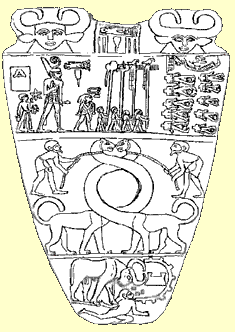
- A pyramid design can be found on the Narmer palette. Some say it depicts a raft (?) but it appears clear to me that a rectangle (Upper and Lower Egypts united) containing a pyramid symbol in its upper part could mean the Giza plateau.


Anyway, here's an incomplete list of similarities between the Pyramid of the Sun at Teotihuacan and the Great Pyramid of Giza. I _will_ include evidence which is nothing more than speculation, for the sake of the argument.

- Both pyramids were places where "men became gods", which means they were both burial places or at least an instrumental part of a burial ceremony.

- Both pyramids have the same base measurements, which makes me believe that 230x230 meters somehow "means" something.

- A universal flood myth present in practically all of the old world's mythologies, which could link whatever cultures are responsible for building both pyramids. Charles Hapgood's book, Maps of the Ancient Sea Kings, is a good place to start.

- The Pyramid of the Sun is associated with Quetzalcoatl, the winged serpent god. The Pyramid of Giza is associated with Thoth, the Egyptian god of knowledge and wisdom. There are many similarities between the two dieties, mainly that they were teachers of mathematics, architecture, numerology, etc. Both share the symbolic number of 52, both gods are sometimes associated with a serpent or winged serpent. Allow me to speculate that both dieties were the same person.

- Alignments: As far as alignments go, I couldn't find anything that linked Teotihuacan with Giza. Using Photoshop, I played around for an hour, overlaying both pyramids and trying to see if other things matched up. All I was looking for was 3 aligned objects, but I couldn't find it. I tried rotating the whole thing by 15.28 degrees due north; I tried overlaying the Jaguar temple with the Sphinx; I tried matching the Khufu pyramid with the temple of Quetzalcoatl... nothing worked. So far, nothing there.

I'd just like to close this post by saying that I am biased in believing that there is indeed a correlation between both pyramids. Whatever link exists could lead thousands of years before they were actually built, which would explain the discrepancies in building material and techniques.

What we're dealing here is a puzzle old as civilization itself, and I find it foolish to dismiss certain theories because the status quo does not agree with them. Just look at what happened to independent researchers like Rudolf Gantenbrink, Robert Schoch and Graham Hancock when they tried to investigate the structures at Giza: they got kicked out, and the director of Egyptian antiquities, Dr. Zahi Hawass, deals with "alternative views" with something that resembles religious zeal. I just think that he should stop dealing with people as if they were children and start answering questions.

 
Frostbite said:

I'll start by disproving that the Great Pyramid was built by Khufu.

You use very strong words here. I'll leave answering to your points to Joshua because he'll do it better than I would, but I just have to comment on one thing:

A pyramid design can be found on the Narmer palette. Some say it depicts a raft (?) but it appears clear to me that a rectangle (Upper and Lower Egypts united) containing a pyramid symbol in its upper part could mean the Giza plateau.

I have been staring at the Narrmer palette (well, a picture of it) for several minutes and I can't see any pyramid figures in it. Could you explain what you mean by it.
 
LW said:


You use very strong words here. I'll leave answering to your points to Joshua because he'll do it better than I would, but I just have to comment on one thing:

Well it's not like anyone ever proved Khufu built the Great Pyramid in the first place anyway. There still is a debate about the two Great Pyramids and the Sphinx. Bad choice of words on my part though.

I have been staring at the Narrmer palette (well, a picture of it) for several minutes and I can't see any pyramid figures in it. Could you explain what you mean by it.

narmer2.gif


On the upper-left corner, left of king Narmer wearing the crown of unified Egypt, there's a rectangle with a pyramid symbol in it. According to dynastic egyptian history, pharaohs didn't start building pyramids until many generations later. The symbol could mean anything else though, but I can't find anything.

Edit: Problems with that idea is the triangle symbol could very well represent the Nile Delta, and that ancient Egyptians reversed north and south, so technically the pyramid symbol should've been on the bottom of the triangle.
 
Status
Not open for further replies.

Back
Top Bottom