I was thinking more of a trans-pacific boatride.

I'll start by disproving that the Great Pyramid was built by Khufu. The only evidence pointing to that conclusion are 1) inscriptions up in the Construction Chamber and 2) a statuette of Khufu which was found in the temples surrounding the pyramids. Records indeed say that Khufu built mortuary temples and mastabas on the plateau, yet there is no mention of him actually built one of the seven wonders of the old world! I do not dismiss the possibility that such records could have been destroyed due to jaelousy or Khufu's cruel ways.
Concerning the Construction Chambers red ochre paint writings, there was a certain amount of secrecy during Vyse's excursions. Many men were fired from his team for knowing too much, the name Khufu is mis-spelled "Re-ufu", and I believe Vyse wrote these himself. All of the Construction Chamber's walls feature writings, except for the east wall, which was partly blown apart by Vyse with dynamite.
There is enough evidence however to believe that Khufu adopted the Great Pyramid as his own.
- Cement found between some of the Great Pyramid's blocks contained straw particles carbon-dated back to 3,100 BC, right around when Upper and Lower Egypt were unified under Narmer.
- Unlike Menkaure and Sneferu, Khufu and Chephren are never credited for building their pyramids. They are however credited for building mortuary temples.
- The Great Pyramid does not fit Egyptian dynastic history. The builders used revolutionary features (such as advanced portcullis systems, a "King's Chamber" surrounded by granite walls, an all-around over-engineered design, etc.) which were never found in later pyramid designs. In some cases, features were found to replicate those at Giza, but with a negligeable quality.
- The use of monoliths is contrary to practical uses, and is found exclusively at Giza. The weight of the blocks average at 2.5 tons, and the biggest blocks are made of granite and reach 80 tons. Other pyramids throughout the world use much smaller blocks and mud bricks.
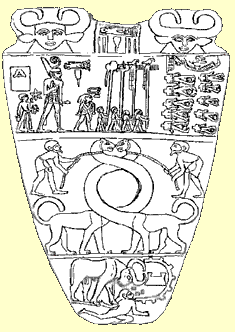
- A pyramid design can be found on the Narmer palette. Some say it depicts a raft (?) but it appears clear to me that a rectangle (Upper and Lower Egypts united) containing a pyramid symbol in its upper part could mean the Giza plateau.
Anyway, here's an incomplete list of similarities between the Pyramid of the Sun at Teotihuacan and the Great Pyramid of Giza. I _will_ include evidence which is nothing more than speculation, for the sake of the argument.
- Both pyramids were places where "men became gods", which means they were both burial places or at least an instrumental part of a burial ceremony.
- Both pyramids have the same base measurements, which makes me believe that 230x230 meters somehow "means" something.
- A universal flood myth present in practically all of the old world's mythologies, which could link whatever cultures are responsible for building both pyramids. Charles Hapgood's book, Maps of the Ancient Sea Kings, is a good place to start.
- The Pyramid of the Sun is associated with Quetzalcoatl, the winged serpent god. The Pyramid of Giza is associated with Thoth, the Egyptian god of knowledge and wisdom. There are many similarities between the two dieties, mainly that they were teachers of mathematics, architecture, numerology, etc. Both share the symbolic number of 52, both gods are sometimes associated with a serpent or winged serpent. Allow me to speculate that both dieties were the same person.
- Alignments: As far as alignments go, I couldn't find anything that linked Teotihuacan with Giza. Using Photoshop, I played around for an hour, overlaying both pyramids and trying to see if other things matched up. All I was looking for was 3 aligned objects, but I couldn't find it. I tried rotating the whole thing by 15.28 degrees due north; I tried overlaying the Jaguar temple with the Sphinx; I tried matching the Khufu pyramid with the temple of Quetzalcoatl... nothing worked. So far, nothing there.
I'd just like to close this post by saying that I am biased in believing that there is indeed a correlation between both pyramids. Whatever link exists could lead thousands of years before they were actually built, which would explain the discrepancies in building material and techniques.
What we're dealing here is a puzzle old as civilization itself, and I find it foolish to dismiss certain theories because the status quo does not agree with them. Just look at what happened to independent researchers like Rudolf Gantenbrink, Robert Schoch and Graham Hancock when they tried to investigate the structures at Giza: they got kicked out, and the director of Egyptian antiquities, Dr. Zahi Hawass, deals with "alternative views" with something that resembles religious zeal. I just think that he should stop dealing with people as if they were children and start answering questions.