• Quick note - the problem with Youtube videos not embedding on the forum appears to have been fixed, thanks to ZiprHead. If you do still see problems let me know.

Pyramids - Egypt/Yucatan Connection?

Joshua Korosi


Well I think we've established that the only likeness is the area of their bases (in the present time at least). They have nothing else in common...

*Their common base dimensions (as originally constructed) is suspect to me.


I hate to be so harsh, but it's time to slam the hammer down on this one. I think the interjection of the flood myth paradigm has nothing to do with this argument. Although the Egyptian creation story has the earth rising from the water (sort of like the bible), there is no catastrophic flood myth there. And the South American peoples had no flood myth either - they claimed to have originated from an "eden" in the north called Atzlan, and migrated down to the south - perhaps a passed down memory of the real migration from Asia down through North America. Several authors insisted that their cultures held a "flood" myth - that Atzlan was a "land in the eastern sea" that was flooded disastrously and forced them to flee. I think Berlitz was the first person to assert this (trying to suggest a link to Atlantis..."Atzlan", flood, get it?), and since then so many people have simply accepted Berlitz's interpretation. The fact is, it is complete invention. The Egyptians, Aztecs, and Mayans had no flood myths. Several cultures did - but that argument simply doesn't belong here.

*EXACTLY. Different histories to different people in different regions, and yet still you find several subsets of like tales. In fact, it is difficult to find a completely original tale of creation, without a sister society that suffered like events at about the same point in time.


Sacrifice victims did not become gods.

*Okay, 'religious cermony', then.


No, the Sun pyramid is less than half as tall as the Great Pyramid, even counting the Sun pyramid's brand new "top level".

*Okay, but do you find the base dimensions to be equal?

I won't be meanspirited toward Frostbite; I believe he read about the Quetzalcoatl/Thoth connection as proferred by Hancock (maybe?), but it is in fact Hancock who is mistaken - none of the links between the two that Frostbite posted are true - not one. If that's the case then, the only thing left connecting Quetzalcoatl with Thoth is the fact that they're both gods. How do we still go about connecting the former to the latter? Thoth wasn't the only god of the Egyptians. Since Thoth isn't represented or associated with the Great Pyramid after all, why is the old chap even relevant?

*I hold that these god-entities are connected in some way, but that there are as different and as diverse as we are.

---

Frostbite:

You say that you don't 'believe' in god or heavenly beings or entities...

Do you believe in my Oak tree? I mean If you picked up a man's writing that spoke in earnest of seeing "Star-like objects move with a constant velocity and make right angle turns", and then applying this known to what is also known about human flight capability. 'I' have seen things in the heavens that were not piloted by human hands. These thing, "came two, together to make a larger versions of themselves", something I have not seen earthly things do.

I testify that I HAVE seen the Oak tree, and that these notes are based on my first hand eye witness account. Although I have no pictures or evidence that I can present here, I tell you no less that these things are true.
 
I've read stuff about the "starships" of Ezekiel, the indu Ramayana and its flying chariots, the travels of Gilgamesh, etc. It's indeed intriguing, but I don't see how these could not have been created from scratch by an imaginative author; much the same way Da Vinci designed his flying engines and wrote about them. I think UFO's are intriguing, but they belong to a different debate altogether.
 
Forget the Kennsington Rune, and other such nonsense hoaxes. The Viking coin found in Mass. has been stupied and tested over and over, and is always found to be REAL and legit. It even has a date on (14-- something).

There was a lot more going on between the continents before Columbus, and I think a lot more of Europe knew of 'something over there' then we think.
 
Larspeart said:
The Viking coin found in Mass. has been stupied and tested over and over, and is always found to be REAL and legit. It even has a date on (14-- something).

Do you have a link for information on that coin? I googled for a while but the only thing I found was a coin minted by Olaf Kyhre (1065-80) that was found in Maine. The 15th century date raises my suspicions since that is well after the end of the Viking era.
 
LW said:


Do you have a link for information on that coin? I googled for a while but the only thing I found was a coin minted by Olaf Kyhre (1065-80) that was found in Maine. The 15th century date raises my suspicions since that is well after the end of the Viking era.

What about the Roman coins? Anyone know more?
 
Well, there is talk about Phoenician coins found in Carthage that bear a map of North America on them. . .

Still, the Viking coin was found in Maine (sorry to mistake it for Mass) in an old indian villages' trash dump. The site has been studied for along time as a wealth of native american info. then, they find a Viking coin in it. There is no evidence of 'planting', or any kind of forgery.

Beyond that,
 
Larspeart said:
Well, there is talk about Phoenician coins found in Carthage that bear a map of North America on them. . .

Extraordinary claims, and all that. The early Spanish maps didn't bear that great of a resemblance to north america. It seems much more reasonable that the squiggles on the coin originally represented something else entirely.


Still, the Viking coin was found in Maine (sorry to mistake it for Mass) in an old indian villages' trash dump. The site has been studied for along time as a wealth of native american info. then, they find a Viking coin in it. There is no evidence of 'planting', or any kind of forgery.

Beyond that,

How much circumpolar traffic was there? Was there traffic by the Inuit or Eskimo between Asia and North America? Anyway, i can see small things like coins, or useful things like knives, being carried as trade goods.
 
Larspeart said:


Still, the Viking coin was found in Maine (sorry to mistake it for Mass) in an old indian villages' trash dump.

That Maine penny is not really so surprising. It was already known that there was at least one Viking settlement in North America around the 11th century (the 15th century date would have been a surprise). Also, it doesn't prove that Vikings themselves visited Maine. The coin had been used as a pendant by indians and it is possible that it had been acquired by trade.
 
Have you ever heard of this monument? The Greek Pyramid? :)

Of course many people doubt the explanation archeologists gave...

If you do a google search you will find the most crazy things about this monument. Some people suggest that the Pyramids of Egypt were built by the Greeks, just because of this monument :rolleyes:

The Greek "Pyramid"

The link belongs to the official site of the Greek Ministry of Culture.
 
Cleopatra said:
Have you ever heard of this monument? The Greek Pyramid? :)

Of course many people doubt the explanation archeologists gave...

If you do a google search you will find the most crazy things about this monument. Some people suggest that the Pyramids of Egypt were built by the Greeks, just because of this monument :rolleyes:

The Greek "Pyramid"

The link belongs to the official site of the Greek Ministry of Culture.

Funny!

There's nothing odd or special about pyramids in and of themselves. If you want something really, really tall, and your culture hasn't invented the butress yet, a pyramid is an obvious solution. And although some of the pyramids get really big, there is absolutely nothing within them or about them that their contemporary cultures weren't capable of doing or making.

The whole "pyramid" thing is sort of analogous to the evolution argument. When creationists argue against evolution, they present evolution as a theory held in question - something that the scientific community is leaning toward but not betting on. Of course, this is a misrepresentation; the fact of the matter is, scientists are as sure of the actuality of evolution as they are that the earth orbits the sun.

Likewise, people who have alternative theories about the pyramids present those theories as if their incidental and nebulous "suggestive" evidence can actually hold a candle to the evidence mainstream historians use to determine the truth. For example, in this thread it has been asserted that the only things linking the Great Pyramid to Khufu was a bit of graffiti and a statue - of course, that's not true. There are remains of mortuary temples, the causeway, and the nearby mastabas of nobles and architects whose incriptions cry out "I helped build the Pyramid for Khufu!". That Khufu had the pyramid built was common knowledge in Egypt for thousands of years, even up to Herodotus' time, when they even told him how it was built. The sheer size of the Pyramid led Herodotus to insist that Khufu must've been a horrid taskmaster who drove countless slaves to toil night and day for 23 years. Now we know it was probably more of a public works project, with the engineers and laborers bragging about their parts in the construction of the marvel. During the four months in which the valley farms were inundated by the Nile, farmers flocked to Giza to help earn themselves a place by their king's side in the afterlife - as well as grain and beer to last them and their families until the next planting season. The swollen river even allowed the quarry barges to bring the stone blocks closer to the construction site than was otherwise possible.

Many television programs, even of late, claim that it is unknown how the Egyptians "moved such huge stones" up inclined planes. The same thing has been asserted by such sources of the Easter Island statues, despite the fact that when Thor Heyerdahl visited there, the natives demonstrated how the statues were moved. At Giza, now we know that there is no mystery at all; the stones were moved by gangs of 12 to 20 men or so. Tomb and quarry incriptions indicate that the teams even gave themselves special names, like "The Strong-arms of Giza" and "Khufu's Drunkards".

To scientists, the fact that the Great Pyramid belonged to Khufu is, like evolution, as certain as the earth orbits the sun. There are many mysteries in archaeology - even in Egypt. The Great Pyramid is no longer one of them. For all their hard work, ingenuity, and perseverance - all their blood, sweat, and tears - these wonderful people are entitled to the credit. They built monuments that, barring no great calamity, will be enjoyed by our descendants a thousand years from now. Men fear Time....but Time fears the Pyramids.
 
Cleopatra said:
Have you ever heard of this monument? The Greek Pyramid? :)

Of course many people doubt the explanation archeologists gave...

If you do a google search you will find the most crazy things about this monument. Some people suggest that the Pyramids of Egypt were built by the Greeks, just because of this monument :rolleyes:

The Greek "Pyramid"

For that matter, remember this thread about the so-called Italian Pyramids?

http://host.randi.org/vbulletin/showthread.php?s=&threadid=18666

Something about pyramids seems to cause a shutdown of critical faculties in certain people.
 
I've got an alternative to the Orion Belt/Giza alignment theory. I do not know if this is asserted by mainstream Egyptology; I certainly can't find anything about it. So I guess I can take the credit... :cool:

Somebody in the thread ceo linked to mentioned that although the apices of the three pyramids are offset, the southeast corners of all three pyramids are lined up. Here's Giza, once again:

pyr_vo.jpg


Remember that in this photo, north is at the bottom. The alignment of the corners is obvious here.

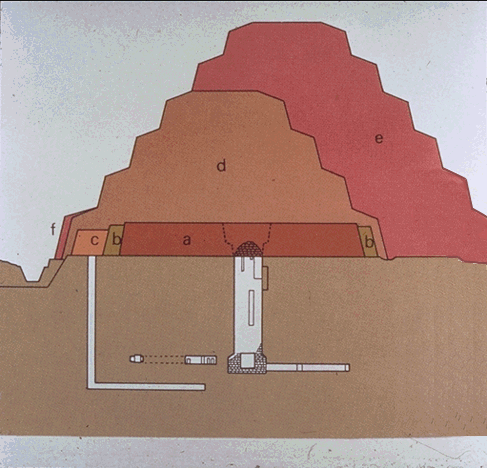
Now, I remembered reading something about Djoser's old step pyramid - how it was originally designed to be smaller than it is now, but mid-construction, the plan was changed and the pyramid was made bigger. It's very, very easy to change the size of a pyramid before it is complete - the levels sort of make things easy. Here's a graphic of the Djoser pyramid now, compared to its original design:

20.gif


It's clear how easily the pyramid's construction facilitates the design change.

Now, Menkaure's pyramid (the small one) at Giza is approximately one quarter the size of the other pyramids - in other words, you could "superimpose" four Menkaure pyramids on the footprint of Khufu's pyramid. The slope of Menkaure's pyramid is the same as Khufu's. Look back at the Giza photo once again, and note that if you draw a line between the apex of Khufu's and Khephren's pyramids, and continue that line to Menkaure's, you'll notice that the line touches the northwest corner of the third pyramid.

What does any of this mean? Simple! If, like Djoser did, Menkaure had built his pyramid with the same slope, and the southeast corner aligned with the others as it is now, but with a bigger base - to be specific, the same footprint size as the previous two pyramids, the apex of Menkaure's pyramid would be over nearly exactly the same spot now occupied by the pyramid's northwest corner....and all three pyramids' apices would line up! Cool, huh?

So what happened? Perhaps Menkaure realized the project was too expensive, and did essentially the reverse of what Djoser did. Perhaps the quarries were becoming exhausted. I shall do some research and see if I can substantiate this uncharacteristic bout of wild speculation.

By the way....why, you may ask, if Menkaure decided on a smaller pyramid, did he line up the corners instead of the apices? Simple, I think. It would be easier for a surveyor to stand on the site and ensure that his pyramid's corner would be in line with the other pyramids'. It would be difficult to ensure that your pyramid's apex was lined up with the Kephren's and Khufu's, if Kephren's pyramid blocked sight of the Khufu pyramid's apex! It's also a little known dirty secret that Khephren's pyramid isn't as perfect as Khufu's - it's ever so slightly uneven. The surveyors would've known this (because they'd just built the thing, of course), and wouldn't have relied on the slope and dimensions of Kephren's pyramid.
 
Joshua Korosi said:
To scientists, the fact that the Great Pyramid belonged to Khufu is, like evolution, as certain as the earth orbits the sun. There are many mysteries in archaeology - even in Egypt. The Great Pyramid is no longer one of them. For all their hard work, ingenuity, and perseverance - all their blood, sweat, and tears - these wonderful people are entitled to the credit. They built monuments that, barring no great calamity, will be enjoyed by our descendants a thousand years from now. Men fear Time....but Time fears the Pyramids.

Well, whatever scientists wanna think that make them feel better, imho. The fact is, there's no proof that Khufu ever built the Great Pyramid or that Chephren built the second one. There's no mention that the "gangs" built pyramids, just mortuary temples and other structures at Rostau. No mention about the Sphinx or Sphinx temples either. There's still a possibility that they have in fact been adopted, and that the original builders were sea farers (or their descendents).
 
Frostbite said:

There's still a possibility that they have in fact been adopted, and that the original builders were sea farers (or their descendents).

That's all fine...what's this about sea farers?
 
Well if the pyramids were indeed adopted, that would explain a Yucatan/Egypt correlation and the flood myth. Unless the builders or their ancestors used an ice bridge, they must've travelled overseas.
 
If the later Saga's are taken literally, then the Vikings spent a good 200-300 years in the New World, in some form or another (not settlement exclusively). There are records of Polar bears being given to the Danish kings as gifts, and documented records of timber shipments from North America as well.

When the Greenland settlement was abandoned/died out, trade with the New World died as well. Without Greenland serving as an intermediary, it became far too expensive to ship. Plus, scandinavians were on better terms with the rest of Europe, thus allowing them to get theri much-needed timber from elsewhere closer to home.
 
There's also stories around here about Knights Templar visiting Nova Scotia and burying treasures... I'll look into that sometimes.
 
Frostbite said:
Well if the pyramids were indeed adopted, that would explain a Yucatan/Egypt correlation and the flood myth. Unless the builders or their ancestors used an ice bridge, they must've travelled overseas.

OK...

...but did you miss my post somewhere above explaining that while many cultures in the world do indeed have flood myths, their number doesn't include the Egyptians or the Aztecs?
 
Joshua Korosi said:


OK...

...but did you miss my post somewhere above explaining that while many cultures in the world do indeed have flood myths, their number doesn't include the Egyptians or the Aztecs?

Not true. The Inca had a flood myth in which Viracocha, another god symbolized by a feathered serpent, created the world and destroyed it with a mighty flood. My research isn't indepth, but I think it's obvious that Quetzalcoatl is a later interpretation of the older Viracocha. And the Egyptians also had the remnants of a flood myth, whereas they saw their lands emerging from the waters of the Nile by Ptah. I think both cultures are referring to the same events, with different deities.
 
Frostbite said:


Not true. The Inca had a flood myth in which Viracocha, another god symbolized by a feathered serpent, created the world and destroyed it with a mighty flood. My research isn't indepth, but I think it's obvious that Quetzalcoatl is a later interpretation of the older Viracocha. And the Egyptians also had the remnants of a flood myth, whereas they saw their lands emerging from the waters of the Nile by Ptah. I think both cultures are referring to the same events, with different deities.

You are correct, of course. Quetzalcoatl and the later Kukulkan were of course simply newer adaptations of old myths; much like Triton being the Roman version of the earlier Greek Neptune.

But the Inca were not the Aztecs. T'was the Aztecs who built the Sun Temple, and no low Inca temple comes close to resembling the Aztec pyramids, let alone the Egyptian ones.

And do you see the emergence of the world from water during creation to be a flood myth? It seems exactly the opposite to me. Perhaps I should be specific - while other cultures with flood myths have the world destroyed by an angry god, floods were sacred gifts in Egypt. Every year, the flood would return life to the valley, making it fertile again. Flood was creation, in Egypt. It seems odd that the Egyptians are a couple thousand years older than the Inca, yet somehow the Inca know more and earlier information about such an important event.
 

Back
Top Bottom