• Security incident: ISF was recently accessed by intruders. Please change your password, and change it anywhere else you used it. Read more

Pyramid Older than Civilization

Thanks for that. I haven't quite finished yet, but it's a great video and very informative.


Why that specific place? The specific claim was about agriculture being required for spare time and monuments.

In fact, you can almost certainly have both without agriculture and I suggested Gobekli Tepe may be an example of a monument that pre-dated agriculture.

The video that Lithrael posted is worth watching if you want to know where the surplus calories came from. Post-Pleistocene hunter-gatherers in the region became sedentary and built their own dwellings. Unlike previous hunter-gatherers they did not necessarily have to spend so much of their time foraging because wild seeds and berries may have grown in sufficient abundance and there may have been sufficient game. This could be particularly true at times of migration of particular animals. The video suggests that the engravings at Gobekli Tepe may have been information about seasonal migrations of birds and other animals, and that there are examples that pre-date this at other archeological sites. This information is aimed at Graham Hancock who spouted off some theory about how all the technology exhibited at Gobekli Tepe was unheard of prior to its sudden emergence. But it also debunks the theory that agriculture creates settlements, spare time and monuments.

The place you mention, Catal Huyuk, seems to have been created a couple of thousand years after Gobleki Tepe, which means that agriculture would have had plenty of time to develop in the interim.

I meant Gobleki Tepe. I apologize for the confusion.

And, as I surmised, there is an alternative theory of surplus calories, to explain the construction of Gobleki Tepe prior to the invention of agriculture.
 
A link from the phys.org site beats the **** out of this johnny come lately pyramid. They uncovered a wood structure that they say is nearly half a million years old. Logs notched out to interlock for a base structure or something. And I can't keep my exterior wood crown moldings from rotting away. The old growth wood was the good stuff, man.
 
IMO the builders of large ancient structures were smarter than probably 90% of the humans alive today.

Get a random selection of 10 humans, and 1 of them is probably smarter than 90% of all humans ever.

Large scale structures are never designed by the average human of any time, they're always going to be designed by some of the brightest available. And most ancient civilizations had a lot more than 10 people to choose from.
 
I hear that. When I see ancient architecture, I find it so inspiring that the builders had to be so determined and damned clever and innovative to have pulled it off. It's insulting to dismiss it as "they were too dumb, so...aliens". No way. The pyramids at Giza and worldwide are a standing testament to human willpower.

Yep I think when I see the constant claim that human cannot do masonry by alien astronauts would have. Its a little known fact that Armstrong was picked to be the first man on the moon because Buzz couldn't make an interior angle in granite to save his life.
 
Here's the most recent situation report (from Nature):

A 27,000-year-old pyramid? Controversy hits an extraordinary archaeological claim

“I'm surprised [the paper] was published as is,” says Flint Dibble, an archaeologist at Cardiff University, UK. He says that although the paper presents “legitimate data”, its conclusions about the site and its age are not justified.

Investigations continue:

Archaeological Prospection and its publisher, Wiley, have since launched an investigation into the paper. Eileen Ernenwein, an archaeological geophysicist at Tennessee State University in Johnson City, who is co-editor of the journal said in an e-mail to Nature: “The editors, including me, and Wiley ethics team are currently investigating this paper in accordance with Committee on Publication Ethics guidelines.” She declined to elaborate on the nature of the concerns raised.

Standing by!
 
It's amazing how many publications and websites were uncritically parroting the claims of known cranks with barely any attempt to raise an eyebrow.

One of those is that website called IFL Science. Geeze! That is a garbage source.
 
Controversial Claim of a 27,000 Year Old Pyramid Made by Ancient Humans
(Anton Petrov on YouTube, Dec 7, 2023 - 12:30 min)
 
It's amazing how many publications and websites were uncritically parroting the claims of known cranks with barely any attempt to raise an eyebrow.

One of those is that website called IFL Science. Geeze! That is a garbage source.

Yes, Google even promotes some of those garbage stories in its "news" feed.

I followed IFL Science for a short while maybe 10 years ago when it was going viral, but soon realised it was not actually very scientific and unfollowed it.

Looked it up just now, and the site/owner has also committed thousands of copyright violations.

https://en.wikipedia.org/wiki/Elise_Andrew
 
Doorframes with square lintels are significantly less effective at supporting weight and distributing load than curved archways. Developing arches (as opposed to square lintels) means doing significantly more with less. You can build taller structures, using less materials. That's the distinction being made. "Some concept of arches" meaning square lintels doesn't cover the quantum leap forward in engineering represented by actual arches in construction.

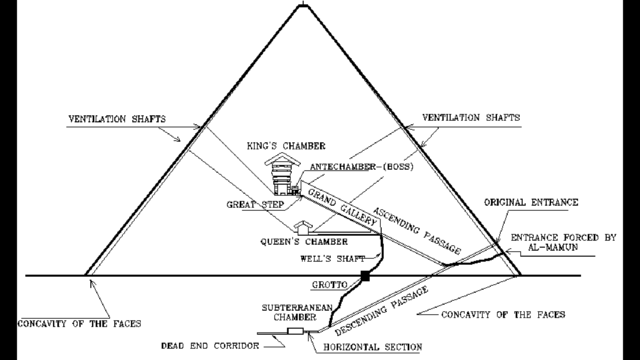
If I remember correctly, the hall in the Great Pyramid was actually a 'peaked' roof (identical to what is found on many modern houses lol), so a 'primitive arch' of sorts

(bit later on)- had a look around, and yup...

The Kings Chamber and the Queens Chamber both had peaked 'roofs' to distribute the weight above

Screenshot-from-2023-12-09-21-46-09.png
 
Last edited:
AH, well. A pyramid older than Civilization is nonsense. Perhaps a civilization older than we have known of up till now, but ... stone structures are intrinsically hard to date.

Pre civilisation cultures have constructed huge monuments. For example Silbury Hill is a late Neolithic mound in Wiltshire is about the same size as contemporary Egyptian pyramids. The second phase at Silbury was about 2490–2340 BCE, this pre dates civilisation in Britain by well over two millennia. While needing large scale organisation projects on this scale don't require civilisation, tribal societies can manage them. Tribal societies have a demonstrated ability to mobilise manpower construct large monuments some using very large worked stones.
 
Pre civilisation cultures have constructed huge monuments. For example Silbury Hill is a late Neolithic mound in Wiltshire is about the same size as contemporary Egyptian pyramids. The second phase at Silbury was about 2490–2340 BCE, this pre dates civilisation in Britain by well over two millennia. While needing large scale organisation projects on this scale don't require civilisation, tribal societies can manage them. Tribal societies have a demonstrated ability to mobilise manpower construct large monuments some using very large worked stones.

I'd hate to start another quibbling semantic thread here, but doesn't this kind of depend on how you define "civilization?"
 
The journal, Archaeological Prospection, has now retracted that garbage paper.

Link

Here is an interesting Twitter thread from an archeologist who is disappointed at the journal for not having talked to genuine archeologists from Indonesia.

Link
 
That's just silly, they were long dead by then.
Mega-fauna would be the obvious likely suspects. Giant sloth maybe?

I would think mammoth or mastodon would be more likely, though I'm not sure either of those ever inhabited Indonesia.

With their tusks, they're pretty much a living forklift.
 
Last edited:
The journal, Archaeological Prospection, has now retracted that garbage paper.

Link

“This error, which was not identified during peer review, is that the radiocarbon dating was applied to soil samples that were not associated with any artifacts or features that could be reliably interpreted as anthropogenic or “man-made.” Therefore, the interpretation that the site is an ancient pyramid built 9000 or more years ago is incorrect, and the article must be retracted.”

:thumbsup: Glad they spotted it eventually, but a failure of peer review.
 

ISF - Join now!

Every member here is approved by hand. No bots, no spam, just people who care about evidence and honest debate.

Membership is free!

Create your free account

Back
Top Bottom