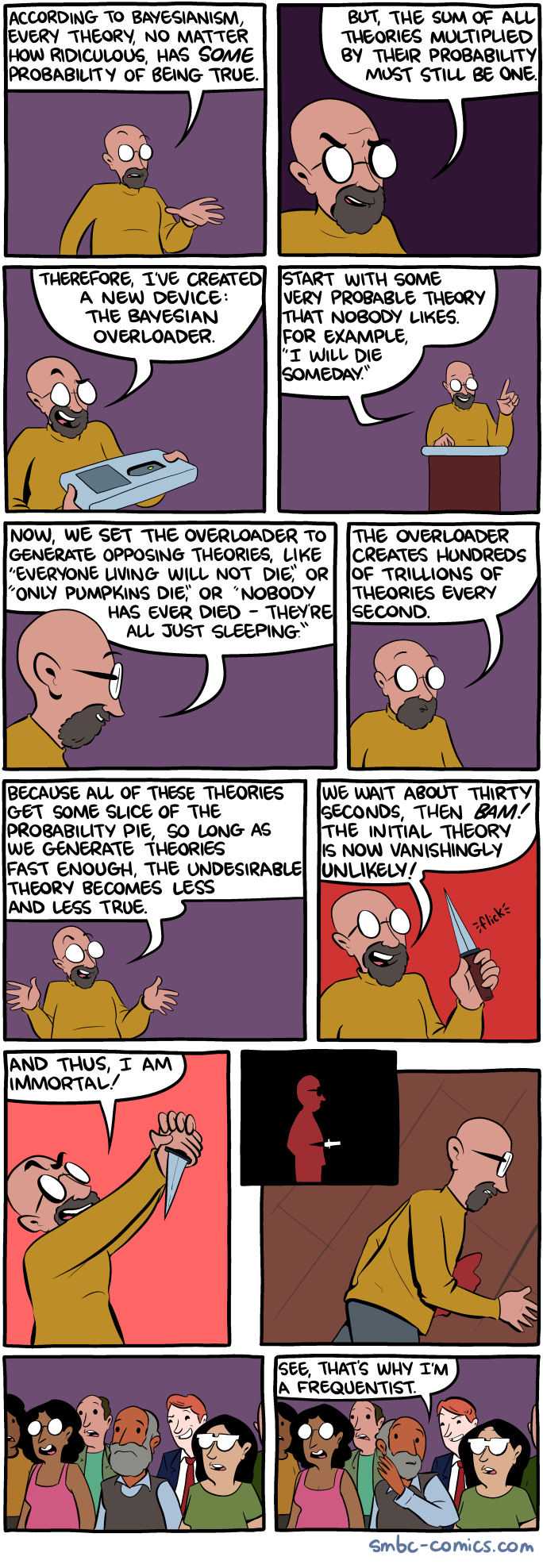
In addition, I think that Caveman agreed with my claim that the sharpshooter fallacy doesn't apply to my logic.
I'm not particularly agreeing with any of your claims, and I wouldn't call what you're doing logic. But under the most lenient interpretation of what you appear to be
trying to argue it indeed doesn't apply. There's no inherent reason why one couldn't make conclusions based on one's own existence anyway. Here's a counterexample I already gave earlier:
Suppose there is an electrical wire which can be either live (L) or not live (~L) with P(L) = P(~L) = 0.5. Let E be "I exist" after having touched the wire and P(E|L) << P(E|~L). Then after having touched it and still finding myself existing I would correctly conclude P(L|E) << P(~L|E).
Other examples, already given multiple times, include "I exist therefor my parents have met" or "I exist therefor the universe supports life". It's not that hard to make up more counterexamples. The notion that you somehow can't conclude things from your own existence because [magic happens] is patently idiotic really.
So you're completely free to ignore that particular objection and/or give a link to this post so that its promoters can account for the counterexamples.
Other objections which you're free to ignore are for example this:
Lets put numbers to it:
Likelihood of your body: .000000000001
Likelihood of soul: .01
Likelihood of Body & Soul: you do the math, it is impossible for that number to be more likely than your body alone.
Or similar ones using that so-called "Conjunction Fallacy" objection, which are trivially refuted by noting that ~H is not a subset of H. Or in words, "you have a body and a soul" is not a subset of "you only have a body". Of course in the case quoted above "soul" (~H) actually
is a subset of "body" (H ∪ ~H) so those first two numbers are impossible in the first place. Ironically they are impossible for the very reason that objection purports to be based on, namely the most simple thing in math since 1 + 1 = 2, that if A ⊆ B then P(A) ≤ P(B).
Because that's all that so-called "Conjuction Fallacy" is, but presented in what must be the most convoluted way, taking advantage of all sorts of linguistic and cultural ambiguities, and completely obscuring the very simple point. Fixing an event A and then enumerating all other events B and comparing the probability of the intersection of A and B with the probability of A is just a convoluted way of fixing an event A and enumerating its subsets and comparing their probability with the probability of A.
Or this objection:
Consciousness is a process, not a countable thing.
and all those other appeals to "(mathematically) countable" or "but it's a process". When pressed they could define neither and started evading the question of definition in pretty much the same way you do.
Like always, the irony completely goes passed them that if we accept their definition of the self as a process (ie a sequence in a state space) and that we are mortal (it's a finite sequence) and that there's a finite number of possible states for a brain (it's a finite state space) then we'd get that the set of potential selves (ie the set of finite sequences in a finite set) is...wait for it...countable!