Plasma Cosmology - Woo or not

And thats whats being disputed, the acceleration of the expansion.

This is like talking to a random word generator.

The current acceleration is yet a third thing, discovered at the end of the 90s, and has nothing whatsoever to do with either early universe inflation, let alone Hubble's observations in the 20s.
 
Zuezzz said:
Yep plenty. I think to clear up your list I need to distinguish between papers that are;

a) relevant and part of plasma cosmologies
b) papers about the the plasma universe
c) standard plasma astrophysics papers
d) Alfven-Klein plasma cosmology

As your list is kinda blurring all four. I'll get back to you on this....
(bold added)

Do you think that will be before or after you have answered the dozens of open questions, dating back almost to its inception, about the material you presented in this thread?
And the answer is ...

... Z will continue to ignore the dozens of questions about the PC material he himself has posted in this thread, and once again try to bluff his way through

... by re-presenting material he has already presented, in many cases more than once, ...

... in the vain hope that everyone else participating in this thread has gone to sleep.
 
Zuezzz
Before you get around to stating what the actual theory of plasma cosmology is, you should consider what it needs to address. The fundamentals are:
  • It needs to resolve Olbers' paradox.
  • Hubble's law.
  • The cosmic microwave background
    • Has to exist.
    • Has to have a temperature of 2.725 K.
    • Must have a perfect black body thermal spectrum.
    • It would be good if the observed power spectrum was matched by the theory.
The pc theory must not exclude the existence of dark matter since the evidence for this is overwhelming. So Peratt's model of galaxy formation is out. But dark matter can be added as in the CDM model.

There are other observations that may need addressing. For example the increase of neutral hydrogen as we look back in time has been measured from the Lyman-alpha forest. Extrapolate this further and the universe is either all neutral hydrogen - no plasma! - or does not have any ionizing sources in it - no galaxies!.

It would be nice to have answers to a couple questions:
  • Why have we not seen no extremely old objects in the universe?
    For example 15 billion year white dwarf stars have not been observed anywhere. There must be a reason why we cannot find them in the Milky Way.
  • Why have we not observed extremely massive objects in the universe?
    For example where are the galaxies that have been mostly (or completely!) absorbed by their central black holes?
 
1. I don't remember what I said before and that it was refuted.

2. Here is the mish mush of ides that I presented before.

3. I can't answer any direct questions. Especially those that require data to support my theories.

4. Here are the problems I will pretend exist for the current theory.


Um Zeuzzz, you have been asked for specific numbers, figures and data to explain the PC model you present.

Here is a simple one:

How do you explain the 'flat rotation curve' of galaxies?

a. We know the masses of the objects involved.
b. We know the velocity of the objects involved.
c. We know what the acceleration of the objects is that can not be provided by gravity-dark matter.
d. We know the magnetic field that the galaxy (our own) appears to have.

What charge then must be on the objects to account for the acceleration of the objects (gravity-dark matter)?

Now Zeuzzz, I asked you these questions about a year ago, you have waffled, you have avoided and not responded!


What evidence indirect or direct do you have for the charge needed to explain the flat rotation curve of galaxies?

Please note:
The answer "We don't know the charge of the sun." Is not an answer!

a. What charge would have to be on the sun if other stars of similar mass are accelerated?
b. What evidence supports that charge?
 
1. I don't remember what I said before and that it was refuted.

The thing is, someone that really doesn't want to be convinced can really never be convinced. Zeuzzz is very much like a 9/11 "truther" - no matter what evidence is presented, he will either ignore it based on some misunderstood detail, or he will shift his position temporarily (until it goes out of the discussion again).

It's not about physics, or learning, or understanding - it's some bizarre plasma fetish.
 
BAC will do this as well.

You rang?

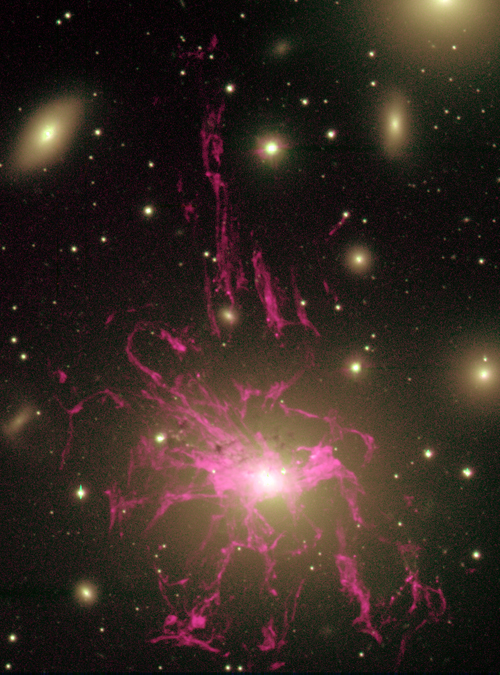
ngc1275_wiyn_big.jpg


:)
 
looks like an alien got smashed on the lense of the Hubble Telescope, like a fly on the windshield of my car.
 
Here is a simple one:

How do you explain the 'flat rotation curve' of galaxies?


By Peratts model, which produces flat rotation curves by the interaction of two plasma filaments. Alfven, or Lerners model of star formation (EM forces > gravity, rather than gravity > EM forces) produces the stars by the magnetic pinch effect of filaments, or from nebulae. Also Meierovich proposed a model for star formation based on the dense plasma focus. All of which are consistent and can account the orbit of stars in Peratts model, rendering a flat roation curve (a few links on these below). I'm sure we've been over this before.

a. We know the masses of the objects involved.


There could even be problems with this based on some of the assumptions in scaling gravity and how we determine mass based on these assumptions. You might want to read my previous post addresssing this, the long post I posted which Sol dismissed as claimed it was all woo, apparently its all "nonsense and some old discredited results" and he said that according to me "there is some vast conspiracy to suppress these results" but when reality check posted a paper which stated the nearly EXACTLY the same things I had pointed out in my post, suddently Sol says that many of the gravitational anomalies in the paper are "quite intriguing". Which just about sums up his closed minded and myopic attitude when confronted with new information.

Here it is again.

In his excellent book on the worrying situation of theoretical physics, Lee Smolin gives an example of the mechanism that leads to such a narrowing of our view: “The possibility - that we are wrong about Newton’s laws, and by extension general relativity - is too scary to contemplate.” (page 15). Indeed.

There are major problems with the applicability of Newtons law of gravitation. This law is the sole reason why cosmology/astronomy is filled with so many unresolved problems, most notably dark matter and dark energy. Rarely are dark matter and dark energy seen as problems with gravity, but that is exactly what they are, entities invoked to try to explain the plethora of objects in space that do not follow the gravitational model of an exclusively attractive field.

There is no definitive law for gravity at all scales. Newtonian gravity is accurately measured and proven with the bounds of the solar system. However, Newtonian gravity remains untested in other areas. All we have is the formula. This formula has been used to determine the mass of the Earth. This is based on the concept that for each mass of M inside the Earth, it exerts an equal attractive force of F. We do not know the valid range for Newtonian gravity. It is assumed, and assumed is the correct word here, that each mass of M exerts the same force of F regardless of where in the universe it may be placed. It is also assumed that each mass of M exerts the same force F whether it lies on the surface of the Earth or whether it be deep inside the Earth. When using the Cavendish balance to determine the mass of the Earth, it is assumed that each particle exerts a fixed force upon all others. This assumption rules out the very real possibility that particles near the surface of a planet might exert a force greater/less than those deep down.

The key to all of our gravity is the mass of the Earth. If the mass of the Earth is wrong, then so are our estimates for those of other bodies. If the mass of the Earth has been overstated, then it follows that the masses of other bodies have also been overstated.


There is however one method that would be able to prove the Newtons law of gravity on a geophysical scale very directly. This would be to take measurements of the gradient of g as you descend into the Earth. Strangely, not much research has been done into measuring this accurately. And the few experiments that have measured it seem to give very different values than Newtons law would predict.

Testing the inverse-square law of gravity on a 465-m tower

Tower gravity experiment - Evidence for non-Newtonian gravity


The data from this was questioned by some, but further evidence for a discrepancy from Newton’s law was found for a deep mine hole.

Gravity in mines - An investigation of Newton's law - hysical Review D (Particles and Fields), Volume 33, Issue 12

Recent history of tower and mine searches for non-Newtonian gravity


And these results have been backed up by further tests in Greenland on the ice sheets.

Test of Newton's inverse-square law in the Greenland ice cap


So from an experimental viewpoint, Newtons law runs into various problems even right here on Earth. Who knows what problems it faces when extrapolated to the large scale constituents of the universe.


Since gravity was related by Einstein to the geometry of space-time (whatever the hell that physically is) gravity has received support from various tests, such as the perihelion of mercury, and others. However, the following quote from a very popular book on astronomy, is quite remarkable:

Galactic dynamics (page 635)

"It is worth remembering that all of the discussion so far has been based on the premise that Newtonian gravity and general relativity are correct on large scales. In fact, there is little or no direct evidence that conventional theories of gravity are correct on scales much larger than a parsec or so. Newtonian gravity works extremely well on scales of ∼ 1014cm (the solar system).
(...) It is principally the elegance of general relativity and its success in solar system tests that lead us to the bold extrapolation that the gravitational interaction has the form GM/r2 on the scales 1021 − 1026cm..."

The above cited 'bold extrapolation' of gravity seems to have encountered problems even in the solar system now, with the pioneer and voyager anomalies, so it seems very naive to presume that gravity functions how we currently model it when applied to much larger scales.

Many tests show that gravity obeys an inverse square law in terms of distance, but little work has been done on observations that test the dependence on the field mass, M. Since mass estimates of the whole universe depend on it, determining the absolute value of G is kinda important. The thing is that they all tend to give different values for G, and whereas other (fundamental) constants in nature achieve an accuracy of over 12 decimal places the value of the gravitational constant lags behind with far greater uncertainty, with only about 3-4 decimal places remaining undisputed by various methods. This indicates that we still have a lot to learn about the true nature of gravity.

A lot of work has been done on determining the value of G. What seems lacking however are test which test the spatial and temporal dependence of G, which can also be used to test Newtons law as well. At the atomic level, although you can work out the ratio of electric and gravitational forces at 2.27x1039 (respectively), this has never been measured as particles this size are too light to be used as field masses. Gravity is amazingly illusive at this small scale, and remains so right up to much larger scales. At the standard laboratory scale the torsion balance is the usual method, done usually over a distance of 10 – 30 cm, which is the method used by originally by cavendish, which has changed very little to this day. One further method is by using a superconducting gravimeter and a moving mass (see http://www.iop.org/EJ/abstract/0957-0233/10/6/311).


And that’s about it from methods of determining G directly. We only have direct confirmation of this law over a very small scale range, from laboratory to geological size, it is presumed from this that it applies exactly to all other scales. Other larger scale methods like satellite based experiment’s to find the value of G, such as LLG, are in fact finding the product MEG, using the mass of the Earth, under the presumption it is correct, and other larger scale estimates use generally use the mass of the sun (inferred from the mass of the Earth) to determine G.


Another interesting way to test gravity would be check the dependency of Newtons law on the amount of field mass in question. Which is an idea lacking much experimental verification too. When M = m (in F=GMm/r2) the law becomes symmetric, but a deviation for large masses would not violate the equivalence principle, at least within its experimental constraints which apply mostly to test masses. It is often claimed that any physical theory has to be linear in the weak-field-limit, but this cannot be definitively proven, mainly due to the amazingly weak nature of gravity making tests for this very hard. We just perform an extrapolation of our mathematical methods, which should be tested. There are plenty of ways to test the r2 term in Newtons law, but testing the exponent 1 on M is much more difficult to prove.

Torsion balance experiments typically use masses in the range 5 – 20 Kg, and this is the mass at which we base our most accurate measurements of G. And this mass range goes up to about 107 Kg with lake experiments to measure gravity (see: Determination of the gravitational constant with a lake experiment.), which achieved results close to laboratory values, but not to such a high degree of accuracy. Generally, the more mass is used the less reliable the value becomes. And when you get to the solar system scale satellite data of planetary orbits can not be used to find the field mass dependence of Newtons law (ie, the exponent of M not equal to 1 in F=GMm/r2) as the same data is used to measure the mass. You can use Keplers law to test the validity of the inverse square relationship, but this can not reveal an exponent of M different from 1. This problem stems from not being able to find independent mass estimates of these larger scale objects (apart from some very crude methods with a very high amount of uncertainty), and so from the mass range of the moon \earth (1023 kg) all the way up to sun, no accurate test for this exists. When dealing with the galactic scale (from 1039 to 1044) you run into the same problem of not having independent mass estimates. And this applies to all scales above the solar system. Solar mass to light ratio measurements for galaxies do not fit the dynamically determined mass, and so dark matter is invented to explain this failure of Newton’s law. And right up on the cosmological scale Newtons law fails, and so dark energy is invoked to explain the anomalies. So over time Newtons law has been patched up with numerous ad hoc solutions, but maybe instead of just assuming these entities exist and can explain away everything we should just consider that the law of gravity is plain wrong when applied to large scales. This is where theories like MOND and others come in. And while MOND presents more problems than it solves (in my opinion), it has been very useful in pointing out another problem with Newtons law, that it is poorly tested for accelerations below 10−10ms−2.


I think that it is highly likely that the hierarchy of structures in the universe, the lab, earth, solar system, galactic, cosmic does not stop at the laws that we use in the solar system but requires a corresponding hierarchy of theories. Inventing new entities and new free parameters to simulations will not be sufficient; this type of approach seems to me to be a modern day version of the epicycles of Ptolemy. Extrapolating theories beyond their true testable scope should be avoided, unless we want to walk down the path of ever more complex theories piled up ontop of each other in an attempt to try to hold on to the basic law underlying them all, this type of approach merits a warning from history.


The amount of research that is done in cosmology based on this unverified extrapolation of gravity over some 14 orders of magnitude is quite a remarkable spectacle.

There are considerable gaps in our knowledge about how gravity functions at large scales. Take a look at this graph for example;


gravityvd8.jpg


Generally objects fall into three groups at different scales. The group on the left are the only area where direct absolute measurements of G are possible, from tiny scales up to geological scales. Everything else on this table, from our satellites up to super-massive black holes are extrapolations of Newtons law that remain to be tested, as even the middle group are testing Keplers law rather than Newtons. For the group on the right, none of them offer any sort of undisputable evidence for Newtons law, without having to invoke quantities such as dark matter or energy. To put it simply, tests of the field mass dependence are entirely determined by only 1-2 independent types of experiments on the small scale. The extrapolation to the other larger objects is assumed.


The interesting thing about Maxwells electromagnetism is that it is not like gravity, it is scale invariant. Gravity has no effect on that atomic scale. But it does on the solar scale. And it is assumed to be the only force that can effect even larger scales. But the sheer amount of large scale objects that do not obey Newtons law by their shape and structure, certainly imply that other forces are at work on the large scale. And now we know that plasma is so pervasive in the universe, something not known when most gravitational models were invented back when they thought that space was a void of empty space, EM forces in plasma are the obvious candidate to explain these objects. As I said before;


I would highly recommend reading about large scale plasma/EM forces Sol, due to this fact. You continually ignore the fact that we are not talking about electro/magnetostatics in neutral gasses, we are referring to these forces in plasmas, where the charges are separated into ions, and EM forces can have long distance interactions. Yes, you can show (and so can I, or anyone else for that matter) that EM forces in a neutral medium can not account for large scale motion of objects, but that’s not applicable to the universe, as the visible universe is 99% plasma, not neutral gas. The properties of plasma are very complex, and are still being investigated to this day, but it is now generally becoming accepted that in plasma EM forces can have long range interactions comparable to gravity.

http://www.ctr4process.org/programs/LSI/2006-Cosmology/EastmanT - Cosmic Agnosticism.pdf


How else can you explain galactic wide magnetic fields?

And I would start with these two publications for detailed descriptions of large scale EM interactions in space plasma and how they function;

Advances in Numerical Modeling of Astrophysical and Space Plasma, A. L. Peratt, APSS 242, 1997 (3.3MB)

Advances in Numerical Modeling of Astrophysical and Space Plasma, Part II Astrophysical Force Laws on the Large Scale. A .L. Peratt, APSS 256, 1998 [Adobe annotated edition]



b. We know the velocity of the objects involved.


Indeed.

d. We know the magnetic field that the galaxy (our own) appears to have.


Which is exactly the same as the field used in Peratts model
. Its called fitting your model to the data. And many scientists are still a bit puzzled as to how the galactic magnetic field can be so large, sinse EM forces are supposed to drop off far quicker than gravity, but magnetic fields often reach from one corner of the galaxy to the other.

What charge then must be on the objects to account for the acceleration of the objects (gravity-dark matter)?


No charge is needed. Peratt, or anyone else, certainly doesn't mention a charge on stars in any of their publications. You could add a large charge on the surface due to a double layer (which is what drives the heliospheric current circuit/solar wind acceleration/coronal heating) but this would generally be cancelled out by the surrounding space.

Maybe a large charge could cause a change in rotation, In fact it most certainly could, but I haven't yet seen this adressed adequately.

What evidence indirect or direct do you have for the charge needed to explain the flat rotation curve of galaxies?


Its largely irrelivant to Peratts model. Simple calulations of eletcro/magnetostatic forces are largely meaningless in plasma anyway. Plasmas separate into cellular structures, and develop into much more complex structures than simple electrostatics laws in gas.

a. What charge would have to be on the sun if other stars of similar mass are accelerated?


You are confusing Peratts model, dealing with the large scale structure of plasma filaments initally forming galaxies, with how stars on an individual basis are maintained in their orbit, which is due to gravity. Most theories say gravity starts galaxy formation (which fits in well with a Big Bang), and then EM forces come second, in PC its the other way around, the plasma filaments start the formation, and due to this attraction the objects get compressed and start to behave gravitationally. See this page on Peratts website, he's well aware that stars, planets and the solar system are dominated by gravity, but EM forces obviously have to dominate on larger scales where gravity stupendously fails to explain the shape and structure of objects (like the one in BAC's pic above, and the link to Peratts website) And his model and the EM plasma forces he uses in his model can account for these enigmatic shapes.

As he says: "But perhaps the most important characteristic of electromagnetism is that it obeys the longest-range force law in the universe. When two or more non-plasma bodies interact gravitationally, their force law varies inversely as the square of the distance between them; 1/4 the pull if they are 2 arbitrary measurement units apart, 1/9 the pull for a distance of 3 units apart, 1/16 the pull for 4 units apart, and so on. When plasmas, say streams of charged particles, interact electromagnetically, their force law varies inversely as the distance between them, 1/2 the pull if they are 2 arbitrary measurement units apart, 1/3 the pull for a distance of 3 units apart, 1/4 the pull for 4 units apart, and so on. So at 4 arbitrary distance units apart, the electromagnetic force is 4 times greater than that of gravitation, relatively speaking, and at 100 units, apart, the electromagnetic force is 100 times that of gravitation. Moreover, the electromagnetic force can be repulsive if the streams in interaction are flowing in opposite directions. Thus immense plasma streams measured in megaparsecs, carrying galaxies and stars, can appear to be falling towards nothing when they are actually repelling."

And in his publications he addresses the formation of stars within the plasma filaments:

Then, as the synchrotron-radiating Birkeland current-conducting outer plasma components move inward on the elliptical core, peculiar galaxies form and in sequence the spiral types Sd, Sc, Sb, and Sa (or their barred equivalents SBd, SBc, SBb, SBa). Stars form first in the densely compressed elliptical core (Population II stars) and then in the pinched plasma that make up the spiral arms (Population I stars). For Sd and Sc galaxies, the axial Birkeland currents are just reaching the Alfven Carlqvist threshold 0.1 X 10 -20 A/m2 (Section VIII) and star formation is irregular. For Sb and Sa galaxies the current is 10 -20 A/m2 and star formation follows closely the morphology of the plasma in the spiral arms that are usually fragmented because of the diocotron instability. The well-known Baade description that stars in spiral arms appear "like beads on a string" is also an equally apropos description for the simulated galaxies. As in the laboratory, Birkeland current sheet filaments, and lumps within the filaments interact with their neighbors to produce the phenomena outlined in this paper. [....] Finally, the pinch effect from the currents carried in the galactic plasmas illustrates the importance of the electromagnetic field in initiating the first stages of dusty plasma collapse into stellisimals, then into stars


For a more info on the formation of stars withing the plasma universe model, which uses the same approach as the galaxy model in that the plasma forces initiate the stars formation which then afterwards becomes dominated by gravity, I suggest the following:

Electromagnetic collapse. Problems of stability, emission of radiation and evolution of a dense pinch

Interstellar clouds and the formation of stars Alfven, H.; Carlqvist, P.

Magnetic Fields and Spiral Structure

Or the more recent version of this paper (2002) Magnetic Fields and Spiral Structure Astrophysics and Space Science Library

And Lerners star/QSO formation Model can also be applied inthis context, with similar results; http://adsabs.harvard.edu/abs/1986LPB.....4..215L

To quote him:

Such filaments act to pinch matter together in turn leads (for large enough filaments) to gravitational instabilities that cause clumps to form along the filaments like beads on a string. These gravitationally-bound clumps, spinning in the magnetic field of the filament, generate electric forces that create a new set of currents moving towards the center of the clump, as in a disk generator. This in turn creates a new set of spiral filaments that set the stage of the coalescence of smaller objects. A hierarchy of structure is thus formed.


b. What evidence supports that charge?


The charge in the double layer? Unrelated to galaxy formation, but the acceleration of the solar wind, the fact the solar wind has stopped completely, the heating of the corona, and the heliospheric current circuit all indicate a considerable charge from a double layer which is producing a glow discharge on the suns surface giving rise to its visible spectra, the glow discharge could possibly even be producing IECF.
 
Last edited:
Thanks Zeuzz, I will read, so what causes the acceleration beyond gravity-DM?

By Peratts model, which produces flat rotation curves by the interaction of two plasma filaments. Alfven, or Lerners model of star formation (EM forces > gravity, rather than gravity > EM forces) produces the stars by the magnetic pinch effect of filaments, or from nebulae. Also Meierovich proposed a model for star formation based on the dense plasma focus. All of which are consistent and can account the orbit of stars in Peratts model, rendering a flat roation curve (a few links on these below). I'm sure we've been over this before.
So are you saying that stars are plasma and are effected by (what) to produce the flat rotation curve?

The Perrat double filament is a formation model isn't it?

Or are you saying that momentum imparted during galaxy formation creates the flat rotation curve.

Plrease elaborate while I read the rest.

So how is the flat rotation curve produced?
 
Last edited:
You are confusing Peratts model, dealing with the large scale structure of plasma filaments initally forming galaxies, with how stars on an individual basis are maintained in their orbit, which is due to gravity.

But gravity isn't strong enough to maintain stars in their orbits without dark matter. Hence if Perratt's model requires gravity to explain stellar orbits, it also requires dark matter.
 
DeiRenDopa said:
Huh?

I thought this thread was about Plasma Cosmology ... am I mistaken?

If not, then can you please provide a consistent, quantitative explanation for the observations (of the dwarf galaxies) that is built from first (plasma physics) principles? Preferably one that is contained in a paper (or three) published in a relevant peer-reviewed journal ...
Bump.

May I - and other readers of this thread - expect an answer from you BAC?

If so, when?
That was back in early July, nearly two months ago now ...

With BAC now back with us, when may I - and other readers of this thread - expect an answer from you BAC?
 
Z said (the bold text in between quotes):

In answer to DD's question ("How do you explain the 'flat rotation curve' of galaxies?"):

"By Peratts model, which produces flat rotation curves by the interaction of two plasma filaments. [...] I'm sure we've been over this before."

And indeed we have, and many of the several dozen open questions to Z are about just this topic! Lather, Wash, Rinse, Repeat.

When may readers expect some answers to those open questions Z?

In response to DD's point ("a) We know the masses of the objects involved"):

"There could even be problems with this based on some of the assumptions in scaling gravity and how we determine mass based on these assumptions. You might want to read my previous post addresssing this, the long post I posted [...]

Here it is again.
"

So you intend to address the many questions and challenges on the points in this post of yours? Unlike last time, when you ignored them?

Forgive me Z, the history of yours posts in this thread, which anyone can see, strongly suggests that you'll continue to ignore anything substantive that anyone writes. Do you mind if I ask how much you get paid to do this kind of trolling?

In response to DD's points/questions ([...]) ...

Well, you get the point: we've been over all this material before Z, if not in other threads then in this.

Your misunderstandings, misrepresentations, lies, delusions, etc have been pointed out, numerous times.

Questions aimed at clarification, elucidation, and so on concerning the material you have posted have been almost universally ignored (by you).

Not so long ago I started to see if I could get you to pay attention to the many unanswered questions, by repeating the posts in which they were asked.

Obviously this approach has been unsuccessful so far.

Shall I try it again?
 
Last edited:
DRD said (post#882 in this thread):
DeiRenDopa said:
Zeuzzz said:
[...]

I am getting through [the open questions], but theres over fifty, and its much quicker to respond to current comments that keep dragging up old ones. I'm just lazy.
Well I guess we all know now, don't we?

Following your logic, those >fifty questions (or some subset) could simply be repeated every time you post to this thread, couldn't they? That would make them "current comments", wouldn't it? And it should be pretty easy to do, simply copy and paste from the posts, which are all conveniently located in a small number of summary posts ...

But maybe it's worth taking a little time to understand how this "viscious [sic] cycle" started?

Here's one attempt: it all began when Z refused to provide a succinct summary of PC; when he finally got around to it, the conclusion "PC is the very definition of woo" became immediately obvious (as I noted, not too long ago). Had the succinct definition been given on page 1 of this thread (as RC requested), by page 2 we'd have been pretty much done ... or at least getting deep into a discussion of the many, mutually inconsistent PC mechanisms to explain the Hubble relationship.

Of course, as any reader of this thread can quickly verify, Z's posting behaviour was anything but helpful, in terms of addressing the questions in the OP ... lengthy post followed by lengthy post and more and more, with nary a concern about the content of any response to such posts.

In short, the burden you now have Z is one entirely of your own making.
There's good news :jaw-dropp

Z did actually post a succinct summary of PC, at last.

There's even better news :eye-poppi

Z's succinct summary makes it crystal clear that PC is non-science, and therefore woo.

However, then came the bad news: Z ignored questions and challenges concerning this non-science nature of PC, and returned to his usual behaviour of posting great gobs of material.

Ah well; time to repeat the content of the posts on the non-science nature of PC?
 
Last edited:
But gravity isn't strong enough to maintain stars in their orbits without dark matter. Hence if Perratt's model requires gravity to explain stellar orbits, it also requires dark matter.

What the........?

Which orbits do you refer to?

Binary orbits? No need for all powerful dark matter.........

Galactic orbits? No need for all powerful dark matter within a certain galactic radius............
 
Tubbythin: But gravity isn't strong enough to maintain stars in their orbits without dark matter. Hence if Perratt's model requires gravity to explain stellar orbits, it also requires dark matter.

Wangler: What the........?

Which orbits do you refer to?

Binary orbits? No need for all powerful dark matter.........

Galactic orbits? No need for all powerful dark matter within a certain galactic radius............


Which "galactic radius" would that be, Wangler? And how would Peratt's model explain the orbits of stars, around the galactic nucleus, beyond that radius (sans DM)?
 
By Peratts model, which produces flat rotation curves by the interaction of two plasma filaments. Alfven, or Lerners model of star formation (EM forces > gravity, rather than gravity > EM forces) produces the stars by the magnetic pinch effect of filaments, or from nebulae. Also Meierovich proposed a model for star formation based on the dense plasma focus. All of which are consistent and can account the orbit of stars in Peratts model, rendering a flat roation curve (a few links on these below). I'm sure we've been over this before.
You seem to have forgotten that Peratts model of galaxy formation has already been totally debunked in the thread:

  • He totally ignores gravity.
  • He compares plasma distribution maps with optical photos of galaxies, i.e. a map of mass against a map of hot stars.
  • No signs of the enormous galactic sized plasma filaments with enough energy to spin galaxies (but strangely not enough to produce any radiation at all).
It is also strange that there is no sign that he has run his computer model again with better simulation software since 1986.

Perhaps you have evidence of the galactic plasma filaments that are spinning the Milky Way?
 
What the........?

Which orbits do you refer to?

Binary orbits? No need for all powerful dark matter.........

Galactic orbits? No need for all powerful dark matter within a certain galactic radius............

Galactic orbits. Unless I've completely misunderstood what Zeuzzz was saying (not beyond the realms of possibility...).
 
DRD said (post#882 in this thread):There's good news :jaw-dropp

Z did actually post a succinct summary of PC, at last.

There's even better news :eye-poppi

Z's succinct summary makes it crystal clear that PC is non-science, and therefore woo.


Reason why my summary "makes it crystal clear that PC is non-science, and therefore woo" please? Typical Nereid, just say its so. Do you know the difference between a cosmological framework (the Big BAng for exmaple) and the specific scientific theories formed within this framework? I tried to define this and relate it the term plasma cosmology, but no-one seemed to notice it, they just said "thankyou for confiming that PC is woo", with no real accompanying reason.

Lets have a go at this approach of supposition without evidence.

You can now presume that all the questions are answered. I'll answer them in a year or so.

God, that was easy.

However, then came the bad news: Z ignored questions and challenges concerning this non-science nature of PC, and returned to his usual behaviour of posting great gobs of material.


As yes, the ever sucessful tactic of dismissing information because someone posts a lot of it. Brilliant!

I suppose that I can also dismiss the mass of material written for the Big Bang because there are great gobs of material about that.

Which "unanswered questions" do you regard as the most pertinent?
 

Back
Top Bottom