• Quick note - the problem with Youtube videos not embedding on the forum appears to have been fixed, thanks to ZiprHead. If you do still see problems let me know.

Photon Energy

Easily. I already told you: the field is changing with time in a periodic manner. This is an oscillating field, so it has a frequency of how fast the field is changing, but it is not a displacement. You keep trying to picture the photon in terms of a massive particle rather than a field, but that's not what it is.

What property of the field is changing?
 
Some people talk about photons having "relativistic mass", which is nonzero but is NOT constant for all photons. But relativistic mass is redundant with energy, and it's a pointless concept which isn't used anymore. Rest mass (or invariant mass) is the only mass one ever needs to use, and it's zero for photons. As previously indicated, relativity allows for non-zero momentum even for massless particles. The equation given above is usually written as E2=m2c4+p2c2. Putting in a zero for m still gives you p=E/c.

Thanks.

This is the bit I don’t get how can something without mass have momentum? Is it merely stipulated?

I have an idea why rest mass is zero for a photon but I don’t want to derail this at the moment.
 
What property of the field is changing?

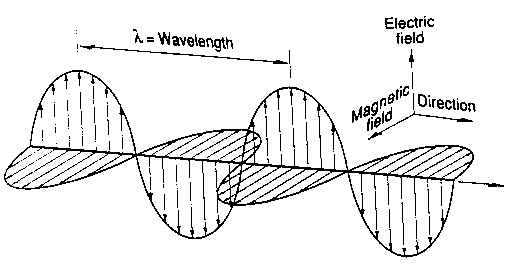
Its amplitude and/or its direction. But remember: we're talking about the field at a fixed point. There's no displacement involved. It's hard to visualize without drawing arrows to represent the field at each point, as in this picture:
e_mag.gif

and it can be tempting to think of those arrows as being a displacement, but they are not. They represent the field at a point. The field at the point changes, but the point doesn't move.
 
Which could be explained by massive particles hitting an object.

Could be, but isn't. People have done experiments to search for a mass for photons, and they always come up empty. You don't need mass to have momentum - it's not intuitive, but the math works out beautifully, and experiments all seem to confirm it.
 
Which could be explained by massive particles hitting an object.

It could also be explained by invisible elves blowing into the sail, but neither of those explanations is relevant. The only relevant explanation is the conservation of momentum.
 
This is the bit I don’t get how can something without mass have momentum? Is it merely stipulated?

No, it's not merely "stipulated". It follows immediately from fundamental principles (Lorentz invariance, for example) and it's also measured experimentally with extreme accuracy.

Think of it like this. Take a massive particle, and accelerate it by imparting a certain total amount of energy. The more energy you give it, the faster it will end up going, but as the energy gets very large the speed will simply approach c, the speed of light.

At speeds close to the speed of light the momentum is no longer given by mass times velocity. That would approach a maximum m*c, which is not what experiments observe. Instead, the momentum continues to grow as you add more and more energy, and for speeds close to the speed of light the momentum is given by a formula that gets close and closer to p=E/c. The same formula works perfectly for photons.

If you don't like that you can try to think of the momentum of a photon as zero times infinity, where zero is the rest mass and the infinity is related to the amount of energy you'd need to accelerate something of finite mass to the speed of light. That's a distasteful (and rather confusing) way to say it, but it might make clear why the momentum doesn't have to be zero.

 
Last edited:
Its amplitude and/or its direction. But remember: we're talking about the field at a fixed point. There's no displacement involved. It's hard to visualize without drawing arrows to represent the field at each point, as in this picture:
[qimg]http://www.geo.mtu.edu/rs/back/spectrum/e_mag.gif[/qimg]
and it can be tempting to think of those arrows as being a displacement, but they are not. They represent the field at a point. The field at the point changes, but the point doesn't move.

It is damn tempting I can tell you, it is also damn tempting to consider that to be a visual representation of two streams of photon particles travelling as waves and interfering with each other as they collide. But maybe that is just me.

So the field has a property which is amplitude and a property which is direction but this does not relate to a spatial displacement is that correct? Why do we use the terms amplitude and direction if no displacement is involved?
 
Could be, but isn't. People have done experiments to search for a mass for photons, and they always come up empty.

Yet you agree the mass could be greater than zero? The link I gave above defines a limit which is very small but it doesn’t prove the mass is 0.

You don't need mass to have momentum - it's not intuitive, but the math works out beautifully, and experiments all seem to confirm it.

What experiments confirm it? Is there anything else with a zero mass that has momentum?

The maths does work I agree but it also works for a non-zero ‘relativistic mass’ but a zero rest mass.
 
It could also be explained by invisible elves blowing into the sail, but neither of those explanations is relevant.

Yes absolutely I am aware this idea is practically not falsifiable hence I was asking for observations that contradict it. I think you can model the photoelectric effect, the double slit experiment, light interference and light diffraction if you assume this to be true. Consider it a thought experiment.

The only relevant explanation is the conservation of momentum.

Again agreed and on that note I have a couple of questions:

1) Consider De Broglie’s hypothesis that every moving particle has a wave why can’t this be interpreted as an electron, to use his original example, actually moves in a wave? Do we ‘know’ how electrons move?
2) Neutrinos change flavour as they travel how is momentum conserved?
 
Yet you agree the mass could be greater than zero?

It is zero in our theories Our theories could, in principle, be wrong. I have confidence in our theories, but there is no absolute disproof. Nor can there be. But the upper limits on any possible mass (which experiments can provide) are amazingly small.

What experiments confirm it?

As mentioned above, experiments can only set an upper bound for the mass. Here is one such experiment.

Is there anything else with a zero mass that has momentum?

gluons (excitations in the strong force field) are massless, and if they exist, gravitons should be as well. Neutrinos were once suspected to be massless, but experiments have shown that they do have mass.

The maths does work I agree but it also works for a non-zero ‘relativistic mass’ but a zero rest mass.

Rest mass is the only mass that matters. Relativistic mass is an outdated and thoroughly useless concept, and is mathematically redundant with energy. It was introduced to maintain a superficial similarity between some relativistic mechanics equations and their Newtonian counterparts, but that doesn't work for all of them anyways, and there's really no reason or need to try to maintain that superficial similarity. Modern relativity texts frequently don't even introduce it, because it leads to confusion more often than enlightenment.
 
No, it's not merely "stipulated". It follows immediately from fundamental principles (Lorentz invariance, for example) and it's also measured experimentally with extreme accuracy.

Think of it like this. Take a massive particle, and accelerate it by imparting a certain total amount of energy. The more energy you give it, the faster it will end up going, but as the energy gets very large the speed will simply approach c, the speed of light.

At speeds close to the speed of light the momentum is no longer given by mass times velocity. That would approach a maximum m*c, which is not what experiments observe. Instead, the momentum continues to grow as you add more and more energy, and for speeds close to the speed of light the momentum is given by a formula that gets close and closer to p=E/c. The same formula works perfectly for photons.

If you don't like that you can try to think of the momentum of a photon as zero times infinity, where zero is the rest mass and the infinity is related to the amount of energy you'd need to accelerate something of finite mass to the speed of light. That's a distasteful (and rather confusing) way to say it, but it might make clear why the momentum doesn't have to be zero.

I am not multiplying anything by infinity, isn’t this bizarre enough? :)

Ok so we know photons have momentum, all the experiments work and we know QM is the most rigorously tested theory we have. So now we have the problem of how an object can have momentum but no rest mass yet all the equations work. Or to put it another way why doesn’t

p = mv

work for a photon?

Again thought experiment time. Consider rest mass to be the amount of energy released as photons when a mass is ‘converted’ into energy:

E = mc2
(The energy is proportional to c2 as the photons travel in a sphere at c from the mass, an area effect)

For a photon this would be 0 as they couldn’t be ‘converted’ into energy they are energy. So

E2 = (mc2) 2 + (pc) 2
Can be read as

ETotal = Efrom converting into photons + Efrom momentum

For a photon:

ETotal = 0 + Efrom momentum

I don't think this idea invalidates anything you have written above but I am sure someone will point out my error soon enough.
 
1) Consider De Broglie’s hypothesis that every moving particle has a wave why can’t this be interpreted as an electron, to use his original example, actually moves in a wave? Do we ‘know’ how electrons move?

Electrons do move as waves. But what oscillates is NOT the position of the electron, but its phase. Unlike for a photon, there is no classical quantity to describe the phase of an electron: it is a purely quantum property. Even for a massive particle like an electron, the picture of sideways oscillations is wrong. In other words, assigning the photon a nonzero rest mass wouldn't make your original picture any more accurate.
 
Ok so we know photons have momentum, all the experiments work and we know QM is the most rigorously tested theory we have. So now we have the problem of how an object can have momentum but no rest mass yet all the equations work. Or to put it another way why doesn’t

p = mv

work for a photon?

But p=mv doesn't work for anything, as I just explained in detail. It's approximately correct only when v<<c, which is not true for a photon.

Again thought experiment time.

I don't understand what you're trying to say there - sorry.
 
It is damn tempting I can tell you, it is also damn tempting to consider that to be a visual representation of two streams of photon particles travelling as waves and interfering with each other as they collide. But maybe that is just me.

So the field has a property which is amplitude and a property which is direction but this does not relate to a spatial displacement is that correct? Why do we use the terms amplitude and direction if no displacement is involved?
Beacause fields have an amplitude and direction.
Displacement is not the only thing that can have an amplitude .
Displacement is not the only thing that can have a direction.
 
Yet you agree the mass could be greater than zero? The link I gave above defines a limit which is very small but it doesn’t prove the mass is 0.


What experiments confirm it? Is there anything else with a zero mass that has momentum?

The maths does work I agree but it also works for a non-zero ‘relativistic mass’ but a zero rest mass.
There are no experiments I know of that have measured a zero mass for light. But the upper limit is extremely small, e.g. see What is the mass of a photon?
The gluon also has no mass (according to quantum field theory).
 
There are no experiments I know of that have measured a zero mass for light. But the upper limit is extremely small, e.g. see What is the mass of a photon?
The gluon also has no mass (according to quantum field theory).

The only particle which one knows for sure is massless is the graviton. You can add a tiny mass for the photon without violating either experimental or theoretical consistency, and same goes for the gluon (although in both cases the mass must be extraordinarily and unnaturally small). The reason is that the limit where mass goes to zero is smooth, i.e. the results for the theory with very small mass are very close to the results for the theory with zero mass.

This, however, does not hold for gravity. The angle through which light is lensed by a massive object is not a smooth function of the graviton's mass, and that makes it possible to rule out anything other than zero mass (at least for the simplest and most obvious way to add one).
 
Yes absolutely I am aware this idea is practically not falsifiable hence I was asking for observations that contradict it. I think you can model the photoelectric effect, the double slit experiment, light interference and light diffraction if you assume this to be true. Consider it a thought experiment.

Ok, can you define such a “thought experiment”, as Zig has noted actual experiments have failed to show any rest mass for the photon (within the limits of those experimets)


Again agreed and on that note I have a couple of questions:

1) Consider De Broglie’s hypothesis that every moving particle has a wave why can’t this be interpreted as an electron, to use his original example, actually moves in a wave? Do we ‘know’ how electrons move?

The wave is a quantum wave function relating to the complex probability amplitude of finding the electron in some particular state.

The best description we have for how an electron travels is the path integral.

2) Neutrinos change flavour as they travel how is momentum conserved?

Well, as the Neutrino oscillations in flavor are currently modeled as oscillations of varing mass and flavor states, the momentum would be maintained by those combined states, if I’m getting it correctly.
 
Last edited:
Yes absolutely I am aware this idea is practically not falsifiable hence I was asking for observations that contradict it. I think you can model the photoelectric effect, the double slit experiment, light interference and light diffraction if you assume this to be true. Consider it a thought experiment.
It is not a thought experiment just the idea of photons being a "very small mass that travels in a wave like manner where all the waves have an equal peak-to-peak amplitude".

Double-slit experiment (in fact any slit experiment): How do photon "waves" fit through slits smaller then their amplitude?

What about radio waves and their large wavelength (and so presumably amplitude of mass oscillation). How do they get detected by aerials that are much smaller?
Especially consider the extremely low frequency radio waves with wavelengths of 100,000 km – 10,000 km.
 

Back
Top Bottom