Thermal
August Member

Probably a good sign.Not understanding you.

Probably a good sign.Not understanding you.

 www.itspronouncedmetrosexual.com
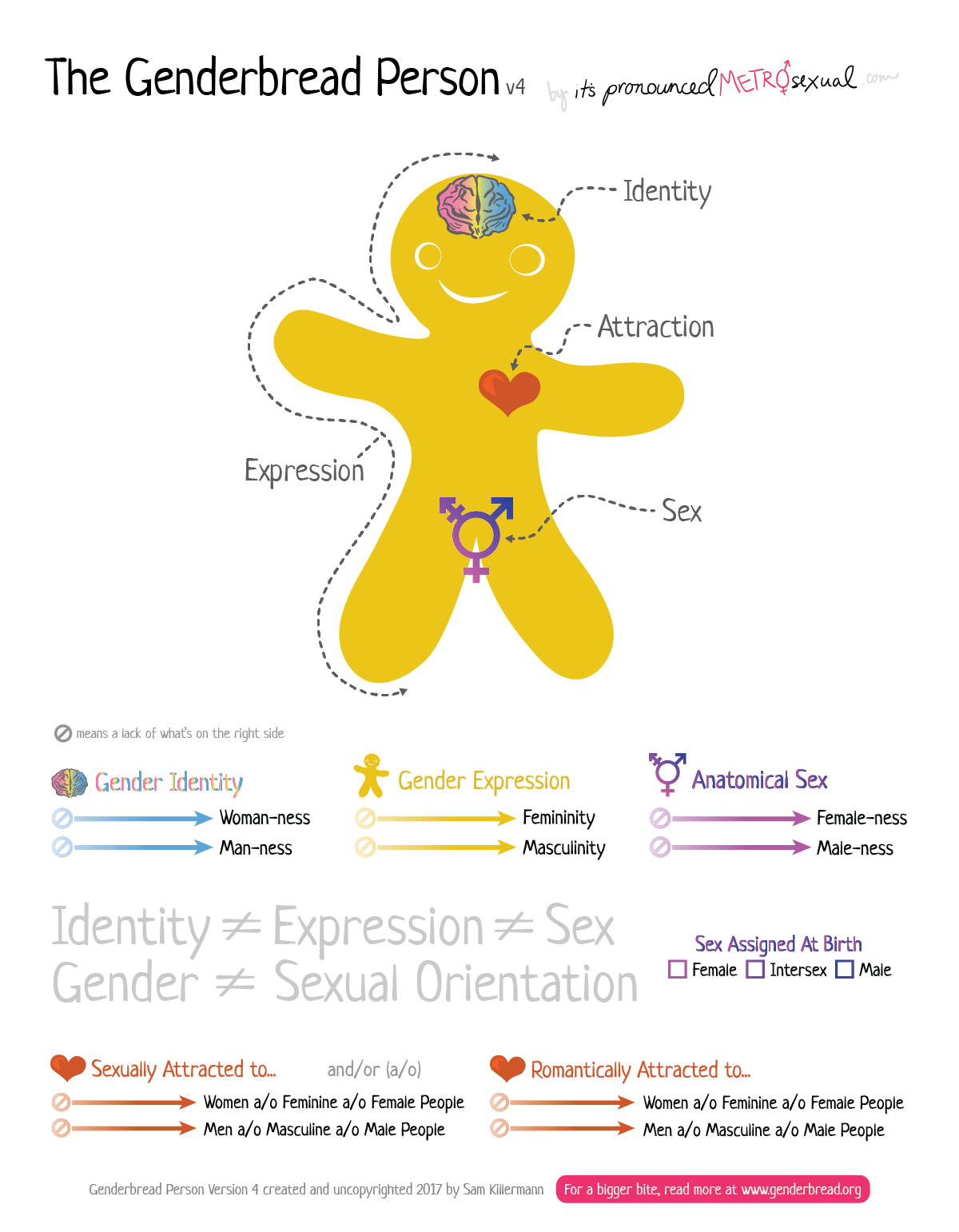
I'd personally have 'attraction' sitting a little lower...The Genderbread Person.
The Genderbread Person version 4 - ❤ It's Pronounced Metrosexual
For 2018 and beyond, my fourth take on this tasty little introduction to understanding gender.

I'm not sure gender identity (however defined) falls in that category, since it doesn't seem like a form of subjective perceptual experience....what other qualia should we speculate about?
If another person's gender identity is not their own experience, what is it?I'm not sure gender identity (however defined) falls in that category, since it doesn't seem like a form of subjective perceptual experience.
I'm unsure whether it is even based on qualia.
Not all experiences are qualitative characteristics of sensations.If another person's gender identity is not their own experience, what is it?
The Gender UnicornThe Genderbread Person.
The Genderbread Person version 4 - ❤ It's Pronounced Metrosexual
For 2018 and beyond, my fourth take on this tasty little introduction to understanding gender.

 transstudent.org

Why does it have three sexes instead of two?The Genderbread Person.
The Genderbread Person version 4 - ❤ It's Pronounced Metrosexual
For 2018 and beyond, my fourth take on this tasty little introduction to understanding gender.
I see we're still not doing "sex observed at birth".The Gender Unicorn
Gender Unicorn -
Note: There is an interactive version of the Gender Unicorn that is only visible on desktop. English Coloring Book (English) Español (Spanish) Português (Portuguese) ру́сский язы́к (Russian) 日本語 (Japanese) Deutsch (German) Français (French) italiano (Italian) ภาษาไทย (Thai) Türkçe (Turkish)...
Mostly I shared it for the explanatory notes, e.g.These charts seem to make things even more confusing.
I don't have an internal sense of being male. I have an internal sense of being me.Mostly I shared it for the explanatory notes, e.g.
Gender Identity: One’s internal sense of being male, female, neither of these, both, or another gender(s). Everyone has a gender identity, including you.
(Emphasis mine)
It's that last bit that I'm being skeptical about at the moment.
Not even sure I have that, without checking in the mirror.I don't have an internal sense of being male. I have an internal sense of being me.

Perhaps you are not "neurotypical"? We often assume that other people's internal private behaviours are the same as ours. It could be that you do lack one of the internal behaviours that most of us have.Mostly I shared it for the explanatory notes, e.g.
Gender Identity: One’s internal sense of being male, female, neither of these, both, or another gender(s).Everyone has a gender identity, including you.
It's that last bit that I'm being skeptical about at the moment; I know what it is like to feel hungry, dizzy, hot, cold, etc. but I've little idea what it is like to feel manly, womanly, neitherly, bothly, or otherly.
Does sound as if you have different internal behaviours to what most* other folk have.Not even sure I have that, without checking in the mirror.
(Too much sci-fi in my media diet.)
As I said, I can think of plenty of "internal senses" which I have in common with others, such as the experience of hunger, nausea, body temperature, bladder or bowel urgency, orientation relative to gravity, or proprioception. I don't know if we all experience these things in the same way, but I'm pretty sure we're all talking about the same things when we talk about them. When I wake up in the morning, I can feel different than baseline comfortable in any of those ways, but none of them are gendered or sexed.We often assume that other people's internal private behaviours are the same as ours.
I'm more comfortable in athletic shorts than a drop-waist skirt, but this is where we have to be careful to keep "gender identity" and "gender expression" separate, according to the genderbreadists. Can I get some non-expressive examples of either social gender?does your sense of "me" match for example the social gender of "man"?
Do other people wake up and not check their tattoos to be sure they are in the same body?Does sound as if you have different internal behaviours...

I'd say they are useful for defining the relevant terminology, since they are designed to be broadly accessible rather than scholarly.These charts aren't explaining anything.
"Everyone has a gender identity, even you" isn't a lay translation of a scholarly principle. It's an ideological claim.I'd say they are useful for defining the relevant terminology, since they are designed to be broadly accessible rather than scholarly.
If it really is as simple as "gender identity is what you believe you are, regardless of your genitalia", that's at least a solid jumping off point?"Everyone has a gender identity, even you" isn't a lay translation of a scholarly principle. It's an ideological claim.