• Quick note - the problem with Youtube videos not embedding on the forum appears to have been fixed, thanks to ZiprHead. If you do still see problems let me know.

On Consciousness

Is consciousness physical or metaphysical?


  • Total voters
    94
  • Poll closed .
Status
Not open for further replies.
That depends, define consciousness, and don't be vague.

BTW: I believe that computers may be conscious someday, not at this time.

For me consciousness is synonymous with my "I". It is a word with a unique meaning for every person.
We cannot objectively know what it's like to be someone else(another "I" ) and so any attempt to generalise a definition of consciousness is next to useless since it immediately misses the point. There are as many consciousness's as there are people. It's like trying to define my mom objectively so that I can tell when I see her. I don't do this and you don't either. My recognition of my mom is my consciousness because the meaning of my mom is part of my consciousness only. Not some objective category.

Everything "I" perceive is part of my consciousness and a computer is as conscious as I am conscious of it.
 
For me consciousness is synonymous with my "I". It is a word with a unique meaning for every person.
We cannot objectively know what it's like to be someone else(another "I" ) and so any attempt to generalise a definition of consciousness is next to useless since it immediately misses the point.
Non-sequitur.
 
For me consciousness is synonymous with my "I". It is a word with a unique meaning for every person.
We cannot objectively know what it's like to be someone else(another "I" ) and so any attempt to generalise a definition of consciousness is next to useless since it immediately misses the point. There are as many consciousness's as there are people. It's like trying to define my mom objectively so that I can tell when I see her. I don't do this and you don't either. My recognition of my mom is my consciousness because the meaning of my mom is part of my consciousness only. Not some objective category.

Everything "I" perceive is part of my consciousness and a computer is as conscious as I am conscious of it.
So you have an idiomatic expression that does not communicate anything other than your opinion.

Please don't go into neurology. this is not the R&P forums. So I call you out on this, you have no actual basis for your definition other than an opinion.

I can substitute any words to make the fallacy of your statement shown as sophistry

I can use body or rock and it shows your sophistry as it is.

So please remove yourself to the philosophy forum.

"We cannot objectively know what it's like to be someone else(another "I" ) and so any attempt to generalise a definition of body is next to useless since it immediately misses the point. There are as many body's as there are people. It's like trying to define my mom objectively so that I can tell when I see her. I don't do this and you don't either. My recognition of my mom is my body because the meaning of my mom is part of my body only. Not some objective category."

The problem is this !Kaggen, and I expect you to ignore it unfortunately, 'consciousness' is a reification of a verb, there is no such thing (object) as 'consciousness' it is like 'fast', it has meaning only in action, not state.

So if you insist in treating 'consciousness' as a noun as opposed to what it is, a behavior, then you are engaged in a category error and a fallacy of construction.

Now personally i would really like to discuss this point with you, and I will be patient.
 
“Scientists, animated by the purpose of proving they are purposeless, constitute an interesting subject for study.” Alfred North Whitehead
 
So you have an idiomatic expression that does not communicate anything other than your opinion.

Please don't go into neurology. this is not the R&P forums. So I call you out on this, you have no actual basis for your definition other than an opinion.

I can substitute any words to make the fallacy of your statement shown as sophistry

I can use body or rock and it shows your sophistry as it is.

So please remove yourself to the philosophy forum.

"We cannot objectively know what it's like to be someone else(another "I" ) and so any attempt to generalise a definition of body is next to useless since it immediately misses the point. There are as many body's as there are people. It's like trying to define my mom objectively so that I can tell when I see her. I don't do this and you don't either. My recognition of my mom is my body because the meaning of my mom is part of my body only. Not some objective category."

The problem is this !Kaggen, and I expect you to ignore it unfortunately, 'consciousness' is a reification of a verb, there is no such thing (object) as 'consciousness' it is like 'fast', it has meaning only in action, not state.

So if you insist in treating 'consciousness' as a noun as opposed to what it is, a behavior, then you are engaged in a category error and a fallacy of construction.

Now personally i would really like to discuss this point with you, and I will be patient.

DD, whether you like it or not words have a history and we cannot ignore this even when we want to be scientific.

consciousness
1630s, "internal knowledge," from conscious + -ness. Meaning "state of being aware" is from 1746.
http://www.etymonline.com/index.php?term=consciousness&allowed_in_frame=0

conscious
c.1600, "knowing, privy to," from L. conscius "knowing, aware," from conscire (see conscience); probably a loan-translation of Gk. syneidos. A word adopted from the Latin poets and much mocked at first. Sense of "active and awake" is from 1837.
http://www.etymonline.com/index.php?term=conscious&allowed_in_frame=0

ness
word-forming element denoting action, quality, or state, attached to an adjective or past participle to form an abstract noun, from O.E. -nes(s), from West Germanic *in-assu- (cf. O.S. -nissi, M.Du. -nisse, Du. -nis, O.H.G. -nissa, Ger. -nis, Goth. -inassus), from *-in-, noun stem, + *-assu-, abstract noun suffix, probably from the same root as L. -tudo (see -tude).
http://www.etymonline.com/index.php?term=-ness&allowed_in_frame=0

conscience
early 13c., from O.Fr. conscience "conscience, innermost thoughts, desires, intentions; feelings" (12c.), from L. conscientia "knowledge within oneself, sense of right, a moral sense," from conscientem (nom. consciens), prp. of conscire "be (mutually) aware," from com- "with," or "thoroughly" (see com-) + scire "to know" (see science). Probably a loan-translation of Gk. syneidesis, lit. "with-knowledge." Sometimes nativized in O.E./M.E. as inwit. Russian also uses a loan-translation, so-vest, "conscience," lit. "with-knowledge."
http://www.etymonline.com/index.php?term=conscience

knowledge
early 12c., cnawlece "acknowledgment of a superior, honor, worship;" for first element see know. Second element obscure, perhaps from Scandinavian and cognate with the -lock "action, process," found in wedlock. Meaning "capacity for knowing, understanding; familiarity; fact of knowing" is late 14c. Sense of "an organized body of facts or teachings" is from c.1400, as is that of "sexual intercourse." Also a verb in Middle English, knoulechen "acknowledge" (c.1200), later "find out about; recognize," and "to have sexual intercourse with" (c.1300).
http://www.etymonline.com/index.php?term=knowledge&allowed_in_frame=0

know
O.E. cnawan (class VII strong verb; past tense cneow, pp. cnawen), "to know, perceive; acknowledge, declare," from P.Gmc. *knew- (cf. O.H.G. bi-chnaan, ir-chnaan "to know"), from PIE root *gno- "to know" (cf. O.Pers. xšnasatiy "he shall know;" O.C.S. znati, Rus. znat "to know;" L. gnoscere; Gk. *gno-, as in gignoskein; Skt. jna- "know"). Once widespread in Germanic, this form is now retained only in English, where however it has widespread application, covering meanings that require two or more verbs in other languages (e.g. Ger. wissen, kennen, erkennen and in part können; Fr. connaître, savoir; L. novisse, cognoscere; O.C.S. znaja, vemi). The Anglo-Saxons used two distinct words for this, witan (see wit) and cnawan.
http://www.etymonline.com/index.php?term=know&allowed_in_frame=0

e·go
   [ee-goh, eg-oh] Show IPA
noun, plural e·gos.
1.
the “I” or self of any person; a person as thinking, feeling, and willing, and distinguishing itself from the selves of others and from objects of its thought.
http://dictionary.reference.com/browse/ego

con·scious·ness
   [kon-shuhs-nis] Show IPA
noun
1.
the state of being conscious; awareness of one's own existence, sensations, thoughts, surroundings, etc.
http://dictionary.reference.com/browse/consciousness


So no you cannot substitute any words for consciousness other than "I" because it has a specific meaning.
The state or quality of self/inner knowledge which makes consciousness a noun.

Even the dictionary agrees with me as regards your question as to a definition of consciousness.

Now whether the word is useful or not is another question.
If you want to convince people that computers have the quality of self-knowledge then it probably is not a useful definition.
If you want to tell someone about your inner thoughts and emotions then it is a useful definition.

My point is you cannot just hijack a noun with a historical meaning and turn it into a verb with a different meaning just because you want a useful word and expect those that find the historical meaning useful to sit back and loose our vocabulary.
Make up your own bloody word and call it what you like and give it whatever meaning you like.
 
Last edited:
DD, whether you like it or not words have a history and we cannot ignore this even when we want to be scientific.


http://www.etymonline.com/index.php?term=consciousness&allowed_in_frame=0


http://www.etymonline.com/index.php?term=conscious&allowed_in_frame=0


http://www.etymonline.com/index.php?term=-ness&allowed_in_frame=0


http://www.etymonline.com/index.php?term=conscience


http://www.etymonline.com/index.php?term=knowledge&allowed_in_frame=0


http://www.etymonline.com/index.php?term=know&allowed_in_frame=0

http://dictionary.reference.com/browse/ego

http://dictionary.reference.com/browse/consciousness


So no you cannot substitute any words for consciousness other than "I" because it has a specific meaning.
The state or quality of self/inner knowledge which makes consciousness a noun.

Even the dictionary agrees with me as regards your question as to a definition of consciousness.
And again, we are in the science forums, your definition would not be useful in an emergency department or a surgery at all, nor will it help in assessing neurological events and damage.

Congratulations, you have never proven that consciousness is a useful definition, just like 'human races'.
Now whether the word is useful or not is another question.
This is the Science, Medicine and Technology forums, not the 'Antiquated Vague Issues Concerning Language' forum.

And you have avoided the actual point.
If you want to convince people that computers have the quality of self-knowledge then it probably is not a useful definition.
And apparently you don't actually read my posts for content, false dichotomy and strawmen alert!
If you want to tell someone about your inner thoughts and emotions then it is a useful definition.
No it isn't, it is the same kind of muddle headed thinking that leads to neofreudian talk therapy instead of cognitive behavioral science.
My point is you cannot just hijack a noun with a historical meaning and turn it into a verb with a different meaning just because you want a useful word and expect those that find the historical meaning useful to sit back and loose our vocabulary.
Just because 'humors' used to be used in medicine and had a consistent usage, doesn't mean the should be discussed in modern treatment modalities, now doesn't it?
Make up your own bloody word and call it what you like and give it whatever meaning you like.

take your sophistry and pander in some other forum.

Meanwhile i am using the same term they use in the emergency departments and neurology offices.

I am disappointed you engage in further sophistry, rather than discussion.
 
It's a stretch because it doesn't work - as Feynman discovered.

So,

I'm not allowed to challenge Feynman ?
Because he's a brilliant scientist and I'm just some old dork on the intrawebs who dabbled (pretty hard dabbling) with novel psychoactive compounds?

I have mega-respect for Feynman.
I believe he'd love to hear my hypothesis.
He was the pinnacle of open minded and creative.
 
Hang in there, !Kaggen.

This is a philosophy discussion.
Why it landed here is baffling to me.

And why the uber-geeks need to be nasty about it is even more disturbing.
 
I'm not allowed to challenge Feynman ?
Because he's a brilliant scientist and I'm just some old dork on the intrawebs who dabbled (pretty hard dabbling) with novel psychoactive compounds?

By all means, challenge away. I believe Feynman found it hard to account for the matter - antimatter asymmetry with that model, so that might be something to address.

I have mega-respect for Feynman.
I believe he'd love to hear my hypothesis.
He was the pinnacle of open minded and creative.
Sadly, we can only guess what Feynman would have thought of your theory...
 
By all means, challenge away. I believe Feynman found it hard to account for the matter - antimatter asymmetry with that model, so that might be something to address.


Sadly, we can only guess what Feynman would have thought of your theory...

For one thing, he would have noted that I called it an hypothesis.
 
Exactly what is it about consciousness that makes people uncomfortable with the idea that it's a form of data processing a man-made machine could do?

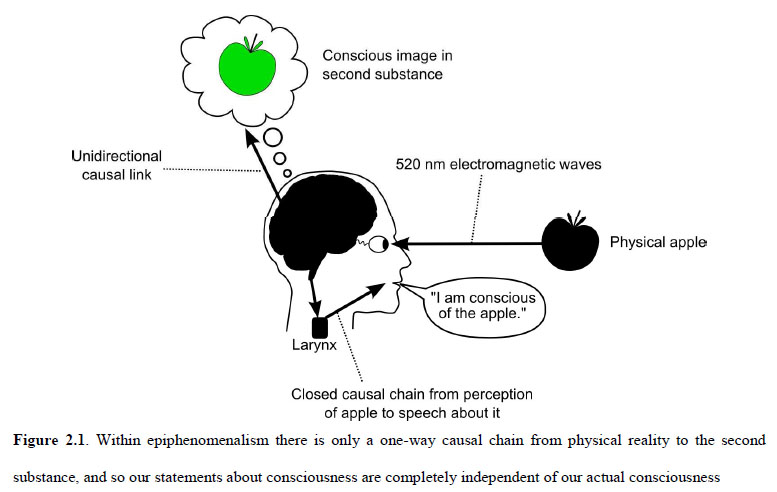
Exactly why is it that people tend to feel more comfortable with pseudo-scientific, second-substance (below) hypotheses for consciousness, like dark matter, quantum mechanics, carbon, and electromagnetic columns?

Why do we argue for hypotheses that make us feel comfortable, rather than those with some supporting evidence? Comfort can be quite delusional.

From David Gamez's THE DEVELOPMENT AND ANALYSIS OF CONSCIOUS MACHINES:

67364f8ca50f6f542.jpg
 
My recognition of my mom is my consciousness because the meaning of my mom is part of my consciousness only. Not some objective category.

Your mom is different to you than to anyone else because we all have different associations with her, if any. Also, she has special meaning for you because of being YOUR mom. Your brain has, do doubt, instinctive mom wiring which make her special to you, but still like how other people view their own moms. It's not that hard to reduce it to neural wiring. I assume the idea that your view of your mom is reducible to wiring of neurons, and neurotransmitters and hormones that can be drawn in cold schematic diagrams, is offensive, because your mom is important and special to you. However, there's evidence that importance and specialness is also due to wiring and hormones reducible to schematics.

You have a set of unique associations with your mom that no one else has. No pseudo-science is required.

It's like this explanation from Dennett about what happens uniquely in one person's mind while looking at a painting (1:35)

 
Last edited:
Hang in there, !Kaggen.

This is a philosophy discussion.
Why it landed here is baffling to me.

And why the uber-geeks need to be nasty about it is even more disturbing.

I am not an uber-geek nor am I nasty. This is not the R&P section, despite people who want to use antique notions , the definition of consciousness in medicine is widely used and widely recognized. Vague and fuzzy 'because I say so' definitions are equal to concepts like the 'soul', 'humors' and 'race'.

They are harmful, unhelpful and idiomatic to the point of being foolish.

There are plenty of meandering discussions of consciousness in the R&P forum.

If people want to be all fuzzy minded and make silly statements, I won't challenge them there.
 
Exactly what is it about consciousness that makes people uncomfortable with the idea that it's a form of data processing a man-made machine could do?

Exactly why is it that people tend to feel more comfortable with pseudo-scientific, second-substance (below) hypotheses for consciousness, like dark matter, quantum mechanics, carbon, and electromagnetic columns?

Why do we argue for hypotheses that make us feel comfortable, rather than those with some supporting evidence? Comfort can be quite delusional.


That’s amusing. You’re always throwing these stupid insults around…that anyone who challenges your assertions is somehow emotionally juvenile. Not surprisingly, the evidence supports the exact opposite conclusion. Consciousness is a singularly unique phenomena by every measure of the word and it encompasses a vast range of conditions that, at this point, science has absolutely zero explanation for. What’s that word that applies to someone who constantly insists answers exist that do not?

D e l u s i o n a l

Your mom is different to you than to anyone else because we all have different associations with her, if any. Also, she has special meaning for you because of being YOUR mom. Your brain has, do doubt, instinctive mom wiring which make her special to you, but still like how other people view their own moms. It's not that hard to reduce it to neural wiring. I assume the idea that your view of your mom is reducible to wiring of neurons, and neurotransmitters and hormones that can be drawn in cold schematic diagrams, is offensive, because your mom is important and special to you. However, there's evidence that importance and specialness is also due to wiring and hormones reducible to schematics.

You have a set of unique associations with your mom that no one else has. No pseudo-science is required.


…but apparently lots of pseudo-science is required cause you never stop heaping it on.

The reason your proposition is offensive is not because of your gobble-de-gook, it’s offensive because no one has come within a million light years of producing a scientific explanation of what, how, and why ‘mom’ exists for any person on this planet. What do you think, that Chomsky was joking when he said our understanding of human nature is thin?

…but blast away with your meaningless assertions. It’s all reducible to this, that, and the other…basically a steaming heap of reductionist materialism that does a great job of concealing the unavoidable fact that you can’t prove a single thing. Must be comforting though…to believe you’ve got it all figured out…when the facts come to the exact opposite conclusion.

Consider these two quotes…both produced by individuals with a singular insight into the condition known as human consciousness:

Destruction is finding being in matter

Whereof one cannot speak, thereof one must be silent.


Draw me a schematic that can explain them.

…. the definition of consciousness in medicine is widely used and widely recognized.


…and, as has been pointed out in this thread and many of the others that you refer to… there does not exist any one definition, let alone a definitive one. There are quite a range of interpretations…and virtually all acknowledge the simple fact that they exist as a consequence of necessity, not understanding.
 
Last edited:
So,

I'm not allowed to challenge Feynman ?
Because he's a brilliant scientist and I'm just some old dork on the intrawebs who dabbled (pretty hard dabbling) with novel psychoactive compounds?

I have mega-respect for Feynman.
I believe he'd love to hear my hypothesis.
He was the pinnacle of open minded and creative.

Check out Feynman's Nobel lecture:
http://www.nobelprize.org/nobel_prizes/physics/laureates/1965/feynman-lecture.html
As a by-product of this same view, I received a telephone call one day at the graduate college at Princeton from Professor Wheeler, in which he said, "Feynman, I know why all electrons have the same charge and the same mass" "Why?" "Because, they are all the same electron!" And, then he explained on the telephone, "suppose that the world lines which we were ordinarily considering before in time and space—instead of only going up in time were a tremendous knot, and then, when we cut through the knot, by the plane corresponding to a fixed time, we would see many, many world lines and that would represent many electrons, except for one thing. If in one section this is an ordinary electron world line, in the section in which it reversed itself and is coming back from the future we have the wrong sign to the proper time—to the proper four velocities—and that's equivalent to changing the sign of the charge, and, therefore, that part of a path would act like a positron." "But, Professor", I said, "there aren't as many positrons as electrons." "Well, maybe they are hidden in the protons or something", he said.
 
the facts come to the exact opposite conclusion

What facts come to the opposite conclusion? Would you please post the facts or the links here? That's what this thread is for. I love being proven I'm wrong. Then I learn.

Show us the facts.

Thanks in advance!
 
I am not an uber-geek nor am I nasty. This is not the R&P section, despite people who want to use antique notions , the definition of consciousness in medicine is widely used and widely recognized. Vague and fuzzy 'because I say so' definitions are equal to concepts like the 'soul', 'humors' and 'race'.

They are harmful, unhelpful and idiomatic to the point of being foolish.

There are plenty of meandering discussions of consciousness in the R&P forum.

If people want to be all fuzzy minded and make silly statements, I won't challenge them there.

Maybe a wee bit nasty?
 
That’s amusing. You’re always throwing these stupid insults around…that anyone who challenges your assertions is somehow emotionally juvenile. Not surprisingly, the evidence supports the exact opposite conclusion. Consciousness is a singularly unique phenomena by every measure of the word and it encompasses a vast range of conditions that, at this point, science has absolutely zero explanation for.
Name one.
 
Status
Not open for further replies.

Back
Top Bottom