
BasqueArch
Graduate Poster

- Joined
- Jan 11, 2009
- Messages
- 1,871
Yepper.Nope.
Will disagrees with you. My money is with Will.Correct. He was out of whack at the time. He chose to perform his calcs in a way that was innapropriate.
True. Will did say your actual trace data was superior to NIST's. It's not mathematics though, it's mining accurate data from video. I don't know if this is true.Not quite. He estimated coefficients for a Poly10 curve fit, ignoring region of interest, which given that the NIST T0 is a full second before that resulted in the early moments being massively skewed by early behaviour of the poly fit...which should have been cropped. Poly10 fit was a very old smoothing method used simply to show trend. Such has very little bearing on the accuracy of the actual trace data, which Will has freely stated is superior to that of NIST.
Will and Myriad disagree with you. My money is with Will and Myriad.You're talking about a curve fit I didn't perform, using innapropriate time range, not the accuracy of "my data". Will even highlights the T0 difference, but still chose to start earlier. Tsk, tsk. Sorry. Try again.
That’s what Will began with and you didn’t disagree.Not my paramaters.
?NIST's stage 1 profile is pants.
And your stage 1 profile is what … knee high stockings?
I don’t know where this came from. Accompanying text? Is this graphic-mined?If you want another viewpoint, other than mine, as you clearly have issues there, how about tfk...

Doesn't seem to resemble the NIST acceleration profile determined by deriving their function for velocity...
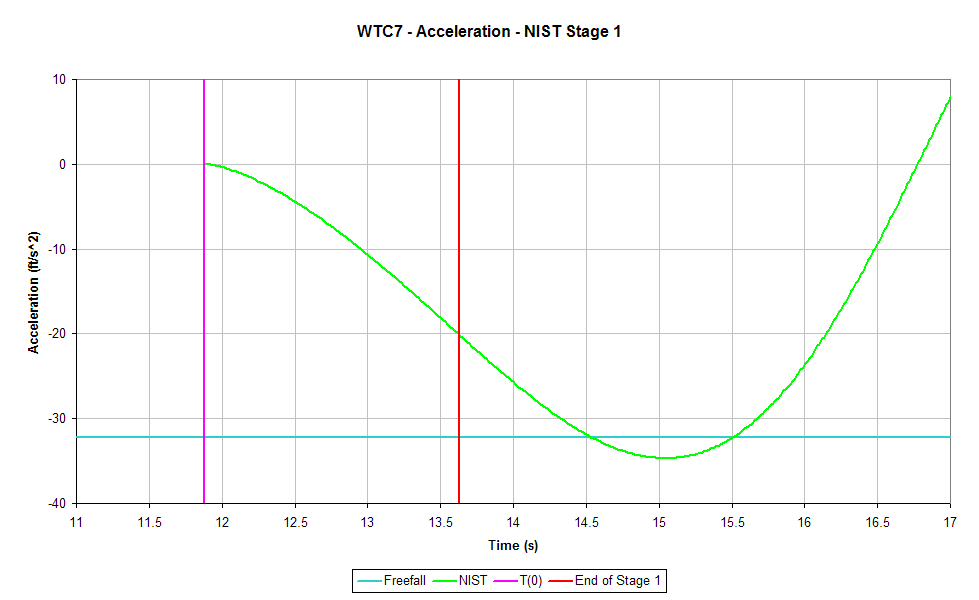
Oh, what a quandary
No mistake then, intentional or memory loss explains these obstinate errors.LOL. I wrote much of it
It's pretty clear you haven't looked at this in much detail. Simultaneous ? Er, no. "Kink" is not a good word to use in this context.
Umm… ok, I can change, how about “flexure”.The building experienced flexure, lesser of course, for years prior to descent without columns "falling down".
“Erroneous, video shows NIST NE wall fall simultaneous with flexure.”
Also please notify MT, you and him have got me all confused.
MT repeatedly refers to "the kink."
Flexure due to wind was very small, this collapsing flexure was much greater, as MT insists, the result of a collapsing building, a matter of degree. Don’t blame you though. Not being an architect or structural engineer it would be difficult for you to tell the difference. Two aspirin, headache gone- 1000 aspirin, dead as a door nail.
It’s the only explanation for those who don’t know what’s going on.Must be magic
Sure I can, or rather others could. You left out data margin of error position, time calculations, compounded by position with time and its MOE graphing bands. Even greater for acceleration lines. This would tell you what data outliers to reasonably discard and whether or not >FFA was achieved.You're not going to get data of higher quality than I have provided.
Ok.For additional information, look at the comparison between the velocity profiles (with the NIST T0 shifted 1s as appropriate)...

I knew that. I stated it so. Why are you confused?And, of course, make sure you remember that the NW corner is not a wandering position nearish the East side of the louvers.
No Mr Bond, I expect you ....Were you expecting them to behave in exactly the same way ?
No. NIST’s measure near column 44 was at the beginning of the collapse, with different dynamic loading than at the end of the core collapse at the NW column. I don’t expect you could recognize this structural engineering difference, though.
Last edited:


 ):
):