• Security incident: ISF was recently accessed by intruders. Please change your password, and change it anywhere else you used it. Read more

NASA Engineer (ret.) is a Twoofie?

I state my reasons for being skeptical, and therefore find justified in being more deliberate in the critical thinking process.

Yes, each and every one in turn has, easily, been shown to be baseless and you haven’t modified or retracted a single one of these erroneous reasons.

These are not the actions of a sceptic let alone a time served NASA Engineer. They are the actions of your common garden truther. I think we all were expecting far more from you. In fact, for some time, I have been struggling with the notion that we are talking to a NASA Engineer at all.

What I see you all doing is arguing why my reasons for being skeptical are not valid.

And that in itself should ring alarm bells for you. The reason why we are doing this is that your posts are so barren of any interesting, substantive technical fact that that is all that is left to do.

After reading your various arguments, I find my skepticism did not diminish.

Frankly, at this point I am neither surprised nor do I care.

Now, as I proceed further with my critical thinking, let me remind everyone, I only ask for a new independent investigation. Is that too much to ask?

Again, whatever it is you are doing it is not critical thinking.

You believe a new “independent” investigation is necessary based on your probability sum and the reasons you gave? Your feeling? What? (and no I’m not doing another topic hop whilst you continue to leave your previous claims just laying there)

Look here’s WhatYaDo: Present your reasons for wanting a new “independent” investigation to the US judiciary, an academic institution, a Journalist or two, a veracious and ambitious young lawyer, write a paper outlining your objections and get it reviewed. Someone with your credentials should be able to make enough waves and provide a solid argument for it.

If you haven’t already done so, why not? Go for it!

I feel though, that I should warn you up front that if you use the same arguments that you have here you should be prepared to be laughed at. Copiously.

I am asking for no more than the Colorado Democratic Party asks. They have adopted, as part of their party platform, the following statement:

"Whereas many disturbing facts were consciously ignored by the 9/11 Commission; Be it resolved, therefore, that the CDP calls for the establishment of a truly independent Grand Jury and public investigation into these and other anomalies in order to find the truth of the September 11, 2001 attacks, so that we have a greater probability of preventing attacks of this nature in the future."

Annnnnnnnd the next erroneous statement.
Will you retract this one? I’m not holding my breath!

Woof!
 
Now, as I proceed further with my critical thinking, let me remind everyone, I only ask for a new independent investigation. Is that too much to ask?
.
It is when you refuse to define "independent" and explain how you, personally, are going to finance it.

What? You don't intend to personally finance it?

Can you explain in *rational* terms why anyone else should, when it's *your personal choice* not to believe the results of the many investigations that have been done?
.
 
Taking outright distortions about the events, such as distortion about airfones, your propagation of the standard truther lies about the BTS data, your mistaken assertion regarding controllability, etc. and asserting the need for review. Review or a new investigation would be warranted if the points you bring up are correct.

Although you express these three topics in confrontational language, the simple matter is the public should be able to get information on these through a simple inquiry, possibly through a Freedom of Information Act (FOIA) request. However, generally, the government agencies have stonewalled nearly all FOIA requests related to 9/11.

Airfones on AA77
Considerable discussion has gone on involving David Ray Griffin and Rob Balsamo (Pilots for 9/11 Truth) on the one side, and a number of JREF regulars on the other. Why should we have to infer, playing like detectives, whether or not airfones (or air phones) were installed (AND OPERATIONAL) on AA Flight 77, Sept. 11, 2001? Even if they were installed and operational (rather than NOT, as some paperwork from AA suggests), there should be records of calls placed through that system. Such records, if they exist, have not been made available to the public. A new investigation, with subpoena power, would bring all this into the light. Why argue against it?


Questions about the BTS (Bureau of Transportation Statistics) data
Maybe a different set of players, but the ending is the same: A new investigation, with subpoena power, would bring all this into the light. Why argue against it?

Assertions regarding controllability
The question of controllability, not to say anything about information on the possibility a novice pilot could perform this difficult flying task, really is not something that can be proven definitively. All kinds of information on the airplane’s aerodynamic characteristics would have to be made available. Boeing does not place this kind of information in the public domain, if for no other reason than to protect whatever competitive advantage they may have. Equally important is detailed information on the flight control system. What the FCS does when it is well beyond its design conditions is a complete unknown to the public. Only Boeing knows the answer to that.

This part comes down to the same ending as above: A new investigation, with subpoena power, would bring all this into the light. Why argue against it?
 
Although you express these three topics in confrontational language, the simple matter is the public should be able to get information on these through a simple inquiry, possibly through a Freedom of Information Act (FOIA) request. However, generally, the government agencies have stonewalled nearly all FOIA requests related to 9/11.

Bald assertion fallacy. Go talk to John Farmer or Mike Williams about that. Sometimes you get some push-back on an FOIA, sure, but your assertion that they've "stonewalled nearly all FOIA requests" is no more accurate than any of your other ludicrous claims.

Airfones on AA77
Considerable discussion has gone on involving David Ray Griffin and Rob Balsamo (Pilots for 9/11 Truth) on the one side, and a number of JREF regulars reality on the other. Why should we have to infer, playing like detectives, whether or not airfones (or air phones) were installed (AND OPERATIONAL) on AA Flight 77, Sept. 11, 2001? Even if they were installed and operational (rather than NOT, as some paperwork from AA suggests), there should be records of calls placed through that system. Such records, if they exist, have not been made available to the public. A new investigation, with subpoena power, would bring all this into the light. Why argue against it?

Fixed that for you. There is no question about whether they were installed and operational, and no one even doubted it except for you lot making up rumors. No evidence has ever appeared to support your wild ideas -- except for the time Cap'n Bob and company tried to forge maintenance records, and were caught doing it.

The Airfone records exist, have been made available, and were presented to you in this very thread. Who did you think you were going to fool with these lies?

Questions about the BTS (Bureau of Transportation Statistics) data
Maybe a different set of players, but the ending is the same: A new investigation, with subpoena power, would bring all this into the light. Why argue against it?

Bring what into the light? You made up some wild claims with no evidence in support whatsoever. You'll excuse me if I don't feel like starting a national inquiry just to confirm that you have nothing.

Assertions regarding controllability
The question of controllability, not to say anything about information on the possibility a novice pilot could perform this difficult flying task, really is not something that can be proven definitively. All kinds of information on the airplane’s aerodynamic characteristics would have to be made available. Boeing does not place this kind of information in the public domain, if for no other reason than to protect whatever competitive advantage they may have. Equally important is detailed information on the flight control system. What the FCS does when it is well beyond its design conditions is a complete unknown to the public. Only Boeing knows the answer to that.

My bold added.

So in this thread your story has changed from "one in a thousand" to "nobody can know if it's possible or not."

And you're still wrong. We've showed you examples in this very thread of similar aircraft surviving and remaining controllable at higher speeds, and at lower altitudes. You've been made aware of past experiments using untrained pilots in simulators. The proof has already been provided.

Why do you even bother asking for a "new investigation?" The stuff you're asking for is right there in front of you, yet you refuse to acknowledge it.

This part comes down to the same ending as above: A new investigation, with subpoena power, would bring all this into the light. Why argue against it?

So start your own already. Nobody is stopping you. I'll bet you haven't filed a single FOIA request of your own, have you? Ahhhh, that's why you lied at the beginning of your post, begging the question by asserting it would only be "stonewalled" if you tried.

Let's be honest: You don't even want a new investigation. What you want, like all other deniers and conspiracy theorists, is to maintain the illusion of doubt. Only sustained doubt allows you to pretend you could miraculously turn out to be right about something.

Prove me wrong. Show me your willingness to investigate. Otherwise, I'm afraid your actions, or lack thereof, speak louder than your words.
 
So in this thread your story has changed from "one in a thousand" to "nobody can know if it's possible or not."

No, my story has not changed. If it is possible, but extremely unlikely, the “one in a thousand” is a way of indicating that. What I am saying is no one can prove how unlikely it is, particularly someone who doesn’t have access to proprietary data from Boeing.

Now, since I am arguing it is much closer to “one in a thousand,” certainly, than it is to “a thousand in a thousand,” which you are maintaining, I will say one more thing. No one in charge of designing this whole operation would go into it with a “one in a thousand” probability of it being successful. Therefore, the master planner(s) would have taken steps to make sure the operation had a high likelihood of being successful. Most importantly, they would not have relied on novice pilots to carry out such a difficult flying task.

And you're still wrong. We've showed you examples in this very thread of similar aircraft surviving and remaining controllable at higher speeds, and at lower altitudes. You've been made aware of past experiments using untrained pilots in simulators. The proof has already been provided.

"Untrained pilots in simulators?" Absolutely not proof of anything. The simulators have not been validated as being accurate at 100 Knots above the design dive speed. Being controllable in general is not the same thing as being controllable enough to perform this difficult task, and the task in terms of visual cues as well as motion (g loads, vibration, etc.), are not suitable to assess this task. And finally, there has not been data published that would enable an independent person to assess the performance of these untrained pilots in the simulator.
 
Now, since I am arguing it is much closer to “one in a thousand,” certainly, than it is to “a thousand in a thousand,” which you are maintaining, I will say one more thing. No one in charge of designing this whole operation would go into it with a “one in a thousand” probability of it being successful. Therefore, the master planner(s) would have taken steps to make sure the operation had a high likelihood of being successful. Most importantly, they would not have relied on novice pilots to carry out such a difficult flying task.

And this is where the debunking argument will be made that the task was not that difficult, that all the pilots had to do was crash into the target, not land.
 
No, my story has not changed. If it is possible, but extremely unlikely, the “one in a thousand” is a way of indicating that. What I am saying is no one can prove how unlikely it is, particularly someone who doesn’t have access to proprietary data from Boeing.
Fact, four terrorist pilots flew 4 Boeing jets into three buildings and the ground. Reality based possibility of flying jets into buildings, into planned targets, 75 percent on 911. This is based on events, a real number after the fact. The chance of terrorists hitting a building when the passengers decide to take the plane back is zero percent, based on events. The chance of hitting buildings when the terrorists have the element of surprise, is by event, 3 events, 100 percent.

Pilots for truth followers and their leader Balsamo claim they can't hit buildings in the safety of a simulator. I flew kids in simulators with no experience in flying they hit targets equal in size to the WTC towers with ease, first time.

As for proprietary data from Boeing, don't need it. Flight 175 was clearly seen going 510 knots and no problems were noted, and no major maneuvering was done, the plane was flown at less than normal accelerations experienced during regular commercial flights.

Zero fancy flying on 911, the closest to aerobatics was Flight 93, when the terrorist pilot pulled excessive Gs and crashed upside down at -41 degrees pitch, about 142 degrees of roll. Crashed on purpose to avoid being stopped by passengers.

Now, since I am arguing it is much closer to “one in a thousand,” certainly, than it is to “a thousand in a thousand,” which you are maintaining, I will say one more thing. No one in charge of designing this whole operation would go into it with a “one in a thousand” probability of it being successful. Therefore, the master planner(s) would have taken steps to make sure the operation had a high likelihood of being successful. Most importantly, they would not have relied on novice pilots to carry out such a difficult flying task.
It is easy to hit buildings in the Boeing 767/757, they handle very well. Have you flown a 757/767? You are making claims based on blind opinion. You have offered no data or evidence to support your made up numbers. You posted implied nonsense about handing qualities and never backed your BS with facts and evidence.

Based on flying Boeing Jets and simulators at NASA, I would have picked 767/757 to fly. Have you flown a Boeing Jet?, I have? Have you flown a jet over Vmo as I have, or my fellow USAF pilots have? Got any experience to go with you numbers made up without data, based on your opinion?

Data, reality evidence shows Flt 175 doing what you say is not possible, one in a thousand. How does it feel to ignore the fact you have been shown wrong by events?


"Untrained pilots in simulators?" Absolutely not proof of anything. The simulators have not been validated as being accurate at 100 Knots above the design dive speed. Being controllable in general is not the same thing as being controllable enough to perform this difficult task, and the task in terms of visual cues as well as motion (g loads, vibration, etc.), are not suitable to assess this task. And finally, there has not been data published that would enable an independent person to assess the performance of these untrained pilots in the simulator.
Untrained pilots in simulators, proves anyone can hit a building, and crash a jet. It proves a lot. Flying is easy for some people, they find it boring, like driving a bus. Playing in clouds at 600 knots and pulling 7 Gs I found, not so boring.

How do you know the simulator is not validated over Vmo? How many jets on 911 were over certified speeds?

The terrorist pilots were not untrained, they were certified pilots by the FAA. The kids I flew in simulators were not trained and they hit targets as small as the WTC towers. It is easier to fly the real jet than the simulator; flown either?

Only one plane on 911 was over Vmo or Vd for more than 20 seconds that hit a building. No hard flying tasks on 911. Anyone who says there were hard flying tasks on 911 for the terrorists is making up nonsense, a lie.

Flight 11, only at dive speed, very much a valid possible speed. Proved as 11 impacted the WTC.

Flight 77, only over Vmo for 20 seconds! How can you miss a 900 foot wide profile? Explain how you would miss the Pentagon? The only pilots in the world who can't hit the Pentagon, the Pilots for truth; this is the only claim I agree with made by p4t.

Please explain the hard task? What was so hard about aiming at a target the width of a runway and hitting it at any angle you happen to hit it at; unlike landing when you have to be precisely lined up with the landing centerline. Hitting a building does not require a line up, you just hit it. Do you understand why hitting a building is 360 times easier than landing on a runway? If not go rent a plane, an instructor and learn.

Fact, I have flown a Boeing jet at 500 feet MSL over Vmo and the plane handled better, flew straight and had no vibration, no flutter, and no problem controlling. Fact, a fellow pilot was chasing me to catch up on a JCS directed mission and he exceed Vmo by a lot, the only problem he encountered; he lost skin on some honeycomb under the leading edge, a small strip became de-laminated.

What does Boeing say about flight above Vmo? I have presented that information, and they make no claims of impossible.

What happen to all your evidence and supporting data for your claims?
 
I will say one more thing. No one in charge of designing this whole operation would go into it with a “one in a thousand” probability of it being successful. Therefore, the master planner(s) would have taken steps to make sure the operation had a high likelihood of being successful. Most importantly, they would not have relied on novice pilots to carry out such a difficult flying task.

You have an unusual understanding of what the terrorists behind this attack consider a success. I am sure that hijacking the planes alone made this operation a great success in their eyes. Even if they had missed one of the towers, putting down the plane somewhere else in New York City would have been almost as effective.

I am certain that they would have been and were more than pleased that they could find even a novice pilot to hijack the plane and commit suicide.
 
No, my story has not changed. If it is possible, but extremely unlikely, the “one in a thousand” is a way of indicating that. What I am saying is no one can prove how unlikely it is, particularly someone who doesn’t have access to proprietary data from Boeing.

I don't know why you bothered writing that. It doesn't hurt my position. It hurts yours.

Assuming you were correct, what you've just done is confirmed that your claim -- that piloting a Boeing 767 at those speeds and altitudes is difficult to impossible -- is sheer speculation. It's your objection, not mine. So with that objection mooted by lack of data, we look to other evidence to formulate our conclusion.

The evidence overwhelmingly says the aircraft in question was UA 175, a Boeing 767, with a poor but trained and licensed terrorist pilot at the controls. You've provided no evidence to the contrary. Now you state that even your speculative concern cannot be evaluated, because it involves proprietary information not available to you.

Too bad. That means you have absolutely nothing at all.

Now, since I am arguing it is much closer to “one in a thousand,” certainly, than it is to “a thousand in a thousand,” which you are maintaining, I will say one more thing. No one in charge of designing this whole operation would go into it with a “one in a thousand” probability of it being successful. Therefore, the master planner(s) would have taken steps to make sure the operation had a high likelihood of being successful. Most importantly, they would not have relied on novice pilots to carry out such a difficult flying task.

Again, this hurts your argument, not mine. If there were a mysterious conspiracy "master planner" -- I invite you to clarify whom you think was to blame, but I know already you won't -- then They wouldn't have flown the aircraft quite so fast. Very, very simple. There would be no "modified" planes, no trickery, nothing! Logan's Law applies here.

What you've done above is an Argument to Motive logical fallacy. It's more interesting than your ordinary Argument to probability, but it's stilll completely invalid.

Terrorists, on the other hand, accept an extremely high failure rate. I'm on record stating that had I somehow been one of the highjackers I wouldn't have flown that fast either, but compared to the other risks they incurred, this hardly merits a second thought.

"Untrained pilots in simulators?" Absolutely not proof of anything. The simulators have not been validated as being accurate at 100 Knots above the design dive speed. Being controllable in general is not the same thing as being controllable enough to perform this difficult task, and the task in terms of visual cues as well as motion (g loads, vibration, etc.), are not suitable to assess this task. And finally, there has not been data published that would enable an independent person to assess the performance of these untrained pilots in the simulator.

Again, this doesn't help you. If we accept your drivel above (a Special Pleading logical fallacy) and the experiment I mentioned were to be neglected, then we still have a large amount of evidence that the aircraft was UA 175, flown at those speeds, with a highjacker at the controls.

There's no credible alternative.

There's no evidence to the contrary.

There's only one guy, that's you, complaining that it doesn't seem right. Complain all you want. Without evidence that something else happened, your complaints are worse than meaningless. They don't make evidence against you go away. They don't change reality. All they do is reveal your own prejudice.

Finally, you didn't answer my question above: How many FOIA's have you filed? What were the results? I'm betting you haven't even tried. And if that's the case, you have no business clamoring for a "new investigation." If you can't be bothered, no one else should be either.

Your replies are really quite unresponsive. If you have anything to say, the next thing I want to see from you is one of the following:

1. Some evidence that the aircraft was not UA 175, or

2. How many FOIA's you've filed, and their results.​

Fair enough?
 
I flew kids in simulators with no experience in flying they hit targets equal in size to the WTC towers with ease, first time.

Beachnut,

Restricting this to the question of lateral control, other than kids being more experienced in video games, how is it that a task requiring a faster reaction time is so easy?

To illustrate, I have compared two lateral piloting tasks, the first is flying towards the tower at 587 MPH, and the second is towards a runway at the landing speed of 175 MPH. For the first of these, the included angle is 7 deg. at 2 sec. out. For the second of these, the plane would be 4.8 sec. out for the same included angle. A figure to illustrate is at:

http://gallery.me.com/dwain769#100051/Closure-to-target-20time&bgcolor=black

The landing situation has more than twice the time to correct an offset error than the tower strike situation.
 
Beachnut,

Restricting this to the question of lateral control, other than kids being more experienced in video games, how is it that a task requiring a faster reaction time is so easy?
There is no faster reaction time required, you are making up bogus examples that make no sense.

To illustrate, I have compared two lateral piloting tasks, the first is flying towards the tower at 587 MPH, and the second is towards a runway at the landing speed of 175 MPH. For the first of these, the included angle is 7 deg. at 2 sec. out. For the second of these, the plane would be 4.8 sec. out for the same included angle. A figure to illustrate is at:

http://gallery.me.com/dwain769#100051/Closure-to-target-20time&bgcolor=black
This is nonsense. That is not how to fly, it is backward.

The landing situation has more than twice the time to correct an offset error than the tower strike situation.
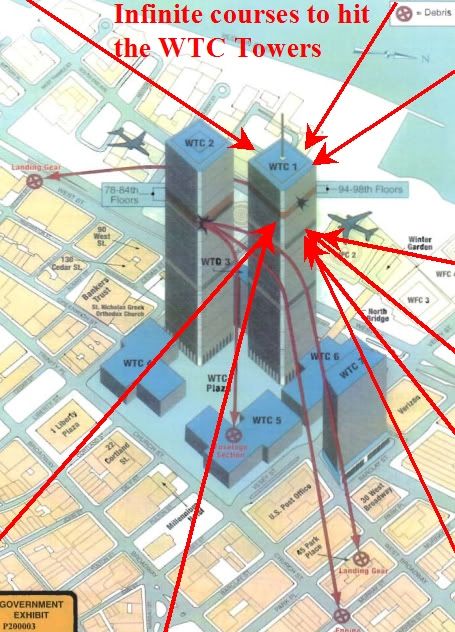
No, the landing example is harder because it is landing. For landing you have to cross the threshold of the runway, and you must be lined up with the runway course. When aiming at the tower you have infinite courses to hit the WTC towers, and when you impact it does not matter if you are not lined up on some specific course to hit the tower.

For landing the plane in theory has to be exactly on one course, we don't care if you can hit the runway threshold, we care if you can land going the proper direction down the runway.
1landingpatternonecourse.jpg

This illustrates the reason Hani would not be allowed to rent a plane; at least a possible reason why he failed to do good landing, his goal was not to land, it was to hit a target. If Hani was not lined up to land, even if he makes it to the threshold, and can hit the runway, he has to be lined up properly to land, on course, stabilized. A skill not needed to crash into the WTC, or the giant, big, Pentagon.


Oops, for hitting the WTC we have in theory infinite courses to take! INFINITE! Not one, not two, but millions, countless, TONS. No flying skills required! How many times easier is it to hit the WTC? INFINITE!
1WTCinfinitecourses.jpg

This does require math, not opinion! Your illustration is nonsense and not how flying works.

Going slower makes any outside perturbations to course larger, faster is as easy as slow. No great flying skills were needed on the VFR day, the relative light wind day of 911. The weather helped the terrorists. The flying is what anyone could do, a kid off the street, or my mother who has never been trained to fly. I am not saying a kid or my mother could do it, but I am saying it was at their level; What? The flying skills used on 911 by the terrorists, novice, no skill needed. It is a fact, I cheated, I looked at the FDR, and the kids I have flown in orientation flights, and simulators did better without training. Gee, the terrorists trained for Years.

I soloed in 1973, learned to fly heavy Boeing Jets in 1976. Before you make up opinions about flying, please get some help from real pilots, not p4t pilots. I have a masters in engineering, am a trained accident investigator, board president for aircraft accidents, and extensive aeronautical engineering background and experience at the Wright Aeronautical Flight Dynamics Lab. I don't understand your diagram, and it is not related to flying.

I have flown fast, over Vmo and lined up precisely, it was as easy or easier than lining up at landing speed. I find driving a car faster is easier to aim! Why? If going fast was a problem aiming, there were be no NASCAR, no Indy 500! End of story!


We are not watching a LCD TV, we are landing, aiming at a target; a single point, not 150 feet, not 207 feet.
1photoofsomething.jpg

This means nothing. This is not how we aim for landing. We line up on the centerline miles out for instrument approaches, on course. For visual patterns we line up based on speed in a sense, but we use angles and visual cues to make a turn to final so we have enough space to line up. Thus, going faster we would have more offset, and we would line up based on cues, which would result in time to turn, and line up with the runway. On 911 the pilots could see the WTC from 50 to 100 miles, or more; they line up, they hit! Runway, one course to line up and land, WTC Towers, infinite courses to line up and Hit!

Why was hitting the WTC towers so easy? There is no need to line up with one course, you see the towers, line up and hit them, no real course is needed, and if you plan your approach in the big picture, you can come in from the south, when you see the towers approach directly north of you, 10 miles away, you turn and line up, and bingo, you hit the towers. The terrorists were trained to fly, they had flying skills learned over the years; 911 was easy, and the terrorists remain dead pilots, with poor flying skills.
 
dadeets said:
To illustrate, I have compared two lateral piloting tasks, the first is flying towards the tower at 587 MPH, and the second is towards a runway at the landing speed of 175 MPH. For the first of these, the included angle is 7 deg. at 2 sec. out. For the second of these, the plane would be 4.8 sec. out for the same included angle. A figure to illustrate is at:

http://gallery.me.com/dwain769#100051/Closure-to-target-20time&bgcolor=black

Meh. Not such a good argument.

Several hundred rookie pilots who barely knew how to fly managed to hit smaller targets, or hit close enough to them to scare the bejeebus out of people on those targets, despite having to run a guantlet of the most gawd-awful Triple A fire ever directed at a single aircraft, and all of them at far more than the typical landing speed of a jet airliner.

You theory gets mugged in the light of day when you send it out against reality.
 
Beachnut,

Restricting this to the question of lateral control, other than kids being more experienced in video games, how is it that a task requiring a faster reaction time is so easy?

To illustrate, I have compared two lateral piloting tasks, the first is flying towards the tower at 587 MPH, and the second is towards a runway at the landing speed of 175 MPH. For the first of these, the included angle is 7 deg. at 2 sec. out. For the second of these, the plane would be 4.8 sec. out for the same included angle. A figure to illustrate is at:

http://gallery.me.com/dwain769#100051/Closure-to-target-20time&bgcolor=black

The landing situation has more than twice the time to correct an offset error than the tower strike situation.

Texas sharpshooter fallacy much?
 
http://gallery.me.com/dwain769#100051/Closure-to-target-20time&bgcolor=black

The landing situation has more than twice the time to correct an offset error than the tower strike situation.

You offer meaningless observations.
You answer nothing.

1. meaningless observations

The fuselage of the jet was about 12' in diameter. The side of the tower was about 208' wide.

208/12 ≈ 17.

A cadillac is about 6' wide. 6' x 17 = 102'.

102' equals "the broad side of a barn".

A cadillac traveling 50 mph has more than twice the time to correct an offset error than a cadillac traveling 110 mph.

So what?

A cadillac traveling 50 mph can easily ram the broad side of a barn.
So can a cadillac traveling 110 mph.

You make no point. Your observation is dirt dumb.
___

2. Unanswered questions

It is trivially easy to understand how & why an amateur pilot would flirt with disaster by flying that fast.

You refuse to answer why some alleged professionals would spent $200 million, & dramatically increase their risk of exposure, modifying a 767 to pointlessly fly that fast, rather than simply fly slightly slower.

Do you find the question "inconvenient"?

tk
 
Speed matters only if you are trying to land safely. The reason aircraft don't come in at near cruising speeds is that the airplanes will break if they do. (Happened once of my watch.) It really isn't all that dificult to make minor corrections at speed. Kamikazes would not have been able to hit many targets at all, by your reasoning.
 
To add to Mr. Deets credibility problem, he now has come out claiming that the Dec. 7, 1941 attack on Pearl Harbor was a "false flag" operation.

Be advised, the above link takes you to the P4T web page.

The saying goes that credentials do not equate to competency. Mr Deets, I believe, is a living example of that adage.
 
The things that bother me the most about these impossible speed claims:

1. The evidence for is verified by both ground radar AND video evidence.

2. It is clear that these planes were in control.

3. The Max operating speed does not mean that a plane will not perform safely outside this limit. It just means that to operate a plane beyond these limits for a long duration is risking not only the integrity of the plane but the safety of those on board. Planes have often performed safely and controlled when push beyond max operating limits.

4. There that have exceed max operating speeds as shown in a few earlier examples. Many have crashed, yes, but what is important is they have not crashed because of this speed or potential control factors arising from that speed or broken up because of that speed.

5. The anecdotal "evidence" that the terrorists could not do what they did when seasoned pilots could not do it. I have watched many a program on airline accidents that have shown me that until a pilot is in such a real life scenario they really have no clue what they can or cannot do.

Case in point, FedEx Express Flight 705. I will let you read up on that one Mr Deets as not only did the pilots sustain serious injury but the maneuvers often exceed tolerances of this plane and the plane not only did not fatally break up but the pilot(s) actually maintained CONTROL through all of what were SUPPOSED TO BE not only max tolerances but well outside the added buffer all commercial airliners design in.

That's right Mr. Deets Boeing and other airlines HAVE TO plan for these rare cases where their planes may be required to go above and beyond the MAXIMUM safe operating limits.

A few years ago no one had ever successfully landed a large airliner that had lost hydraulic control. On November 22, 2003 in Baghdad, Iraq a DHL Airbus A300 Cargo plane was struck by a surface to air missile and eventually lost all hydraulic control. Despite knowing no large airliner had ever successfully landed in such a situation and still under threat from ground danger the Pilot was able to use knowledge from previous disasters to land the plane.

No of course these were seasoned pros doing "impossible" things and the terrorist were not. These guy only needed a rudimentary knowledge of the aircraft they were in to do what they did. They weren't going to be landing these things and the take-off was already taken care of. As for doing what you suggest is impossible ... they only needed the resolve and that manufactured buffer to last the few second of high speed flight to hit to very large STATIONARY, VERTICAL targets.

As a side note I watched that deplorable PFT video on this subject and while I will give them the effort for plugging in some numbers that on the surface make sense the rest of the claims and videos are probably as deplorable a mess as the so-called nano-thermite paper by Harrit, Jones and co.

Mr Deets, your former status may lend you authority to some but for those of us who do actually know some of what you blather on about and have experience in the scientific process know that what you say is mere speculation/opinion. It is not fact, it is is certainly not truth, and it is certainly not verifiable.

Not only that but the "theory" that stems from it, that these planes were reinforced or remotely operated, is junk as well. Since you have no data to back your claims from Boeing, you cannot refute the existing speed claims by the NTSB, or can provide evidence of reinforced/remote planes your have zero credibility in my books. If you want to make wild claims and implicate a whole bunch more people are mass murderers then you better come to the table with irrefutable proof that the ENTIRE chain of events as currently described by the 9/11 Commission, NIST, NTSB, etc is not only false but you have to present what the "real" story is. To date I have heard a crapload of theories about specific points of the official story but not one single workable theory as to who did this supposed inside job and why. The fact that there is no specifics is because there is absolutely no reason for any American to commit mass murder. The government tried to used 9/11 to garner support for invading Iraq and it didn't work. They tried to use WMDs and it only sort of worked. They tried the whole terrorist angle and it sort of worked. What is not lost on me is that even before 9/11 Bush and Co wanted Iraq and even after doing what they could to get people onside they failed and invaded anyway. So what should that tell you? THEY WERE GOING TO INVADE IRAQ.

Heck I didn't agree with just about everything Bush did in office but anyone whole actually puts aside their political leanings and opinions can see that the path to 9/11 was building for awhile, well before Bush. Heck back in 1994-95 Ramzi Yousef and other planned to take out several airplanes with bombs. On December 11, 1994 on Philippine Airlines Flight 434 he made his first test run and place a bomb on this plane which later exploded and killed one young man. A lucky coincidence saved the flight from being blown out of the sky. Later Yousef screwed up in mixing his bomb mixture and it resulted in one of his lackeys getting caught when he was sent back to get Yousef computer with all of the bombing plans on it (so yes truthers that whole finding a car with flight manual and whatnot is entirely plausible because these guys are that careless).

Yes this is the very same Yousef that was responsible for the 1993 WTC bombing. Despite being a wanted man Yousef got around. Obviously the whole blowing planes out of the sky thing was compromised so the using planes as missiles is an obvious next step. It was already clear from the Yousef case that these guys are perfectly capable of blending in and had the brain and cash to do many things that us here in North America refuse to give them credit for. They are not idiots in caves, heck most of them live among the rest of us plebs. Another face among the multitude of faces. They count on that. That is why the main guys like Bin Laden can't do the dirty work.
 
Beachnut,

Restricting this to the question of lateral control, other than kids being more experienced in video games, how is it that a task requiring a faster reaction time is so easy?

To illustrate, I have compared two lateral piloting tasks, the first is flying towards the tower at 587 MPH, and the second is towards a runway at the landing speed of 175 MPH. For the first of these, the included angle is 7 deg. at 2 sec. out. For the second of these, the plane would be 4.8 sec. out for the same included angle. A figure to illustrate is at:

http://gallery.me.com/dwain769#100051/Closure-to-target-20time&bgcolor=black

The landing situation has more than twice the time to correct an offset error than the tower strike situation.

I'm curious, Mr. Deets...are you a licensed pilot? (I apologize if this has been discussed already, but I haven't responded to this thread in a while and I can't remember.)

I guess what I'm getting at is to why you feel that hitting a building with an aircraft is difficult for a pilot with any level of training?

While I have never actually flown a "real" plane, I have spend many hours in training simulators. After one particular A&P class back in 1994, a few of us were toying around with "what we could hit" with the Cessna 410 sim one afternoon. It started at buildings, but we quickly found that hitting those were too easy...instead, we starting hitting the little moving vehicles that rolled down the virtual roads. I went 6 for 6. No one in the group missed more than once.

If a bunch of us "non-pilots" could toy around with a sim to hit small moving targets, who is to say that someone with real training couldn't guide a plane into giant skyscrapers and a huge pentagon?

Correcting for offset at the speeds and targets we saw on 9/11 are not nearly as impossible as you are making it out to be. Any 13 year old with an Xbox could easily drive a plane into a building.
 
I'm curious, Mr. Deets...are you a licensed pilot? (I apologize if this has been discussed already, but I haven't responded to this thread in a while and I can't remember.)

No, I’m no longer a licensed pilot. When I was, I had a private pilot’s certificate. However, I have experience designing and conducting flight experiments where the primary purpose was to evaluate airplane flying qualities. This includes gathering information on the degree of difficulty of the piloting task.

I guess what I'm getting at is to why you feel that hitting a building with an aircraft is difficult for a pilot with any level of training?

A lot of issues come to mind. Therefore, I wouldn’t automatically expect it to be an easy piloting task. Your characterization of the task, “hitting a building with an aircraft” makes it sound much easier than it probably is. Most importantly, it is not just “an aircraft,” it is an aircraft flying considerably faster than its design speed (maximum dive velocity). Some of the issues that come to my mind:

1. Probably would have pilot alerts going off (audio warnings, blinking lights, etc.), causing distractions to the pilot. This creates a higher workload, increasing the likelihood of getting behind in the primary task of hitting the building. If the pilot gets behind, the deviations from some nominal flight path become larger, and the need to correct the deviations become more time critical.

2. The need to correct deviations is where the increased closure rate, and need for faster reaction times is where I would expect the greatest problems.

3. Since the plane is flying well beyond the design limits, I wonder at the primary control surfaces power actuators ability to respond to the pilot’s more abrupt commands (which would be coming if the deviations from nominal became quite large.) Can the hinge moments possibly demanded by the pilot’s commands be met by the power actuators (which were designed under the assumption the plane would not be flown that far beyond its design limits.)

4. Is there what traditionally has been called a pilot induced oscillation (PIO) possibility? This is where the pilot’s commands, usually to correct a deviation, couple with the airplane such that the airplane at first seems slow in responding, but then overshoots. The pilot then commands in the opposite direction which becomes out of sync, and an oscillation grows in amplitude, with the pilot inadvertently driving it. This can happen even to an experienced pilot when well outside the design envelope, in that the flight condition would not have been anticipated by the control system and airframe designers.

While I have never actually flown a "real" plane, I have spend many hours in training simulators. After one particular A&P class back in 1994, a few of us were toying around with "what we could hit" with the Cessna 410 sim one afternoon. It started at buildings, but we quickly found that hitting those were too easy...instead, we starting hitting the little moving vehicles that rolled down the virtual roads. I went 6 for 6. No one in the group missed more than once.

Flight training simulators are often not able to reproduce all the factors that bring out these conditions, such as those leading to PIO. The further beyond the design envelop, the less likely the effort has been put in to validate the simulator at the extremes.

If a bunch of us "non-pilots" could toy around with a sim to hit small moving targets, who is to say that someone with real training couldn't guide a plane into giant skyscrapers and a huge pentagon?

A lot depends on how precisely the targets were intended to be struck. I believe the precision desired was much greater than apparently you believe. We can’t resolve that easily, since it deals with intent.
 

ISF - Join now!

Every member here is approved by hand. No bots, no spam, just people who care about evidence and honest debate.

Membership is free!

Create your free account

Back
Top Bottom